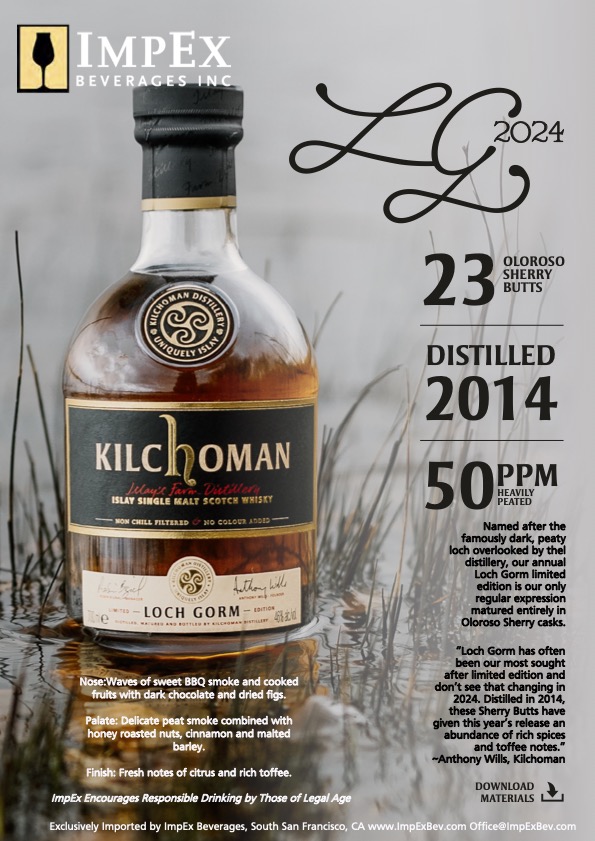


Kilchoman Distillery
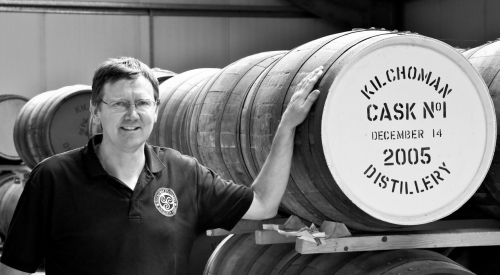
Founded by Anthony and Kathy Wills in 2005, Kilchoman [kil•HO•man] is a farm distillery producing single malt whisky on the northwestern coast of Islay. Conceived with the goal of controlling every aspect of whisky production, from growing and malting barley, to fermenting, distilling, aging, and bottling, Kilchoman—intentionally or not—has become the vanguard for a new wave of independent distillers: Over sixty new distilleries have sprung up across Scotland during the first two decades of Kilchoman’s operation alone.
Among other notable achievements, Kilchoman was the first distillery built on Islay in 124 years (a near neighbor, Bruichladdich, was revived as a brand in 2000, though that distillery was built in 1881). Unsurprisingly for this sparsely populated, whisky-obsessed island, Anthony Wills’s provocative status as an Englishman garnered as many local headlines as the audacity of the project itself. Wills had come into the drinks industry first via wine, and then through a modest career as an independent whisky bottler. It was that latter experience that allowed him to see that—as is often the case in the Scotch whisky industry—the excess historical stocks that had been gold to bottlers for so long had begun to dwindle. Producing his own whisky addressed that problem; reviving farm distilling (there were once thirty farm distillers on Islay alone!) would set his brand apart.
Kilchoman is currently able to produce nearly twenty percent of its malt across approximately 220 acres (the most fertile soil) of their nearly 2,300-acre Rockside Farm; the balance (peated to fifty ppm) is purchased from Port Ellen Maltings. The Kilchoman-grown barley is floor malted on-site and dried over peat to fifteen ppm for fifteen to twenty hours, then exposed to hot air for an additional thirty hours. The peat is locally sourced and water for production comes from Glen Osamail, a burn that runs from the hill behind the distillery.
Tutelage at the side of the late Jim Swan taught Wills the value of long, slow fermentations and high-end barrel selection. There’s a pronounced influence, even in the core range, of ex-bourbon barrels from Buffalo Trace, and all sherry casks are acquired directly from Bodega José y Miguel Martin in Jerez, Spain. Both influences are pronounced in Kilchoman’s soft, fruit-forward distillate, proving an elegant offset to the seaside campfire salinity and iodine that are the calling card of peated Islay whiskies. Producing a more instantly approachable distillate allowed Wills to speed up the distillery’s release schedule, and elements of what would become the core range (which remains non-age stated) were available as soon as they were legally allowable, three years (and one day) after distilling was begun.
Kilchoman is very much a creature of its moment, joining other next-wave producers as they seek to explore the margins of what it means to make Scotch whisky. Having triumphantly celebrated their second decade, the team at Kilchoman now has the leisure of offering innovative one-offs and intriguing limited releases. That said, the craft of farm distilling is Kilchoman’s north star, and in that respect their production is governed not so much by the “old fashioned” way of making spirit, but the right way, at every step, from barley to bottle.