




Next week, Noah Braunstein and Yoni Rabino join the podcast to talk about their New York apple-based distillates from Neversink.
Be sure to subscribe to Skurnik Unfiltered wherever you find your podcasts so you can stay up to date on all the exciting content to come.
Introduction
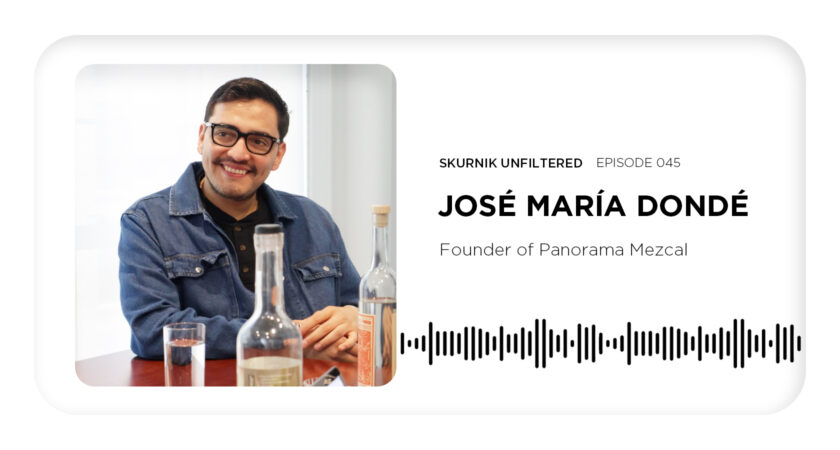
José María Dondé Rangel 0:03
Giving meaning to what we pour is really important because otherwise it’s just a liquid, right? And this is not only for spirits, this is more like a lifestyle, right? You just gotta give meaning to everything that you do so it actually feels special, then it’s just not doing for doing or just drinking for drinking, right? And not having bottles just to have bottles, right? Because once you have the picture of the person, once you know the name, once they tell you about the terroir, you’re able to see the agave that they were using or the cooking process, it doesn’t taste the same, it actually tastes better.
Harmon Skurnik 0:38
Hey, this is Harmon Skurnik. Welcome to another episode of Skurnik Unfiltered. Today we have a very special episode and a very special guest. Right now, I’m here with Justin Lane Briggs.
Justin Lane Briggs 0:51
Hello, everybody.
Harmon Skurnik 0:52
Justin is our portfolio manager for all things Mexico. And recently you sat down with José María Dondé Rangel.
Justin Lane Briggs 1:01
Who also goes by Chema, which is a common nickname for people named José María.
Harmon Skurnik 1:06
And he has an organization called Panorama Mezcal.
Justin Lane Briggs 1:09
Yeah, not a distiller, not a vigneron. He’s an advocate for the category of Mexican spirits in general, most of all, a mezcal focus. He’ll throw events, he throws bartending competitions, he throws massive tasting events, a lot of educational and advocacy work, but really with a bent towards building community around Mexican distillates.
Harmon Skurnik 1:28
How interesting. He’s a Mexican national, but he’s been in the States for a long time, here in New York.
Justin Lane Briggs 1:34
Exactly, yeah, and deeply, deeply involved in the New York hospitality scene for his entire time here.
Harmon Skurnik 1:39
Awesome. So in this advocacy for mezcal and all things Mexican beverage, he does various events and things like that. What’s an example of an event that he might put on?
Justin Lane Briggs 1:51
This week, in fact, the week of the 12th is one of his major annual events, Sotol Week. He’s partnering with restaurants all around New York and across the country. You’ll see a few people in Chicago, a few people in LA also participating. It’s a celebration of sotol, which is similar to mezcal, but is made from the desert spoon or the Dasylirion plant, which is a close relative of agave, but not actually the same plant. He’s hosting a panel discussion on Monday the 12th, and then a walk-around tasting on Sunday the 18th, which you may find me at.
Harmon Skurnik 2:19
Well, that’s really cool. I would say, Señor Dondé, thank you for all your advocacy for this category, which we love so much. And I think it’s fair to say, and maybe you can correct me if I’m wrong, but he doesn’t necessarily promote all categories of Mexican beverage. He has a particular fondness for smaller producers, authenticity, et cetera, et cetera, right?
Justin Lane Briggs 2:42
Absolutely, yeah. He’s very much an advocate for producer-owned labels, productions that are remaining true to their heritage and their origin, situations where it’s less extractive and more helping to continue building community around these categories of spirit, both here and at home in Mexico.
Harmon Skurnik 3:00
Awesome. On that note, why don’t we listen in on your conversation with Chema, aka José María Dondé of Panorama Mezcal.
Justin Lane Briggs 3:09
Excellent. ¡Salud!
Harmon Skurnik 3:10
¡Salud!
Building Community Around Mexican Distillates
Justin Lane Briggs 3:12
Good morning. I’m Justin Lane Briggs, and I’m sitting here today with my dear friend José María Dondé, whom many of us know as Chema. He is the founder of Panorama Mezcal. He’s been the director of numerous beverage programs around the city and bartender at some of the finest establishments, in terms of cocktails, in New York City as well, a real OG industry legend at this point. I wanted to have a conversation with you about what that’s been like in the last decade and change and hear your story a little bit.
José María Dondé Rangel 3:38
Alright. Hola, buenos días. Yes, my name is José María, and I go by Chema. That’s a short name for José María. I’m not sure how that happened, but there’s not that many of us. I’m from Mexico City, born and raised, and then I moved here to New York when I was 20. I feel like New York is my home. I like living here. I like the industry that I work for, and it’s been fun. It’s been now 17 years working in the restaurant industry since I moved here. I started as a busboy. I was in a Cuban place in Forest Hills, and I didn’t know what I was doing. They were like, “Oh, go ask for a job as a busboy.” I didn’t know how to do that job, and they were going to fire me because I wasn’t that good. I actually left because it was a little bit toxic, and then I ended up working with a group of Italians, and I stayed with them for seven years. I got to work with a lot of really cool people that they were able to teach me, and then I started getting better at what I was doing, and that was actually really cool, working with different people from different places, especially Italians that are really passionate about it. I like their food a lot, for sure. They gave me an opportunity to grow in the industry. I was there as a busboy, I was an expo, I was a food runner, and then I was a server, and I was there with them for like seven years. That was pretty much my beginning, when I was trying to figure out what I was going to do living in New York. I was going to school, I was working in a lot of different places at the same time, like three jobs. I had the energy and I needed to make money too.
Justin Lane Briggs 5:26
Oh, to be young.
José María Dondé Rangel 5:28
Yeah, of course. I was riding my bicycle everywhere and I was just getting things done.
Justin Lane Briggs 5:34
Where were you going to school? What were you studying?
José María Dondé Rangel 5:36
Well, English as a second language, and I was taking a few workshops because I was trying to go to school, to CUNY, but I wasn’t able to pay. I guess now I see it that probably I needed to do a little bit more effort, but I was always curious about things, and I was always trying to look for different workshops just to learn something different. I remember I used to go to the Apple Store because I was taking pictures and they were giving—and they still do—workshops about photography and videography and editing and everything. I used to go to all these places just to learn a little bit more because I’ve been always curious about things, and I just don’t like the feeling of being stuck and being the person that doesn’t know the question in the room. I don’t like that. That was pretty much when I started here, and then someone told me, “Oh, you didn’t go to college in Mexico just to stay as a busboy here, right?” And then he called me a “bus burro.” Burro is a donkey. He was like, “Just stop being a bus burro.” And I was like, “Oh shit, I need to really focus, I really need to move. What’s next?” I started moving things around, and then I started looking for jobs. I started to pretend that I was a good barback, and I never was a barback before. That’s how I started working behind the bar, and then I got a chance to work in really cool places. I got hired in really cool places where I learned a lot. Everything started when I was working at The Dutch with Andrew Carmellini. I was there as a barback and they were really cool, they were really organized, they put things back in places. I really liked working there because everyone was really professional about what they were doing, and that’s when I realized that that’s what I was doing for a living. Everyone else was really professional at work, so I just needed to be professional about the profession I was doing, which is hospitality. This is when I understood that this is what I was doing for a living, and I was already too into it to change into something, so I just started trying to do things better. And then I started training at this place for Masaharu Morimoto. It was a whole month of training. I was hired to be a barback, and there was a lot of testing—sake, wine, spirits—and I was really into reading and trying to remember things. I had the highest scores every time they were doing tests, and then once we opened, the other bartenders didn’t know everything about the food or the whole training, so I got the chance to become a bartender, and that was actually really nice because it was for Iron Chef Morimoto. And then they brought in Shingo Gokan from Angel’s Share at the time. He was the beverage director, and Angel’s Share was my favorite bar, the original location. He trained the whole team. I was super green, and I was like, “Oh shit, this is actually really cool,” the way that he was teaching techniques, stirring, this and that. I got more into bartending because I saw people like Shingo Gokan making really cool cocktails, and then I started to work with Panorama Mezcal, which was pretty much at the same time that I was a bartender.
Justin Lane Briggs 8:48
First of all, that story feels sort of familiar, in a way. I feel like a lot of us kind of fell into it, like me. That question of, “What are you really doing while you’re also working in restaurants,” and then you’re sort of like, “Well, no, I think I’m actually doing this. This is my career, this is where my passion is.” But you don’t necessarily notice it until it’s already happening around you. I know that was my story too. And then something happens to really inspire you—some bartender, some educator, somebody really inspires you—and then you’re like, “Oh, this can be a creative pursuit, an emotional pursuit, an intellectual pursuit. There’s so much further that I can sink my teeth into this.” I feel like I know those moments too. When did you found Panorama? When did that start?
The Genesis of Panorama Mezcal
José María Dondé Rangel 9:27
That was like 12 years ago, and everything started because I always wanted to start something, like to create a magazine, to create a way of showing Mexican spirits, especially because when I was in Mexico, I used to have a podcast about music. I don’t even know if anyone else was listening to it, but I was just making it. I was curating something. Also, I was in a group that my dad founded as part of the church. We used to collect money, gather people, organize events, organize retreats and things like that. It was always part of the family to do something, like you need this much time to organize logistics, you have 150 people, this, this, and that. I grew up in that situation where it was part of the church, but I was with my family organizing everything. So when I moved here, it was more about where to go, who do you need to know so you can start moving things around?
Justin Lane Briggs 10:29
How do you build community through an organization or something like that?
José María Dondé Rangel 10:32
Correct, yeah, because I was part of this community in church, and then here I was always trying to bring friends and do parties or be like, “Hey, we’re going to all go to this place together.” Because I met really cool people, and then at some point I wanted to do something that was like what I was doing before—gathering people and throwing a party—and that’s why I was saying, to be honest, it was more to throw a party. I was like, “How can we just do really cool parties?” It’s New York. I remember it was Williamsburg, like 12 years ago. There was nothing around, it was actually one of the coolest times in Brooklyn, for sure. There were a lot of really cool people hanging around, there were a lot of collaborations, there were other Mexicans already doing really cool things. We did this party called Mustache and Mezcal Party, where we were giving fake mustaches to people. I had no idea what the thing was, but I got a lot of videos from YouTube, random videos, Star Wars, Rocky, Mexican things, I made a collage, and then I brought a friend from Italy who’s a graffiti artist, so we presented him too, and we had mezcal shots too, and nobody knew what the event was about. It was just like mezcal, cumbias, and random things, but that was pretty much it.
Justin Lane Briggs 11:54
Ha! Mezcal, cumbia, Star Wars, graffiti, all right!
José María Dondé Rangel 11:57
Yeah, and then little by little, there was an opportunity to represent Mexican spirits in different places, like galleries or different presentations of books, art. Instead of offering wine in an open gallery, I was like, “Why don’t we do mezcal?” And then I reached out to this brand, and I was like, “Hey, look, I’ll talk about the brand, I’ll wear the t-shirt, I’ll say that this is what we do, blah, blah, blah. I’ll do my homework, and that’s it. You don’t have to pay me. If there is any leftover mezcal, can I keep it? That’s all I need.” And that was before Panorama Mezcal. That’s how Panorama Mezcal started. I wanted to do a printed magazine, like the L magazine back in the day. This is before Instagram, before Twitter.
Justin Lane Briggs 12:53
Before print media died.
José María Dondé Rangel 12:55
It was pretty much in the beginning of Instagram, so I got Instagram and then I just made a Panorama Mezcal account because I remember sketching what it was going to be. It needed to make sense in English and Spanish. “Panorama” is a wider view, so it wasn’t just going to be about something specific, like just mezcal, but it was going to be about mezcal and everything else that is around it.
Justin Lane Briggs 13:18
I also love the thinking about that being the term you grabbed onto, hearing you say that you were also taking classes on photography, and then what connects with you when you’re trying to give that kind of idea of an expansive vision is: panorama.
José María Dondé Rangel 13:31
It just needs to make sense; it needs to have a meaning. It’s not just a cool name, just because. If I have to explain it, it’s because it’s a wider view. It’s not just about the product. It’s about the people, and especially having the connection and having the opportunity to be in Oaxaca, to travel around Mexico before I moved here, and getting to try mezcal when I was 16 or just trying to represent. Especially because once I moved here, I was like, “Oh shit, I’m a minority.” You don’t feel like that in your home, but then here it’s like, oh shit. And what do you do? You try to represent, or you start getting to know people who are representing your culture too. And I feel like you just hold onto that, and it’s like, well, I’m from Mexico, what am I going to do? I’m just going to try to represent the same as I was working with Italians, and they were really proud to be Italians. They were really proud about the food, the wine, this and that. I’m like, well, I liked working with them, and I feel like New York is great to try to understand different cultures, different countries. You get out of the box, and then you realize that there’s more out there. That’s why there was a need to represent, to do something with Mexican spirits, to just do something. The Instagram started to bring people’s attention, and I was just taking pictures, going around with bottles in the street. I never got caught by the police, but I was just taking bottles around New York, just taking pictures and trying to do a little bit of content. I didn’t know that content creation was going to be a thing. It was just like, what do I post, and I was posting three times a day. There were a few memes, there were tacos, there were jokes, because it’s just part of the Mexican culture. And then I started to get more into Panorama Mezcal on social media because it was working out. I was going to places and I was asking bartenders, “Hey, do you have mezcal? Can I do a video? I have my GoPro, I know how to edit.” I was just trying to do my best. I was still getting charged for the cocktail I was taking the video of. They were like, “Yeah, sure, sure.” And I was like, “I’m going to make it really cool, blah, blah, blah.” I was sending those videos where I was showing the brands, that I was already working with them, and if they ever needed help, they could just use me to talk about mezcal.
Justin Lane Briggs 16:01
“I’m here, I’m already doing this.”
José María Dondé Rangel 16:03
I know, right? Well, it wasn’t easy, but at the same time, there were a lot of really cool people, like you. I met you probably 12 years ago.
Justin Lane Briggs 16:15
Sounds right.
José María Dondé Rangel 16:15
Well, probably a little bit more when mezcal was booming. It was you, it was another friend that we’re still friends with, and I really liked that because you don’t need to be Mexican to represent Mexico, and there are some people, like you, that actually do really cool things about the Mexican culture, like carrying all these really nice products or curating a really cool Mexican experience portfolio like Skurnik has.
Justin Lane Briggs 16:38
That means a lot, thank you.
José María Dondé Rangel 16:38
I think it’s actually really cool because in Mexico, the Mexicans were looking down at people who were drinking mezcal, because you’re making your own moonshine.
Justin Lane Briggs 16:48
Like farmer juice.
José María Dondé Rangel 16:49
Yeah, right, like farm juice that’s in your backyard, and “I just drink my Absolut and my Smirnoff and this and that.” And that’s when it got really popular, and people like Ron Cooper saw that it was actually a really nice inspirational thing, artistic, artisanal, and then the movement of craft cocktails, of craft things. Artisanal, handmade, farm-to-table, and people actually caring about what they were consuming.
Justin Lane Briggs 17:17
Yeah, there’s a transparency or an ability to have that, not necessarily always, but there’s an ability to find that in mezcal, or to find a connection between soil and what’s in the bottle, connection to terroir, connection to people, that I think people really grabbed onto commercially here a lot earlier than in a lot of other parts of the world, including Mexico.
Defending the Artisanal Against the Industrial
José María Dondé Rangel 17:35
And it’s still a thing, right? People still care about what they’re consuming, or they’re able to have information. And it’s been now, like 15 years since the mezcal category has been growing and growing, and there are more brands now, which is also a little bit scary, but at the same time, there are a lot of really cool producers who have been around for more than 15 years. A lot of the brands that we see, they are really brand new, but the families that have been making it are not brand new. They represent this culture in the most original way. It just happens that they had an opportunity, and this is actually really good because they bring money back to Oaxaca, which is one of the poorest states in Mexico. And then having an opportunity for a producer to actually come out of that lifestyle that wasn’t probably the best for the family. And that’s because someone came from outside, and they were like, “Look, we believe in this, we like this, we want to support it.” That’s also really good because it brings jobs, and because of that, there are a lot of families that have been able to have a better quality of life because someone wanted to invest in them, they wanted to invest in what they were already doing, that probably was overlooked before. It’s actually really, really nice. And I think I’m going to have some mezcal now.
Justin Lane Briggs 18:54
Salud. Well, Chema, one of the things that I’ve been really impressed by, that you’ve been doing for so long, has been so much advocacy. And once upon a time it seemed like the big stuff was the stuff that was seen as valid, the big industrial stuff, and the small artisanal producers, ancestral producers, that people like us really gravitate towards, those things were seen as less than. They weren’t as respected as the big industrial nonsense. And I feel like, in a funny way, we’re constantly fighting against the inexorable draw towards those big producers. I feel like it’s on a big swing right now, where a lot of money is still being poured in and people are trying to consolidate and trying to build up scale and make things more efficient and more industrial, which is not the right direction for great spirits, great food, great wines. Great things to enjoy eating usually are not made in larger quantities faster. And it feels like we’re still having to fight the same fight, just in new ways all the time, for a decade.
José María Dondé Rangel 19:46
Well, it’s pretty much how the world works, and everyone wants to take the biggest piece. That’s what I was saying. Mexico is really corrupt, and a lot of things are able to happen, and a lot of big brands are able to run the show because that’s how it works. But I think it’s my social responsibility to educate, to talk about these things, because if I say something about this brand, it’s going to go back to the right people. It’s going to be a small difference for sure, but I know that it’s been working. A lot of people hear you, they hear me, and they hear that we’re giving meaning to things. Because that’s the important part about that. Giving meaning to what we pour is really important because otherwise it’s just liquid. Especially if you don’t know, you just see it and it’s like, Oh, that’s just one ounce of, uh, you don’t know. And you may shoot it, and it’s going to taste good, but you’re missing an opportunity to actually have an experience with what you’re drinking. And this is not only for spirits, this is more like a lifestyle. You’ve just got to give meaning to everything that you do so it actually feels special. Then it’s not just doing for doing or just drinking for drinking, and not having bottles just to have bottles. I feel like now that I’m older, that clicks more, and it makes more sense to take it slow and then turn around and read the bottle or ask the question because I want to know—I want to know what I’m drinking, I want to know what I’m going to be sipping on. Because once you have the picture of the person, once you know the name, once they tell you about the terroir, you’re able to see the agave that they were using or the cooking process, it doesn’t taste the same—it actually tastes better, because you’re adding all of this and it makes more sense. It’s like wearing something that looks good, but then once you get it, it’s not really good quality and it’s not that great.
Justin Lane Briggs 21:39
Fast fashion and that sort of bullshit.
José María Dondé Rangel 21:41
This is not like fast fashion. You’ve heard me talk about mezcal with cars, like a nice introductory, big manufacturer mezcal is going to be like your Toyota Camry.
Justin Lane Briggs 21:52
Oh, sure.
José María Dondé Rangel 21:54
It works, it works great, it takes you from point A to point B, and it delivers. You need that one. You need that one for sure. But these are collectors’ items, right? These are smaller productions, and these are like the Bugattis or the Bentleys of mezcal, because those are really small. Gusto Histórico makes what, like 100 liters versus how many liters a really big brand can make. That means we have one bottle out of maybe 130 or something. I do feel special because I know once we finish this bottle, well, not today, but one day it’s going to be gone, and there’s going to be fewer people that are able to try this. It’s really unique. How many people are able to try this? Not as many people as are able to take a Toyota Camry. Once you get to try this, and then you go back to the 40% ABV big industrial mezcal, you can actually feel the difference.
Justin Lane Briggs 22:53
Like, “I’ve only been driving Camrys, I think cars all suck.”
José María Dondé Rangel 22:58
There you go. Sometimes you need that bad tequila, that bad mezcal, just to open your palate, and then, once you try something that is actually legit, you’re like, “Oh.”
Justin Lane Briggs 23:09
Oh, yeah, for context, sure.
José María Dondé Rangel 23:10
Yeah. So there’s nothing wrong with having a bad tequila or a bad mezcal. It actually is good because then it brings people to look into this direction, and it’s a little bit easier to tell them, “Look, you should really try this.” You bring them inside the Bentley. And once you go back to the Camry, you know you’re missing something. You touch the seats, and it’s like, oh shit, it doesn’t feel the same.
From Content to Fiestas
Justin Lane Briggs 23:35
Yeah. How did the events start to happen? I knew you before I really knew what Panorama Mezcal was, and then when it started to happen more and more, I remember going to some of the first ones I went to and being like, “Holy shit, like do you see this? This place is jammed to the gills.” Chema’s got people climbing on the rafters to fill this room and drink mezcal together. It was it was really amazing. It always blew me away how much you really had spread that so widely and loudly that the room was always jam-packed and everyone was there for the same reason: to have agave spirits, to have mezcal together, and it was inspiring, it was really amazing. How did the events come out of the Instagram feed, the content creation? How did you pivot into throwing big parties?
José María Dondé Rangel 24:22
Well, it was those parties that didn’t make sense that meant a lot. I asked for product from a brand, and I met Diego from Colombia. We were having a coffee, and then he was like, “Look, I just don’t think I’m going to give you product to do a party. This means a lot to me. I just don’t want people shooting mezcal.” He spoke about mezcal in a really beautiful way, and I was like, “Oh shit, this guy from Colombia, he understands this situation better than I do.” That was a real eye-opener. I was like, “Oh shit, I want to do parties, but I want people to hear someone like him talk about mezcal and fall in love and understand that it’s just not meant to be for shooting but to actually appreciate it, and then you can learn something about it.” Then I had my first mezcal tasting. That was Oficina Latina. There were just 10 different brands, 10 people with their tables talking about their mezcal, and I was just trying to push it on social media. I think we were able to bring like 50 people, something like that. It looked busy, but it was actually really nice to be in a room, and this is actually a really cool feeling every time that there’s a tasting like with Mexican spirits. People are really passionate about what they’re saying, and they’re moving their hands, and everyone is like this and agaves, blah, blah, blah. That’s how you know that they’re really passionate about it. That was the first time that I got to feel that. It was like, oh shit, it’s actually really nice. It’s a really small niche. If you really know, you know, and the people that are here that are trying really nice brands, they’re getting to try small producers, and this is probably like 11 years ago. I’m not sure how many brands of mezcal we have right now, but I don’t think there were that many. And they were really cool ones for sure. That was the first time that I did a tasting, and then I decided to do a tasting and a party. It was only about parties, but also Mexican spirits are part of a celebration too, and that’s what you do there too. You do fiestas and you celebrate. But then at the same time, you gotta understand this so you can actually plant the seed, the idea that what you’re drinking is sacred. It means a lot to a lot of people. It means a lot to the whole culture, the country. We can go back to pre-Hispanic times and how important agave is for Mexicans. Mayahuel, all the paintings from the Mexican Revolution, all you see are agaves all around, like in the Batalla de Puebla, you see all the murals and the paintings, and it’s French people on top of agaves. It’s there because it’s a part of us. I like Lamata because it says “The nation of the green leaves.” I like that because we are the nation of the green leaves, and the leaves are the agaves.
Justin Lane Briggs 27:18
I want to ask you, in all these years of advocating for the category, going from bartending to being this very public figure in category education and advocacy and doing all these events and things like that, do you feel like you can see clear examples of the impact you’ve had on people’s engagement with the category? Do you see a change in like the way that consumers, or maybe even more importantly, the bartenders that you know that you work with, the way that people treat mezcal and talk about it? Do you think it’s getting easier to talk about it? Do you think it’s getting harder to talk about it?
José María Dondé Rangel 27:52
I think there’s more representation of Mexican spirits. I think like 12 years ago, there weren’t that many Mexicans behind bars, and it was a little bit harder, probably, for us to be out there. Now you have a Mexican in all different bars—50 Best, Michelin. There’s usually one that is representing, and that’s the one who is recommending mezcal or tequila. I feel like it’s been working, especially because we’re a niche and we have something really cool to talk about and to be proud of, especially in places like New York. If you go outside New York, it’s going to be a little bit more challenging for sure, and you’re going to see more brands that have this industrial capacity to go to other places just to have 40% ABV. But New York is cool, and there is appreciation about all different cultures, and especially Mexican here. Puebla, that’s what we call it, Puebla York. There’s a lot of that representation here, and I feel like we are doing good. I think we’re doing good. I think we’re able to talk more about this, have more Mexican restaurants now. Taquerías are everywhere. So if you have a taquería that has a liquor license, they usually have mezcal, and any Mexican place that respects themselves usually has not only the bad tequila or the bad mezcal, because they know that that’s just to keep things going, but they usually have something really cool that they’re really proud of, that they really like and they want to talk about and they want to share, and they’re like, “Oh, I really like this one. You really gotta try this one.” People like it because it has a meaning and there’s appreciation. It’s something that has a lot of heart. It has a lot of heart, and it’s delicious too. I think we’re getting there. We’re getting there.
Justin Lane Briggs 29:39
I definitely have heard you reference how there were fewer Mexicans in service as bartenders. Or maybe I would even say with less visibility, because there were always so many Mexicanos doing everything in the restaurant and behind the bar and barbacking and doing all the things, but with less visibility, and how much that’s changed in the last 10, 12 years. There’s a lot more visibility now. I think that you’re a part of that too, especially things like the Panorama Mezcal events where you feature lots of different bartenders, the Bartender Legion events from different places or all around the city, and sometimes all around the country. I guess I wanted to ask you how you think it’s changed, just in terms of visibility and access for Mexican restaurants, for people’s expectations around that, and what do you think it’s been like in the last decade and how it’s been changing for the Mexican-American community, and how that’s changing for the next generation?
Puebla York and the Fight for Visibility
José María Dondé Rangel 30:28
I think it’s, well… I guess that there is racism, but I think it has changed a lot. I work with Ramón. Ramón is the beverage director for Mexi. And he’s a character, he’s great, he’s from Michoacán. I like his history because he was one of the first ones behind the bar. We’re on Stone Street, and we’re close to Harry’s, where he used to be a busboy, and then he was a barback, and then they didn’t want to give him a chance to be a server or to be a bartender because he was Mexican. He was really good. He stayed with them for a really long time, and then there was an opportunity for him to be a bartender, and then he was behind the bar, but they built a wall because they didn’t want people to see him.
Justin Lane Briggs 31:17
No. Really? No way.
José María Dondé Rangel 31:18
Yeah.
Justin Lane Briggs 31:18
That’s crazy.
José María Dondé Rangel 31:18
This is like 30 years ago. He was there behind the bar, and for a few years he was just doing service bar, just covered. They were like, “Oh shit, he’s Mexican, we don’t want to show that.” In the end, he became the beverage director for the company, and now he came back 30 years later, and he is partners with the people that he used to work for. It has changed a lot. Now they own six different places, and his partner, Andrés, is also Mexican. He also started as a busboy at the same place, at Harry’s, and then he became the general manager at Harry’s, too. Now they own six different places. And this is just one story. There’s probably a lot of people like them from other places too, not only Mexicans. They probably had a similar situation, but now they’re more confident, they know who they are, and there are more chances too. There are a lot of really cool people like Latinos and Mexicans that have been able to be successful in this industry and then try to present and represent Mexico, and that’s actually really cool. I think that’s really cool. Like when I was a bartender and I hired my barback, I was like, “The only reason I’m hiring you is because you’re going to take my place at some point. I’m going to hire you because I see myself, and I’m going to tell you how we’re going to get it done.” I like to share that because you can put a book in front of someone, but are they going to open it? Just open the book. It’s just a matter of you having the spark and keeping on drinking good mezcal and making sure to ask the right questions. The more information, the fewer question marks. That’s why I always say it needs to have the name of the producer. It needs to give representation and respect to whoever is producing it. If there is a new brand that just started last year but they don’t even mention who the producer is, like, well, you didn’t make it yourself, right? There needs to be more information and there needs to be more education, and this shouldn’t be like having a website where it’s like, “Oh yeah, mezcal,” and there’s a group of guys drinking and this and that, but there is no name for the maestro mezcalero, there is no picture of the family—there is no respect. Like oh, this is just marketing and it’s just about somebody’s ego. I don’t like that. I don’t like that because it’s not about them. It was never about them. I love this bottle of La Medida because then you see who José Díaz is. You know the name, you see the face, and if he has a face and he’s a person, he has also a family, and he’s part of a community. It’s not just like any bottle—it was made by someone. Having someone who represents this, that is not celebrity BS or anything like that—these mezcaleros are the celebrities right here. They’ve been shining for a while. So, salud. Cheers to them.
Justin Lane Briggs 34:22
Thank you very much. Salud.
José María Dondé Rangel 34:24
Salud, gracias.
Skurnik Unfiltered is recorded at Skurnik Wines & Spirits headquarters in the Flatiron District of New York City, which is why you might hear some city noises as we go along, like horns honking. If you found the conversation interesting, please consider liking, subscribing, and leaving a review. You can stay up to date on our show and upcoming events by following @skurnikwines on Instagram and visiting our website at skurnik.com