

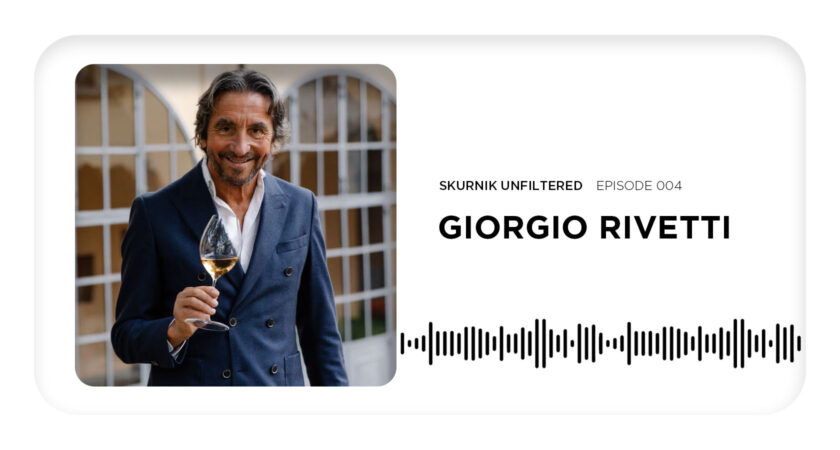
Giorgio Rivetti is the man behind the estates of La Spinetta and Contratto in Piedmont, Casanova della Spinetta in Tuscany, and his own import company based in the US, Indigenous Selections, which imports cult favorites such as Chiara Boschis and Ciacci Piccolomini.
In this episode, Giorgio reflects on the many lessons he’s learned over his long career as a keen businessman and attentive farmer. He shares his insights on the sparkling wine space, the challenges and advantages of farming organically in a changing climate, and how he built brands to support his passionate appreciation for indigenous Italian varieties, like Timorasso.
Above all, Giorgio is fueled by the human relationships that make the fine wine business unlike any other.
What Giorgio and Mark tasted in this episode:



Next week, tune in as German and Austrian wine expert Michael Lykens sits down with Christopher Loewen of Weingut Carl Loewen.
Be sure to subscribe to Skurnik Unfiltered wherever you find your podcasts so you can stay up to date on all the exciting content to come.
Introduction
Giorgio Rivetti: This is a big part of it, to be in this business, okay? To be in the wine business, it’s very important to have this kind of relationship.
Mark Fornatale: The human connection.
Giorgio Rivetti: Yeah, human connection. It’s true. Because otherwise, it’s just business, it doesn’t make sense. You can sell cars, you can sell anything else. But wine is different thing.
Harmon Skurnik: This is Harmon Skurnik, and welcome to another episode of Skurnik Unfiltered. Today I have with me Mark Fonatale, who is the Italian Portfolio Director for Skurnik Wines & Spirits. And Mark has been with us for over 20 years.
Mark Fornatale: 21 years this year, yeah.
Harmon Skurnik: That’s amazing. He’s part of the family. We have with us today a very, very special guest that you interviewed not too long ago, Giorgio Rivetti, who is the proprietor of La Spinetta and many other estates.
Mark Fornatale: Casanova della Spinetta, Contratto, and then he has his own import company here in the USA called Indigenous Selections, and he imports Ciacci Piccolomini and Chiara Boschis, to name just a few.
Harmon Skurnik: Amazing. And I recall meeting Giorgio for the very first time, which is before you worked for the company. We’ve been importing his wine since the early ’90s. And when we visited him for the very first time, he made Moscato d’ Asti. And I remember tasting his very first red wine that he ever produced.
Mark Fornatale: I think that would have been Cà di Pian or Pin.
Harmon Skurnik: Pin.
Mark Fornatale: It was Pin. Okay.
Harmon Skurnik: Named for his father, or grandfather?
Mark Fornatale: For his father, Giuseppe, which they call Giuseppino, becomes just Pin.
Harmon Skurnik: And he was not known for his red wines, that was the first. But he was one of the Barolo boys, and so he hung out with all you know, Clerico and Sandrone and Altare. And to to predict where he would go from there to where he is now, nobody could have predicted.
Mark Fornatale: No, just an incredible meteoric rise from a small Moscato producer. You remember tasting his first red wine to now, impresario of Italian wine, with these three important Italian estates in Italy and then the import company as well. It’s been a long and beautiful friendship that that that also happens to be business. We love his wines and we love the man. And that sort of combination provides a synergy that can’t be can’t be replaced. It’s not just business. It’s these wonderful wines that he makes with his own hands.
Harmon Skurnik: Didn’t you once say that you got introduced to Skurnik through Giorgio’s wines?
Mark Fornatale: Yeah, I remember coming to a tasting at Tribeca Grill in probably 2001 or 2002. And he was the first table immediately on the left as I walked in, and I was just so excited to see the lineup because at that time, you know, it would have been ’97 Barbaresco, ’98 Barbarescos would have been on the table. It was very difficult to get them, even at a prestige shop like Morrell, where I was working at the time. So I think Giorgio is sort of my introduction to Skurnik, and that was, you know, lo and behold, 24 years ago or something like that.
Harmon Skurnik: Well, with that, let’s listen in to Mark’s conversation with the one and only Giorgio Rivetti.
Mark Fornatale: Enjoy his Italianness coming through the podcast.
Harmon Skurnik: Enjoy.
Mark Fornatale: Enjoy, cheers.
Piedmontese sparkling wines from Contratto
Giorgio Rivetti: Mark— [*cork pops*] Sorry.
Mark Fornatale: Ha! That’s the way to start. We’re here today with Giorgio Rivetti of La Spinetta and Contratto and Casa nova della Spinetta, and of course his own import company, Indigenous Selections, based here in the United States. What have you got for us today, George?
Giorgio Rivetti: Yeah, I pour something very good for you.
Mark Fornatale: Cheers.
Giorgio Rivetti: We start with this.
Mark Fornatale: Thank you.
Giorgio Rivetti: Contratto. The oldest sparkling wine producing methodo classico from Italy. We’re talking 1867, they built the cellar, they started to do a very good job. In 2010, we decided to buy this property, Contratto Property. And the cellar is part of UNESCO World Heritage. The cellar is a monument.
Mark Fornatale: It’s like a cathedral. I mean I’ve been to cellars in Riems.
Giorgio Rivetti: The title is Underground Cathedral. It’s true. And when they offered to me this property, I said, I cannot pass this up because I love Champagne. And my idea was to do something very close to Champagne with Champagne verietals. When we bought Contratto, we used to buy the fruit and the wine from Oltrepò Pavese. My idea was to plant the new vineyards and to make all the fruit in Piedmont, Alta Langa.
Mark Fornatale: Make a Piedmontese— I mean the cellars are in Canelli. The cellars are in Piedmont. The wine should be from Piedmont. That’s what you were thinking.
Giorgio Rivetti: Alta Langa is a fantastic appellation because we talk about the high elevation vineyard. We took about something different. And also by law, you have to make Alta Langa with just two varietals, Pinot Noir and Chardonnay. And up there where we planned the vineyard—we’re talking about 2,200 feet high elevation vineyard—you can work with Pinot Noir. And Pinot Noir is one of the most important varieties for me for methodo classico sparkling wine production. And now we have 80% Pinot Noir and 20% Chardonnay there.
Mark Fornatale: The first thing I noticed about the wine was the color, because it’s almost, as the Italians would say, “occhio di pernice,” the eye of the partridge. It’s very, very delicate, almost rosé. And that’s because it’s 80% Pinot Noir and not manipulated.
Giorgio Rivetti: Yeah because we do everything organic in the vineyard, and at the end, the color— it’s Pinot Noir, OK? Some vintages the color is more intense, some vintages it’s less intense, but I don’t care about that. It’s very important for people to understand the point. The point is the quality of the wine.
Mark Fornatale: And this does 30 months on the lees.
Giorgio Rivetti: We do this for 30 months. This is from younger vines. This is the Millesimato. And then we have some other production. We talk about blanc de blancs, we talk about blanc de noirs, we talk about the rosé or special cuvée we are keeping on on the lees 10 years.
Mark Fornatale: And the other strong point that I love to talk about, is that they really are handmade, and you can tell when you look at the bottom of the bottle because there’s the riddler’s mark. So you have all these bottles are riddled by hand in the cellar until they’re disgorged.
Giorgio Rivetti: It’s not easy to find other wineries doing this. Mostly they use gyro palettes, no?
Mark Fornatale: The gyropalettes are like the automatic machines.
Giorgio Rivetti: Yeah, automatically they move that. They take 18 days. 18 days for us to do this kind of thing to move, to move, to move, and then after that we can disgorge.
Mark Fornatale: I can’t remember the name of your riddler.
Giorgio Rivetti: Mauro is my gyropalette.
Mark Fornatale: The marvelous Mauro.
Giorgio Rivetti: Yes, he’s fantastic. Contratto is unbelievable. I love it. It was a big, big thing for me because we bought the property and then we planted all the vineyards. But now we are very happy because there’s room now between simple prosecco and Champagne. There’s good room, good space for great sparkling wine, especially for the young generation. Because the old generation they think about Champagne. It could be terrible, terrible quality Champagne, but there’s champagne on the label. But now people think about the quality, no?
Climate change and organic farming in Alta Langa
Mark Fornatale: So let’s talk again a little bit about the Alta Langa, the high hills of Langhe.
Giorgio Rivetti: The good thing about the elevation is this: we are harvesting the fruit in the middle of September. Normally in Italy, when they produce a sparkling wine methodo classico, they harvest the fruit at the end of July or the beginning of August. It’s a completely different thing. The complexity is not there. The complexity is here because of the high elevation. I used to go to ski there. 30 years ago I was skiing up there, and now we are making wine.
Mark Fornatale: That’s crazy.
Giorgio Rivetti: It’s crazy. This is why I think we have some problem. Global warming is there. It’s not something we can avoid.
Mark Fornatale: That’s something to talk about, I think. How have you seen global warming effect you?
Giorgio Rivetti: Okay, I’ll to be honest with you guys. Okay, just think, in Piedmont, on one hand, it’s better now than before. Because before, we talk about 20 years ago, it was easy to have a great vintage until the middle of September. And then it would rain a lot, a lot of rain, and it would destroy all the quality from the vineyard, especially for Nebbiolo. Right now you can manage that, because in September/October, we don’t have a lot of rain, and we can manage the harvest. And of course, if you go down to Tuscany, to Puglia, to Sicily, it’s very tough.
Mark Fornatale: It’s harder. But historically, there were three great vintages from Piedmont in a decade, and then the 1990s happened.
Giorgio Rivetti: This is this is a good question, but think about that. It’s not just about global warming, it’s about also what the producers changed.
Mark Fornatale: That’s true.
Giorgio Rivetti: The farming.
Mark Fornatale: And a lot has changed farming.
Giorgio Rivetti: The big changing was in the end of ’90s and the beginning of 2000.
Mark Fornatale: A lot of people like to say what changed was the size of the barrels.
Giorgio Rivetti: No, it’s not true.
Mark Fornatale: I mean, they think that that’s the most important thing to talk about.
Giorgio Rivetti: Most of the changes were in the vineyard. The producers started to do a different job in the vineyard, farming in different ways. First of all, they started to use pesticides, herbicides. They started to control the quality from April until the end of the harvest. When it was too hot, they cut a lot of fruit to get maybe less than one kilo of fruit per vine. They started to work in different ways in the vineyard, and they reduced the production. Before the full production was 8,000 bottles per hectare of Barolo. And now the good producers do 3,000 bottles per hectare. This is the big change. This is why now, in one decade, you have maybe seven or eight beautiful vintages, and in the past it was maybe three or three.
Mark Fornatale: Can we talk about organic farming?
Giorgio Rivetti: We can talk about that without any problem, because my father used to work in the vineyard in that way 50 years ago. For us, it was nothing. It was easy for us to to switch, to change, to put the organic farming in the label, because we have been doing this for 50 years. I think it’s very important. It’s so important because— I think it’s very important for the producer to be able to work in this direction, okay? Because the environment is so important, it’s the future for our children, no?
Mark Fornatale: And you have and you have three children.
Giorgio Rivetti: Yeah, I have three children. One is now your age. He’s 46. When he was six years old, my son was always with me in the cellar. Six years old! Imagine. Two hours, three hours at a time, he was with me in the cellar. It was his dream to make wine, to do something like that, like he’s doing now. Now he’s the boss of the cellar, that’s what he became. I’m providing for him the best fruit, and we taste together.
Mark Fornatale: And now you spend more time outside. You spend a lot of time in the vineyards.
Giorgio Rivetti: Yeah. I like to work, to walk in the vineyards every day to see what’s going on, to be part of this, the most important thing.
Mark Fornatale: Yeah, that’s where the wine comes from. You always say that wine is made in the vineyard.
Giorgio Rivetti: Perfect. This is the thing: I think a lot of producers need to take a step back. Go back to the real thing, to the vineyard. And then after that, it’s easy, no? Because we know 90% is from the vineyard, the quality of the wine is from the vineyard, and then 10% from the seller. It’s very important for us because which is the most important thing? Vineyard. Okay. Spend time there. Yeah. And in Piemont, and 99% of the producers are still farmers, okay? It’s a special region, huh? Because you talk about something other than regional, the best in that are for bank or insurance, like Bordeaux. Okay. Piment, they are farmers. You can see the farmers working in the vineyards, it’s making the wine, send the wine.
Mark Fornatale: It’s very it’s my link. It’s a region of a lot of small businesses together and not so much.
Giorgio Rivetti: Can you say Burgundy? More or less, it’s like Burgundy. Yeah. And then after that, it’s just interpretation, huh? Yeah, you like to make wine this way, but at the end of the day, the wines are fantastic. Yeah, yeah, yeah. Absolutely. Absolutely. And now we are going to taste a Barolo.
Tasting La Spinetta ‘Garretti’ and the Barolo boom
Mark Fornatale: Barolo Garretti. First vintage 2006?
Giorgio Rivetti: 2006, yeah, because I think the dream of any Piedmont producer, any Langhe producer, is to work with Nebbiolo grapes. And to do a good job with Barbaresco and Barolo because they’re from Nebbiolo grapes. And this was my dream too, no? And then we did Moscato, we did Barbera Cà di Pian, and then we did Barbarescos, three Barbarescos, and then my goal was to buy a great Barolo single vineyard, and we got this great opportunity in 2000. Beautiful, unbelievable single vineyard Barolo, and a big piece of land, not just one hectare or 5,000 square meters. We’re talking about eight hectares, beautiful vines are so old. That’s why I decided to buy this property. And in the beginning, it was not easy because okay, “Giorgio Rivetti is buying Barolo vineyard,” and all of that. But no, and then we did fantastic. The first vintage was great because it was 2000 vintage, and we got—
Mark Fornatale: I remember that. I remember the cover of the Wine Spectator.
Giorgio Rivetti: Yeah, the scores. It was easy! It was easy, yeah.
Mark Fornatale: It was it was a different time, right?
Giorgio Rivetti: We bought this property in 2000, but in the beginning we started to do to make Barolo. Campè Vineyard is a beautiful vineyard, it’s very big vineyard, but we start from the lower part of the vineyard is 190 meters high elevation, and then we go up very steep to 200, 210, 250. The vines are the same age, the vines are 70 years old. So I decided to pick the fruit from the lower part of the vineyard to make Garretti, a more approachable wine. Also, the bottle shape is different. And then we are still harvesting the fruit from the middle part and the highest part of the vineyard for Barolo Campeè. The previous owner was one big producer, Giordano, a good friend of mine. He was a big producer because he was producing huge amounts per hectare. When we bought the property, we started to do a green harvest. We cut maybe 75% of the production in June, July. Okay.
Mark Fornatale: Because you purchased midway through the season in 2000.
Giorgio Rivetti: We purchased it in May. And 2000 was a great vintage. We were lucky at that time because 2000 for Wine Spectator was a 100 point vintage. This wine, the 2000 Barolo Campè, got maybe 90-something. I don’t remember that. It was quite easy for us to introduce this brand in the market.
Mark Fornatale: I remember thinking, oh, Giorgio’s got a new wine, and it’s going to be expensive. The wine hit the market, and it was part of this 2000 vintage campaign that was extraordinarily successful. I mean, I think a lot of people started picking up bottles of Barolo.
Giorgio Rivetti: That was a good thing for Wine Spectator because it could be something you can really enjoy. And 2000, it was perfect vintage.
Mark Fornatale: It was a good vintage to enjoy.
Giorgio Rivetti: It was great vintage to enjoy from the beginning. People, maybe they were buying Bordeaux, they were buying Burgundy, they were buying some other wines, and they started to buy Barolo because of that. And they realized 2000 was beautiful vintage. They liked Barolo, Barbaresco, and then now they continue to buy.
Mark Fornatale: Of those vintages, that string from 1996 to 2001, let’s say, what was your favorite? What was your favorite vintage of Garretti?
Giorgio Rivetti: If I taste 1996, it’s perfect. But I also had 2000 Barolo just a couple of weeks ago. It’s still beautiful. The vintage is very important, but it’s more important what the producer is doing the vineyard. Because if you want to see if this producer is great, try some wine from a not very good vintage. If the wine is great, it means producer is not just a producer, he’s a great farmer. He’s able to manage the vineyard in different situations. He’s not just making wine. No. He’s making wine, but he knows what he has to do with it. This is the most important thing. And it was a great thing, this Barolo. I like it very much, what we are doing. And Barolo Campè or Garretti, they have this good thing. They are very approachable, they have beautiful nose. In the beginning, they taste like La Morra, but in the end they have the power, the shoulder, like Mon forte.
Mark Fornatale: The perfumes are very captivating and they jump right out of the glass. And then the wine itself has a richness and a lushness to it that really invites you to drink it.
Giorgio Rivetti: And they’re aging very well. We still have some 2004 because since 2003, I decided to keep 25% of the production of Barolo Campè, Gallina, Starderi, and Valeirano Barbarescos on the side, and now we can cellar it for four or five or six years, but now we are sold out.
Mark Fornatale: I think that’s one of the sharpest things a producer can do, is set aside wine because everybody’s always asking us for older wines and library releases and that sort of thing.
Giorgio Rivetti: I’ll tell you a story now, why I decided to do that. Because before it was easy for me to come to New York, we went to eat at so many great restaurants, and they used to buy three cases of this because they used to store it there. And they used to keep in the cellar for maybe for three, four years to sell after. But the inventory is killing the business of the restaurant, of the importer, or of the distributor. Nobody was doing that. I decided why not? Somebody has to do that. I decided to do this, and now it’s perfect.
Mark Fornatale: No, it’s a great, it’s a great idea.
Giorgio Rivetti: And it was a huge investment. But somebody has to do that, because otherwise you’re selling Barolo ’21 now. Okay, people they can drink— the production is very small— they can drink it in one year. You don’t have any testimonial.
Mark Fornatale: It was very important also to have the ammunition for those people who said, “Oh, these new wines won’t last.” Okay, here’s 1998 Starderi. Tell me if it lasted or not. Yes, it did.
Giorgio Rivetti: Yeah, and now they’re showing fantastic. We did a tasting here last year or two years ago with Altare.
Mark Fornatale: Yes, two years ago, when we did the older vintages.
Giorgio Rivetti: My God. People were impressed.
Mark Fornatale: It was you and Altare and Chiara.
Giorgio Rivetti: But they were fantastic. It’s something you have to do because otherwise the memory is very short, you know. People think, “Okay, this Barolo is good now, but you cannot keep it.” I say no.
Mark Fornatale: And I think that too many people let themselves be guided by other people’s voices. Instead, really, let’s open a bottle and taste the glass. You know, that’s the important thing.
Giorgio Rivetti: Like we did this morning with the with the Tuscan wine. Bruce said, “Oh my god, this shows—” 2008, was it ’08?
Mark Fornatale: Yes, 2008.
Giorgio Rivetti: It was showing them. Fantastic. So young. The first thing he said, like, “This is showing so young.”
Casanova della Spinetta in Tuscany
Mark Fornatale: That and that’s that’s another story, right? I mean, your Tuscan project is an enormous success, and I’m sure people see out there Vermentino and Rose and Il Nero, but what probably a lot of people don’t know about is that you make the single vineyard Sassontino and Sezzana, 100% Sangiovese, and you don’t release them until 10 years after the harvest at the earliest. I think it’s really interesting because it gives you the opportunity to show—because you’re not in Castellina in Chianti or Radda or Montalcino, okay, you’re between Pisa and Volterra—it gives you the opportunity to show that hey, these are these are my wines, they’re 100% Sangiovese without Merlot or Cabernet or anything. And here’s how they age, and to taste the wines with 10 plus years and see the progression.
Giorgio Rivetti: The only way for me to build the brand and the value of this this era, to show something is 10, 15 years old, but 100% Sangiovese. Wow. It’s great, no? And a lot of time we’re comparing. We are buying Brunello, the same vintage, and really it’s perfect. Okay. Different way, but they both are great. It means that it’s the only way for me to be able to build the brand of this winery.
Mark Fornatale: It’s important. I think that and the library releases really help to give identity to the brand.
Giorgio Rivetti: But right now, I think a lot of producers they they they pay more attention about Sangiovese, 100% Sangiovese.
Mark Fornatale: I think so. I think Chianti Classico is definitely having a having a moment right now. More producers making very good wine.
Giorgio Rivetti: And right now, if you can say, okay, my Chianti Classico is made with 100% Sangiovese, it’s a plus.
Mark Fornatale: Totally.
Timorasso
Giorgio Rivetti: In the past it was fine. Now it’s plus. Can I say something about Timorasso? Yes, of course. He’s not here, okay?
Mark Fornatale: No, we didn’t we didn’t bring in the bottle, but that’s another important project for you. I’d love to talk about it.
Giorgio Rivetti: Yeah, like I said before, okay. In Italy, we have a lot of beautiful varietals for red wine production. Okay. But about white wine, we don’t have a lot. Maybe, I think there are five great varietals.
Mark Fornatale: Are we gonna name them again? Okay. I’ll start with Garganega. You like to go from south to north. So throw in Caricante, Fiano, Verdicchio, Vermentino.
Giorgio Rivetti: Yeah, and then there’s one in Umbria. Grachetto, that’s good too. Arneis is good. Yes, yeah. Okay. But Timorasso. Timorasso is one of the best. The top one, sorry. Not because I make Timorasso, but because it’s true, because it has everything, this wine. It has everything. It has the complexity, it’s a very approachable wine in the beginning. It can age very well, no problem.
Mark Fornatale: I think your intention, your goal with Timorasso to make a, let’s say, a contained wine— a wine that wasn’t more than 13% alcohol, a wine that was very approachable and drinkable and perfumed— wasn’t always the style of Timurasso. So I think what you did there was very important. You started in 2019.
Giorgio Rivetti: ’19 was the first vintage, yeah, because we bought the vineyard already planted. The vines at that time were 15 years old. If you want to build the brand of Timorasso in the world, you have to make wine that is taking you immediately to where it’s from, you have a sense of place, but also something more approachable, something you can enjoy, like by the glass. Okay, it’s not 15% alcohol, not 16%. It’s something you can enjoy by the glass. You know exactly the potential of this wine. If you are just somebody who wants to have a glass of wine, white wine, you can enjoy it. If you are somebody who is a white wine freak, you can enjoy too, because you know exactly what’s going on in this wine, what this wine will be in five, six years.
Mark Fornatale: I love it when the glass gives something both for the hedonists and also for the heads. You know, so real, true, wine connoisseurs can enjoy it and appreciate it for its layers and complexity, and the hedonists can just enjoy it because it’s delicious.
Giorgio Rivetti: And when I tasted the Timorasso, I tasted Timorasso from from so many producers, they were doing a beautiful job. But for me, I said, “Okay, maybe we can do something better,.” Not better, but something different, okay? To make this wine more approachable, but with some sense of place. People they can taste, “Oh, I like this wine, I like this white wine.” But if they want to keep in the cellar for 10, 15, 20 years, it’s not a problem at all.
Mark Fornatale: But a few producers had broken through and maybe opened the opened the doors to the connoisseurs and the sommeliers. A lot of the sommeliers knew Timorasso, knew it as a rare white wine variety from Piedmont that could occasionally make important wines. And so then, you know, we we jumped in there and we showed them this— your interpretation of Timorasso.
Giorgio Rivetti: And I remember when we started, we started with a hundred cases or something small. And now I’m very happy about this problem. Not just because we are selling very easy, but because I think we can build the brand of this era in the world, the wine world. Now people talk about the Timrasso era, but it’s 50 years behind the Barolo/ Barbaresco era.
Mark Fornatale: I think it’s very fortune right now, right? Because they’re talking about overtourism in Langhe and you know the all the problems with now. I mean, I remember my first trip to Langhe in 2001. It’s very different now.
Giorgio Rivetti: Oh, completely different,
Mark Fornatale: But there’s still that Piedmont magic in the smaller towns outside of the beaten path.
Giorgio Rivetti: And maybe because a lot of great Barolo Barbaresco producers invested there. And now they’re able to sell this Timorasso everywhere, in different markets. It’s good for them. It’s good for the indigenous producers too. They understood that. They are very smart there. They are small, they are farmers, and they are very smart. They knew in the beginning, and they know exactly right now, what it means to have La Spinetta, Vietti, or Borgogno, or Roagna. They are selling Timorasso in the world.
Mark Fornatale: It’s like a stamp of approval.
Giorgio Rivetti: Bravo, a stamp of approval.
Mark Fornatale: A seal of guarantee, maybe, una garanzia.
The importance of human relationships in fine wine
Giorgio Rivetti: Thank you, Mark.
Mark Fornatale: Oh my god, thank you, Giorgio.
Giorgio Rivetti: We are together since a long time.
Mark Fornatale: Oh my god. 20 plus years of friendship and a lot of wines drunk and sold, a lot of great meals.
Giorgio Rivetti: Long, long time, yeah. Because I started to work to work with the Skurnik family, maybe it was the end of the ’90s? No, ’80s. ‘ 85, something like that.
Mark Fornatale: At that time, you were you were just producing Moscato.
Giorgio Rivetti: Moscato and a bit of a Barbera, yeah.
Mark Fornatale: And Barbera started in the early ’80s, right?
Giorgio Rivetti: Yeah, ’82. It was fantastic because it was not easy for a small producer from Piedmont to get attention from somebody from from New York. Somebody was very strong. He had this great idea to import great Italian products like Barbaresco, Barolo, and Moscato. Moscato was the last one in the list, no? But you know, we started that, and it was great. The collaboration was great at the time, and it’s still fantastic now.
Mark Fornatale: Yeah, it’s amazing for me to think how long that Skurnik and La Spinetta have been partners and to think of the growth of the two companies together, whether it was expanding into Ohio with Skurnik Wines Vinter Select or spreading into California with Skurnik Wines West, you’ve been growing as well from Moscato producer to Barbera producer. 1995, what happened?
Giorgio Rivetti: Yeah, in 1995, we bought this property in Barbaresco, Gallina Vineyard, one of the most important single vineyards for Barbaresco production. And then in ’96, Starderi. In ’97, Valeirano. I think it’s very important for us, for this kind of collaboration, because when Michael asked me if I wanted to enjoy this kind of business together in California, I said yes.
Mark Fornatale: Immediately. I think you were one of the very first producers who jumped on board with us in California.
Giorgio Rivetti: I believe in Mark too, because we have been friends for a long time. We have a good relationship. Fantastic. But you know, I really believe in somebody who is trying to push and to sell great Italian products. It could be wine, it could be cheese, it could be sausage, it could be something, but great Italian products, and Skurnik is one of the best. You know, the reputation is that Skurnik is one of the best.
Mark Fornatale: Thank you. It’s nice to hear that from one of the best producers in Italy.
Giorgio Rivetti: No, really. That’s true.
Mark Fornatale: It warms my heart.
Giorgio Rivetti: This is why I’m still with you guys, because we are working with the same philosophy, the same idea, no? The same goal. This is a big part of to be in this business, okay? To be in the wine business, it’s really important to have this kind of relationship,
Mark Fornatale: The human connection.
Giorgio Rivetti: Yeah, human connection, it’s true. Because otherwise it’s just business, it doesn’t make sense.
Mark Fornatale: For me, the biggest kick I get out of my job is being able to show my passion for the wines that you make or the Chiara makes, or that Ciacci Piccolomini makes.
Giorgio Rivetti: Because because we have this kind of— we are on the same page. We are sharing the same passion, it’s true. It’s very important. It’s also very important for us to have a partner like you. Somebody who is able to understand and to share this, our passion. Otherwise to sell, sell, for sales sake— you can sell cars, you can sell everything else, but wine is a different thing.
Mark Fornatale: But it’s not just me. We’ve got the whole team.
Giorgio Rivetti: Oh yeah, of course.
Mark Fornatale: We’ve got the Skurnik family, we’ve got Shadia, Charlotte, and Jake.
Giorgio Rivetti: We’ve had this relationship a long time, like we said before at the beginning. Long time, my god. Cheers.
Mark Fornatale: Cheers.
Giorgio Rivetti: Evviva. Cheers.
Skurnik Unfiltered is recorded at Skurnik Wines & Spirits headquarters in the Flatiron District of New York City, which is why you might hear some city noises as we go along, like horns honking. If you found the conversation interesting, please consider liking, subscribing, and leaving a review. You can stay up to date on our show and upcoming events by following @skurnik wines on Instagram and visiting our website at skurnik.com