

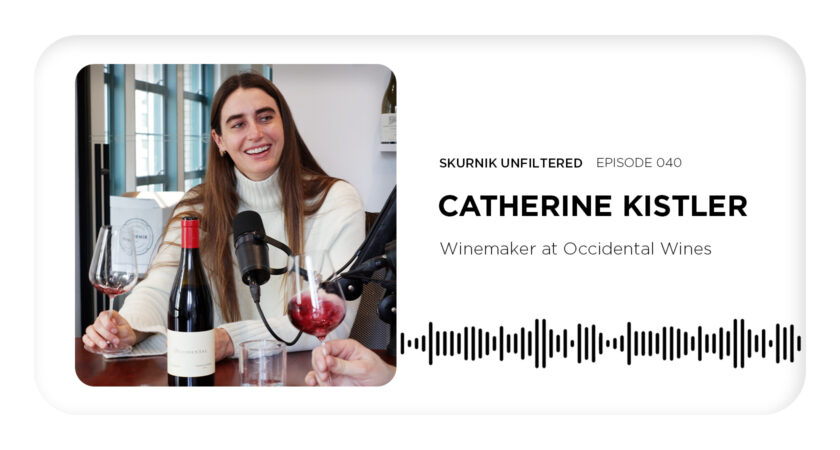
When you grow up in Sonoma, the daughter of a living wine legend, you have a knack for noticing things that others tend to miss. Subtle tasting notes among Pinot Noir blocks stand out boldly. Farming knowledge that took your father a lifetime to learn is innately ingrained in how you see the landscape. Observing changes at seasonal and generational paces releases pressure on your ego. This is how Catherine Kistler was raised.
In this week’s episode, she sits down with her friend and our American wine specialist, Jamie Schwartz, to reflect on her upbringing and the ways her father, Steve Kistler, prepared her for her vocation at the helm of Occidental Wines. They discuss the dramatic realities of farming on the True Sonoma Coast, the lessons in humility she’s learned from her father, and what you can find when you obsess over a precise Pinot Noir clone grown in one small place.



Next week, Justin Lane Briggs sits down with Javier Jimenez of Caballito Cerrero.
Be sure to subscribe to Skurnik Unfiltered wherever you find your podcasts so you can stay up to date on all the exciting content to come.
Introduction
Catherine Kistler 0:03
That’s the beauty of working with Pinot Noir: it’s an incredibly transparent to sight wine, it shows where it’s grown. A perfect wine for me shows that it could not have come from anywhere else, while still keeping things food-friendly and medium-weight and delicious and very beautiful.
Harmon Skurnik 0:22
Hey, this is Harmon Skurnik, and welcome to another episode of Skurnik Unfiltered, where we peel back the layers and get behind the scenes of our favorite wineries and winemakers and find out what makes them tick. Today I have with me Jamie Schwartz, who is the American wine specialist and ambassador for Skurnik Wines.
Jamie Schwartz 0:43
Hey Harmon.
Harmon Skurnik 0:44
You recently sat down with Catherine Kistler, the daughter of Steve Kistler, both of whom are proprietors of Occidental Winery on the True Sonoma Coast. Yep.
Jamie Schwartz 0:56
She is one of the most thoughtful and kind people that we get to work with. I think that really comes through in our conversation. But she’s also got some pretty big shoes to fill. You know, her dad is a living legend, and it’s really cool to go through the history and the future of that project with her.
Harmon Skurnik 1:15
Totally. Steve Kistler is, like you said, a legend, who created the Kistler brand of Chardonnay and Pinot Noir in the Russian River, sold the brand, and moved out to the coast and started Occidental. This project, unlike Kistler, is dedicated solely to Pinot Noir, and they are, what, just a few miles as the crow flies to the ocean?
Jamie Schwartz 1:37
Yeah, it’s super close, and they’ve got a new vineyard. I think they went from eight miles to the coast and now it’s four, maybe, for the next site that’s being developed. It’s pretty cool.
Harmon Skurnik 1:48
Amazing. And Catherine is not only a really, really nice person, but she’s also just incredibly intelligent. I believe she went to Harvard.
Jamie Schwartz 1:58
She did.
Harmon Skurnik 1:59
She has, like you said, big shoes to fill, but I think she’s taken the bull by the horns, and I think this winery has a great future.
Jamie Schwartz 2:07
Couldn’t agree more.
Harmon Skurnik 2:08
In fact, I think it has a pretty great present. Those wines are astounding, super high quality, and much acclaimed at this point.
Jamie Schwartz 2:17
Yeah, the texture is remarkable. They really speak of the place, sitting in the fog line in Occidental by Bodega Bay, a remarkable part of California when you have the Pacific right there and the Russian River meeting the Pacific in Bodega.
Harmon Skurnik 2:33
I’m always amazed when I think about the True Sonoma Coast, how far off the beaten path it is. It’s not where people go to the wine country and they just go take a jaunt out to the coast. It is a good hour and a half, two-hour drive from Healdsburg, which is the center of Sonoma County. It takes a full day to get there and get back. It’s wild. It’s the wild terrain of the coast. Rather than sharing everything about Occidental Winery, why don’t we just tune in now and listen to your incredible interview with Catherine Kistler?
Jamie Schwartz 3:03
Let’s go for it.
The Smell of Nostalgia & Living Legends
Jamie Schwartz 3:05
Hey Catherine.
Catherine Kistler 3:06
Hey Jamie.
Jamie Schwartz 3:07
Great to see you.
Catherine Kistler 3:08
It’s such a pleasure to be here in New York.
Jamie Schwartz 3:09
We’ve had a couple fun days running around New York, and it’s been so fun to talk about the wines and taking over your family winery. It’s really unique this day and age for U.S. wineries. We don’t have like centuries of succession, but you grew up in vineyards and wineries in Santa Rosa with such an incredible perspective. Let’s just jump right into that. What’s your first wine memory?
Catherine Kistler 3:34
The smell. The smell of the cellar and the smell of fermentation and the way my dad wore this Lee denim jacket that would hold all that humid cellar smell. It’s still such a nostalgic thing, him coming home late with an arm stained from being down in the Pinot Noir fermentations. That smell of the cellar is probably what I remember the most. We always had wine around as a family. It was always a part of the table at holidays, Thanksgiving—that’s still a big part of what we do. My mom’s an amazing cook, so having those two things that went together was always really special for us.
Jamie Schwartz 4:12
Was it the case for your parents though? Did they grow up with wine on the table?
Catherine Kistler 4:16
No, my parents are very much like the Mad Men generation, more fish sticks than fine Burgundy or Bordeaux. My mom’s from LA and my dad is from Oakland. He was creative writing at Stanford, and he was still trying to be a writer in San Francisco in the 1970s, which… I’ll let your imagination run wild as to what that looked like in real life. But he was in the right place at the right time where California wine was coming onto the world stage in the 1970s in a way that was brand new and so exciting and dynamic. He worked for Ridge for three years before founding Kistler at 32. I think more than a specific history with wine, it was more the desire to create something, something tangible that you can share—a craft. I think we share that satisfaction. So that drew him into the business when he was roughly my age.
Jamie Schwartz 5:15
I’m not a crafts person, but I find myself drawn to wanting to be more of a tinkerer or something. We talked actually about how I did a pottery class recently.
Catherine Kistler 5:25
Yes! Which I love.
Jamie Schwartz 5:26
I’ll have to show you the photos. But I think it’s amazing that you’ve known that from a young age and that you’ve been exposed to it, of course, as well. But was there ever a thought of deviation? You had a different study in school, but did you entertain it really?
Catherine Kistler 5:40
I did. I was really serious about my studies. I was a joint concentrator in the classics and history with a focus on classical archaeology, so museum studies. You’re in New York, you have the most amazing museums in the world. If you’re a kid, and the one time that you go to the natural history museum is the time that you learn about—pick any topic—whoever formed that exhibit formed your experience. I always thought that was an incredible opportunity to shape the way that people felt about history and the world. So that would have been the only thing that I was interested in outside of winemaking, but having the freedom to go and explore my other interests… I have friends like Jasmine Hirsch who had a totally different career for a time and came back to it, and I think having that pressure release valve is really important for you to go explore those interests. Family business is really intense. Go and feel really independent for a time. And I was so grateful that my parents let us do that, my sister and I do that, before coming back to the winery and now having this very collaborative experience. I love Steinbeck, and the blockbuster line from *East of Eden* is “Timshel,” the concept of “thou mayest,” that there’s an open-endedness to what you do and that you control your own destiny. As somebody who was born into making wine and feels like they also had the opportunity to focus on something else and to explore her own interests—both from an academic standpoint and on the athletic side of things—the concept of forging my own path was very attractive. I love what I do, and I think that’s a key part of what keeps me excited and energized and is critical, no matter if you’re in the wine business or any business. You have to be excited about your life and the opportunities that come to you and to know that you have options always. That can be big things or little things. *East of Eden* is obviously pretty on the nose for me. It’s about a family drama. So I get that. But the concept of having an open door to walk through, no matter what your interest is, it’s very freeing for somebody who feels like their path is pretty clear. I’ve always liked that. And his love for California and his love for the coast, on Steinbeck’s side, I’ve always appreciated somebody who could articulate the light in the right way or something like that. I think there are so many things about wine that are nostalgic, where even if you aren’t involved in wine, if you’re driving through Sonoma, all of the trucks are full of grapes at a certain point in the year, the vineyards are full of people that are pruning in the wintertime. You do get this sense of an agricultural rhythm growing up in Sonoma, and I think there are only a few places in the world where that’s immediately apparent to you.
Jamie Schwartz 8:35
How many of your childhood peers’ parents were also in the industry?
Catherine Kistler 8:39
In middle school, there were a few folks that had wine businesses, of course. Santa Rosa’s not a big city. The Jacksons were a big part of our elementary school. No one that I was really close with growing up shared that exact same experience with me. Through athletics, we were on the East Coast for about 10 years and then moved back home, and I joined the winery in 2017. That was my first vintage, so I’ve been a part of Occidental for the last nine years, and have been on the winemaking side as the winemaker for the last four vintages.
Joining Occidental
Jamie Schwartz 9:12
Your first vintage, 2017, was pretty intense.
Catherine Kistler 9:16
It was.
Jamie Schwartz 9:17
Want to talk about that?
Catherine Kistler 9:18
Sure. It was just an incredible time of transition for our family. It was the year that my dad left Kistler, and the fires were obviously a big part of that. His partner, with whom he started Kistler, passed away in 2017. Just a lot of change. And it was the year that I moved home from the East Coast. Joining the winery was like my first real chance to prove myself. Trying to make an impression while also trying to learn as much as possible is a funny balance, right? You want to seem like an authority on everything while being very open to receiving information. Striking that balance of authority and openness is kind of a challenge sometimes. And with my coworkers, I always want to be a mentor. I work with people who have known me my entire life. My mom was a doctor. She delivered my coworker, Adrian. So he’ll be embarrassed when that airs, but he’s like my younger brother. So there’s an incredible amount of love and trust and respect there.
Jamie Schwartz 10:19
And Adrian is second generation on the farming side?
Catherine Kistler 10:22
Yes, farming and cellar. His dad, Raymundo, has worked with my dad since he was 20.
Jamie Schwartz 10:28
Amazing.
Catherine Kistler 10:28
Raymundo’s two brothers as well. They’re our core cellar crew and also do a lot of the pruning and technical work in the vineyard, which we appreciate.
Jamie Schwartz 10:36
What’s the total team?
Catherine Kistler 10:39
About 35 men and women that we work with year-round. To be a winery of our size, around 8,000 cases, and have a full-time crew that we get to work with year-round is unique. There aren’t many people that make that sort of investment in people. But I think that’s the amazing part about the wine business. It is a people business, whether it’s on the distributor side, farming side, and because a big part of our legacy has been taking care of our crew, taking care of the people we work with. That’s the part that I’m probably most proud of. I hope that I’m working with the people I work with now in 40 years, the way that my dad works with people he’s worked with for 40 years.
Jamie Schwartz 11:17
Yeah. And maybe a third generation?
Catherine Kistler 11:19
I would love that. Selfishly. Like baked in, I don’t have to hire, I don’t have to interview. Ha! It just makes things a lot simpler. But I don’t know. I think also the family side, if you’re inclined in that direction, there’s nothing more rewarding you will ever do than putting in that time. And I’ll be forever grateful for the experience of working with both my parents for these years.
Lessons from Steve Kistler
Jamie Schwartz 11:43
That’s awesome. Maybe we should dive a little into who your dad is.
Catherine Kistler 11:48
We can do that.
Jamie Schwartz 11:49
Is that okay?
Catherine Kistler 11:50
Yes, absolutely. My dad was 32 when he started Kistler. And he’d worked for Ridge for three years before that with Paul Draper. And at the time, obviously there were the very classic vineyards at Ridge, but there was also a vineyard called Occidental Vineyard, which was off of Harrison Grade Road. It’s not quite as far west as we are now, but it definitely was the western edge of where vineyards were planted at that time in the 1970s. And since my dad was very green at the time, he was in charge of driving around and picking up the bins after harvest and driving them back to the winery. And that site always grabbed his attention. And then he had the opportunity to taste an early 1990s Williams Selyem Summa Vineyard Pinot Noir, and was one of the few producers that could taste wines from this part of the West Sonoma Coast. From farther north, he helped plant at the Hirsch Vineyard with Burt and Prue Williams, and he tasted from that coastal site with Walt and Joan Flowers at Camp Meeting Ridge. And then, of course, his own Russian River, Sonoma Valley, Sonoma Mountain sites, and step back and say, Okay, what interests me the most? Where do I want to be? What excites me? Obviously, with the name Occidental now of our project and our vineyards being where they are, it’s clear that this far southwestern corner of the West Sonoma Coast AVA is the part that won out. And I think going back to the risk reward, it can be a pretty unforgiving place to grow Pinot Noir. It’s cold, it’s wet, lots of disease pressure, all of the really fun and exciting things to talk about when you talk about wine growing. But the trade-off for dealing with those things, if you can keep your fruit clean and beautiful and bright, is to make these wines that have this oyster shell minerality, that have this salty signature, red, 13% alcohol, lots of color, lots of intensity, but no weight. Those are the wines I love to drink. I mean, that’s like Champagne, right? You have lots of character, but yet you’re still excited by it, every glass. I think that’s what he started to appreciate over time. And now I’m farming and getting to build on that knowledge, trying to push that even further, trying to be as site-specific as possible every year, make farming decisions that push us in that direction. I have so much respect for his emphasis and insistence on quality at a young age, where he knew that quality was going to be king. At the time it meant partnering with growers that would farm by the acre, not by the ton, and certain things like that, where if you could get the best fruit and the highest quality…
Jamie Schwartz 14:37
That was forward-thinking at the time.
Catherine Kistler 14:38
100%. That was totally out of the box. There weren’t many people that would do that before my dad broached that subject.
Challenging the Status Quo
Jamie Schwartz 14:45
I think it’s clear that your dad challenged the status quo in his career. Are you challenging the status quo anywhere else?
Catherine Kistler 14:52
Ooh. The new ranch that I’m developing that’s halfway between where we are now and the coast is a continuation of the clonal selection that I’ve been working with at Occidental, a proprietary massal selection. But on this even more marginal site, very coastal, very cool, I’m very curious to see how you can translate what’s worked in one place very well out to this extreme version of what we’re doing now. I think we’re pursuing this early edge of ripeness where the skins have just started to soften. You do get this completeness and intensity, but at lower sugar levels. And that’s what you can do at the coast that you can’t do anywhere else. Ultimately, the risk-reward that my dad was willing to take all those years ago with planting the vineyards, and now that I’ve taken on as the winemaker, is the opportunity to make these very singular Pinot Noirs where there’s an oyster shell, there’s briny, there’s this minerality that at riper levels or from warmer sites farther inland is harder to capture. I’m grateful to have the ability to make a wine that translates the wildness of the site, dealing with the fog, the very cool coastal climate, but also being able to make these wines that are high-toned and salty and lifted and taste like they can’t come from anywhere else. If you’re making Burgundian varietals like Pinot Noir or Chardonnay, that’s your goal: you want something that’s singular and precise. I know it took my dad some time to appreciate that, and that’s the place that I started from, so that’s where I’m incredibly fortunate. He’s been an incredible mentor and an incredible teacher. No ego, he likes when we disagree as much as when we agree about things, which as a young person, you want a mentor that wants to hear you. It doesn’t matter what field you’re in, I feel like that’s a universal want. I become a better businessperson, taster, winemaker because I’ve had the ability to ask him and say, “Hey, I’m thinking this, can you back me up or tell me why I’m wrong?” He worked alone at Kistler for a long time, and then I showed up and was suddenly asking all these questions. For somebody who didn’t have to explain themselves to anyone else for a number of years and then to have me—I was very eager—he’s been tremendously adaptable to this situation, and I’m grateful for that.
Jamie Schwartz 17:32
That’s awesome.
Pursuing Perfection
Jamie Schwartz 17:34
You said something earlier at lunch that I think is really important, which is that most upstart winemakers don’t have the resources that you do. I know you’re super thankful for that, but do you pursue perfection? Is there the idea of a perfect wine or the perfect vineyard?
Catherine Kistler 17:52
Absolutely. If you have a site and you’ve tasted a wine that comes from your own vineyard and you’re like, “This is it,” that helps you completely understand your site. That can be your North Star. I have 85 acres of Pinot Noir in my backyard. Our winery is there, my entire universe is pretty condensed. I’m in the vineyard all the time, I’m tasting the wines all the time. I understand my sites. That’s what allows you to say, “Okay, any vintage, I know what the essence of this ranch is. How do I find that?” It’s like Ehren’s question at lunch, like, “Oh, what would you change? Like, what’s your mark?” I feel like that’s sort of the obvious question to ask a second generation person, but the dumbest thing that I could do would be to try to reinvent the wheel. We have these heritage sites. We have sites that mean something to people. There’s a lot of identity wrapped up into that, and the ability to separate yourself from the work that you do, I think is incredibly important. And by separate yourself, I mean, at some point you realize that your control only lasts so long, so how can I make the biggest difference now? There’s not something where I’m, like, dying to make my mark. I’m nine years into this business. Hopefully, I have time. Life is long. I will be able to prove that out eventually, what my perspective is. But while I’m in charge of taking over from the example that was set by my dad, there are legacy parts of my business that I need to keep there, that make us successful as a business from a quality of farming standpoint, but there are things that also make us successful because they’re our identity and who we are as people and our values. Those are the ones that are the easiest to continue because I feel like he set such a strong example for what it is to be a good boss, to be a good mentor, to be a good teacher, to be a good farmer, to be a good winemaker. I’m really just interested in farming at the highest level and trying to make very site-specific wines. And I think that’s the amazing part about working with vineyards for as long as we have, and having planted vineyards on the coast since the mid-1990s: you know what the best version of the Cuvée Elizabeth is supposed to taste like. You know what the best version of the Cuvée Catherine is supposed to taste like. As long as you have this North Star, you can take a hot vintage, a cold vintage, and know—salty, bright, fresh—how do you find the most energy in what you’re making? And as a young winemaker, just having a very clear idea of the signature of the site and letting that instruct my decisions has made even difficult vintages feel more simple and straightforward or more pragmatic, anyway. If you know what you’re shooting for, you’re able to make clearer, more confident decisions. That’s what you strive for, to feel good about what you’ve done and to know that you’re making the best, clearest expression of site possible. That’s the beauty of working with Pinot Noir. It’s an incredibly transparent-to-site wine, it shows where it’s grown. A perfect wine for me shows that it could not have come from anywhere else, while still keeping things food-friendly and medium-weight and delicious and very beautiful. It’s a blessing and a curse to work in sales for the wines you also make because your feelings can get hurt really easily. And so to have people that actually will take the time to be like, “Hey, Catherine, like what are you doing? What are you up to? What’s exciting for you? What am I tasting?” To take that time and put in that effort is incredibly appreciated. It doesn’t go unnoticed, so thank you.
Jamie Schwartz 21:46
Well, we appreciate you so much. We’re so thankful you’re here.
Catherine Kistler 21:50
Thanks, Jamie.
Jamie Schwartz 21:51
Cheers.
Skurnik Unfiltered is recorded at Skurnik Wines & Spirits headquarters in the Flatiron District of New York City, which is why you might hear some city noises as we go along, like horns honking. If you found the conversation interesting, please consider liking, subscribing, and leaving a review. You can stay up to date on our show and upcoming events by following @skurnikwines on Instagram and visiting our website at skurnik.com