




Smooth transitions are crucial to sustaining a family business. Across our portfolio, we champion estates passed on from generation to generation. They last because their work is not just what they do—it’s who they are. They know that the vines they tend will produce the finest wines long after they’re gone, and they seem to feel a stronger sense of duty and satisfaction in what they do for the next generation than what they can reap for themselves today.
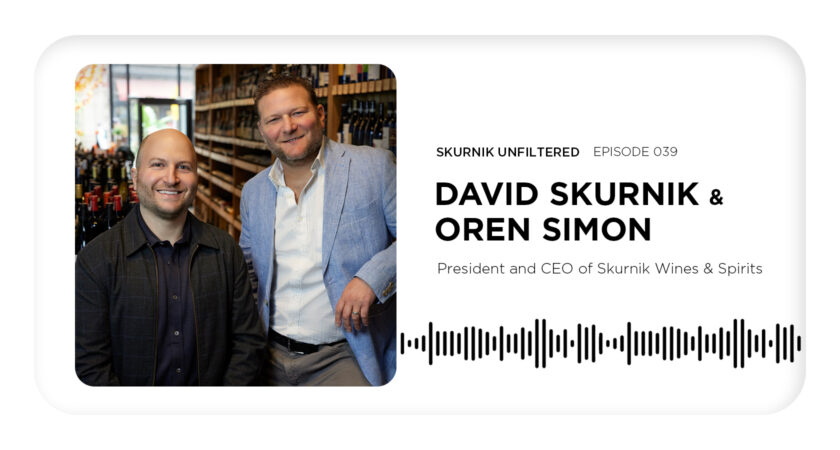
For Episode 39, Harmon Skurnik sits down with his son David, the new president of Skurnik Wines & Spirits, and Oren Simon, the new CEO, to celebrate the first transition of executive leadership in our 39 years of representing the most remarkable winemakers, distillers, and specialty beverage makers from around the world.
Topics covered in this episode:
- The advantages of a robust family business
- The key to good service and hospitality
- What we do that other distributors don’t
- How we hire and choose who to represent
- Why authentic products succeed in down times
- What to expect from this new generation of leadership
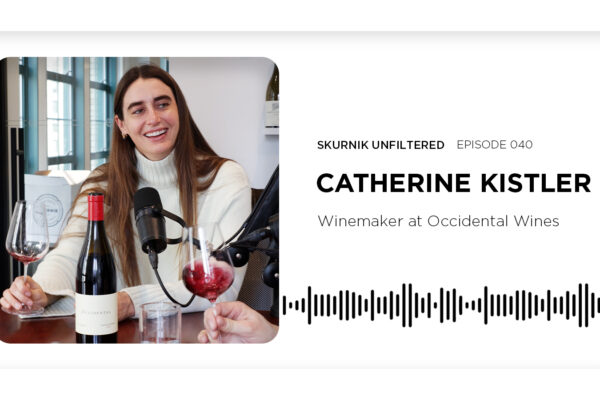
Next week, American wine ambassador Jamie Schwartz sits down with Catherine Kistler of Occidental.
Be sure to subscribe to Skurnik Unfiltered wherever you find your podcasts so you can stay up to date on all the exciting content to come.
Introduction
David Skurnik 0:03
When we put our name on the back of a bottle, it means something.
Oren Simon 0:07
We will always seek out handcrafted products that are made by people, by families that have the greatest quality at every price point. That will always be the ethos of who we are.
Family
Harmon Skurnik 0:20
Hey, this is Harmon Skurnik, and welcome to a very special episode of Skurnik Unfiltered. This is Episode 39. It also happens to be the 39th year that Skurnik Wines & Spirits has existed. So for that, we brought out a couple of very special guests: the future of Skurnik Wines & Spirits. We have our CEO, Oren Simon, and we have our president, David Skurnik.
David Skurnik 0:48
Hey, how’s it going?
Oren Simon 0:49
Good morning.
Harmon Skurnik 0:50
A lot of people in the industry know you by now, but there are a lot of listeners out there who maybe haven’t gotten to know you, and they’re going to get to know you a little bit better.
David Skurnik 0:58
Yeah, I think so. We’ve worked together in this company for, when you combine it, over 30 years, and I like to say we’re cousins-in-law, but what do you call your cousin’s husband?
Oren Simon 1:12
For simplicity, we say that we’re cousins. My wife, Michele, is David’s first cousin. I’ve known David probably since he was about 10 or 11 years old. I’ve known Michael Skurnik since the mid-90s, really since I was a teenager. My wife and I went to high school together, met in high school. I have a different background. I didn’t start my career in the wine business. I have a finance and accounting background. I was on Wall Street for a couple of years, and then in 2012, Michael approached me one day, and I joined the company first as our controller, then as our CFO, and then became CEO when David became president just this past year in January. We had that relationship first, and then as we got to know each other even better through this part of it, through work, it has only expanded our relationship, and I think we’ve got a lot of mutual respect for one another. We enjoy spending time with one another, and I’m really excited about the future of our business getting to do it side by side with David.
Harmon Skurnik 2:09
You have a lot of history and family together, and so it makes it seamless to translate family values into a family business, I would think.
David Skurnik 2:18
You know, there are a lot of family businesses that don’t work. They have drama and they butt heads and they don’t see eye to eye. And I’m really grateful that we’ve been able to work as a family and be a family. Our strengths fit really well together: Oren’s background in finance, my background learning from the ground up in the wine and spirits side of the business. I remember when I was a kid, Harmon would give me a pinky of wine, something I do for my kids now, just to show them that wine has a really important place on the table for families. I know that the history of the company dates back to Michael and Harmon’s parents introducing wine to them when they came back from a trip to Europe, so it’s always been in our family—it’s a family business. I started on our sales support team, like many people do. And that’s where you start—you start on sales support, work your way through, you figure out what it takes for this company to operate every day. I’ve worked in portfolio management, working on our USA portfolio. I’ve worked closely with our sales managers, our national imports team. I learned a lot from our teams and their experience, and now I’m president of the company.
Harmon Skurnik 3:21
I do want to make one caveat, which is that the founders of the company, my brother Michael and myself, are not retired. We’re the board, guiding you guys as you transition toward the future.
Hospitality
Harmon Skurnik 3:33
One of the things that this company is very attuned to is hospitality. Isn’t that true?
Oren Simon 3:39
When you tell people that you’re in the wines and spirits industry, people’s eyes light up right away and they say, “Oh my God, that must be so cool. Are you, like, drinking wine all day or crushing grapes with your feet all day long?” And I say, No, we’re actually running a business and we take it very seriously. But I never forget that we’re talking about products that give you pleasure and give you joy. And there are a lot of great companies out there in the world that are highly successful in their respective industries, but I don’t think they’re having as much fun as we are because we get to work with these products that add so much to the human experience that we get to share with people. I always try to remember that we have serious jobs and we’re doing serious work, but we’re also supposed to have fun, because at the end of the day, we’re talking about wines and spirits here.
David Skurnik 4:23
Yeah, what we need more today than anything else is shared human experience. I think wine can genuinely put you in that place where you’re sharing the same thing. The more we can connect as people, the better.
Oren Simon 4:37
Service and hospitality is central to every aspect of the business. It’s a critical component of everything we’ve built over the first 39 years. It’s the business side of things, it’s the business acumen, but then it’s all the other ancillary stuff that we provide: the education, the seminars, the tastings. It’s all of those things wrapped up together. It’s not really any one individual thing. It’s a combination of seeing the big picture, but also not losing focus on the details.
Education
Harmon Skurnik 5:08
Distributors generally are companies that have warehouses and trucks and they make those deliveries. We do a lot more than deliver that product.
David Skurnik 5:17
Absolutely. We have an incredible team of people who are experts in their fields who’ve been in this industry for a long time before they joined Skurnik and have grown a lot as they’ve been here, being the conduit to get the knowledge from the growers to the people who need to know about why these wines and spirits are so special. You know, there are a lot of wine spirits out there, and if you can’t differentiate one from another, it’s very difficult to pick what you like and where you get started. So, with a little bit of education, a podcast like this where you can listen to the growers themselves tell their stories, it can only help people understand why these bottles are so special.
Oren Simon 6:00
Yeah, the education piece is another part of our business that we’re super proud of and we want to continue to build upon. One of the reasons why we moved into this incredible space here in the Flatiron District is that we now have this space for tastings. But perhaps most importantly, we use it for seminars and for other educational events, and it’s an incredible part of our business that we have this lab here, if you will, that generates all of this education into the marketplace.
People
Harmon Skurnik 6:30
Education is incredibly important, and it all boils down to something that we often talk about. It’s really about our people.
David Skurnik 6:38
We always like to say that it’s about the wine and it’s about the people.
Oren Simon 6:42
Yeah, our process is similar with how we bring on new employees into the company as well as how we take on new suppliers. Michael and Harmon, you guys have tasted every new vintage of every wine that comes on board and anytime we take on a new supplier, to make sure that it fits, to make sure that it has a purpose and a place within our portfolio. And the same goes with the people that we bring on. We have a rigorous interview process here at the company because we put a lot into all of our new hires, and we want to make sure that we’re bringing on people who believe in what we do and what we’re looking to accomplish as a company. We’re going to invest a lot into our new people, whether it’s training, whether it’s education—it’s something that we take very, very seriously because we think that it’s a major source of strength for us as a company.
David Skurnik 7:28
The way that we treat every winery, distillery, sake brewery that we represent comes back to the people. We are a family business, and that’s not just our family—that’s the families of the people who produce the wines and spirits we represent, it’s the families of our team. Creating something, building something that can sustain all of those families—that’s the thing. That’s what’s important here.
Oren Simon 7:51
I think sometimes people forget that. You open a bottle of wine and you’re not really thinking so much about, wow, somebody made this. There were a lot of decisions that went into this, and all the things that go into crafting it. There’s a human being behind it, and it’s made with hands and not machines.
Authenticity
Harmon Skurnik 8:09
The current climate in the wine and spirits industry has been talked about a lot lately. Headwinds, challenges, all that sort of thing. One of the things that I’ve said for many, many years, and Michael as well, is that in tough times, authenticity is really, really important. Curating the portfolio that has people behind it who are real, that has terroir, that really express themselves.
David Skurnik 8:34
Yeah, I think you’re absolutely right about a lot of talk in the world about the industry and what is important right now. I think quality is winning right now. I think authenticity is winning right now. I think people are drinking a little bit less, but that’s okay because they’re drinking less mass-produced wines of the world and they’re drinking more high-quality, excellent, well-made wines and spirits because they’re caring a little bit more about what they’re consuming. And that works for us. We’re not scared of that. I think that that is something that allows us to introduce more people to great bottles because the people care. And when the people care, they want to find something that is authentic and that is quality and is balanced and checks all those boxes because they don’t need it all the time. But when they do, when they decide they want to share a bottle with their friends over the dinner table, they want it to be really good and they can get excited about it.
Harmon Skurnik 9:24
They want it to be authentic. They want there to be a story behind it, they want people behind it who are real farmers who really want it to be real.
David Skurnik 9:31
We have to take an extra level of care into what we bring to the portfolio. We need to taste and we need to decide based on our experience, does this fit in our portfolio? Is this something that we will care about, that we’ll be passionate to put out into the world? There’s an ocean of wines and spirits out there that you can choose from, and we want people to turn the bottle around and see Skurnik on the back and say, “Someone cared enough to choose this.”
Oren Simon 9:55
Yeah, it’s something that I think about all the time. There are a lot of great wines out there. There are a lot of large brands out there, but we generally don’t carry those types of brands. The goal is not to find the most expensive bottle, it’s not about wineries and suppliers that are bigger. Our brands are a little bit different. Usually they’re a little bit smaller, they’re handcrafted, they’re made by families who’ve been doing this for hundreds of years. We will always seek out products that are made by people, by families that have the greatest quality at every price point. That will always be the ethos of who we are.
David Skurnik 10:33
We’re not looking for bigger wineries or things that make things easier for us. Sometimes we find a winery that all we can get for the whole United States is, like, 150 bottles, but it blew our mind. We’re really excited about it, and we’re going to do it. We’re going to find some really great places to place those 150 bottles. That’s the stuff that helps us get out of bed in the morning. When you put our name on the back of a bottle, it means something. We take everyone with the amount of care that we would when we were just getting started. And that’s what I think is so special about what we do and what we care about. We don’t take any shortcuts. We don’t want to. It wouldn’t feel like us if we didn’t put that amount of care in. I’ve been fortunate enough to be able to visit a variety of wine regions over the years. You see the care that goes into every bottle.
Oren Simon 11:23
It’s a lot of tiny little decisions that go into the final product. It’s not one thing at one time. It’s a million different decisions, whether it’s in the vineyard, whether it’s in the cellar, and we run the business the same way. It’s all of the little things that go into the bigger picture. There’s definitely been, for a long time, a drive toward authenticity, toward things that are handmade, that are made with care. Would you rather buy your cup of coffee from a large, massive chain, or would you like to support the small independent that’s on the corner? When you’re buying your vegetables for dinner, we all love driving by a farm stand and getting fresh vegetables and fruit from a farmer as opposed to a large supermarket. I think that wine and spirits are no different. People really appreciate the quality that comes from a product that is made by a family, by people who care deeply about what they’re doing and have cared deeply about that process for, in many cases, hundreds and hundreds of years and generations and generations. That really resonates with people. And then it’s also the authenticity of the experience that you have when you enjoy these products. That’s one of my favorite parts about what we do: that there is no form of technology or AI that can replace the experience of sharing a bottle of wine with your spouse, with friends, with family, and having a cocktail that’s made by hand and enjoying it with somebody who is important to you, that you love. It’s not only the products themselves which are authentic, but it’s also the experiences that you have when you’re enjoying these incredible products.
The Future
Harmon Skurnik 13:01
What about the future? Where do you see the future of this company going under your leadership?
David Skurnik 13:06
I think a lot of people in our similar situation would feel like they need to shake something up, make a mark. That’s not our thing. We’re trying to keep the momentum going and build on this foundation.
Oren Simon 13:17
Young winemakers, whether they’re in Champagne or California, the next generation of winemakers, are going through the same things that we are, where we have one generation going into another, moving that business forward, and they’re doing it just the same way that we’re doing it, particularly ones in Europe. They’ve been through this seven or eight times already. It continues to make me feel that we’re doing the right thing by going on to the next generation, just like all of our winemakers and winemaker families have done over the years. We’re mimicking that now, that change in leadership from a generational perspective. One of the things I love about talking to these winemaker families that have been doing this for generations is that no decision is just an immediate decision. They’re not doing this for any sort of immediate gratification. You know, everything is done with the long term in mind, with the next generation, with the vintage that’s going to happen in 10 or 15 years from now. These folks understand that the decisions they make today are going to have a lasting impression on what’s going to happen in the future. And in many ways, when I tie that back to us and what we’re doing here, we say the same thing. The decisions that we make today are going to have a lasting effect on our business and on all of these families that we get to represent in our markets. We’ve been doing this for 39, almost 40 years now, but we’re always thinking about how these decisions affect the long term.
David Skurnik 14:46
Yeah, it’s great to talk to people who are in a similar place that we’re in. They work with their families, they have similar dynamics with their families that we have here. And just like we are, they’re working towards the same goal of continuing this legacy forward. We have some shoes to fill, but I’m confident that we can fill them with respect and success to continue building this for a long time.
Oren Simon 15:08
It’s also important to remember that David and I are not Michael and Harmon. We’re not looking to be Michael and Harmon. We are looking to continue building upon what they’ve started as a company, and we will approach things in our own way. There’s not any particular one goal that we have. It’s just to continue doing what we do with the people we love doing it with and just to keep building upon the incredible legacy that’s been laid for 39 years. And hopefully we’ll continue that on for another 39 years with the next generation.
Harmon Skurnik 15:38
Well, we’re confident too, and that’s why we are where we are. It’s already working, and it’s exciting to see where the company goes under your leadership and to the future.
David Skurnik 15:50
Cheers to that.
Oren Simon 15:51
Cheers.
Cheers.
Skurnik Unfiltered is recorded at Skurnik Wines & Spirits headquarters in the Flatiron District of New York City, which is why you might hear some city noises as we go along, like horns honking. If you found the conversation interesting, please consider liking, subscribing, and leaving a review. You can stay up to date on our show and upcoming events by following @skurnikwines on Instagram and visiting our website at skurnik.com