

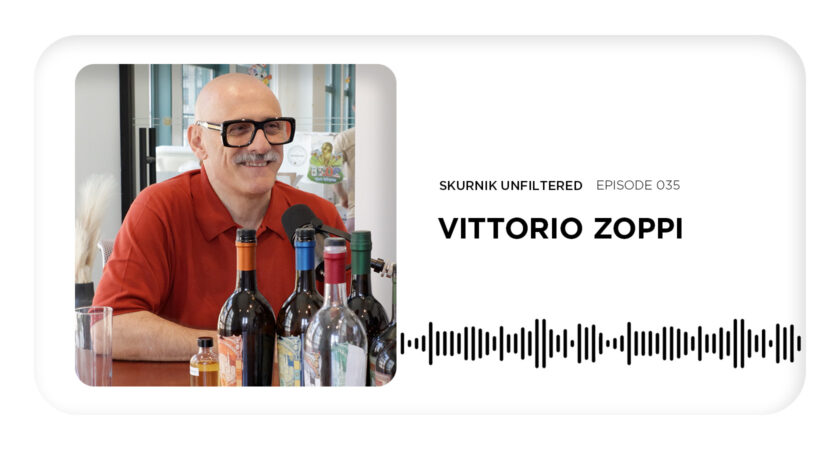
Growing up in Genoa, Vittorio Zoppi was born with an instinctive appreciation for good food and wine and a passion for all things Italian. As a young man, he made a career out of connecting Italian wine estates with American importers, and by the mid-2010s, savvy American drinkers were looking for craft spirits and wine-based aperitivi that communicate a sense of place the same way fine wines do. Vito jumped at the opportunity to combine his love for northern Italian flavors with his extensive network of American beverage professionals, and with the flagship Vermouth di Torino, Antica Torino was born. To date, the lineup has grown to include historic Piemontese classics such as Vino Chinato, Amaro, Genepì, and Genziana.
In this week’s episode, Uncle Vito, as he’s affectionately known at Skurnik, discusses his journey from selling IBM software in Milan, to slinging Nebbiolo in San Francisco, to developing his uncompromising recipes for Antica Torino. He explains the appellation’s rules for producing Vermouth di Torino IGP and shares the cocktail he’s been obsessed with lately.



Next week, tune in as Unified Ferments co-founders Graham Pirtle and Young Stowe discuss their niche in the growing non-alcoholic beverage space.
Be sure to subscribe to Skurnik Unfiltered wherever you find your podcasts so you can stay up to date on all the exciting content to come.
Introduction
Vittorio Zoppi 0:03
Vermouth rosso is like the skeleton in a human body. It keeps the Boulevardier, the Manhattan, the Negroni cocktails standing. Our goal was producing Vermouth di Torino, which is the peak of the pyramid of vermouths.
Harmon Skurnik 0:25
Hey, this is Harmon Skurnik, and welcome to another episode of Skurnik Unfiltered with Jared McGuire, who is the portfolio manager here at Skurnik for all things spirits. You recently sat down with Vittorio Zoppi. He is the proprietor of Antica Torino.
Jared McGuire 0:49
That’s right. If you’ve spent 10 minutes with him, he’s Uncle Vito. He’s slapping you on the back, exchanging jokes, exchanging phone numbers. I think the key with Vito for his whole life has always been his inimitable charisma and his energy and his industry, and it’s really served him well.
Harmon Skurnik 1:07
Yeah, he is lovable around here. I think he’s part of the Skurnik family. And what keeps him here and what keeps us loving him, in addition to his wonderful charisma and personality, are the wonderful products that he represents. These are authentic amari, bitters, Genepì, and chinatos that are ancient recipes, mostly from Piedmont and thus the name, Antica Torino.
Jared McGuire 1:31
That’s right. Most famously, Vermouth di Torino, which we nerd out a lot here. We have representations of a number of different vermouth styles, and he represents—and his brand embodies—the classic Vermouth di Torino, which is characterized very, very specifically. And there’s a real expectation that you’re going to hear about as it relates to other vermouths, totally different from a Marseille style, totally different from Chambéry. Of course we have those representations, as well as domestic vermouths, but he really defines the style and brings out the best of the category.
Harmon Skurnik 2:03
I would also say the recipes that they use are, if nothing, authentic.
Jared McGuire 2:07
Absolutely authentic, a handful of which are actually discovered from old pieces of paper in a very romantic and purely Italian style.
Harmon Skurnik 2:15
And he has quite a following.
Jared McGuire 2:17
Yeah, that is thanks to the steadiness and the quality of the product that he’s represented for as long as he has, again, thanks to the attention he brings, visiting the market. This is a brand that is growing so fast, it’s really difficult to keep enough in stock. We’re constantly growing, and it’s one of our fastest growing brands as well.
Harmon Skurnik 2:38
No wonder he loves us. Well, let’s experience some of that charisma and listen to your conversation with Uncle Vito Zoppi.
Jared McGuire 2:46
I’m very excited.
Uncle Vito’s Early Career
Jared McGuire 2:49
Vito, welcome.
Vittorio Zoppi 2:50
Hi.
Jared McGuire 2:50
Tell us where it all started. Where were you born?
Vittorio Zoppi 2:53
I was born in Genoa in a family with brothers, in a very humble family. Food was everything we could enjoy and be happy with, so lunch and dinner was always a big deal. I remember mom cooking two separate bowls of pasta, one for her and my father, a smaller pot, and another one, bigger, for me and the siblings. Food and wine has always been there in my heart. Around 5 p.m., they used to serve some China Martini, and I was taking them back and forth from the kitchen, the empty glasses, and I was digging my finger into the glass and tasting aromatized wine of any kind. Nothing fancy, talking about the late 1960s. This was the first memory I have of vermouths, chinas, and these kinds of things.
Jared McGuire 3:47
Flash forward to the mid-1980s, you’re living in Milan. You’re a young man, you’re selling computers, you’re doing pretty well. You said you were making some pretty good money, right?
Vittorio Zoppi 3:58
Yes, definitely. Officially in 1984, I joined a company in the computing business, and I started to sell IBM systems and all the softwares that were popping up in the 1980s, and that was the real beginning of my sales career.
Jared McGuire 4:14
You have this career, and then you suffer a personal tragedy.
Vittorio Zoppi 4:20
In July 1995, my younger brother passed away, and I was devastated. A few days later, one of my customers, whom I didn’t know owned an import company based in Brookline, Massachusetts importing in the US Italian wines, he phoned me. He says, Hey Vito, would you be willing to consider a job on the West Coast as a West Coast manager? I think I paused for two, three seconds. I said, Oh yes, okay, when am I gonna leave? I left a few months later. I didn’t even discuss the pay, I just said yes because that was the hook I needed to put my head above water. This is how I ended up in the wine business in San Francisco, where I lived for several years.
Jared McGuire 5:08
Before California, you did a week in Chicago, right?
Vittorio Zoppi 5:11
I did a few weeks of training on the road. I ended up in Kenosha, Wisconsin, with a gentleman who used to import Italian wines. He taught me what he knew in a few days, and he told me one thing. He said, “Vito, you’re going to find a lot of nice people in the United States of America.” And this is what happened then. I went to Chicago. I remember the gentleman’s name, Jim Mello. He was a Vietnam veteran, and I spent a week with him, with his executive management and with some of his salespeople, who were made of Vietnam veterans. It was like being in a jungle with a machete in my hand, learning as fast as I could. And after two weeks, I ended up in San Francisco with two suitcases, and I started my career in the wine business. America means a lot to me. I know that these days it’s not what the rest of the world is thinking, but this is what I think because I met so many good people in America that I owe to this country, and I am who I am because of the time spent in the United States.
Jared McGuire 6:23
You spend a week in this literal boot camp, with an ex-Vietnam veteran as a general manager and a bunch of sales reps who are Vietnam veterans, and here you are, fresh from Milan, and you said you didn’t speak enough English to ask for a shoe shine.
Vittorio Zoppi 6:37
Exactly right.
Jared McGuire 6:38
But it’s a testament to you as a human being and your charms that you still were able to go to California and develop the entire western part of the country.
Vittorio Zoppi 6:48
For this importer of Italian wine, the name of the importer was Dufour and Company. And the gentleman who hired me, he is still alive, he lives in Switzerland, François Dufour, whom again I owe my entrance in the wine business.
Jared McGuire 7:05
After Dufour, seven years or so in California, a really big career opportunity comes your way, and you move to the New York metropolitan area.
Vittorio Zoppi 7:16
Yes, I worked for Vias. In those years, Vias was one of the main players of the Italian wine import business. There was Winebow, and there were a bunch of other companies which were growing very fast, like Skurnik, Polaner, and others.
Jared McGuire 7:35
And Vias at the time—we’re talking brands like Planeta and Gravner, Aldo Conterno, and others.
Vittorio Zoppi 7:42
This is when I developed even more passion for wine. But let me say something that I want to point out. The seven years I spent on the West Coast really helped me understand what the business of importing Italian wine, and wine in general, is. What I understood the most was the needs of the distributors. When I talk about business with you guys and others, I know exactly where you come from, because after seven years with a wine bag on the shoulder, you learn what they want and what they need. So, when you incorporate your own gig as I did in 2015, I knew exactly which door I was going to knock and how strong to knock to have the door open.
Antica Torino joins Skurnik
Jared McGuire 8:36
Now it’s 2005, you’ve been in the United States for ten years, and you need another change.
Vittorio Zoppi 8:43
Yeah, it was time for another change, but it was not a choice of business—it was a choice of life. I ended up going back to Italy, hoping to keep my marriage together. Instead, the marriage fell apart as soon as I landed back in Italy, but that’s life. Again, I started from scratch. I started to broker Italian wineries into the United States. It was not easy, but it was not difficult because I knew the players and I knew their needs.
Jared McGuire 9:19
You start over by leveraging your industry connections to broker estate wineries, and your work in this capacity leads you to Skurnik.
Vittorio Zoppi 9:29
It led me to Skurnik. It was 2014, I was representing a winery from Puglia, which is in the Skurnik portfolio, called Cosimo Taurino. It’s one of the producers—actually, I think it is the producer—that paved the road for Puglian wines in the United States of America. I ended up talking to your Italian sales director, Mark Fornatale, and this is how it started. Then he introduced me to your spirits manager, Adam Schuman. At that time, I was putting together my own gig of Vermouth di Torino called Antica Torino, and this is how the story with Skurnik started.
Jared McGuire 10:10
Let’s talk about the origins of Antica Torino. At some point, I think you said one of your US distributor contacts recommends that you broker an Italian Vermouth.
Vittorio Zoppi 10:20
Exactly right. I said, “Oh yeah, easy.” Honestly, I didn’t have a clue. I had the memories of my grandma and my father sipping on it, but nothing close to reality, so I got back to Italy and I went on a six-month hunt to grab a vermouth producer, but either I didn’t like the juice or the juice was already taken by other importers. Paola, who shares her life with me, suggested I should be bold and start my own gig. One year later, I ended up incorporating a company, making the first batch. It was December 2016, it was a red vermouth, a very long journey to come up with the recipe because I didn’t know how to make recipes for aromatized wine. We bottled the first 3,000 bottles in Torino, and the first shipment went to Skurnik.
Jared McGuire 11:20
Paola gives you the inspiration and says you should try making this yourself. And then you partner with another well-known figure in the wine industry, Filippo Antonelli.
Vittorio Zoppi 11:30
Filippo Antonelli is a Sagrantino di Montefalco DOCG producer in Umbria. He’s a friend of mine, and he’s originally, on his mother’s side, from Piedmont. He had similar memories, so we decided to put the gig together. But it was perfect timing because, on one hand, in the United States of America, there was a renaissance of artisanal spirits, vermouths, aromatized wine, bitters, and so forth. And at the same time, in Piedmont, there was a renaissance similar to the one in the United States, but it was focusing very much on Vermouth di Torino. In fact, in 2017, Vermouth di Torino became an EU appellation called Vermouth di Torino IG, Indicazione Geografica, and that is the only EU wine appellation which refers to a city of almost one million people. Typically, appellations are for small little towns, which are like jewels. Torino is the jewel of vermouth. Also chocolate. We make fantastic dark chocolate. It’s more humble than other cities, not as flashy as Rome, Venice, and Florence. It’s not the first stop. Torino was also a city which, in the 1970s and 1980s, was the heart of political activism because the big car factory was based in there. Fiat, you know, “Fix It Again Tony,” as the Americans used to say. I was part of that protest, and often we went to Torino to protest against this and that. Also, it’s the capital of the region of Piedmont, where the most important wines of Italy come from. Tuscans, excuse me, but the beauty of Nebbiolo is renowned all over the world, so it definitely is a food and wine destination.
Jared McGuire 13:41
They won’t excuse you.
Vittorio Zoppi 13:42
I know they won’t.
Defining the Vermouth di Torino style
Jared McGuire 13:44
You set out to make Vermouth di Torino, which is a very specific style, quite apart from the bright, herbal, Chambéry style, like Vermouth Routin or Dolin, or the more oxidative Marseille style, like a Noilly Prat. What defines the Torino tradition, and what sets your brand apart?
Vittorio Zoppi 14:09
Vermouth rosso, they call it “sweet red vermouth.” It’s like the skeleton in a human body. It keeps the Boulevardier, the Manhattan, the Negroni cocktails standing. The appellation says why Vermouth di Torino is apart from the rest of the vermouths. You must use wine from Italy. It could be white, it could be red. We typically in Italy use fresh wine. In Spain or in Marseille, as you mentioned, they use oxidized wine. It’s different, you make different cocktails. And many producers, including ourselves, go beyond that rule and make one extra hole in the belt, using wine from a specific region, which is even more meaningful. For instance, we try to use Cortese grapes and Chardonnay grapes from Piedmont as much as we can.
Jared McGuire 15:06
How did you settle on this particular blend? I know it varies a little bit, but Chardonnay, Cortese…
Vittorio Zoppi 15:12
Well, the idea was using wines from Piedmont as much as possible. Sometimes it is easier, sometimes it’s less easy, depending on the quality of the vintage, depending on the availability of wine. In our case, our vermouths are driven primarily by the botanicals, which was our idea. In the appellation, wormwood must be the predominant botanical, and wormwood must be grown in Piedmont. You cannot make a Vermouth di Torino using wine from Australia or wormwood from the Czech Republic, or make a Vermouth di Torino from 100% oregano or rosemary, in terms of botanicals. You have to respect the rules of the appellation. Mine excels because of a strong component of aromatic herbs. I use oregano, rosemary, red thyme, and laurel leaf. A significant amount of bitter botanicals, which give structure; we use aloe, gentian, rhubarb, and a hint of Genepì. And then every producer has his ribbon on the gift box. I put cumin, ginger, grapefruit, and vanilla. The actors on the stage are the botanicals, not the wine. We make some other products like Vino Chinato Rosso and Vino Chinato Bianco, where wine and botanicals are equally important. The Vino Chinato Bianco is made with Moscato, the Vino Chinato Rosso is made with Nebbiolo from Barbaresco. But with the vermouth, we want to make a statement in terms of the recipe. It takes forever to come up with a recipe, especially when you are new in the industry. It pleases me the most when I’m in front of sommeliers or bartenders and buyers in general, and they say, “Wow, it’s very drinkable. There’s a lot of equilibrium.” Because drinkability and equilibrium, the way it smells, the midpalate, and the finish is what we really want to achieve in our Vermouth di Torino. It has to be something that you can judge, without depending on which cocktail you’re going to make with it, because when making a cocktail, you can be a magician and make a good cocktail with a lousy vermouth. But if you taste it by itself, it’s got to be good on its own. This is what we care about the most.
Jared McGuire 17:56
The requirements, as you’ve mentioned, for Vermouth di Torino, are fairly loose. The Piemontese wormwood as the primary botanical, the ABV has to fall within a particular prescribed range. But other than that, you have quite a lot of creative license to play with the wine base, with the sweetening agent, and of course, the botanical makeup. Did this freedom in form unleash your creativity or did it give you anxiety because there were so many different directions?
Vittorio Zoppi 18:23
No, actually, starting from scratch, having rules and a guideline helps. The rules of the appellation are important for producing according to quality, and at the same time, they help you to achieve your goal. And our goal was producing Vermouth di Torino, which is the peak of the pyramid of vermouth.
Jared McGuire 18:49
Every detail of these beautiful bottles celebrates Torino. Could you tell us about the art on these labels and the inspiration behind them?
Vittorio Zoppi 18:59
Of course. The label of Antica Torino is not a label I own. It actually was the cover of the catalogue of the international exhibit which took place in Torino in 1911, the World’s Fair. I was looking for something that could deliver a classic and historical image of the appellation and of the city. That image belongs to the city of Turin, so I signed a lease with them, and they authorized us to use it. We are very happy that we are bringing that image of Torino to North America, in particular. It’s a fountain that was called Fontana Monumentale, Monumental Fountain, which was built the year before the World’s Fair.
Jared McGuire 19:54
And the World’s Fair, I think, was for the 50th anniversary of the Italian unification.
Vittorio Zoppi 19:59
Absolutely, yes. 1861 to 1911 makes 50, so a real time to celebrate. It was a very important world’s fair, a very important moment for the city of Torino, which now is flourishing again as a tourist destination. There is also a very strong university. It’s a beautiful city, but it’s a city that, from an architectural and cultural point of view, everybody should see at some point.
Vino Chinato, Amaro, Genepì, Genziana
Jared McGuire 20:28
Outside of Vermouth, you’ve built a pantheon of northern Italian classics, including your Stellare wine-based aperitivi line, also amaro, bitter bianco, you have a Genepì, a Genziana, and a Vino Chinato. While we don’t have time to explore the entire range in detail, give us the general overview of the full range and what each expression represents with regard to your brand and the cocktailing world at large.
Vittorio Zoppi 20:57
Well, the A, B, and C are the three Vermouths di Torino: Rosso, Bianco and Dry. All of them have been somehow inspired also by Skurnik Wines at different moments of their development. Certainly, Skurnik has checked all the prototypes before we arrive at the last recipe. Your help was very important. Then we added the chinatos, which are made with particular wine; we have Nebbiolo from Barbaresco, and we have Vino China Bianco, which is one of the ingredients for the Vesper cocktail, which is made with Moscato secco from a winery called Adriano Vittorio e Marco in the Langhe. So, we have three vermouths, two chinatos, there are two aperitifs called Stellare. One is red and one is white. They are meant for long drinks, a spritz style of product. They are also priced slightly lower. And then there is amaro, Genepì, and gentian, because we are part of the history of Piedmont. Every region, every province of Italy—and I could go even deeper and go into villages—there is a history of homemaking amari. Everybody makes their own thing. Like putting a tea bag into a cup of hot water, it doesn’t take much. Of course when you want to make a product to introduce it to the industry, you have to respect some rules. But amaro is made everywhere in Italy, and definitely in Piedmont. Gentian and Genepì are two different concepts, more specific to the region, because Genepì is a plant that grows above 1500 meters, both in the region of Piedmont and Valle d’Aosta, so it’s very meaningful to the region. And I was very intrigued by making a gentian liquor, because gentian, which is a plant, is like parsley and garlic in the kitchen. In every recipe, every producer, every product there is gentian, but rarely you find a 100% gentian. Mine is 100% gentian. Behind that, we also added some wine to it, so it makes it a very interesting product.
What’s Uncle Vito drinking?
Jared McGuire 23:34
I know it’s a big range, but what are you drinking these days from your own set here?
Vittorio Zoppi 23:39
What I drink these days is a Negroni Bianco, which is a combination of classic, because of the Negroni, and new, because the Negroni Bianco could be a little lower in alcohol, so drinking smarter. I can either make it with my dry vermouth or the bianco vermouth, my Bitter Bianco, and then a fantastic gin. You guys have many of them. I had it last week with Greenhook, which I think is one of your gins.
Jared McGuire 24:10
One of our classics.
Vittorio Zoppi 24:11
All my vermouths have a significant personality, I think, due to the quality of the wine, but also due to the presence of the aromatic herbs. In the Bianco, we have a little bit of basil, sage, marjoram, so it goes well with a juniper-driven London dry style gin.
Jared McGuire 24:32
We will go to the bar and go play around. One more thing, Vito. Your birthday is coming up.
Vittorio Zoppi 24:41
Yeah. August 7th.
Jared McGuire 24:43
I want to give you a shout-out to that, but I also want to offer my hearty congratulations to an incredible achievement that you received just the other day. Do you want to tell our listeners?
Vittorio Zoppi 24:53
Well, it’s something that I’m very proud of: the green card, thanks to my son, who is a US citizen because he was born in San Francisco. He was the sponsor. With everything that has been happening in the United States, people leaving and people coming sometimes, like on a red carpet. But I’m very proud of my green card because, as I said, I am who I am, and I could not be who I am, without the ordinary Americans and the United States of America.
Jared McGuire 25:23
Well, we’re thrilled for you and thrilled to have you here as often as we can get you. Congratulations.
Vittorio Zoppi 25:31
Grazie a te, grazie mille, grazie a tutti. Forza, Juve! I love you!
Skurnik Unfiltered is recorded at Skurnik Wines & Spirits headquarters in the Flatiron District of New York City, which is why you might hear some city noises as we go along, like horns honking. If you found the conversation interesting, please consider liking, subscribing, and leaving a review. You can stay up to date on our show and upcoming events by following @skurnikwines on Instagram and visiting our website at skurnik.com