

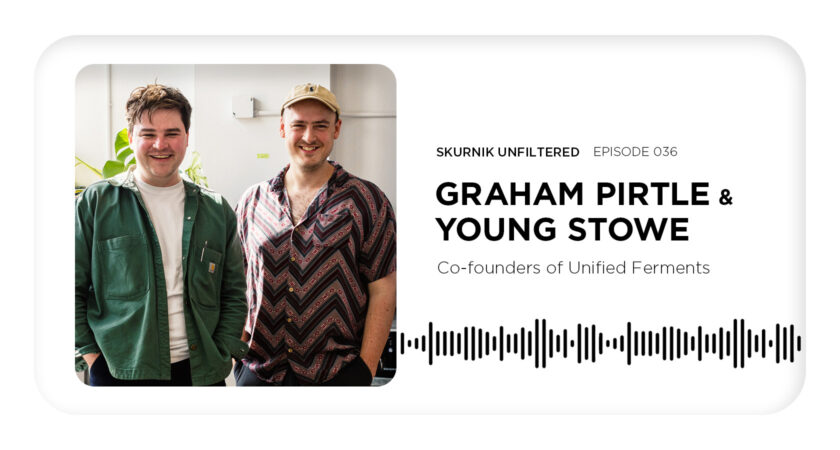
Fermentation can do many things. It can preserve our produce, rise our bread, give us a buzz, and multiply subtle flavors. That last function is the one that most fascinates Graham Pirtle and Young Stowe, the co-founders of Unified Ferments.
From their 4-person facility in Brooklyn, they seek to draw out the hard-to-get-to flavors existing in thoughtfully sourced, single-origin teas through a kombucha-style fermentation process. Unlike commercial kombuchas that use fermentation to augment added fruit flavors, Graham and Young use fermentation as a means of translating or recontextualizing the core ingredient itself, without the interference of alcohol: tea.
In this episode, they interrogate the overlooked terms of “kombucha” and “tea,” discuss the key decisions that differentiate their ferments from any other product in the US today, and survey the future of the blooming category of NA craft beverages.



Next week, tune in as Cody Stephenson sits down with Sami Ghosn of the iconic Lebanese estate, Massaya.
Be sure to subscribe to Skurnik Unfiltered wherever you find your podcasts so you can stay up to date on all the exciting content to come.
Introduction
Graham Pirtle 0:03
I think that we taste at the edge of what we know. We use fermentation to help you taste tea in a different way, to refract it into something that can live in the same category as wine, or can live in the same category as higher-end spirits or something, where you’re tasting this storytelling that tea can do—of places, of regions, of people around the world.
[music]
Harmon Skurnik 0:25
Hey, this is Harmon Skurnik, and welcome to another episode of Skurnik Unfiltered. Today we have an interesting episode, and I’m sitting here with Laura Graham, who oversees our newest portfolio in the company, which is our portfolio of non-alcoholic products. And you sat down recently with Graham Pirtle and Young Stowe, who are the proprietors of maybe our most successful NA brand, which is called Unified Ferments.
Laura Graham 0:56
Totally. I would say so as well, yeah.
Harmon Skurnik 0:57
And they’re based right here in Brooklyn, right?
Laura Graham 0:59
They absolutely are, yes. They’re in the old Pfizer building where Forthave, and I think maybe one other person is in there.
Harmon Skurnik 1:05
It’s like this little community there in Brooklyn producing all these concoctions.
Laura Graham 1:09
Yes. They’re very close friends with a lot of the other young up-and-coming Brooklyn beverage producers. They know and love Alice from Hana Makgeolli, who we also know and love. A really great community.
Harmon Skurnik 1:22
Brooklyn is a thriving place where lots of interesting products are coming out of. I remember sitting down and saying that maybe we should come up with a portfolio of NA products because it seems that great restaurants, in addition to cocktail and wine lists, want to have a list of NA products to offer people who are drinking less or not drinking at all. We tasted through a lot of stuff. One of the things we realized overall was that the products that were made from scratch, as opposed to wines that were then de-alcoholized, for example, were much better. It’s hard to find de-alcoholized wine that actually tastes good. There are a couple, but there aren’t very many. Some of them are downright awful. But these are produced from teas that are fermented in a particular process, and they’re really high-quality teas that come from all over the world, mostly Asia: China, Taiwan, India, Japan. So what is the process? How do they ferment these teas and make them taste so damn good?
Laura Graham 2:27
Yeah, like you said, all of the teas are single-origin and very, very thoughtfully sourced. Most of them are from Asia. They have one North American variety from Canada. They get the tea into their production facility and they ferment it in virtually the same method and style as kombucha, but they do make a distinction that you will hear them talk about, that the brand is much more than kombucha. It’s more about the fermentation method, and less that that is what the final product ends up being. It is quite literally just these beautiful single-origin teas, a proprietary sweetener mix that they use as little of as possible, but you do need a little bit of something for the fermentation process to eat off of. And they use a SCOBY the same way you would use it for kombucha, put them in these gigantic steel tanks, let them ferment. They usually taste them a couple of times through the process and feel out when it’s gotten to the point that they’re happy with it. Then they pull it out and bottle it. It’s a very simple, relatively hands-off fermentation process. One of the most important differences between it and a traditional kombucha is that with kombucha, you’re taking very affordable, large-lot tea and you’re fermenting it a lot so that you taste the fermentation—that funk—more than you are the tea. Then you’re adding sweeteners and fruit flavors and other things to it. Unified Ferments are giving truly as light of a touch of fermentation as possible to the tea, just to give it some complexity and depth and really bring out the qualities and make the tea the star.
Harmon Skurnik 4:19
Well, that must be why they taste so damn good.
Laura Graham 4:21
Yes.
Harmon Skurnik 4:24
When you talk about the process with kombucha, they kind of remind me of natural wines that have gone out of control; all you taste is the process, and you don’t taste the underlying quality fruit. And in this case, these Unified Ferments are so delicious, they remind me of somewhere between the taste of a really fine wine and a really great cocktail. There’s something in between that makes it perfectly delicious to drink at the table, either as an aperitif or with food.
Laura Graham 4:52
Yes, absolutely. Also, with a mass-produced grocery store type of kombucha, the flavor is something that is added in. You’re buying it because you prefer mango flavor or strawberry flavor, whereas if the tea is the shining star, it allows so much more potential to pair with food and to be enjoyed on its own accord. When you were talking about cocktails, we have actually seen a good number of accounts that are using it in cocktails and mixing alcohol with it, but also using it in mocktails to stick with the non-alcoholic serving. Particularly the Lapsang Souchong, which is a smoked black tea, people have cocktailed with that a lot, and it’s really fun to see.
Harmon Skurnik 5:39
I’ve gotta have one of those.
Laura Graham 5:40
Yeah.
Harmon Skurnik 5:41
So that explains why it’s so popular. This brand is doing really, really well. Let’s sit back and listen to your conversation with Graham and Young and find out more.
Laura Graham 5:51
Great.
Wen Shan Bao Zhong and the origin of Unified Ferments
Laura Graham 5:54
I am here today with Graham and Young from Unified Ferments, who are going to talk you through a little bit of their lineup, what they do, and the really awesome stuff they make.
Young Stowe 6:04
Thank you very much for having us. Always thrilled to be at the beautiful Skurnik office.
Laura Graham 6:10
Great. Do y’all want to pick one of the bottles that we have to start off with?
Young Stowe 6:15
Sure. I think Wen Shan Bao Zhong is probably a good place to start here. I’m Young Stowe, and this is Graham Pirtle. We’re Unified Ferments. Graham and I met way back in Tennessee where we were roommates, actually, at boarding school, so we’ve known each other for…
Graham Pirtle 6:36
Too long.
Young Stowe 6:37
Ha! Yeah, I guess we’re going on 20 years now, which is kind of wild. This project is almost seven years old now, which is pretty crazy to think about. It started as a weird little wine bar concept that we sort of got roped into and were developing a program for. Graham was working in fine tea at the time, and I was working in beer and wine, and I think it was mostly Graham’s idea for this little 12-seat wine bar to have like a really interesting in-house fermentation program. He was working with beautiful teas, so he was bringing these things home that I guess we just decided to do a kombucha-style fermentation on.
Graham Pirtle 7:24
Yeah, there’s a lot of fermentation just happening in every level of fine dining and with the Noma Guides and everything like that. I—coming fresh out of working at 29B Teahouse, which was not the first place that was trying to do high-end tea in New York—was trying to land in a wine-adjacent space. At some point in researching these fermentation practices for the bar concept they were looking at, it was like, okay, these are all flavor multipliers; they dig and they excavate out flavor profiles that are existing in substrates. And kombucha, in the simplest terms, is just making the most hay out of tea via fermentation, that just happens to be in whatever metabolic pathway that doesn’t create alcohol. And so, with all these beautiful examples and this storytelling that tea can do of places, of regions, of people around the world, why is nobody using this multiplier that’s laying around on these types of teas? We started doing some tests. We were doing a lot of other random stuff at the time, too. We’re both Southern boys, and for that bar concept, we were trying to do lacto-fermented strawberry pimento cheese sandwiches and stuff like that.
Laura Graham 8:40
Ooh.
Graham Pirtle 8:41
Maybe we’ll circle back. But by far, out of all of those tests, we were like, what have we done with these teas? There were a lot of questions about how to land it. Are we going to be alcoholic? Because natural bottle-conditioned kombucha is going to end up—probably if you made it at home—past that 0.5% federal regulation for alcohol. We had the opportunity to try to chase more of that or to try to chase something that was non-alcoholic. At the end of the day, we thought it was more interesting that it was non-alcoholic, outside of any other consideration.
Young Stowe 9:16
It’s important to reiterate that we had zero concept of there being a non-alcoholic industry at the time. It was 2019. I guess we were aware of Seedlip and a few other things, but COVID was really the force multiplier for NA brands.
Graham Pirtle 9:37
Or more like mid-COVID was it.
Laura Graham 9:39
Yeah, because everyone started drinking too much, and then they were like, wait, how can I tone this down now that I’ve been home for eight months?
Graham Pirtle 9:46
Exactly. How can I like ritualize away from alcohol? Or how can I protect these rituals that help keep some people sane, but have something that doesn’t have complicated downstream implications of ritualized alcohol use without any of the usual buffers that we had in place.
Young Stowe 10:01
Yeah, but that’s definitely a question we get, like, oh, it’s so nice that you guys made this brand to serve this growing NA market. And it’s like, we did not think that was a thing.
Laura Graham 10:12
Yeah, seven years ago is definitely pre the boom that came a couple of years after y’all had started, and now it’s still going up and up and up.
Is it just kombucha?
Laura Graham 10:12
As we’re tasting the Wen Shan Bao Zhong, do y’all want to use this as an opportunity to get into a little bit of your production methods?
Graham Pirtle 10:32
Yeah, sure. For us, it starts with finding a tea, first of all. There are certain types of interesting regions and expressions and production methods of tea that we’re interested in, but it really takes that flint strike moment of being like, oh, okay, I see. This is a story that can survive this process of fermentation and land in this stemware-friendly context in a way that feels like an honest remix of the original tea itself. Each of these have their own fermentation protocol that has to do with aging some stuff, leaving some stuff a little bit less fermented, but it’s all going through a kombucha fermentation pathway. And what you’re tasting in each bottle at any given time is only ever the tea and the time and the requirements of the fermentation, which are the culture itself and the sugar that it needs to drive the fermentation.
Young Stowe 11:28
It’s probably a good time to step back. We’re using the word “kombucha,” which is not a word that we typically use to describe our stuff, but it describes the fermentation process that we use. We are hesitant to use the word “kombucha” because it conjures bottles of GT’s in people’s brains in ways that can distract from what we’re really trying to do. But insofar as kombucha is fermented tea, then we make kombucha, but it’s a word that’s weighty with all sorts of signifiers.
Laura Graham 12:09
It’s probably the closest thing for people who are new to the concept, to give them an idea of what the process is, but it’s definitely toned up past a point that most people have experienced, myself included, when I tried them for the first time.
Graham Pirtle 12:26
For the commercial beverage of kombucha, there was a fork that could have happened. If you’re having a bottle of Health-Ade or whatever, essentially they’re using tea to help you taste fermented flavors; they’re using tea to generate fermented flavors. We use fermentation to help you taste tea in a different way, to refract it into something that can live in the same category as wine or higher-end spirits or something where you’re tasting for a sense of place, the story behind it, or that the flavor of it is telling a story about where it’s coming from. That is why people want to go into these premium categories or do this gastro-tourism type of stuff. In a way, these are like cheaper vacations, in terms of being able to get to these places and hear these types of stories. The Wen Shan Bao Zhong that we’re tasting is made from a ninth-generation tea-producing family in Nantou, in northern, more coastal Taiwan. It tells this story that we really like from Taiwanese tea and from that region of these very light, airy, extra perfumey, nearly transcendental level.
Young Stowe 13:47
It almost can be sort of artificial tasting. Taiwanese teas, like Taiwanese milk teas almost taste like movie theater popcorn, which are like really cool, and the lightly oxidized oolongs that they make, have kind of granny parlor or potpourri flavors to them that are really cool.
Graham Pirtle 14:10
And there’s a premium for these types of highly floral teas with kind of a creaminess or something like that. But this expression is really amazing because it has a little more salinity, it has a little bit more oatiness. I don’t know if it was John Cage who said it or Brian Eno, but style is what you get wrong sometimes. A lot of times, we’re trying to find these stories that we think are independently compelling in these tea contexts, but then find the ones that can make that leap or can be translated in this way that ends up using what we already want to think about when we think about wine. How do we calibrate our taste profiles, and how can we turn those on their heads by presenting something that can be adequately gauged by those sensors, but are coming from a completely different direction. A lot of time when we’re doing tastings, Wen Shan Bao Zhong is the first one that isn’t just kind of interesting. It tells a story of a sense of place.
Young Stowe 15:02
And it’s not just about choosing the most complex tea we can possibly find. In a weird sense, slightly simpler, slightly more humble teas actually work better for our process. We can expand them a little bit more. There’s more space between notes to play in. People are always like, “Why haven’t you guys done like a pu’er yet, or something a bit more aged?” There’s already so much going on in those teas that a process like this could very easily muddy the waters in a way that nothing is being added to that story. It’s hard to overstate that we use teas that are already really, really beautiful when they come to us. So much of what we’re doing is really just trying to stay out of the way. But there are little things that we can turn up or down, little dials that we can play with that are about telling the story of that tea in the best possible way.
Graham Pirtle 16:00
An effort of translation, I would say.
Young Stowe 16:03
Yeah, or interpretation.
What is tea, actually?
Laura Graham 16:05
Are we moving on to Soba next?
Graham Pirtle 16:07
Sure.
Laura Graham 16:07
I think it is a very good example of something that is, at its core, very simple. It’s not something ultra crazy and complex, but the process, as we just talked about, brings it up a notch.
Graham Pirtle 16:29
It’s definitely a proof of concept in terms of fermentation as a flavor multiplier and recontextualizer, because soba is definitely the most head-cocking, like… You mean the noodle?
Young Stowe 16:48
Often it’s called Soba Cha, which is beautiful toasted buckwheat from Nagano, Japan. It’s part of a three-bottle collaboration that we do with Kettl Tea, who is America’s preeminent Japanese tea importer. They get their hands on absolutely technicolor, amazing Japanese teas. We were kind of afraid to play with Japanese teas for a while, but they coaxed us into it in the right way. Soba is, at its essence, pretty simple. But when you dig into it, there’s so much more going on. Something really cozy and comforting about it, but also really deep.
Graham Pirtle 17:22
When it has the space that it has in this context and the expression of this tea that’s balanced with a little bit of sweetness and a little bit of acid, it makes you realize how aromatic it is, how much aromatic stuff is happening in that glass. And that’s one of the little discoveries that we like to try. We’re always chasing, it’s that, but it’s also that. Like Young said, these teas are already such beautiful things when they come in the door. It’s like there are tea masters, tea producers looming over in our heads like, would this be something that could still be enjoyable? How did you get from X to Z, in terms of how you did this?
Laura Graham 18:05
Totally, especially since I feel like many of your teas—most of—are sourced from cultures where tea is a ceremonious, almost religious experience and is very, very highly regarded.
Young Stowe 18:21
It is totally possible that with some of our bottles, they would be horrified. Maybe not horrified, but they would be like, “What have you done?” But something we say a lot, which is becoming less true, is that America is just not a hyper-tea-literate society, especially compared to these major tea-growing regions and the places where we’re sourcing these teas from. I think a little bit of that recontextualization is helpful. I mean, frankly, it was our stuff that got me into tea. I didn’t know anything about tea until Graham started showing me these teas, and something about that little shift, that little recontextualization, I think goes a really long way for connecting people’s brains to something. A little bit of acidity, a little bit of sweetness, some bubbles and something being served cold—there is a slight Americanization happening there.
Graham Pirtle 19:19
Well, you learn to taste in context in the way that you learn to speak and do any other things in context. The interesting thing about tasting—I think this is why there’s such an enduring fascination with stuff that’s premium in the wine category and the spirits category, and why fermentation is so enduring when lots of other food preservation techniques have still been here—I think that we taste at the edge of what we know. We would never have to search for words for flavors. And apparently, I was reading recently that our olfactory is the oldest system in biological history or something like that, so we always are trying to make sense of these things and mint sense about them. And drinking tea in this hemisphere just because it’s less—America actually grows really great tea, we just don’t have the tea production history. It’s hard to bet against thousands of years of history, you know what I mean?
Young Stowe 20:11
Maybe it’s good to define exactly what tea is, because that’s something that I didn’t really know about. You hear about all these different types of tea but two of the things that we’re tasting today, aren’t necessarily even teas at all.
Laura Graham 20:27
Yeah, what is the Merriam-Webster definition? Give it to us.
Graham Pirtle 20:31
All tea that we consider to be tea—green tea, red tea, black tea, aged tea, white tea—all of that is actually either Camellia sinensis or Camellia assamica. Those come from a tea plant, a little shrubby tea tree. And everything that happens in between is actually processing or terroir. So today, what do we have? We’ve got Wen Shan Bao Zhong, which is an oolong, which is a pretty wide category. That is basically everything at a level of oxidation and/or roasting that is between a green tea and what we would call a red tea. We call red tea “black tea” in the West because it’s the color of the leaves, or that’s how we’ve vernacularized it, I guess. We have the very ends of the spectrum: as lightly oxidized as you can get—an oolong, which presents as green, but not quite. It’s not polyphenol, it’s not grassy, it’s very blanched a little bit more. It’s more perfumey and floral, which is what you get in some of those lower oxidation points—and lapsang, which is roasted and then smoked, abused into the beauty that it has. And the other two that we have, you would call them in a tea context, “tisanes.” I’m never completely sure if that’s the right pronunciation. It’s a little hoity-toity, but it serves a good enough purpose that I like still keep it in my lexicon, because herbal tea literally makes no sense. It’s like if I said “Pepsi Coke,” you know? Even trying the soba, it’s not that the treatment is any less incredibly intelligent, bringing the most out of the medium and finding where those intervention points are to prepare it as a tea. But Camellia sinensis and tea proper is going to require a little bit more legwork because so much legwork has been done across so many different cultures for such a long time. It’s interesting. There’s people trying to do tea in America in an interesting way, but we’re just a little behind the curve…
Laura Graham 22:27
In terms of a few thousand years.
Graham Pirtle 22:29
Yeah, exactly. Cultural, infrastructural, whatever.
Recontextualizing tea for the Western palate
Laura Graham 22:32
Totally. I want to talk a little bit more on that difference as far as the Western palate. I might be making an assumption here, but as another southerner, my first experience with tea was iced tea with about two cups of sugar in it, in a gallon bucket in my grandma’s kitchen. And I’ve had the experience of trying more and more as I worked my way through restaurants and finer dining. What have y’all seen often in your reception from first-time tasters in the context of the American palate and how do people perceive it? Digging into what the response is when you speak to people and they’re trying the product for the first time.
Young Stowe 23:14
I think so many people are not that familiar with tea, so we’ll have a little bit of vocabulary to be like, “Is this a green tea? Is this a white tea?” Maybe even without fully understanding, not in a bad way, but without fully understanding exactly what they’re trying to get at. I think our beverages do a really good job of cracking them open and—democratizing is sort of a bad word. It’s not the right word, but recontextualizing.
Graham Pirtle 23:46
That’s why I go back to translation so much. Translation in itself is a high art, but so much of that is trying to communicate a spirit of something without getting in the way of it. A poor translation usually doesn’t represent the original source material or it takes too many licenses. But there are lots of ways to get to a good expression of something. If you want to start with tea, you’re going to look at East Asia because there’s just so many cultures of that for so long. But we were like, we know there’s a North-American-ness that we want to explore too. We don’t want to be totally forever pigeonholed just by where some of the best teas in the world are. We’re trying to find stories of a place. Like Rhododendron, in terms of the processing, it’s about as low-intervention as possible. When we’re trying to brew an enormous bag of it, we basically have to spike it down in our brewer because it’s basically hydrophobic, because it’s barely been treated in the ways that teas are going to absorb water. But it’s still worth the effort because it’s telling us a story about where we’re from. It’s nice to get back into telling a story that speaks to experiences that are actually closer to home. We’re using this as a translation vehicle to recontextualize it and bring these flavors into something where people have already formed a groove of understanding things in flavor, in terms of being in stemware. We used to be really adamant on the back of the bottles that said “stemware required,” and then we softened it to “stemware helps,” and it does.
Young Stowe 25:20
We can’t force people.
Graham Pirtle 25:24
It helps to activate the parts of our brains that have been trained to understand that we’re doing something where we need to lean into taste a little bit more. We always want to keep stuff that’s pretty accessible. But we’ll probably find some stuff that we’re going to be like, all right, now we’re going for broke, this tells a story that we can’t avoid, and we want to do it in a more premium, challenging way for people who want to take a real trip. But when we started out, we were always like, okay, there’s some really beautiful stuff that’s a bit challenging that is not cleanly telling a story about where it’s from in a way that is cool, and we want to keep them accessible.
Young Stowe 26:04
We definitely have the conversation all the time. I think as we’ve leaned further and further away from the word kombucha—and this happens maybe less, the conversation of people being like, “I don’t like kombucha, but I really like this.” And also, “I don’t really like tea, but I really like this.” I don’t exactly know why that’s the case. If you’re somebody who genuinely doesn’t like tea, or maybe you’ve had a bad experience with tea or something, or your idea of tea is super sweet tea from Chick-fil-A or Bojangles or something, and that’s all you know.
Laura Graham 26:37
Or mass-produced accessible grocery store green tea in a tea bag with no honey, no milk in it. That’s boring in comparison to this.
Young Stowe 26:48
Yeah, exactly.
Laura Graham 26:49
What we have seen on our end is, when people are not familiar, the best thing is to get as many of the bottles in front of them and get it in their glass. And I have said that from the jump with you guys. Whether people have some familiarity or no familiarity, if you get it into somebody’s glass, they are going to like it and they are going to find one or more that they connect with. If you’re new to something, whether it’s food or wine or tea, you can only get so far telling someone that it tastes like something else. It tastes kind of like this. It sort of has a flavor of this. But none of that really clicks until you drink it.
Young Stowe 27:31
It’s part of the reason why we have so many SKUs. We have nine. We could easily have more. I think in total we’ve probably had 13, 14, 15, a lot. The reason is, the world of tea is so broad, there’s so much to play with, and we’re able to have a very spectral lineup because it’s like wine. There are so many different processing types, so many different growing regions. There’s so much that we can play with, and we don’t have the problem of having to tend to the farms. Like I said, these things are beautiful when they come to us. They’re already expressions of their producers and their growers.
Graham Pirtle 28:11
When people come up to the table and they’re like, “Which one of them should I try?” I’m like, “You have to try two.” And that’s not because I’m hedging my bet—that’s because I want you to see that, whereas lots of incredible wine producers are generating a usually ever-narrowing expertise to affect a kind of house style on something or to contribute to these styles, just because that is the kind of the professional pathway more. For us, I want you to see that we are trying to gather these stories from around the world and find a way to land them in these bottles and in stemware to find these stories and that we are highly intervening in them. As much as everybody had been obsessed with low intervention, you couldn’t get to this without intervention. It’s about the subtlety of that translation and trying to have a fidelity to the original flavor profile and source, and that we brought it on because we wanted to share that and find if we could share it.
Surveying the future of the NA category
Laura Graham 29:10
Absolutely. How do y’all feel—I assume optimistic, but correct me if I’m wrong—about the future of the non-alcoholic category, the ferments category? Where do you see this going? Y’all have been at it for seven years, as we talked about, so pre-NA boom. Do you feel like it’s a fad? Do you feel like it has lasting potential?
Young Stowe 29:38
One of the things that scares me, in terms of the industry, is, I think about America. There are thousands of breweries. There are hundreds, maybe thousands of coffee roasters. As far as we know, we’re the only company in America that’s doing anything like this. I mean, there are kombucha producers, obviously, but they’re not…
Graham Pirtle 30:03
And some kombucha producers that try to source and use cool teas, I would say.
Young Stowe 30:08
But not in this format, and they are not necessarily trying to sell into the industry that we are trying to sell into. And no shade, but there’s a lot of co-packed products out there that feel like more of a marketing exercise than anything.
Graham Pirtle 30:21
Katy Perry got into the non-alcoholic wine space without, I think, demonstrating a huge amount of enthusiasm before 2020, but what do I know?
Young Stowe 30:32
Yeah, exactly. There are a lot of things that are being sold. If you were to go into one of those NA bottle shops and pull some bottles off the shelf, there are a lot of things that are being sold that I frankly don’t think are all that good. For instance, all of these de-alcoholized wines that, just personally, I don’t think we find interesting at all. And it’s a really expensive process, so you’re usually taking pretty cheap juice and putting it through a process that’s going to pound out anything that’s interesting about that wine to begin with. So you wind up with an industry that is a weird negative copy of another industry, which is just kind of weird. A point that Aiden, our lovely employee, made one time was, younger people who are drinking less are being sold products that are proxies of things that maybe they’ve never even had before. You’re drinking a “tequila” that is an NA tequila when you’ve never had tequila. It’s weird. One of the things that we’re trying to do is completely circumnavigate whatever that conversation is. These things are exactly what they are.
Laura Graham 31:43
As you said before, you did not go into this project seeking to make something non-alcoholic. You went in with the intention to make something delicious and tell stories and maintain a place in the hospitality industry that you both have grown up in and love.
Defining perfection
Laura Graham 32:01
The next question I have for you is, what are you seeking? And can you give us a definition of what perfection means to you?
Young Stowe 32:09
Oh man. Perfection. Graham, I’m sure, will answer this differently than I do, but I don’t think about perfection at all. I don’t think it’s ever crossed my mind, in terms of tasting through these today. You’re tasting little things that I would say are off from what our perfect center of the bullseye is, but that’s everything. We always have an ideal in our head of what we’re trying to hit, but do we always get there? No, of course not. I don’t know. What does perfection even really mean? I think we can try to focus on being excellent and we can focus on trying to be as good as we possibly can be and make things that are as good as they can be, whatever that even means, because I don’t even really know what that means. I think we’re always chasing that around the bush. But yeah, I don’t know. Graham may have a better answer to that.
Graham Pirtle 33:04
Uh, we’ll see. I feel like perfection is the privilege of the un-material world, if it’s going to be anywhere. But I do think that you always need to have something that’s inspiring you to do what you’re doing. Anytime you’re trying to invoke a new thing in the world, or maybe in our case, you’re strangely burdened with a lot of newness that you brought into the world when you were just trying to make something yummy.
Young Stowe 33:33
Truth. Facts.
Graham Pirtle 33:35
What you have to mint in that conversion of something that is new into something that people can understand and have a relationship with has to be driven by a higher-level thing. Maybe not only the privilege of the non-material world, if we’re going to get philosophical about it, but I’m happy to be in a place where I feel like I am trying to apply artistic sensibility and pure grunt craft to something that is by its definition a kind of acknowledgement of my own gratitude for having it.
Young Stowe 34:12
Ha! Pure grunt craft is maybe the most accurate definition of what we do, I’ve ever heard. Ha! That’s the daily basis.
Laura Graham 34:19
That’s what y’all are doing for 10 to 12 hours a day in the warehouse?
Graham Pirtle 34:24
Maybe 5:00 to 5:12 gets this kind of effort, but at the end of the day, something that you can always show up to that always puts you into a frame of mind has the closest valence to what I can think of as being perfection. To be able to want to do justice to something that you have enjoyed and want to share it with people, and that the grunt of that ends up being fueled by that is, I think, what can help me get through these things. And for that reason, I feel like it’s close to perfection.
Young Stowe 34:58
In terms of the perfection conversation, there’s maybe an interesting metaphor inside of Lapsang Souchong because it is a tea that exists because the tea itself was imperfect, and there was an attempt to fix it by trying to smoke it.
Graham Pirtle 35:13
The story of Lapsang Souchong, which is probably apocryphal, but I feel like speaks to a part of the spirit of the tea, is that there was a village in Wuyi where this is from, where the tea got a little bug-eaten or had some kind of issue with it. And they were like, “Maybe if we smoke it over pine, it’ll clear up.” And then they did that, and they tried and they were like, “Nobody will want to drink this. This is not good.” But as it happened, there were Dutch traders that were coming up, and they were like, “Maybe we can peddle it off on them.” And the Dutch were like, “We’ve never had anything so good. Like, immediately bring it to the queen.” Or something like that, which is probably fabulating a couple of different things from a couple of different cultural perspectives, but it was seen as something that was geared for a Western palate in a certain sense. But as time went on, there was way more of a Chinese cultural ownership of Lapsang. And now there are lots of different levels of smoke in Lapsang, and very high quality. This is a pretty high-quality tea that’s being applied this treatment to, and it’s being applied this treatment in a pretty targeted, more surgical way. In a conversation about perfection and achieving perfection, there are lots of routes to something that is maybe not exactly perfect, but can be enough of a story to become a mythos of a certain area, of a certain tea, that ends up being what we go try to find and harvest.
Young Stowe 36:32
Roots in hell…
Graham Pirtle 36:33
…so the branches can reach to heaven. Yeah, exactly.
Laura Graham 36:37
Thank you guys so much for coming on. This has been so much fun. Shall we cheers with our Lapsang?
Young Stowe 36:42
Yes. Cheers to Skurnik, too.
Graham Pirtle 36:43
That’s right.
Skurnik Unfiltered is recorded at Skurnik Wines & Spirits headquarters in the Flatiron District of New York City, which is why you might hear some city noises as we go along, like horns honking. If you found the conversation interesting, please consider liking, subscribing, and leaving a review. You can stay up to date on our show and upcoming events by following @skurnikwines on Instagram and visiting our website at skurnik.com
Ferments tasted in this episode

- Lightly Oxidized Oolong Tea
- Sourced from a ninth-generation tea family in Nantou, Taiwan
- Powdery florals, oat-like sweetness, delicate salinity
- Notes of orchid, honeysuckle, and fresh marzipan
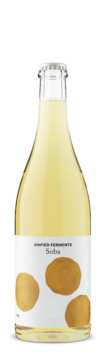
- Toasted Heirloom Buckwheat Tea
- Sourced from the highlands of Nagano, Japan
- Warm, toasty character
- Notes of golden grain, spun sugar, sourdough, licorice
- Collaboration with Kettl
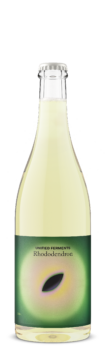
- Wild harvested whole leaf Rhododendron
- Also known as Labrador Tea or Greenland Lemon
- Sourced from the northern forests of Quebec, Canada
- Notes of fir, dill, juniper, and Asian Pear
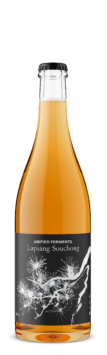
- Pinewood smoked broad-leaf black tea
- Sourced from Fujian, China
- Finished with a traditional method of smoking over pinewood fire, to dry and preserve the leaves
- Notes of peat, pine smoke, sourdough, and licorice