

The story of Lebanese wine is a story of perpetual revival. One of the oldest wine regions in the world, this well-protected and resource-rich section of the Levant has been producing and trading wine for millennia—as a global currency by the Phoenicians, in secret by persecuted Christians under Ottoman rule, and in spite of violent times today.
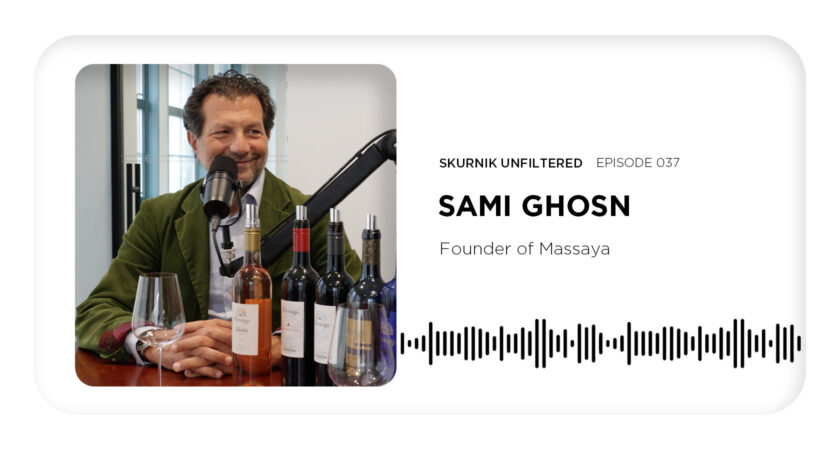
Sami Ghosn relies on his ancestors to sustain his beloved culture. After fleeing the outbreak of civil war in 1975, he returned to the Beqaa Valley in the early 1990s where he started distilling arak and selling it from his parents’ pharmacy. Eventually, he and his brother founded the iconic Massaya estate, which helped propel the latest chapter of Lebanese wine revival.
In this week’s episode, Sami supplements a lineup of his wines with tidbits of forgotten history and memorable encounters with Anthony Bourdain and the former prime minister of Lebanon.



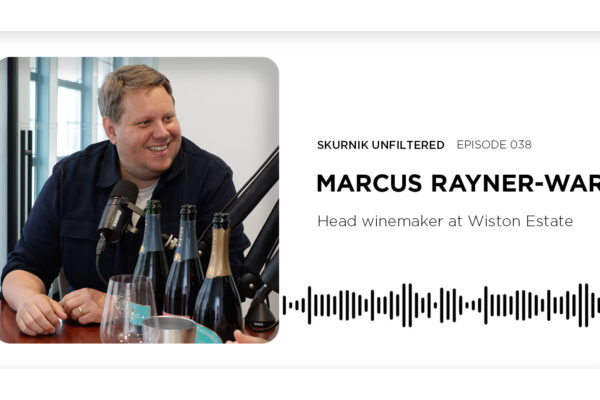
Next week, tune in as Desiree Russo sits down with Marcus Rayner-Ward of England’s head-turning Wiston Estate.
Be sure to subscribe to Skurnik Unfiltered wherever you find your podcasts so you can stay up to date on all the exciting content to come.
Introduction
Sami Ghosn 0:03
Massaya means twilight. It’s “el masa.” When you are walking in the street in a village in Lebanon or in Beirut, you say “masa el-kher,” evening of grace, good wishes, to a passing by person.
[music]
Harmon Skurnik 0:17
Hey, this is Harmon Skurnik, and welcome to another episode of Skurnik Unfiltered. Today I have with me again the illustrious Cody Stephenson, who is the portfolio manager for all things in the world.
Cody Stephenson 0:32
Mostly the Southern Hemisphere, but in this case the ancient world.
Harmon Skurnik 0:35
Yes, the ancient world. We’re focusing today on Lebanon, where we are privileged, I would say, to represent one of the very best producers in the country, Massaya. You sat down with the proprietor of Massaya. His name is Sami Ghosn, who’s a wonderful human being. I really like him, and I really like his wines, as well as his arak, which is a distilled spirit that originated in the Middle East. I think it’s similar to ouzo in Greece, for example.
Cody Stephenson 1:07
And pastis, but yeah, that’s where the Massaya story all starts in the late 1990s. He was making it with his brother and selling it out of his family’s pharmacy, and that’s where the Massaya name was born. Massaya means twilight in Arabic, and “masa” is part of the evening greeting. It’s an important part of Lebanese culture. Lebanon is this incredible cradle of many different influences in the Middle East. And he was really one of the first wineries in the late 1990s. I think there were four in all of Lebanon.
Harmon Skurnik 1:43
Three besides Château Musar.
Cody Stephenson 1:45
Exactly. Then 30 years later, there’s now 45. And Massaya, we’re proud to say, was one of the first. The relationship with Skurnik started with breaking bread with him in a Lebanese restaurant here in New York City. And now, four years later, we represent the wines in all of our markets, and it’s an incredibly important part of the portfolio.
Harmon Skurnik 2:09
Absolutely. And they’re making both red and white wines. They make red wines in the Beqaa Valley, which was made famous by Château Musar. And the white wines come from a different part of Lebanon.
Cody Stephenson 2:19
Mount Lebanon, yes, which is one of the highest mountains in all of the Middle East. The winery sits there at the foothills of the ski slopes, and they grow their Obeïdi, Sauvignon Blanc, and Chardonnay for their white wines and to use in their arak. The red wines have this incredible Mediterranean feel to them. There’s this spice and acidity that I think is so iconic to the entire region.
Harmon Skurnik 2:48
And the whites are refreshing and with good acidity and good minerality, which you wouldn’t necessarily expect from the Middle East.
Cody Stephenson 2:56
No, you think of the desert and very flat land, but this is an incredibly mountainous region that you would look at and think, This is a place where they would make great wine. And they do.
Harmon Skurnik 3:07
Maybe that explains why Sami partnered with a couple of very famous French winemakers in this venture. Daniel Brunier, who’s the owner and winemaker of Domaine du Vieux Télégraphe in Châteauneuf-du-Pape, is a partner. And also Dominique Hébrard.
Cody Stephenson 3:25
He formerly co-owned Cheval Blanc in the 1990s, when Sami was introduced to him. I think that Sami is proud to shout those connections because Sami and Ramzi don’t come from a winemaking background. They’ve taught themselves everything and really are greatly appreciative of the influence and the partnership of those two important winemaking families in France. And there’s a very rich historical tradition and connection between the countries of France and Lebanon. It only makes sense. There are a lot of grapes that were brought over by the Phoenicians thousands of years ago to France that have then found their way back to Lebanon, which I think is a pretty special story.
Harmon Skurnik 4:05
The wines are really fantastic. Growing wine in Lebanon can be challenging, especially now. There’s politics, wars, various obstacles. Somehow Sami comes to the market with a smile on his face always, and throughout all those challenges, produces consistently high-quality wines. I don’t know how he does it.
Cody Stephenson 4:25
Yeah, Sami always finds a way, and it really is a family affair. His parents helped him and Ramzi found the winery, his sister is involved, his kids are involved. It takes a village, and in challenging times, I think that’s so important, to be able to lean on your family. The wines keep getting better and better, and I think that the same hospitality and warmth that you get from Sami and Ramzi, you also find in the wines themselves.
Harmon Skurnik 4:52
That’s a good way to put it. Well, let’s sit back, feel that warmth, and listen to your conversation with Sami Ghosn of Massaya.
Establishing Massaya with Arak
Cody Stephenson 5:03
Here today, the very old world, the ancient world. I am joined by Sami Ghosn of Massaya. Sami, good morning.
Sami Ghosn 5:10
Good morning, Cody. I love New York.
Cody Stephenson 5:12
We love New York here too. We’re very excited to finally have you and be able to fully welcome you to Skurnik HQ. It’s safe to say that you’ve had a pretty epic story. Could you walk us through the last 25 years of Massaya? At least the footnotes.
Sami Ghosn 5:29
Wow. Massaya started with us playing in the fields in the Beqaa Valley in the early 1970s. My parents would gather friends every weekend, and those were the memories of us having food, playing with the dogs and the horses and playing around, and all of a sudden everything turned dark, and in 1975, trouble started. We were pushed away and ended up in France for studies. Then I came to the US in the early 1990s, and all these years Lebanon didn’t leave me. I had a lavish life, I was much more fortunate than other friends of mine that gave their lives for us to be able to stay on this land, so I always refused to sell. In the early 1990s, I decided to come back and claim the land from squatters. Once the squatters left the land, I met an elderly gentleman that suggested to me making arak, as I had no clue what to do with the land. I said, “What’s arak?” He said we had to source some grapes, which we did. We made wine and made the first distillates. We rented a still, and his wife would cook for us all those flavors which now you are very much used to globally, and particularly in the US—hummus and tabbouleh and baba ghanoush—and we would watch the still. It was the fall, the first raindrops on the earth, and the smell of the Beqaa land. I just knew that is the place I am meant to be, and this is how the Massaya blue bottle came to life. I started selling the arak at my parents’ pharmacy in jars with handcrafted labels, organic, handmade, and people came for more. My dad said, “Sami, you must be doing something right,” and the rest is history. And then a gentleman came to sell me corks. I got a call one day and I said, “Yes, sir, what can I do for you?” And he says, “I provide corks to the wine industry in Lebanon.” I said, “Well, introduce me to winemakers from France willing to invest with me in a winery, and I’ll buy corks from you.” And by luck, I meet Dominique Hébrard; his family owned Cheval Blanc. He was fascinated by Lebanon, the history, the Temple of Bacchus. He said, “It would be a dream come true for me to produce wine at the foothills of the Temple of Bacchus.” And then came in the Brunier family from Vieux Télégraphe. We’ve been partners for almost 28, 29 years now, and this is how the wine range came to life.
The rise and fall and rise of Lebanese wine
Cody Stephenson 7:57
What was the first wine that you produced?
Sami Ghosn 7:59
It was 1998. At first, we did not have single vineyards as we do now with our reds, the ‘Colombier,’ ‘Terrasses,’ and ‘Cap Est’ are single vineyards. The first red was called ‘Classique,’ and it was a blend of these, finding the notes and the essence of the Beqaa with different terroirs and blendings, and it evolved little by little until 2013, when we had three single vineyards for the red.
Cody Stephenson 8:26
What was the industry in Lebanon like when you first started? Obviously, Lebanon has one of the most ancient winemaking traditions of any country in the world, but with the civil war in the 1990s, this is a pivotal moment for Lebanese wine.
Sami Ghosn 8:47
Yes, yes. There were about three known wineries. Okay. The big names like Ksara, which was the largest producer and still is, Kefraya, Musar. The renaissance of wine in Lebanon came after the First World War with the fall of the Ottoman Empire. We kept on making wine during the four or five hundred years of Ottoman ruling, but quite a bit in hiding, in the mountains and for the church, in the Christian rituals. But winemaking came back with the Allies coming in and the French armies. I think the average was four liters of allowance of wine a day per soldier. Imagine how much they had to plant. This is why they brought a lot of grapes like Carignan and Cinsault. We came into play in the early 1990s. My thoughts were Lebanon and the memories of our youth and what I knew Lebanon was about—the true values. I discovered later the immense heritage of Lebanon since the Phoenicians and our ancestors. All of this I did not know. The first shipping of wines, the Grand Cru at the time of the ancient civilizations, was called Bybline. It stemmed from Byblos to the Romans, to the Greeks, to the pharaohs of Egypt, and then the Temple of Bacchus that came after. The only wine region mentioned in the Old Testament in the Bible is Lebanon, believe it or not. There is so much essence. The first white crossing of grapes occurred in the Levant, the heart of which is Lebanon, 7,000 years ago. Originally, we thought the vine came from Georgia through Mesopotamia to the gateway of the old world, which is modern day Lebanon through Phoenicia, but actually, no, it was recently discovered through DNA that those are two different species. It was simultaneous, and the one that came about in the Levant and travelled through the old world very much with the Phoenicians is the current Vitis vinifera we work with now. I did not know all this. Certainly Dominique Hébrard knew more than me, telling me he would love to make wine at the foothills of the Temple of Bacchus. But believe it or not, Cody, in our little experience, getting closer to the Temple of Bacchus, the better the grapes, the better the vines, the better the wine. What the Romans and the Phoenicians knew is still true to date. It’s unbelievable how much this came more and more into our attention and into our knowledge and understanding of wine.
The meaning behind Massaya
Cody Stephenson 11:07
This is a family project. This is you and your brother.
Sami Ghosn 11:09
Yes, certainly. It’s actually not just my brother and me. It started with my parents, Amal and Michel, who acquired the land in the Beqaa and in Faqra, where we later, in 2014, built our winery in altitude over on Mount Lebanon, where we produce our Massaya Blanc and cellar our vintage reds. My parents acquired the land in the early 1970s. I came back from the US in the early 1990s when Ramzi was still working and studying in Chicago. And my sister Ghada, who’s the eldest, has always been a driving force behind us and is also involved when it comes to the glue of the family. She’s always been our guardian angel. And Ramzi, with time, became organically the winemaker. In 2005, he fired the winemaker because with our French partners, we used to bring a winemaker every year who had worked after interviewing and stuff. He was upset because he was putting too much sulfites in the wine, so he literally fired him and he said, “I’m taking control of that.” Ramzi had studied marketing, I, finance—nothing to do with winemaking. And believe it or not, since 2005, the wines have been evolving drastically. And in 2006, a war occurred between Hezbollah and Israel. We were caught in the fire. Anthony Bourdain was coming to see us, and luckily we had Ramzi as winemaker because no one would dare come to the Beqaa. Bless my brother, he really salvaged the vintage and did it with so much passion that the wines became of, I think, an international quality.
Cody Stephenson 12:45
Where does this name Massaya come from?
Sami Ghosn 12:48
Yeah, Massaya. I’m often asked this name. With a friend of mine—when I started, arak was still in jars without a name, transparent—and I went to an exhibition in Paris. We found blue bottles. Blue is firstly reminiscent of the purple-blue of our Phoenician ancestors, the Purple People, as they were referred to by the Greeks, thanks to their dyeing the silk brought all the way from Asia, along with the other quality produced spices and what have you. They mastered dyeing the silk purple by grinding the murex seashell on our shores, purple, so they would become the Purple People. And then we chose Massaya; it means twilight. “El masa” is the evenings, it’s the Thousand and One Nights, it’s the blue and the gold, it’s the Mediterranean, the devil’s eye. Blue is important in our part of the world. So Massaya means twilight; it’s el masa. When you’re walking in the street in a village in Lebanon or in Beirut, and you say “Masa el-kher,” evening of grace, good wishes to a passing by person. So it has a bigger meaning. But once, bless his soul, the Prime Minister of Lebanon asked me to come see him, and he said, “Is it Messiah, like the coming prophet?” Not much prophecy other than making wine and arak and portraying the image of the Mediterranean.
Cody Stephenson 14:06
That’s for the drinker to decide, whether it’s the second coming for them. We should try the wine.
Sami Ghosn 14:12
Shall we start with the rosé? The rosé is from the Beqaa, it’s 100% Cinsault. I would like to
Sami Ghosn 14:20
Say that we never bottle our rosés, nor white actually, before snowmelt over on Mount Lebanon because we like the sedimentation to happen naturally, organically. This is how our rosés last so beautifully with time. We don’t filter the wines, it’s a natural filtration, so you don’t end up with sediments in the bottle and all of that, and wines that age beautifully well. Rosé is a go-to wine, and I love rosé. It is very popular around the Mediterranean, as you know, with our dishes and what have you.
Cody Stephenson 14:51
Yeah, it’s 100% Cinsault. Is this stainless steel or is this concrete for fermentation? Everything’s natural yeast.
Sami Ghosn 14:59
No industrial yeast, we don’t use pesticides, fertilizer, what have you. The wines are organic by default. It’s very easy in Lebanon to make organic wines, and this is one of the explanations that the first white crossing of the Vitis vinifera occurred in the Levant or in Lebanon, thanks to the altitude and the 300 days of sunshine, very dry weather, so no real room for fungus, bugs, worms, that you would have to spray elsewhere. The wines up in altitude spend a couple of months under snow in the winter, so whatever has not been wiped out by the sun and the dryness is caught within the sub-zero Celsius temperatures. Perfectly organic and with their beautiful acidity, thanks to us not irrigating and the vines having to find the moisture and the nutrients deep down in the soil. It’s mostly clay limestone in Lebanon, and you get this backbone that plays beautifully well with cuisine. It’s not just a rosé to drink and sip—it’s a rosé that has structure.
Cody Stephenson 16:02
I think you can clearly see from this, the 23rd vintage, this will age gracefully for years to come.
Phoenician-inspired Tempranillo in ‘Le Colombier’
Sami Ghosn 16:08
Shall we go to the Colombier?
Cody Stephenson 16:10
That would be my honor.
Sami Ghosn 16:12
Thank you. “Colombier” in French is a birdhouse, the dovecote. Before we fled, we had in place a birdhouse, and when I recuperated the land in the 1990s, we put it back in place. Those are the vines of the original property of Massaya, where we have the winery and the distillery, and this is Grenache and Tempranillo.
Cody Stephenson 16:36
Tempranillo. This is interesting. Talking to customers this week, I feel like it’s piqued their curiosity. You planted the Tempranillo vines. What inspired that? The history of French grapes in Lebanon is something that is spoken about, but what else do you have planted? You have Obeïdi planted for the Blanc and for the arak. Do you have other indigenous varieties planted in your vineyards too?
Sami Ghosn 17:08
Yes, predominantly Obeïdi for the arak making, but the Tempranillo, we have re-imported rootstock from Spain because the Phoenicians, our ancestors, were the ones that planted Tempranillo in Spain, and we had a new parcel to plant. One of the colleagues at the time who worked in Rioja said, “Why don’t we try Tempranillo?” And it was a great idea. The Tempranillo does superbly well in Tanaïl. Phoenician-inspired Tempranillo speaks for itself. There is no oak in this wine. It’s a wine that is so natural and naked. We have no makeup to it, it’s really the expression of the terroir at its best. Those are the grapes that are on the property between Cinsault, Grenache, and Tempranillo vinified in concrete vats.
Cody Stephenson 18:03
Not that there couldn’t be you know great you know Pinot Noir planted in Lebanon at altitude, but coupled with the Phoenician history, I just think to recognize the potential of some grape like Tempranillo that does so well in warmer climates in Spain and to bring it back, I think that that’s what I find so fascinating about how viticulture is changing around the world. We were talking about it earlier this week in South Africa, we’re seeing it in South America, where people understand that with global warming, with their climate, not every region in the world is destined for Chardonnay and Pinot Noir and Cabernet, and you need to embrace that. I’m excited to see where Lebanese viticulture trends towards.
Sami Ghosn 18:45
Exactly. We like to think we’re working with Mediterranean varietals that are more in tune with our climate and with our terroir. And as we go along, the future is bright.
French influence in ‘Terrasses de Baalbeck’
Sami Ghosn 18:57
I would love for you to taste the ‘Terrasses de Baalbeck.’ Baalbeck is where we have the Temple of Bacchus in the Beqaa Valley, and this is a Grenache, Syrah, and Mourvèdre blend—a GSM—which is a wonderful expression of the terroir. You’re already into more notes that have more depth. They’re a bit more animated, more expressive of this region that is a bit higher than Tanaïl, overlooking the Temple of Bacchus. And with time, Cody, we’re talking about the French influence. The French kept the books in Lebanon. In our early days, we went to all the monasteries to see what would be Grenache in Lebanese or what would be Syrah, and we saw that the vines are all intermixed and with different names in every village and every monastery and every mountain, so we decided to stay on with the French names. Daniel Brunier would tell me, “Sami, look at this, this is exactly Grenache.” He would look at a leaf of the vine, and we went with the French names.
Cody Stephenson 19:55
Yeah. This is always my favorite wine that you make. It has such freshness but still this concentration and depth. It’s really hard to beat, in terms of the price-for-quality ratio there. It’s gorgeous.
The evolution of Lebanese wine through ‘Gold Reserve’
Sami Ghosn 20:09
Thank you for pouring the Reserve. This is a wine we pride ourselves to cellar. Those are wines that got a lot of acclaim when we started. We got points, and we got recognition internationally, and little by little we morphed into wines that are more single-vineyards expressing terroir, and certainly the Gold Reserve is the wine that captured all our beginnings of Massaya with the full-bodied 50% Cabernet Sauvignon, but with quite a bit of Mourvèdre and Syrah as well. It was Bordeaux meeting the Rhône in the Beqaa Valley with our partners.
Cody Stephenson 20:50
Yeah, Brunier, Hébrard, and you.
Sami Ghosn 20:54
At the time, Hébrard still owned Cheval Blanc, and this is why you have the signatures of the three families on the back labels of the Reserve.
Cody Stephenson 21:02
We’re starting to notice here in the US, which I think is exciting, more Lebanese wineries. Do you feel like this is a very important moment in Lebanese wine over the last 10 years?
Sami Ghosn 21:14
In frankness and modesty, we started the revival of the Lebanese wines. When Massaya started, as I said, you had the three or four well-established wineries, and I love to see more wineries and young ideas, different regions. They’re planting different varietals, and I love that. It’s very healthy because Lebanon is exposed in a way that is more true to its place and values and truth. I love to see wines from Lebanon that are coming from different regions with personalities and different winemakers’ approaches, and I understand that this is all very healthy and very good, I think.
Cody Stephenson 21:58
I was thinking the same thing when you were talking about that next generation of winemakers. You have children, they’re still young, but do you see any of your children taking on Massaya?
Sami Ghosn 22:08
We don’t force it. As long as it comes organically within the family, we will welcome it for sure. They’re definitely interested, and they know it’s a work of passion. They know it’s the legacy of Lebanon and our family in Lebanon. They might be still young, but they absorb what they feel and they have their own interpretation, and it’s beautiful to see them engaged. Ramzi and I and my sister Ghada, we never shielded them away from our daily ventures in the vineyards or in the winemaking or in the traveling and meeting of our partners globally.
Cody Stephenson 22:48
That’s great. What excites you about wines, whether it’s yours or other wineries around the world? I don’t know if there is a perfect wine, but what do you look for?
Sami Ghosn 22:59
Yesterday I was in New Jersey. I’m a bit far from home, you know. I travel quite a bit, and the lady that greeted us, wonderful, Natalie, I believe the name is, she says, “I admire what you do.” And that really touched me. She said, “I love what you do, I admire what you do. I already have your rosé here, and it’s going to be featured by the glass.” She was really knowledgeable about wine. We tasted and chatted. It reminded me of the moment that Anthony Bourdain, bless his soul, came to the winery. He came to see us in 2010, and we had this memorable day together of sharing, through cuisine, through culture, through discussions, and of course, the wines were setting the tone, and we finished with arak. It was really a moment that was pivotal to me because he, bless him, Anthony said to me, “Sami, Lebanon is the most fascinating country I visited in my life. It changed my life, and I decided to become a father after being in Lebanon in 2006,” where he got trapped and was evacuated with the marines and stuff. He said, “I’ve never seen such a melting pot of cultures, flavors.” And you see, Lebanon is a tiny country with many minorities that were persecuted around us along the years, be you Armenian, Kurdish, Druze, Shiite Muslim, Christian, Jew, whatever. And this mix of ethnicities made the food so rich and the cuisine so rich, and the climate helped a lot. It’s not a plain; it’s mountains, rigid mountains that are very hard to access and so forth. And when he said that—and this is the attitude behind Massaya, when I was in Hoboken, New Jersey, a young lady telling me I admire what you do—it touched me so much. This is the satisfaction I get. I love wine in general. I love wines when there is no forcing of wine, when wines express organically the terroir, and it’s quite available around the Mediterranean. But what I enjoy most is sipping a glass of arak with friends.
Cody Stephenson 25:07
Okay, well, let’s do that.
Sami Ghosn 25:08
Okay.
Massaya Arak
Sami Ghosn 25:10
So for arak, which actually was discovered by the Moors, the Arabs of North Africa in the seventh century, they discovered distillation. And the anise botanical that is dominant in our Eastern Mediterranean is quite healthy, actually; it’s alkaline and it’s very good for your gut. People drink it differently. You can have it neat as we’re having it now. With a bit of water, if you wish. My mom, bless her, would have it neat. And when you add water, look what happens. The essential oil of anise crystallizes. I was saying this to Bourdain—it blooms. And then you add a bit of ice. This is how we usually have it. Would you like to make yours?
Cody Stephenson 25:52
Yes, sure.
Sami Ghosn 25:53
And we have a cheers, Cody. At Massaya, we make it in traditional pot stills, copper stills. It’s very labor-demanding. We get the finest anise seeds fresh every year, and while anise seed is planted in Lebanon, Turkey, and Syria, Hineh has the finest. We age it a couple of years in amphora because we blend it. Even the sweetness you get, the peppery notes, the spices, it’s just the botanical anise seed. At Massaya, there are no additives, no colorings, no sweeteners. It’s a craft spirit that takes a lot of labor, a lot of work, and it’s gaining steam and growing organically in all markets, thanks to the quality, because we don’t have shortcuts in making this at all.
Cody Stephenson 26:41
A terroir-driven expression of what Lebanon is, your family’s history, and hundreds, if not thousands, of years before that. Thank you, Sami.
Sami Ghosn 26:51
Cheers to the many friends that are to visit us and keep on visiting us and recognizing Lebanon for the quality of its produce, being wine or arak. Thank you, Cody.
Skurnik Unfiltered is recorded at Skurnik Wines & Spirits headquarters in the Flatiron District of New York City, which is why you might hear some city noises as we go along, like horns honking. If you found the conversation interesting, please consider liking, subscribing, and leaving a review. You can stay up to date on our show and upcoming events by following @skurnikwines on Instagram and visiting our website at skurnik.com