

Though the increasing prevalence of English wine might feel like a novel side effect of the day’s changing climate, Vitis vinifera first took root in the British Isles in the year 43 AD; wherever ancient Romans went, so went wine. Since then, the motivations behind British viticulture have ebbed and flowed from the necessary to the eccentric to the nostalgic.
Today, it’s rather sensible. A warmer climate helps grapes ripen, and the same chalk that defines Champagne runs under the English Channel and reappears in the South Downs, where the Goring family (re)planted Wiston Estate. It’s here that you’ll find lively sparkling wines with verve and quintessentially English notes of citrus peel and green apple.
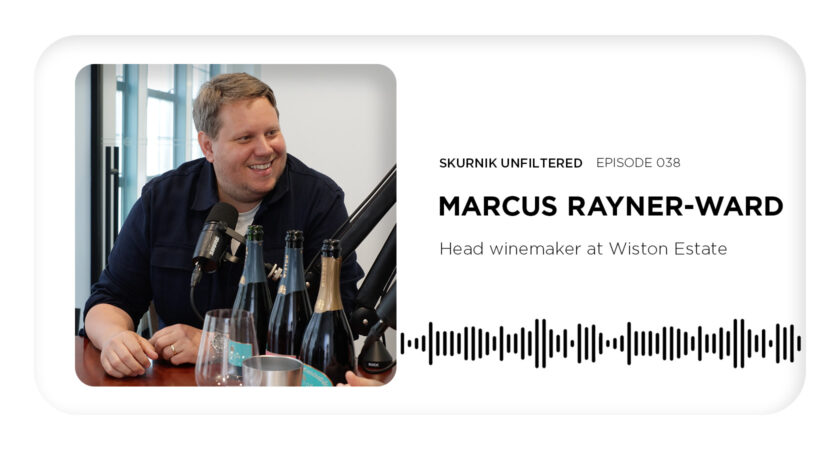
This week’s guest is Marcus Rayner-Ward, the estate’s head winemaker since 2022. In this episode, he fills in the historical context often left out of the discussion on English wine and tastes through the estate’s three core wines that deliver, in his words, “England in a glass.”



Next week, Episode 39 marks 39 years of Skurnik Wines & Spirits with CEO Oren Simon and President David Skurnik.
Be sure to subscribe to Skurnik Unfiltered wherever you find your podcasts so you can stay up to date on all the exciting content to come.
Introduction
Marcus Rayner-Ward 0:02
I just think it’s really exciting to be part of this new exciting industry that is learning at a rapid pace—and watch out because there’s so many people coming that are making really exciting wines. But what sets Wiston apart from everyone is the fact that we’re family-owned. We’re here to learn, understand, and make quality sparkling wines.
[music]
Harmon Skurnik 0:20
Hey, this is Harmon Skurnik, and welcome to another episode of Skurnik Unfiltered. Today, I have with me none other than Des Russo, who is our portfolio ambassador for all things around the world. Today we’re going to be focused in on one country, England.
Desiree Russo 0:39
Yes.
Harmon Skurnik 0:40
The bastion of quality wine for centuries. No, wait a second. That’s not actually accurate. Years and years ago, I don’t think people would take wine that’s being produced in England very seriously, but they are now, particularly in southern England, where some of these really good sparkling wines are being made. And there are two major reasons for that, I would say. One is the climate has changed. England is becoming a little bit more hospitable to grape growing, when in the past the climate was just completely inhospitable. And secondly, you have the terroir and the soils, which are a direct line across the channel to Champagne, and they have very, very similar chalky soils to that of Champagne, right?
Desiree Russo 1:24
100%. We obviously think of English sparkling wine to be relatively new, but as it goes for Europe, wherever the Romans went, they also brought vineyards. The Romans actually did plant vineyards in England. Viticulture has always been in England ever since then. But when you have the Norman aristocracy, for instance, in England wanting to drink, they actually would just go to continental Europe. That being said, there is a huge drinking culture in England. But to give you an idea, the Domesday Book, which was an English survey done by William the Conqueror in 1086, surveyed 47 vineyards, so we have documentation that vineyards did exist in the 11th century. When we see English sparkling wine really take over, is starting in the 1960s and 1970s. Obviously, with the arrival of climate change, we start to get a little bit more wine production. It becomes even more serious, like in the early 2000s. And now you have some English sparkling wine houses that are found on the finest lists in the world. But I think it’s really important to talk about where we are. As you say, we’re in the southern part of England. It’s one of the most beautiful places. Everyone likes to think of England like it’s humid, drizzly, cloudy. But I remember this one time I was hiking through Devil’s Dyke in Sussex with a colleague of mine, and we were on a slope, and it was like, “We should plant a vineyard here.” Sun trap on a slope, beautiful airflow. And the thing is, when it’s sunny in England, there’s no other sunshine like it in the world.
Harmon Skurnik 2:53
You know this because you lived there for many years, right?
Desiree Russo 2:56
Yeah, I lived there for seven years, and I came back to the US for you, Harmon. Ha!
Harmon Skurnik 3:02
Well, we’re happy to have you. You sat down with Marcus Rayner-Ward, who is the winemaker for Wiston Estate.
Desiree Russo 3:11
Correct. Yes.
Harmon Skurnik 3:12
And who is Megan, his wife? Is she involved in the estate as well?
Desiree Russo 3:15
Yep, she’s his assistant winemaker.
Harmon Skurnik 3:16
Ah, yes. It’s a winemaking couple.
Desiree Russo 3:19
Yes. They are making the wines for the Goring family.
Harmon Skurnik 3:22
I remember tasting through a number of different producers of English sparkling wine that we rejected. And I think Wiston stood out qualitatively. You know, we do a lot of Champagne business. We taste a lot of Champagne, and we were really, really impressed with the quality that Wiston is producing. They became our first and they continue to be our only sparkling wine producer from England.
Desiree Russo 3:44
That’s correct. I remember us tasting Wiston, deciding when the brand should be brought on to us. There is such a quintessential aroma and flavor profile that just takes you back to being in England. I think for me, what makes the Wiston wines in particular so special is because there’s this fine-boned minerality that you find is a common thread in all of the wines. There’s obviously an explosive amount of green apple, but there’s also a little bit of that elderflower, almost gooseberry thing that you find in the wines. And that to me is just so quintessentially English. They really speak of where they’re from. And we’ve talked about this chalk that rises. If you have never seen the picture of the Seven Sisters on the south coast of England, it’s literally this fortress of chalk that rises out of the water. It is one of the most impressive things.
Harmon Skurnik 4:34
I’ll have to put that on my bucket list. I have not seen that.
Desiree Russo 4:37
We should go hiking. It’s great.
Harmon Skurnik 4:39
We shall when we go visit Wiston.
Desiree Russo 4:41
Yes.
Harmon Skurnik 4:42
In any case, let’s go to your conversation with Marcus and learn more about Wiston Estate and what makes the wine so good.
Desiree Russo 4:49
Let’s do it.
The history of Wiston Estate
Marcus Rayner-Ward 4:51
Hi Des. Thanks very much for having me. I’m Marcus Rayner-Ward. I’m the winemaker at Wiston Estate Winery in the UK. Really, really excited to be partnered with you guys as our New York distributor.
Desiree Russo 5:02
Amazing. First of all, let’s start off with your first impressions of New York. What did you think?
Marcus Rayner-Ward 5:07
Oh, it’s amazing. It’s my first time here.
Desiree Russo 5:09
Oh my gosh.
Marcus Rayner-Ward 5:09
I’ve definitely got the stereotypical cricked neck from staring up at everything. Yeah, and just all the little things that you see as a tourist. Like, it’s great to see the yellow cabs and the steam coming out of the streets.
Desiree Russo 5:22
Amazing. New York, even if you spend a couple of years away, it’s still impressive to see these huge buildings and the energy of the city. But where you’re from is kind of the opposite of that. You’re at Wiston. Where is Wiston in the UK?
Marcus Rayner-Ward 5:38
We’re based pretty much directly south of London, about an hour and a half train journey south of London, and about five miles from the coast, just outside a little town called Worthing.
Desiree Russo 5:47
And what is Worthing like? Is it in the South Downs? What would be considered the South Downs?
Marcus Rayner-Ward 5:54
You can see the South Downs from the seafront. It’s a very lovely old, kind of, before global air travel, what used to be a very popular English seaside holiday destination. It’s got a lovely pier, it’s got a nice seafront, some lovely little shops, a lovely old cinema, and a bandstand.
Desiree Russo 6:10
Oh my gosh, that sounds ideal, very opposite of New York. And what is the meaning of Wiston behind the estate?
Marcus Rayner-Ward 6:17
Wiston itself currently sits as a 6,000-acre farming estate. It’s owned by the Goring family. They’ve been there since 1743. They actually married into it. They lived across the road, and from the Fagg family who lived in Goring House, Charlotte Fagg was actually betrothed to someone else. And he got very excited about this arranged marriage, and he started showing off before the wedding. “Look at what I’m going to inherit,” “This is all going to be mine,” and she overheard this and didn’t really like that, so she went to her mum and dad and said, “This isn’t okay, like, I’m not down with this.” So her parents were like, “Okay, that’s not happening then, so why don’t you choose someone else?” So she chose John Goring across the road. And that’s how the Goring family came to Wiston Estate, and they’ve been caring and stewarding for the land and farming it ever since.
Desiree Russo 7:02
Amazing. When did viticulture start to come into play in the estate?
Marcus Rayner-Ward 7:06
That was in the 1970s, was the first idea, really. Harry, before he took over from his father, did a bit of a gap year in South Africa. He fell in love out there and met Pip, married her, and brought her back to the UK. She came back basically with weather not too dissimilar to what we have this week, and she thought, “This is great. England’s fantastic.” And then the week later, the real England showed up and it was pretty rainy and she got pretty homesick pretty quick, so she asked if she could plant a vineyard in 1973. Basically, everyone said, “No, that’s this ridiculous idea. You can’t do this.” She kept persisting. She had 30 years of persisting and six children. And eventually she got her dream. They planted a vineyard in 2006, a 16-acre site, and they paid for it all by selling a dairy—the herd and all the equipment—and were able to plant the site.
Desiree Russo 7:57
And was the intention always to start off with sparkling wine, or was it going to be still wine?
Marcus Rayner-Ward 8:06
Pip’s dream has always been to release a still Chardonnay from South Africa, but it was very much with the mind, because of the fantastic chalk soils that we have and the climate, the focus is on premium quality sparkling wine.
The viticultural history of England
Desiree Russo 8:17
I think a lot of folks probably don’t think of England as being a wine-producing country. Tell me about the viticultural history of England.
Marcus Rayner-Ward 8:26
So it really dates back to Roman times where the climate was a little warmer. And certainly there’s an ancient hill fort on the estate called Chanctonbury Ring. And there’s actually one a bit further down the road called Cissbury Ring, and there’s very much evidence of vineyards being planted around Cissbury Ring. And actually, on our labels here, on the vintage label, all the artwork here is lifted directly from the artwork around the fireplace in the Great Hall of Wiston House.
Desiree Russo 8:52
That’s so cool.
Marcus Rayner-Ward 8:53
And if you look, there’s grapes. This plaster work was done in the 1800s.
Desiree Russo 8:57
Wow.
Marcus Rayner-Ward 8:57
It was a direct representation of what the estate has farmed in the past. There were definitely grapes that were farmed there during Roman times. We went through a bit of an ice age and then it gets a bit warmer. Into the 1970s, people start planting German varietals, really, and it’s not really until the 1990s when people start engaging more with Champagne and start looking at Pinot Noir, Pinot Meunier, and Chardonnay.
Desiree Russo 9:24
What inspired people to start making sparkling wine? Is it because the soil goes under the English Channel and then it rises and you see these dramatic Cliffs of Dover, which I think, for lack of a better word, look like a natural fortress? I think it’s just utterly breathtaking. Is that what defines English sparkling wine?
Marcus Rayner-Ward 9:39
Certainly, yes. For us, I would say in the South Downs, we very much have that same band of chalk that runs across the south coast and dips under the channel. Obviously, you see it beautifully, as you mentioned, with the fortress-like cliffs of Dover, it goes into the channel, and pops up again in the Côte des Blancs. We very much have the same soils as that. And then the slight increase in climate as well. The ability to suddenly ripen those grapes really, really drove forward the thoughts of sparkling wine.
Desiree Russo 10:05
Yeah, for sure. English sparkling wine, to me, is something quite youthful. It has this expression of elderflower, a little bit more citrus, they’re definitely more bright, which I absolutely love about them.
How Marcus landed at Wiston
Desiree Russo 10:15
But a little bit more about you, though. You studied film at some point, and then you ended up at Plumpton College. Is that correct?
Marcus Rayner-Ward 10:22
Correct, yeah. I started life in the film industry and that was great fun. But then 2008 happened, you know, big problem, lack of funding.
Desiree Russo 10:30
Yeah.
Marcus Rayner-Ward 10:30
I ended up running a pub in London near where I lived, which I enjoyed to a certain extent, but the late nights weren’t for me. But I got to do some WSET courses, which I loved, and then I went to New Zealand for four months to do a harvest in Hawke’s Bay and I really fell in love with winemaking and the process of it all. I came back, I did a bit of wine sales for a while with a couple of big national retailers and a couple of small independent retailers. But I really missed making something, like the film days of actually putting something together. I went to Plumpton, studied for three years, Bachelor of Science degree, and I basically got the job at Wiston straight off the bat.
Desiree Russo 11:05
Wow. That’s awesome.
Marcus Rayner-Ward 11:07
Yeah, just before I handed in my final project, I went for the interview. I did an all-nighter finishing that off.
Desiree Russo 11:12
Who hasn’t pulled an all-nighter?
Marcus Rayner-Ward 11:14
And luckily it obviously worked because I turned up absolutely shattered.
Desiree Russo 11:18
That’s awesome. With Wiston, what is your personal style that you’re trying to impart in making the wines? I know your wife is also the assistant winemaker for you, so she’s driving the whole project, and you’re like, I’m here for the ride. Ha!
Marcus Rayner-Ward 11:31
Basically, yeah, she’s obviously the boss. I get paid to fantasize I’m the boss. But no, she’s awesome. We met at Plumpton. We weren’t together then. We were with other people and we studied together and worked together in another vineyard, in a very kind of basic, small vineyard. I mean, so basic, we’re talking no canopy equipment. It was just handheld shears, no running water, no facilities, anything. When I got the job at Wiston, I was very lucky that the guy ahead of me, the assistant winemaker, left within about the first five weeks. And Dermot Sugrue, the head winemaker at the time, said, “The job’s yours if you want it.” I had to very quickly backfill my position. When I started, I was box making, disgorging, labelling, riddling, and that was kind of all I was doing. And even as assistant winemaker to start with, that would be my main role. And then I would spend all my free time in the winery with Dermot, absorbing everything I could and learning.
Desiree Russo 12:26
How do you divide your responsibilities with your wife in the winery?
Marcus Rayner-Ward 12:30
It was very easy to start with because I was in the winery with Dermot, and she ended up running the whole post-production side of the business. And then when Dermot left, he and the family very kindly offered me the job of head winemaker. I know Meg’s passion lies in wine and not in the production side, so I pulled her across into the winery, and she’s really made the role her own. She’s got a real passion for science and laboratory work and investigation, so she’s been responsible for massively professionalizing that side of our business and allowing us to get real-time data on all that, which is hugely important for traceability and for sparkling wine with these massive variations of ripeness and all other parameters to help drive decision making.
Desiree Russo 13:13
How have the wines changed from when you started to now? And what are you looking forward to in the future? Do you have any cool projects? Are you working on any still wines?
Marcus Rayner-Ward 13:24
We have a great core range of wines that Harry and Pip and Dermot set up with their vision—that’s what we’ll be tasting later—that celebration of the Englishness of the wine. Certainly, new vineyards have come online. We started with 16 acres, we’re now 30. A lot of the wines will naturally change as you play with different ages of vines and different ages of grapes. We’re looking really to maintain this, but can we experiment by looking at different plots, seeing what the land does, really dividing those small plots up to investigate that more? Yes. We have a restaurant now, so we have an opportunity to make still wines in a very small volume. I make a red, my wife makes the white, and then we come together to make a small amount of still rosé as well.
Tasting Brut Non-Vintage
Desiree Russo 14:08
Speaking of tasting the wine, let’s jump in and let’s start off with some Brut Non-Vintage.
Marcus Rayner-Ward 14:15
We make non-vintage wines every year. These wines are made up of Wiston fruit and some purchased fruit as well. We do contract winemaking at Wiston, and we have partners that we’ve been working with for the last 15 years, so we know the quality of their parcels of fruit. We’re able to grab a few little parcels here and there that really enrich these wines. And then the Meunier for this and the rosé comes from a partner grower in Kent. Obviously, we’re on this fantastic chalk bedrock, which offers fantastic purity, an amazing drive for our wines. Meunier is a little skinny on chalk, so we have a grower in Kent where the soil is very, very clay-rich. It gives a little bit more bass notes to the wine that we want for these wines that are going to be released a little earlier.
Desiree Russo 14:56
Cool, let’s try it.
Marcus Rayner-Ward 14:58
It feels alive in your mouth.
Desiree Russo 14:59
Yeah, it really does. You’ve got Chardonnay, you’ve got Meunier in here as well.
Marcus Rayner-Ward 15:02
And Pinot Noir. Every great variety. It’s a third, a third, a third, so each grape variety gets its own soapbox to shout from. And then we use a reserve wine for our non-vintages to make up that multi-vintage aspect. I have a perpetual solera tank in the winery, which has wines dating back to 2008.
Desiree Russo 15:20
You were just about to answer my question. I was like, how far does it go back? That’s really cool. You really feel the heart of the Brut Non-Vintage as this really beautiful concentration of fruit and flowers and almost that chalky saltiness that you get. It’s delicious.
Tasting Rosé Non-Vintage
Desiree Russo 15:35
Let’s go to the Rosé NV.
Marcus Rayner-Ward 15:45
We make a red wine from estate fruit every year to color, so we do the color as assemblage rather than a saignée.
Desiree Russo 15:51
Tell me a little bit more about the lees aging with the non-vintage.
Marcus Rayner-Ward 15:54
I’d say the rosé is the one that we perhaps have a program for. We want that to remain quite fresh, whereas everything else really is ready when it’s ready. The base of this Brut Non-Vintage is 2018, whereas this Rosé is 2020. Because of the contract winemaking side of our business, that buys us time and keeps the accountants away from the door a little bit. Some of our competitors or peers, they’re having to release their vintage wines of 2018, whereas we can hold on to those non-vintages a little longer. We don’t do any acid correction in the winery. Everything is fully non-malo. These wines are both 100% tank fermented and tank made. But that malic acid presence really allows the wines to develop and age. It’s almost like a tightrope or a bullet train that fires through the wine on its journey and allows all these flavor compounds to get on the train, if you like, but not overtake the wine and not give it any kind of flabbiness.
Desiree Russo 16:42
Yeah. You mentioned reserve wines that you use. How’s the reserve wine situation going in England, especially with the demand for English sparkling wine? Can it keep up? What’s the future of it?
Marcus Rayner-Ward 16:53
We had really fantastic bumper years in 2018 and 2023. I would say that non-vintage wines coming out of Wiston—I can’t speak for others—is going to be more like 60% reserve wine. But we have had these bumper years, and I think we’ll probably continue to get these sporadic bumper years where we have the opportunity to hold back and keep hold of a lot of reserve wine if need be.
Tasting 2016 Estate Cuvée Reserve
Desiree Russo 17:16
Okay, that’s awesome. Let’s try the 2016.
Marcus Rayner-Ward 17:21
We’re moving up into the vintage category now. Vintage at Wiston means that everything is pressed in our Coquard press. We have a 52-year-old wooden basket press, which was bought from a vineyard in Champagne. It’s a fantastic piece of kit. It is not a museum piece—it’s very much a key part of what we do at Wiston. It’s so gentle. It liberates the juice under the least amount of duress, which then gravity flows into the tank below for a very gentle settling before heading off for fermentation. All of our vintage wines are fermented in a barrel. These are all third-fill and more ex-Burgundy barrels, or whatever I can get my hands on, basically.
Desiree Russo 17:59
Choosing one of these three, you really can’t have a favorite, but which of the three would be your favorite? Would it be the vintage?
Marcus Rayner-Ward 18:04
I love the vintage wines, don’t get me wrong, because they represent a time and a place. We don’t put a heavy winemaking stamp on our wines. We want to really do justice to the guys and their work in the vineyard every year. Yes, I love the vintage wines because of that. But I think for me it’s generally the Brut Non-Vintage because I think it just delivers for what it is. It’s England in a glass. It’s got the complexity and depth and structure, and I think it’s a beautiful showcase for Wiston as a concept and as a philosophy.
Desiree Russo 18:29
England in a glass is the perfect way to describe the Brut Non-Vintage. From living in the UK, I always say there’s no other place in the world where the sun is so glorious when it’s shining in the UK. And it’s not because of the normal weather, but there is something so magical and something really beautiful about that light, and I think the Brut really captures that. It’s so nimble, it dances, it’s got this beautiful acid, these gorgeous flowers, and elderflower is the one thing that always makes me think of anything English. And I get that with the Brut, and it’s just delicious. Where is England going to go from here? What is going to be that special moment for England, for people in the United States, to grab on and just run with it and really see the potential?
Marcus Rayner-Ward 19:17
It’s just such an exciting industry, right? We’re still so new, and we’re still searching and finding exactly what we’re about. There is a still wine popularity now in the UK. We’re finding our zones. Still wine is becoming popular from Essex, an area called the Crouch Valley. That’s the first area, which you would probably call a wine area, where you can look down a valley and see lots of different vineyards, because every other winery is very isolated and all the vineyards are very isolated. English sparkling wine is made from Kent to Cornwall, and that’s a six-hour, seven-hour drive. I think it’s really exciting to be part of this new industry that is learning at a rapid pace. And watch out because there’s so many people coming that are making really exciting wines. But what sets Wiston apart from everyone is the fact that we’re family-owned, we’re not trying to escalate and grow massively. The family have owned the place for 200 years, they want to own it for the next 200 years. We’re not trying to build an asset sheet. We’re here to learn, understand, and make quality sparkling wines.
Desiree Russo 20:14
Amazing. Well, Marcus, thank you so much for your time. It’s great to have you part of our portfolio at Skurnik.
Marcus Rayner-Ward 20:20
Oh, it’s fantastic to be here. Thank you. Cheers.
Desiree Russo 20:22
Cheers.
Skurnik Unfiltered is recorded at Skurnik Wines & Spirits headquarters in the Flatiron District of New York City, which is why you might hear some city noises as we go along, like horns honking. If you found the conversation interesting, please consider liking, subscribing, and leaving a review. You can stay up to date on our show and upcoming events by following @skurnikwines on Instagram and visiting our website at skurnik.com