

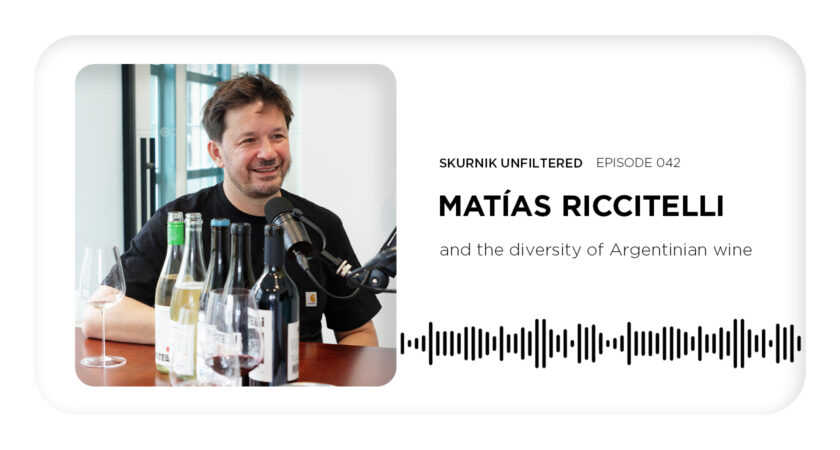
From a Pét-Nat of Chenin Blanc salvaged from a forgotten 1950s Chandon estate in Patagonia to an extreme-altitude Riesling in Mendoza’s Uco Valley, Matías Riccitelli seeks to express the diversity of Argentina beyond cheap Malbec. His life’s work is a perpetual discovery of his country’s potential, and every experiment deepens his appreciation for his heritage.
For our continued celebration of National Hispanic Heritage Month, Matías joins the podcast with five bottles, a fraction of the forty he makes. The lineup is a microcosm of the vast diversity of varieties, climates, vine ages, and vinification methods found in Argentina.



Next week, Pete Stolpman joins the podcast to talk about his estate’s commitment to dignified labor and profit-sharing through La Cuadrilla.
Be sure to subscribe to Skurnik Unfiltered wherever you find your podcasts so you can stay up to date on all the exciting content to come.
Introduction
Matías Riccitelli 0:03
I’m very passionate about my country and the potential of Argentina. All the people were talking about the Uco Valley and forgot our roots. It’s not just only Malbec for me. I decided to start with traditional places to show old vines and I want to keep it. I want to keep this heritage.
Harmon Skurnik 0:22
Hey, this is Harmon Skurnik, and welcome to another episode of Skurnik Unfiltered. We are going into Argentina, and I’ve got with me Cody Stephenson, who is the portfolio manager for all things in the world outside of Europe, et cetera, et cetera, including South America and Argentina. Welcome, Cody.
Cody Stephenson 0:43
Thank you, Harmon.
Harmon Skurnik 0:44
You sat down recently with Matías Riccitelli. He is getting a lot of attention from the wine world at large for his quality of wines, but also his innovation. There are so many things. He’s got vineyards in Mendoza and the Uco Valley, but he also has vineyards in Patagonia, and he’s not just doing Malbec like everybody else. He’s doing all kinds of varieties and Sémillon and all kinds of crazy stuff, right?
Cody Stephenson 1:09
He is an Argentinian Renaissance man. He is just an incredibly excited human being about wine and winemaking and viticulture. I feel like he thinks it’s his—along with many other great producers in Argentina’s—duty to really shine a new light on what’s possible in Argentina. His dad was a winemaker, the foundational winemaker at Norton, one of the largest wineries in Mendoza. He grew up in the vineyards and in the cellar and saw what Argentina was producing, how Argentina was perceived. When he started his own eponymous project in 2009, I think he came to it with a confidence to have his own name on the bottles and to both push the boundaries of what was possible, in terms of some of the highest elevation vineyards in all of Mendoza at almost 7,000 feet, but also going south to Patagonia, as you mentioned, and going back to the heritage of Argentina in some of these incredible old-vine vineyards on the valley floor just outside the suburbs of the city of Mendoza. And to be able to do that all and do it all well, I think, is impressive, and he’s getting the attention he deserves.
Harmon Skurnik 2:18
It’s one of the reasons I think that his wines are so exciting, is that they’re different than your typical Argentinian wines. One of the things about Mendoza, it’s kind of like Napa Valley. This guy makes a Cabernet, that guy makes a Cabernet, the next guy makes a Cabernet, and his Cabernet is better than that guy’s Cabernet. And Mendoza, it’s Malbec. Everybody makes Malbec. And it’s kind of perceived in the marketplace sometimes as a commodity, unfairly, perhaps, but he’s doing so many interesting things. He’s got a wine under flor, he’s doing blends, Sauvignon Blanc, Sémillon. He calls his wine, ‘The Apple Doesn’t Fall Far from the Tree.’
Cody Stephenson 2:52
Yeah, an homage to his dad, making those more classic wines that people think of when they think of Argentinian wine and Mendoza. But he is always looking for freshness when it comes to his wines. And Malbec, he makes a number of different expressions from all across Argentina. Sitting down to taste with him, you’re tasting something like 40 wines. He makes a lot of different labels and a lot of different wines, but none of them feel like afterthoughts. And you really understand the potential of Malbec and how reflective of terroir that variety can be, that I think people throw off.
Harmon Skurnik 3:27
You mentioned freshness, which I think maybe defines his style, perhaps, and makes it unique and different from your typical Malbec that’s high alcohol and kind of heavy. His wines always have verve and freshness that I think defines his style.
Cody Stephenson 3:44
He talks about the picking day in the interview and how you don’t want the wines to come across as green, but you want wines that are energetic.
Harmon Skurnik 3:51
So not only is he making dynamic wine, he’s kind of a dynamic person himself. I think we should sit back and listen to your interview with Matías. I think everyone will be impressed with where he’s coming from.
Cody Stephenson 4:03
Please.
Harmon Skurnik 4:03
Let’s do it.
Argentina is more than Malbec
Cody Stephenson 4:05
Hola Matías, buenos días. Welcome back to Nueva York. It’s good to see you.
Matías Riccitelli 4:10
Hi, Cody. Yeah, I’m so happy to be here.
Cody Stephenson 4:13
Who are you and where do you make wine?
Matías Riccitelli 4:16
Well, I’m Matías Riccitelli. I was born in northern Argentina, in Cafayate, a very small town where everybody makes wine and loves wine. My father was working there in the wine industry, and then when I was very young, I started to make wine with him. All my family moved in the late 1990s to Mendoza, and then I worked with other wineries. Every year for 10 years, I did two harvests. In 2009, after a very long trip around the world, I came to Mendoza and decided to start my own project with two wines making Malbec from old vines because, in that moment, all the people were talking about Uco Valley and forgot our roots. I decided to start with traditional places to show old vines, so in 2009 I started my own business and everything was very fast. Now we have 40 different wines and we are exporting to 40 countries.
Cody Stephenson 5:18
That’s amazing. I feel like your lineup really does show how far and wide you traveled and where you made wine. I think it is a really diverse expression of what Argentina can be. When I first got into wine and started working on this portfolio, it was all about Uco Valley and altitude, altitude, altitude. And you make wine from some of the highest vineyards in Mendoza. But the conversation that you started over the last 15 years is so much more than that, which I think is pretty special.
Matías Riccitelli 5:50
Argentina is huge, so we have a huge diversity. You can make wine in northern Argentina, you can make wine in Patagonia as well, you can go to the west side where we have the beautiful Andes Mountains, and you can play with latitude as well as altitude, so many, many different weathers and soils. Now we are developing projects on the east side of Argentina, near to the ocean. Argentina is huge. It’s not just only Malbec, it’s not just only altitude. It’s many things.
Cody Stephenson 6:26
Reading the Tim Atkin report from 2025, he names regions that he was excited about that I think most Americans have no idea make wine in Argentina. It’s pretty incredible. And that’s even people in the wine industry, let alone the average American wine consumer. Shall we taste?
Matías Riccitelli 6:41
Yeah. I make 40 different wines.
Cody Stephenson 6:44
This would be a much longer tasting if we did all forty.
Matías Riccitelli 6:47
It would take four hours to try all of them.
Torrontés ‘The Apple Doesn’t Fall Far’
Matías Riccitelli 6:49
I’ve brought Torrontés. Torrontés is a local grape. I love this grape. We make four different Torrontés in the winery, and this is our entry, coming from Mendoza. Normally Torrontés comes from northern Argentina, from Cafayate, and I love that. But when you make Torrontés in Mendoza, you get a more citric character of the grape. I want to show Torrontés in a different way. This Torrontés is fermented in concrete eggs, and then six months after, we put it in the bottle. It has a fresh, citric character, good acidity, low alcohol. You can find lemon, lychee, and mandarin peel.
Cody Stephenson 7:30
I think that these aromatic varieties, whether it’s Gewürztraminer or Torrontés, have a very intense reception here. People either love it or hate it. And I think that Torrontés and Malbec are often people’s first impressions, the gateway to Argentinian wine. To make something like this that is a subtle, complex, food-friendly expression of Torrontés, this is like 90-degree days in Buenos Aires. This is what I want to be drinking.
Matías Riccitelli 7:54
Definitely, definitely. Yeah, I want to make a Torrontés that you can combine with many kinds of food, and it’s not just only floral and that’s it. And for that reason, I choose Mendoza to try to get more acidity and freshness in the wine because normally we get a very floral character, very intense in the nose, but in the mouth, normally it’s a bit heavy or sweet. In Mendoza, we can get better acidity and that gives you more drinkability.
Cody Stephenson 8:22
This is Torrontés for Sancerre drinkers.
Chenin Blanc ‘Invader’ Pét-Nat
Matías Riccitelli 8:26
The next one is a Chenin Blanc from Patagonia. I call it ‘Chenin Invader’ because it’s a grape that right now in Argentina is coming back. I bought this vineyard six years ago in Patagonia. It’s a very special place, a place that we call Isla Grande, or Big Island. It’s a river island in northern Patagonia, where the Río Negro, the Black River, splits into two arms and forms a big island. Inside this island, we have this vineyard that was planted by Chandon in the 1950s. It was the first vineyard that Chandon planted in Argentina. When Chandon came to Argentina, they planted in Patagonia, and after a while they decided to sell all those vineyards because nobody lives in Patagonia. It’s quite difficult to make wine there today. Imagine in the 1950s. Six years ago, seven years ago, I bought the only vineyard that is still alive. And then we worked a lot in the vineyard because I found it very abandoned. I did this Pét-Nat like a remix because they planted the vineyard to make sparkling wine. The vineyards are very old and low-yielding, and I decided to make this beautiful Pét-Nat. The fermentation is starting in concrete eggs as well, and then the fermentation ends in the bottle, and we keep it for eight months with the lees and we release it to the market. Chenin Blanc in Patagonia has huge acidity, so I think it’s a really good grape to make sparkling wine, to make a Pét-Nat.
Cody Stephenson 9:58
Patagonia, people don’t realize just quite how far it is from Mendoza. How far is that drive?
Matías Riccitelli 10:04
Drive?! It’s 14 hours.
Cody Stephenson 10:07
And you have your own winemaking space there, right? A hundred-plus-year-old winery.
Matías Riccitelli 10:14
It’s a very old winery. I rent the facility there. My idea is to make my own winery in one or two years, but right now we have this very old winery that was built in 1916 near to the vineyard. It’s like a Burgundy winery with open tops and concrete vats. It’s a beautiful place. We make wine there. It’s quite far away from Mendoza, so you have a flight to Neuquén and then a four- or five-hour drive. Or if we go by car, it’s 14 hours.
Cody Stephenson 10:48
You’re a busy man.
Matías Riccitelli 10:49
Ha! Yeah.
Cody Stephenson 10:50
“Regenerative” is something that people talk a lot about in terms of agriculture right now, and that’s something that excites me. But this is almost like regeneration, restoration in terms of Argentina’s history, which I think is something that isn’t talked about.
Matías Riccitelli 11:04
This is our heritage that I found abandoned. If I don’t make wine there, nobody wants to because it’s a very difficult place to make wine. I found a family that wants to live there to do the pruning and to keep the vineyards. It’s quite difficult. And I want to keep it. I want to keep this heritage. I have very beautiful grapes that in the rest of Patagonia don’t exist, but just only in this vineyard, because Chandon planted it to make sparkling wine. I have Chenin Blanc, Sémillon, Pinot Noir, Riesling, all those grapes that they wanted to plant to make sparkling wine in that moment. I make two Chenins from Patagonia. I have this Pét-Nat, and then in the best spot that we have, we make a Chenin Blanc still wine, which is a beautiful wine.
Cody Stephenson 11:52
Yeah, it’s delicious. Shall we move on?
Pinot Noir ‘Rio Negro’
Matías Riccitelli 11:55
The Pinot Noir came from this vineyard too.
Cody Stephenson 11:59
If people know Patagonian wine here in America, I think Pinot Noir is where people’s heads go, thanks to producers like Chacra that we see on the market here.
Matías Riccitelli 12:13
This is a beautiful place to make Pinot Noir. We are in the middle of this island, so we have a microclimate. Very, very cold in the nights and warm days. Old vines, very low yields, so we get all this expression of the place inside the wine. I don’t know which clones are in the vineyard because I don’t have this information, but I think it’s sparkling clones. But now we make still wines with low yields. It’s the same.
Cody Stephenson 12:42
I feel like the sparkling clones make a brighter, fresher, more saline high expression.
Matías Riccitelli 12:47
Typically they yield higher quantity in tons per hectare, but now they’re very old vines. I get 3,000 kilos per hectare, which is nothing. I do the fermentation with some whole cluster because I want to put all the place inside of the wine, and then I age in used barrels for a year, for eight months, depending on the year. Good acidity, 12.5% alcohol. It’s beautiful. I really like this wine.
Cody Stephenson 13:13
Yeah, it has fruit, but it’s an austere Pinot Noir style. It’s not Burgundy. It’s such a unique expression. I’m excited about Pinot Noir in Argentina. Malbec is obviously where people’s starting point is for Argentina, but you’re making Garnacha, Pinot Noir, Sangiovese, these lighter wines, which I think so much of the market in America and abroad is trying to find. Fresher, more food-friendly wines, and you’re making those with Malbec too. But I just think these wines are great. And for ungrafted old vines, a steal for this Pinot Noir. It’s beautiful. What was your first vintage down in Río Negro?
Matías Riccitelli 13:49
2020. Patagonia is huge, so you have to choose the correct place to make Pinot Noir because the west side of Patagonia is very cold and extreme. On the east side, where we are, depending where you are, it could be—it’s a desert. It’s *estepa patagónica*. You have to choose the correct place to make a really good Pinot Noir. If not, it’s a desert. Sometimes you get very warm days, so the ripeness goes so fast. And if you move down south, you get more acidity. We are in the middle of this island, further south than the traditional places, because I don’t want a very cold place. I’m lucky to have this vineyard.
Cody Stephenson 14:36
Yeah, it’s beautiful.
Malbec ‘Viñas Extremas’
Matías Riccitelli 14:37
Yeah. Okay, so, moving to Malbec.
Cody Stephenson 14:42
Back to Mendoza.
Matías Riccitelli 14:43
Yes. I have two different expressions of Malbec right now in Argentina. Today in Argentina, we make a different kind of Malbec. It’s no longer only big wines, sweet in the mouth, and no tannins. I’m trying to push for freshness, Malbec and other expressions, to have a Malbec with huge potential, aging potential, without losing drinkability. We have two different Malbecs to represent what we have in Mendoza. Viñas Extremas means “extreme vineyards.” This is Malbec from Los Chacayes. It’s the higher Malbec from this appellation. We are at 1,500 meters, where we can make a Malbec with good acidity, freshness, minerality. We get these calcareous soils in the mountain, so if you move near to the mountain, you get more rain. The wines are lighter and I think more interesting in terms of drinkability and texture. We work with whole bunches, 50% or 30% depending on the year, because we want to put on display this landscape in the bottle, and that gives me more complexity and layers. We work with small concrete vats, the whole bunches we crush with our feet because we don’t want any carbonic maceration. Then we do an infusion. When fermentation ends, we press and we keep the wine for 16 months in 2,000-liter foudres. It’s a very uncommon Malbec. It’s floral.
Cody Stephenson 16:16
The color on this is beautiful. Just like the great grapes of the world, like Chardonnay and Pinot Noir and Riesling, I think this is a grape that has personality, that can express itself so differently, such a diverse grape. To me, it’s almost Syrah-like, where you can make these really light, crunchy expressions of Malbec, but you can also make these big, brooding, and particularly if you’re using oak, these very intense expressions of the grape. I think that it has so much potential and depth to the variety, and I feel like you have to be there to really understand it and taste the full potential.
Matías Riccitelli 16:50
Yeah, the Malbec you can make depends on where you are. But all the people right now in Mendoza and Argentina are trying to move to this style, the lighter and not heavy wines, light in alcohol. We pick the grapes a bit earlier. In the past, people picked overripe sometimes. Now we know more our terroir, we know more what we want in terms of the style of Malbec. And it’s not just only one winery, it’s all the wineries, I think. It depends on the producer, the interpretation of the producer.
Cody Stephenson 17:24
But you and the Michelini brothers were some of the first to do that. I think that picking earlier in warmer regions can often go too underripe and the wines become green and they lose the typicity of the grape. You’re not fighting that. Mendoza is a warm place, it has an amazing diurnal temperature swing. Same with our producers in South Africa, the great wineries aren’t fighting that. They’re making these micro-decisions that end up making a much fresher wine over the course of a vintage, all these little choices that you have to make.
Matías Riccitelli 17:54
Yes. I’m trying to pick at the correct moment. I don’t want to pick too early and lose typicity and personality of the grape. For that reason, all the time, I’m looking for new places that give me this potential to pick in the correct moment to have low yields, but still keep the personality, freshness, and concentration at the same time. This combination is amazing.
Malbec ‘Viejos Viñedos’
Matías Riccitelli 18:24
Now let’s move to the traditional places, because Argentina and Mendoza is not only mountain and altitude, as I told you. It’s about tradition. We’ve made wines for more than 200 years. I chose the higher appellation in Luján de Cuyo. I like altitude with old vines. In Las Compuertas and Vistalba, you have that. In Luján de Cuyo, we have four different vineyards. It’s a blend of two appellations, two Indicación Geográfica, we call it, Las Compuertas and Vistalba, where you can find old vines, ungrafted old vines, in altitude. We are at 1,100 meters. The higher old vines in Luján de Cuyo are 80, 90 years old. Here you can find more elegant tannins, different fruit character, not red fruit, or this minerality that we have in Uco Valley. Here has more complexity and elegant wine. The way that I communicate my wines is very honest. I love tradition and I love new places, and I’m very passionate about my country and the potential that we have. It’s not just only Malbec for me. It’s not about trying to sell cheap Malbec at all. For me, it’s about showing the potential of Argentina.
Cody Stephenson 19:53
Well, Matías, cheers. Welcome back to New York City. Good to have you here this week.
Matías Riccitelli 19:58
Thank you, Cody. Thanks.
Skurnik Unfiltered is recorded at Skurnik Wines & Spirits headquarters in the Flatiron District of New York City, which is why you might hear some city noises as we go along, like horns honking. If you found the conversation interesting, please consider liking, subscribing, and leaving a review. You can stay up to date on our show and upcoming events by following @skurnikwines on Instagram and visiting our website at skurnik.com