

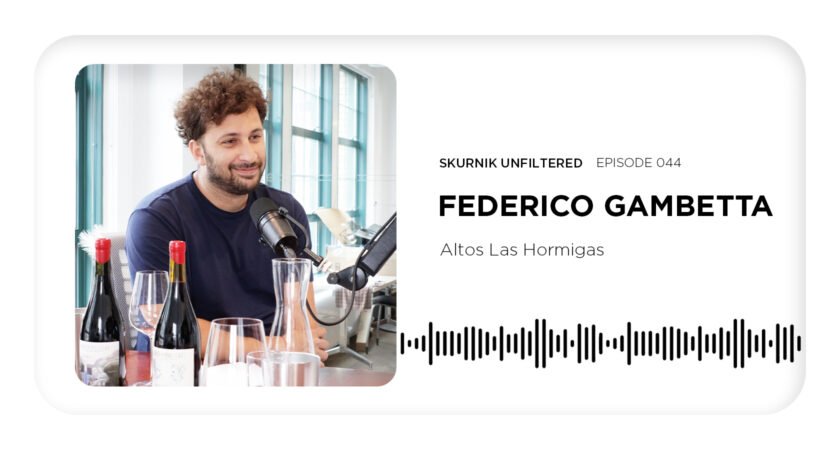
Every vigneron knows that the only constant is change. Federico Gambetta feels this everywhere—in the vineyard, in his wines, and in himself.
The tradition of wine in Argentina is also a story of change. In this episode, Fede explains how a period of tropical, coconutty wines that he calls “Nutella wines” matured into an era of terroir wines and is now entering a new age of producer wines.
Leading this charge is the iconic Altos Las Hormigas estate in Mendoza, Argentina, where Fede was brought on as a young talent at just 31 years old. For our ongoing series celebrating Hispanic Heritage Month, he and our Southern Hemisphere portfolio ambassador, Des Russo, taste the remarkable ‘Meteora’ and ‘Los Amantes’ Malbecs from the Jardín de Hormigas project.



Next week, José María Donde joins the podcast to talk about he spreads appreciation for Mexican distillates through Panorama Mezcal.
Be sure to subscribe to Skurnik Unfiltered wherever you find your podcasts so you can stay up to date on all the exciting content to come.
Introduction
Federico Gambetta 0:03
All the years, the terroir is changing, and we, ourselves, are changing. I’m sure that the Federico of 2026 is not the same Federico as 2022. I’m a different guy, more grown up, whatever. But it’s kind of a way to see ourselves in time, our different vintages. It’s an incredible thing. It’s the magic of wine.
Harmon Skurnik 0:25
Hey, this is Harmon Skurnik, and welcome to another episode of Skurnik Unfiltered. Today we are going down south to the southern hemisphere to a producer that we’ve been working with for a very long time. In fact, it may be our very first Argentine producer, Altos Las Hormigas. At the time, wines from Argentina and Mendoza were not as commonplace as they are today. And now we’re almost, what, 30 years later? And the evolution of the region and of the wines from Altos Las Hormigas has been, I think, incredible over the years. And part of that evolution was bringing on a young and very talented winemaker, Federico Gambetta. So you sat down with Federico?
Desiree Russo 1:15
I did.
Harmon Skurnik 1:16
He’s a dynamic guy, right?
Desiree Russo 1:17
He’s a wonderful dude. Federico, I think, embodies where Argentina is going. As you’ve mentioned, he’s young, he’s dynamic, he’s constantly thinking about, where does Argentina’s wine story go from, what he calls the “Nutella wines” of the 1990s to terroir wines to producer wines. I think it’s really interesting, when he was here, he mentioned that now you have people who go to restaurants and they’re not just asking for a bottle of Malbec—they are asking for the ‘Meteora’ Malbec from Jardín de Hormigas. It’s very much focusing on the names of these wines that are now propelling Argentina onto this stage of world-class wines. I think their first container that they ever exported out of Argentina was to you, Harmon. They rightly so put on their labels “The Malbec Specialists.” Malbec has had this evolution, and I think Altos really embodies it. While everyone was focusing on French and American oak, Pedro Parra comes into the picture.
Harmon Skurnik 2:24
Pedro Parra, the PhD in terroir?
Desiree Russo 2:27
Yes, who I always say knows where all the bodies are buried because he’s constantly found in a bunch of holes all around the world, but that’s because he’s studying soil. But I digress. Pedro comes along and they’re looking for caliche, which is calcium carbonate in soils, and they’re digging these soil pits all throughout Mendoza. And along with that comes the evolution of Altos, of concrete, untoasted foudres, whole cluster, and starting to make these wines that Fede rightly says puts terroir in the driver’s seat of the car and Malbec in the back, just riding along. And it’s about really understanding not just different vineyard sites like Gualtallary or Paraje Altamira, we’re now looking at specific parcels within a single vineyard like Los Amantes, and I think that’s just really fascinating.
Harmon Skurnik 3:12
That’s exciting. You said he used the term “Nutella” to describe Malbecs of yore, where the terroir was never distinctive, and it was just a big red wine that was from the region without any sense of place. And now this evolution has taken place, and Altos has been at the forefront of that. Well, Des, as usual, your enthusiasm is infectious. Let’s tune in and listen to your conversation with Fede Gambetta from Altos Las Hormigas.
Desiree Russo 3:41
¡Vamos!
Harmon Skurnik 3:42
¡Vamos!
The Evolution of Terroir Winemaking
Desiree Russo 3:44
Hola Fede.
Federico Gambetta 3:46
Hi, Des.
Desiree Russo 3:47
How are you?
Federico Gambetta 3:48
Pretty fine.
Desiree Russo 3:49
Good. Welcome back to New York. It’s great to have you here.
Federico Gambetta 3:53
Thank you so much. I’m really excited about it.
Desiree Russo 3:55
Oh, so glad to have you here. Thank you so much for spending some time with me to talk a little bit about Altos and Malbec and the future of Malbec and all the things. When we talk about Altos Las Hormigas, where are we? Who are you? I think you’re a big part of that story too. And what inspired you to become a winemaker? How did you end up at Altos?
Federico Gambetta 4:18
Every year I’m trying to figure out who I am and constantly evolving. Altos Las Hormigas is a winery since 1995, so we have been through a lot of storms and winnings. We are in Mendoza, in Luján de Cuyo. That is where our winery is. We have also a really particular vineyard that is in Altamira, it’s in the Uco Valley. I’m Federico Gambetta, I’m 37 years old.
Desiree Russo 4:44
Oh my goodness.
Federico Gambetta 4:45
Yeah, oh my goodness. I started in Altos when I was 31, so yeah, time flies. I think I have become a part of the history of Altos, like 15% or something like that. And both of my grandparents were in the wine business, and every Sunday we were together drinking wine and talking about life. Maybe when I was 18, I was at uni, and I remember being in the vineyard during the night, and I felt it: this is my life. This is gonna have to be my life. Nowadays, I still am really sure that this is my life, and it will be my life forever, I think. I hope.
Desiree Russo 5:27
I hope so too. I can’t even imagine what that’s like to have this innate feeling when you feel that you have a calling. To call it a profession, I think, is an understatement. This is who you are, which is why I like to think of you as a big part of that Altos story. Like we were talking about before, Altos raises the bar on itself always, and you are pushing that bar up and you are making some pretty epic wines.
Federico Gambetta 5:52
Yeah, and I remember when I was 18, and that feeling, and my heart was beating so fast. Okay, this is it. And when I was making wine in Altos in the 2021 vintage, I felt the same way, same sensation. It was the same. Okay, this is me. Nowadays, it’s kind of a KPI. When I feel that sensation, it means something’s ready. We will talk about this later, but when I was making the Los Amantes 2024, I felt it. This is it. It’s a good KPI.
The Defining Features of Mendoza
Desiree Russo 6:25
Another thing we talked about last time we saw each other in Paraje Altamira was, you talked about energy, which we’ll talk about later. Speaking of vineyards, you are in one of the most dramatic landscapes of the viticultural world. I always like to compare Paraje Altamira to an ancient battlefield. While you call it the wall of the west, I call it the wall of the north. What are some of those defining features that, let’s say Luján de Cuyo versus Valle de Uco, set each other apart?
Federico Gambetta 6:53
Yeah, there are three key points. First one is the altitude. Luján de Cuyo is near to the city, it’s 900 meters elevation, and is far away from the rivers, so the composition of the soils is different, it’s more sandy kind of soils and some clay. It depends on where you are completely because Luján is huge, it’s sandy and clay. Altamira is a valley next to the mountains. You are on the face of the mountain, so here the altitude is near to 1,200 meters, and as you are part of the alluvial cone—there’s one on each of the mountains, with like 10,000 years of geological activity, but you are in the mountains, in the riverbed, so the calcium carbonate, the limestone, is part of the landscape of your soil, so the wines are different.
Desiree Russo 7:44
Feeling that energy in the Valle de Uco, you can almost picture watching these boulders roll off the Andes 60 million years ago, seeing how tiny some of these pebbles are or how massive these boulders are. It contributes to the energy that we will definitely feel when we taste the two wines from the Jardín. How has Mendoza changed since Altos Las Hormigas established themselves as the Malbec specialists in the mid-90s?
Federico Gambetta 8:14
A lot. Actually, it’s constantly evolving. All the time it’s changing. Our styles are changing. I mean, Altos, when all the Argentinian wines were like field blends in the 70s and 80s, Altos Las Hormigas was one of the first to bet on high-end Malbec. Actually, the 2003 Reserve was the first one in Argentina to achieve the Top 100 from Wine Spectator. And when we got that, we were, like, famous because of our Malbec, as Malbec specialists. We said, “Okay, no. Let’s go to another world, to another direction.” And in 2010, they changed the philosophy completely, 180 degrees. Altos Las Hormigas, Alberto, and Antonio, with maybe other flying winemakers, they said, “Okay, it’s time to put Argentina on a new level. Let’s talk about terroir. Let’s talk about how we can use Malbec as a vehicle to show terroir to the people, to show the Argentinian terroir, our revolution, our independence to the world.” Nowadays we are in a different moment. It’s incredible because now in the 2020s, we started a new chapter where the Malbec is important, of course, the landscape is impossible to avoid, it’s incredible, but also the way to interpret the landscape, and this is what I call the producer wines. We are calling a wine by its name, and that name, for example, ‘Meteora.’ Jardín de Hormigas ‘Meteora’ has a first name and last name. It means it has a full package of terroir, variety, and the way we do things. I think nowadays the balance is the new wave, no matter the style. If you have balanced wines, it’s a good thing to have. Wine is pleasure, and we are in the business of making empty bottles. I think that’s the new thing. Nowadays we think that we got the quality on the high end. We can sit at the table of the worldwide producers, but we have to work more in the mid-level to be at that table. I think Mendoza is nowadays going in that direction.
The Evolution of Malbec
Desiree Russo 10:21
Malbec obviously has gone through an evolution as these massive, oaked and fruit-bombed wines. Can you talk a little bit more about the past, the present, and the future of Malbec? What makes you excited about Malbec?
Federico Gambetta 10:34
The thing I get mostly about Malbec is that there’s no limit. There is no limit at all. We have been through a lot of stages in Malbec. I call them the “Hawaiian Tropic” Malbecs, you know, with coconut and vanilla, or the “Nutella” Malbecs with all the extraction that, I mean, they were fine. They were the first Malbecs that became worldwide Malbecs. And then we passed through the real fruity, high-acidity, textured Malbec phase, and now maybe we are in the middle. The future is really bright because it’s unlimited. You can plant everywhere. And now in Mendoza, we are going up into the mountains to plant Malbec on the higher side of the valley.
Desiree Russo 11:22
Because some of those altitudes go up to 1,700 meters, right?
Federico Gambetta 11:25
Yeah, San Pablo, El Manzano Histórico—they are really unique and extreme places. But also ourselves, we are changing our way of crafting Malbec. I’m traveling a lot to Spain to understand how the sun impacts a grape because we are in the desert. The sun is oxidizing the grapes by nature, by chemistry. The challenge for my viticulture and my winemaking is how to prevent over-oxidation, so vinifying with the sun in mind is the new frontier for making fine wines.
Desiree Russo 12:00
What I try to explain about Mendoza, and Argentina as a wine-producing country, is that it’s not just about diversity in terms of altitude or Malbec. Are there any other varietals, outside of Malbec, that you feel represent the future of Argentina, or Mendoza for that matter?
Federico Gambetta 12:22
Yeah, of course. Nowadays, the two princes are Malbec and Cabernet Franc; they are the most well-known varieties. I think some blends are on the table as well. But two things: the first one is the whites. The whites are incredible right now. The quality of the whites is increasing. Every year we get better white wines in Argentina, and a secret that cannot be said outside this table is that Grenache, for me, will be the queen in the next five to ten years. It makes so much sense that we should develop more Grenache in Argentina.
Desiree Russo 13:02
What kind of style of Garnacha or Grenache?
Federico Gambetta 13:05
The textured one, the Rioja Alavesa style.
Desiree Russo 13:08
Nice. Okay, alright. I’m excited to try some. We can fast forward five, six years from now, Fede, and have this conversation.
Federico Gambetta 13:16
Ha! Des, it’s impossible.
Measuring Life in Vintages
Federico Gambetta 13:18
That’s the bad thing about being a winemaker: you have just 40 vintages to make wine. It’s kind of a magical thing, you know? It’s not unlimited. You have just one bullet per year, and time goes really slow sometimes, so you have to be patient.
Desiree Russo 13:32
Oh my goodness, I feel like I need to take a moment with that statement—you only have 40 vintages.
Federico Gambetta 13:37
Yes. I’ve made, like, 20 vintages in my life, and I was thinking, okay, I maybe can do 30 more, 35 more vintages. If I travel to Europe, maybe I can do 50, but it’s not that much, 50 more vintages, so we have to enjoy the present and make wine. I’m a part of the chain. I’m putting myself and the plant with my team and harvesting them and defending against the frost, with the fire in my eyes, and then I’m making the wine all year. I put in my whole life to give you, in Manhattan, a glass of wine. I think that is important. If I give my whole life and my whole energy to this, hey, that’s something special. When you try my 2022s, you are tasting how the vintage 2022 was in Mendoza, with the weather, with the terroir, etc. But you are also tasting how Federico and the team were thinking about wine in 2022.
Desiree Russo 14:36
Interpreting, yeah.
Federico Gambetta 14:36
I’m sure that the Federico of 2026 is not the same Federico as 2022. I’m a different guy, more grown up, whatever. But it’s kind of a way to see ourselves in time, our different vintages. It’s an incredible thing. It’s the magic of wine.
Jardín de Hormigas
Desiree Russo 14:53
What sets your new Jardín de Hormigas project apart from Altos for you, Antonio, and Alberto? How did it come about?
Federico Gambetta 15:02
It was a dream. When they started in 2010 to believe in something else, they bet on the Uco Valley, and they bet on a different kind of viticulture. I mean, Jardín de Hormigas is, for me, one of the best vineyards in South America because of the way it was planted. They put all the energy into the design, and they needed somebody to interpret it and put all that magic into the bottle. That was my job—to put my energy there and to put Jardín de Hormigas on the top level of the world.
Desiree Russo 15:31
With the soil studies, with the application of Alan York’s biodynamic principles, what makes it so exciting, this vineyard? I remember, like I said to you before, standing in this vineyard, and you’ve talked about this before we visited, it’s like you feel this energy, and you stand amongst the parcels of Meteora and you feel this intensity that feels like it vibrates from the soils, from the vineyards, from the dramatic Andes in the distance. What makes it so special for you as a place to make wine and to grow grapes?
Federico Gambetta 16:04
Yeah, with Pedro Parra, we were talking about this like one year ago, and we don’t know. Actually, we don’t know what makes Jardín de Hormigas so special because, as you said, it’s something so particular that if you are there, you feel it. It’s impossible to not feel it. This is a landscape, the energy, the vibes that we are creating. I think of all the effort of these guys planting this beast in the middle of the Andes, and it’s a perfect playroom for a kid, for a winemaker. We have 23 different soil types, 23 different blocks to do whatever I want. I think that’s really impressive. And the Alan York statement is incredible because I am part of a system. I remember Antonio, when I started at Altos, he said to me, “Okay, your first job, Federico, is to kill your ego every day. You wake up and the first thing that you do is kill your ego, and then you put your pants on and you go to the vineyard.” And that’s the thing. For me, Jardín de Hormigas is a place that teaches me a lot about being a person, about being a winemaker and a viticulturist. I have to believe that I’m a part of something else. And maybe that’s the special thing about Jardín.
Desiree Russo 17:21
For sure. It definitely makes you feel small. There’s a term that came about in the 19th century in art history, which is called the sublime, which is that man can never conquer nature, and you just have to embrace the fact that you are tiny amongst this force of nature that can overcome us. I think you definitely feel that when you’re in that vineyard. I’ll never forget that feeling.
The Teachings of Pedro Parra
Desiree Russo 17:45
You’ve spoken a lot about Pedro Parra, and we’ve had the pleasure of interviewing him for this podcast, and he’s played a significant role in Altos’s story. How has he influenced you as a winemaker? We talk about how you are in the church of Pedro Parra in one of his soil pits.
Federico Gambetta 18:00
Yeah, I am his priest. I’m the priest of Pedro Parra’s church. Pedro is—we call him the beast. He’s incredible. His knowledge about soils and about viticulture is incredible. And his palate is like something from another planet. He teaches me a lot about how to taste and how to differentiate the different soils by the mouthfeel. And that’s insane. Pedro and Alberto as well, I think they both have a sensibility for things. I think nowadays, if you want to become a really good winemaker that makes you feel emotional in some way, you have to have that. You can have all the techniques in the world, you can read a lot of books, but if you do not have that sensibility to taste and decide some things, it’s impossible. I remember the story when Jardín de Hormigas was planted; it was like a desert. He said, “Okay, here will grow the Grand Cru of Altos Las Hormigas.” And that X on the map was Los Amantes. How the hell did he figure that out? Sensibility. I think that’s the message.
Desiree Russo 19:13
I can’t even begin to fathom… I mean Pedro is such a supertaster, and the idea of feeling the textures of soils in your mouth, but then to literally X mark the spot and declare this is where your Grand Cru is going to come from? Mind blown.
Federico Gambetta 19:34
Yeah, Pedro’s ideas changed the world as we know it. I think we have to give him that place in the history of winemaking. He teaches you to see the whole system, the whole picture, and how to put all the points together. I think Pedro is an amazing guy.
Desiree Russo 19:53
He’s also such an incredible educator. I always say there are very few people that I would put in a room with someone who is an MW and someone who is starting their wine journey. If you’re going to have someone who can educate both levels of discovery, Pedro is really the one who’s going to be able to do that. He is such an incredible communicator.
Federico Gambetta 20:13
Yeah, he is.
Desiree Russo 20:14
Yeah, I wish he was here.
Tasting Jardín de Hormigas ‘Meteora’
Desiree Russo 20:17
We can enjoy some ‘Meteora,’ which I think we should try.
Federico Gambetta 20:20
Yeah, of course.
Desiree Russo 20:21
This wine is ‘Meteora.’ This is the second vintage, 2022. It comes from four parcels within Jardín. Can you tell us about those four parcels that go into this wine?
Federico Gambetta 20:33
Yeah, it’s an amazing thing, Meteora. At the beginning, the first vintage was from four blocks, the second vintage is coming from two blocks, and the 2024 vintage is coming from one block. This is because ‘Meteora’ has become a target, a goal. When we tasted the 2021 vintage blind with the guys, nobody said it was a Malbec.
Desiree Russo 20:59
Wow.
Federico Gambetta 21:00
It was something special. ‘Meteora’ is something from another planet that hits you in the head. That ‘Meteora’ feeling, the texture with the substance and the perfect body in the mouth, becomes something that we’re going to recreate every year. And all the years, the terroir is changing. The vintage is changing—more humid, more dry, more warm, or more cold. And we ourselves are changing, so every year all the soil types are performing in a different way. We are choosing the right plots that every year can achieve ‘Meteora.’ That’s why they are not always the same plots. ‘Meteora’ became something special. We have to recreate the ‘Meteora’ feeling, and which parcel we use depends on the year.
Desiree Russo 21:47
The fact that this wine has gone from four parcels to two, and now with the 2024 vintage being just one, it’s almost like you’re hyper-focusing this insane microscope like, okay, let’s really dig in and see how each of these parcels is performing in that vintage. The two parcels that go in here, what made you choose these two parcels?
Federico Gambetta 22:10
The 2022 vintage was a warmer template. In the warmer vintages, normally the deep soils are the ones that perform the best because they have the chance to hold more water in the profile. On the opposite side, for example the 2021, that was a cold year. We used the shallow soils with more limestone. The thing that I’m looking for is that blue fruit texture. It’s fruity with some herbs, of course, but with the perfect amount of volume. We call it the substance. It’s something that makes you have another drink, another glass. It’s just the perfect feeling in the mouth. That’s why I choose those deep soils in the warmer years.
Desiree Russo 22:53
You can feel on the palate, it has this poise. It’s elegant. It almost feels like it’s standing on a balance beam, if you will. You feel there’s a lot of energy in this wine where you’re getting that blue fruit that you’re talking about. There’s that herbal quality about it, but then it’s all standing on this single balance beam. It’s perfectly in balance in terms of texture. How would you describe the tannins?
Federico Gambetta 23:22
We call them the elastic tannins. It’s a tailor-made wine. You said the word “perfect” like three times. It suits you perfectly in the mouth. Everything is in place; it’s a fine-tuning of every detail. I think that’s ‘Meteora.’ It’s a fine-tuning. For me, it’s the wine that you can sip, and ‘Los Amantes’ is the next level of that. ‘Meteora’ is in a really cool language that everybody understands, and ‘Los Amantes’ is the stepping up of that feeling.
Desiree Russo 23:55
Before we move on to ‘Los Amantes,’ you’re putting ‘Meteora’ only in concrete, right?
Federico Gambetta 24:01
Yep, just in concrete, because it’s the way for me to make a naked Malbec. If I have to use it, I use it. Normally in the cooler vintages, we use more oak than concrete. It depends on the year, and that is something really beautiful. We are free to make wine. We don’t follow recipes. I remember a phrase that is written on so many labels: “18 months in barrel, 12 months in bottle.” That’s a worldwide recipe for making wine. We are not following that at all. We are just tasting the wines monthly. This wine, this moment, needs some concrete or needs more oak. And that’s okay.
Desiree Russo 24:39
I think this wine is sublime.
Federico Gambetta 24:42
Yeah, thank you so much.
Tasting Jardín de Hormigas ‘Los Amantes’
Desiree Russo 24:44
Stepping up. This is like a microscope made by NASA when it comes to ‘Los Amantes.’ What inspired you to make ‘Los Amantes?’ ‘Los Amantes’ came first before ‘Meteora,’ right?
Federico Gambetta 24:55
The same time.
Desiree Russo 24:56
Same time, okay.
Federico Gambetta 24:57
Yeah, actually, this is kind of a funny story because when I started at Altos, Jardín de Hormigas had just one vintage, the 2020. And I remember having a Zoom call with Alberto and Antonio, and they gave me some key points to make the entry-level wines. And when we reached the Jardín de Hormigas vineyard, I said, “Okay, Alberto, how can I do this? It’s my first time doing it.” And he said to me, “I don’t know. Because I have never done it. So be yourself.” And that “be yourself” phrase was everything to me because he gave me freedom. I think the biggest people, the most important people, the most talented people in the world are the ones who let you go for it. Thank God the results were there. When we were tasting the 2021 vintage, when we reached ‘Los Amantes,’ I remember, I will never forget this in my life, he said to me, “Okay, Federico, we’ve done it. We made it to the final destination. This is it. This is the best wine I ever tasted from Argentina in my past 25 years.” I remember I was crying. But I think the inspirational part of Altos, of ‘Los Amantes,’ started 30 years ago. It’s not a six-years-ago wine, it’s a 30-years-ago history, when they dreamed about making a wine that makes you feel emotional, that puts Argentina in a different situation, showing what Argentina can give to you as a Malbec producer. ‘Los Amantes’ was not the final destination for me. It was the first step in this new chapter of Argentina. It’s evolving and evolving and evolving, and showing to the world that Argentina can make these kind of wines.
Desiree Russo 26:50
How would you compare the 2021 vintage to 2022?
Federico Gambetta 26:54
2021 was the perfect vintage for Argentina. 2021 was incredible. 2022 was warmer, so the texture is more in the front of the palate. And then 2024 is coming in again to the 2021 feeling—more silky, more chalky, and that kind of texture.
Desiree Russo 27:14
I remember tasting both side by side in Altamira, and I remember feeling how different it feels, like 2022 ‘Los Amantes’ has arrived. Those tannins are much more upfront, that texture.
Federico Gambetta 27:27
When you talk about the layers of a wine, I always think about an onion. You are taking out the layers until you reach the heart. In the 2024s, 2025, and 2026, we stopped talking about that, and we started from the heart. The heart is the beginning of the wine. It’s already naked, so the wine can go deep.
Desiree Russo 27:50
How does this play into the future for Argentina?
Federico Gambetta 27:54
This wine changed my life, absolutely. And for me, for Argentina, this wine is giving us some clues of what we can do. Argentina is going places definitely, and I think we have the time to go deeper in Malbec. And ‘Los Amantes’ for me is giving us that clue. This can be the potential of a wine, and if we can replicate this feeling in our mid-levels, for example, in ‘Meteora,’ we have something to achieve.
Desiree Russo 28:27
This is also sublime. This just really takes me back to tasting this at the vineyard. Fede, thank you so much for your time.
Federico Gambetta 28:35
Of course.
Desiree Russo 28:36
It’s always a pleasure to see you.
Federico Gambetta 28:38
Yes.
Desiree Russo 28:38
These wines are atomic, as Pedro would say.
Federico Gambetta 28:40
Ha! Atomic! Thank you for having me. For me, it’s always a good time to be here with you. We are happy doing what we do, making wine. I hope that this always will be my phrase: be happy and make wine.
Desiree Russo 28:56
Awesome. Thank you so much.
Federico Gambetta 28:57
Thank you.
Skurnik Unfiltered is recorded at Skurnik Wines & Spirits headquarters in the Flatiron District of New York City, which is why you might hear some city noises as we go along, like horns honking. If you found the conversation interesting, please consider liking, subscribing, and leaving a review. You can stay up to date on our show and upcoming events by following @skurnikwines on Instagram and visiting our website at skurnik.com