




Next week, tune in as American wine expert Jamie Schwartz sits down with Sonoma county-based winemakers Matt and Sara Licklider of LIOCO.
Be sure to subscribe to Skurnik Unfiltered wherever you find your podcasts so you can stay up to date on all the exciting content to come.
Introduction
Tom Jackson 0:03
Spirits, when they are at their best, are about facilitating joy and connection and building community, so if we could be a small part of that in any way, then I think we’ve done our job.
Harmon Skurnik 0:15
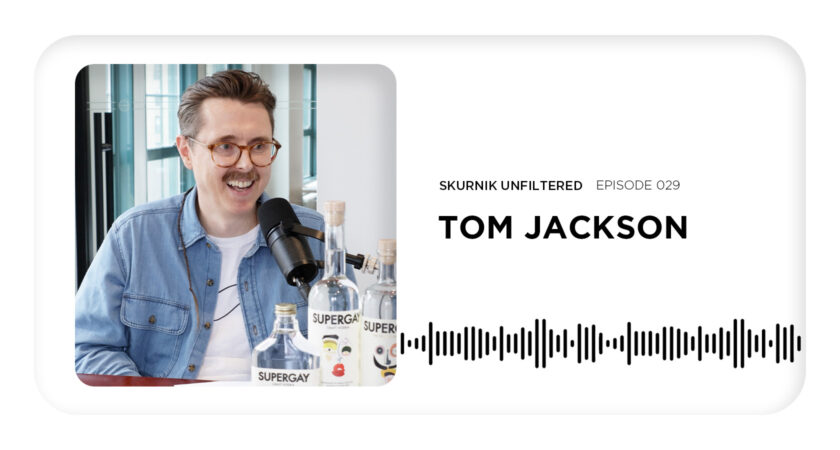
Hey, this is Harmon Skurnik, and welcome to another episode of Skurnik Unfiltered. Today I’ve got with me Jared McGuire, who is a portfolio manager here at Skurnik for all things spirits. For today’s interview, you sat down with Tom Jackson, who is a local spirits supplier. He’s got a brand called Supergay.
Jared McGuire 0:36
He does. Local, not originally. He’s an Aussie, as you’ll no doubt hear in the recording. We had a wide-ranging conversation about his early life, all of the many artistic and creative pursuits that led him to where he is today.
Harmon Skurnik 0:51
He he used to be a creative director in an ad agency or something like that.
Jared McGuire 0:57
That’s right. An ad agency, a lot of work in marketing, brand building for brands as wide-ranging as Jim Beam to Pampers diapers, which I called him out on because I saw his LinkedIn profile.
Harmon Skurnik 1:11
His creativity shows in the packaging for Supergay, because I think it’s absolutely a beautiful package.
Jared McGuire 1:17
It’s a stunning package. It’s the first thing that really grabs your eye. He clearly has a tremendous eye for detail. He knows how to capture an audience.
Harmon Skurnik 1:25
The vodka is made in upstate New York. He also has a gin now, something which he labels Fire Island Dry Gin. Must be popular there.
Jared McGuire 1:34
Incredibly popular there. Incredibly popular outside of it too. It’s the first thing he introduced to us after five years of just a single item with his vodka, so it was a really welcome and very intuitive addition to the portfolio.
Harmon Skurnik 1:46
He also has a tagline, “farm to disco.” What’s that all about? Does he talk about that?
Jared McGuire 1:50
He does talk about it. We talked about it a lot. I think it perfectly embodies his outlook on life. I think the bona fides are certainly there as far as the quality and the scrutiny and the very deliberate acts that he takes to make sure the product is clear and clean and well-supported. And then the disco is just this little lovely, cheeky nod.
Harmon Skurnik 2:14
It’s kind of like farm to table, but it’s farm to disco.
Jared McGuire 2:16
It’s farm to table, which it truly is in its production, and then he throws in the little nod to all things joyful, which is ultimately what Tom Jackson is all about.
Harmon Skurnik 2:25
Very cool. And lastly, I think he donates a certain percentage of his proceeds to LGBTQ causes, isn’t that right?
Jared McGuire 2:33
He does consistently every year. There’s always a portion that’s donated there, and also he supports other social justice causes. Famously, during the pandemic, just as he was getting his brand off the ground, he donated to restaurant workers who were out of work and provided a real support.
Harmon Skurnik 2:49
Awesome.
Jared McGuire 2:49
Yeah.
Harmon Skurnik 2:50
On that note, why don’t we listen in on your conversation with Tom Jackson of Supergay?
Jared McGuire 2:56
Sounds great.
Tom’s life before spirits
Jared McGuire 3:00
Tom, welcome.
Tom Jackson 3:01
Thank you for having me.
Jared McGuire 3:02
Tom, you started Supergay Spirits in 2018, but let’s wind back the clock a little bit. Where were you born and raised?
Tom Jackson 3:12
I was born and raised in Melbourne, Australia, the cold part of Australia, we like to say, and moved to New York in 2007.
Jared McGuire 3:22
And before you moved to New York, what defined your life and interests while you were in Melbourne as a student?
Tom Jackson 3:30
Well, I grew up working in bars and restaurants from the time I was legally allowed to work, if not maybe earlier. I worked in pubs, worked all over the place, and then I studied art history in college as well as creative advertising. I was living with two friends who were going to travel South America, and we were going to have to give up our shared house. And I had had kind of wild year, a lot of crazy things had happened. I broke my arm, arm wrestling.
Jared McGuire 4:03
That sounds so Australian.
Tom Jackson 4:04
It was very Australian. It was on a barrel in a pub and I wouldn’t advise arm wrestling anyone over a barrel in a pub. I had a breakup, my brother had passed away very suddenly, and so it was a lot of big changes happening, and I just thought, What better time to run away from my problems and give New York a go? That was really the inspiration to come over here.
Jared McGuire 4:28
And then you find yourself in New York and you’re copywriting for a lot of big clients, yeah?
Tom Jackson 4:37
Yeah. Worked on a lot of different accounts. I worked on Cointreau, Tanqueray, I worked on the Jim Beam brand for a number of years, and then also worked on a couple of launches for some celebrity tequila, which was a fun experience. Quite a range.
Jared McGuire 4:54
A big history in spirits. And did I see did you did copywriting for Pampers too?
Tom Jackson 5:02
Did I do Pampers? Yeah, I’m sure I did. I did so many different brands. I mean, when you work at agencies, they throw you in on all kinds of things. One moment you’re doing some sort of governmental thing, and then the next you might be doing Pampers. A lot of variety.
Jared McGuire 5:16
So, you’re working for ad firms and you’re doing copywriting, and then in 2009, you founded GAYLETTER magazine. Tell us a bit about the inspiration for this publication, its evolution over the years, and how it has shaped your life and your career.
Tom Jackson 5:37
We launched the magazine as an email newsletter originally. We were going out. I was going out a lot with my best friend Abi. We were going out four or five nights a week, so we were enjoying everything that the New York City nightlife had to offer. And there was no guide about what was happening in the city, and it felt like an opportunity to create something like that. So we did. We created this email newsletter that went out once a week. It was like, “Five Most Important Things You Should Do This Week,” and it quickly amassed an audience and got quite popular. From that, we evolved it into a website and then eventually a magazine that comes out twice a year that focuses on art, culture, fashion, and is now in its 23rd issue.
Jared McGuire 6:21
You have these interests and this history with art and culture and advertising, and the pieces start to fit.
Jared McGuire 6:28
How did you get from GAYLETTER to deciding to launch your own spirits brand?
Tom Jackson 6:34
Well, we were going out a lot and we were throwing parties, we were attending parties, and we got to see how our community likes to connect and how they like to drink. It felt like there was an opportunity there to create a brand that could connect with that community in a really authentic way. A lot of brands will slap a rainbow on a product and call it a pride edition, and to us, that felt like a very hollow expression and didn’t really feel like it had much connection to the actual people they’re selling their products to. We felt like there was an opportunity there to do something very authentically connected to the community. And, having worked with a lot of legacy spirits brands, there’s a a lot more rules and a lot more brand codes that you have to adhere to. We took as much as we could from those experiences into Supergay; respect for craft and respect for the heritage of the brand—those things are important. But being a new and younger brand, it felt like an opportunity for us to have a bit more fun, to show up a bit more provocatively and to do things a little differently. That was that was our inspiration when launching Supergay.
Jared McGuire 7:42
And then the next question is, why vodka?
Tom Jackson 7:44
Well, one, because vodka is the most iconically gay spirit. A lot of people refer to it as “gay water” because it’s consumed so much by the community. So there’s that. Two, it felt like a really approachable first spirit to create. It really does have my heart. I think it’s a very misunderstood spirit. I think it’s quite a simple spirit, but paradoxically quite complex.
Jared McGuire 8:09
On the subject, what do you think about the statement that we hear both within the industry and outside the industry: “Oh, it’s vodka. It’s not meant to taste like anything.”
Tom Jackson 8:20
Well, I think that is true. And legally, you can’t really make it taste like anything before you have to reclassify it as a flavored vodka. I think it is true that it shouldn’t have an overpowering taste, but I do think you can do quite a lot with the little you have. There’s very few levers you can pull, but if you pull them right, I think you can create something that does have a bit more texture, it can have a little bit more personality and can be unique in its own way while still very much being a vodka and not scaring anyone off. Vodka is made to be versatile and mixed in cocktails, and you don’t want to do anything that doesn’t work beautifully in a martini. But I think you can do more than people expect.
Jared McGuire 9:04
So that makes me ask the question, what separates a good vodka from a bad vodka?
Tom Jackson 9:09
Well, I would say a bad vodka—I hear this all the time when I do tastings, and I’ll taste people unmixed. I always like to offer an ice cube because I think vodka is better cold. But the one thing I hear most is, people will say, “Oh, I had a bad experience in college with vodka,” or “Vodka is harsh or sharp.” I think a not-so-great vodka is gonna hit you a little harder and have sharp edges, and I think a good vodka is gonna be a little softer, maybe have a little sweetness, a bit more texture, and should be pleasant. You should be able to sip a good vodka over the rocks. Most people aren’t going to do that, but you should be able to, I think.
Jared McGuire 9:50
And you did a lot of RD when building this brand, right? For the source material—without getting too much in the weeds, but a little bit for the nerds—how much did you play around with the source distillate? Did you know immediately you wanted to use corn?
Tom Jackson 10:04
We did. We wanted to use corn because corn offers a little bit more of that sweetness I was talking about. It’s also a very American grain, which, were a New York-made product, so we wanted to use a local grain. In a vodka, everything has to earn its place. The grain has to earn its place, the water has to earn its place. How you filter it has to be very intentional and has to earn its place because even small changes to the flow rate when you’re filtering can really strip quite a bit from the final product. Everything has to be very, very intentional because you’re going to notice if you do too much, if you pull some of those levers too much.
Jared McGuire 10:42
At what point does filtration start removing character instead of improving the overall product in your view?
Tom Jackson 10:48
For us, that would be three passes. We use a coconut charcoal filter. We tried five, we tried one. Three was that perfect sweet spot where it didn’t strip too much flavor, kept a bit more of that “European mouth feel,” as some people like to call it, that viscosity. That was our sweet spot: three.
Fire Island Gin with kelp
Jared McGuire 11:08
We started working with your product here at Skurnik in March of 2021, and your brand immediately found its place. But we did have to wait about three years before you extended the line. In 2024, you were just vodka, and then you launched a line of RTDs, ready-to-drink cocktails. And last year around this time, you launched Fire Island Gin. Tell us about this gin and how it came to be.
Tom Jackson 11:38
The gin came about from an encounter with an oyster farmer, a former WNBA basketball player named Sue Wicks, which I know is quite a lead, but she’s kind of a legend in the WNBA. She was the first woman to come out of the closet in the WNBA, and now she’s a really great oyster farmer in Moriches Bay, in the waters of Fire Island, we like to say. She recently started farming kelp, which is very exciting because New York doesn’t really have much of a kelp industry. It’s largely in Maine, but we have a beautiful, wide open ocean, and kelp is great for the water. It cleans the water, it protects her oysters. We had a conversation about how we could incorporate her kelp into a gin. We always knew we wanted to do a gin, but we only wanted to do it when we felt like we had an idea that made sense for us as a brand. And working with her made a lot of sense because she is farming the waters of Fire Island, and Fire Island is a really special place for me personally. I’ve spent many summers on that island. It’s a really special place for the queer community, has a super long history. It’s just a beautiful island. We wanted to do a gin that incorporated her kelp, but also had some other summer-inspired botanical. It’s a coastal summer-inspired gin, so we have her kelp, we have an elderflower that is native to this region, we have two types of lime, lime peel and whole finger limes from Australia, where I grew up, as well as Tasmanian pepperberry from where I grew up. It’s really a combination of my summers as a kid in Australia and my summers as an adult in New York going to Fire Island. It’s been a really enjoyable and pleasurable spirit to make and share with the world.
Jared McGuire 13:23
I love that. I love how New York identified your brand is, and then that little bit of home that you bring.
Two Fruits canned cocktails
Jared McGuire 13:30
And then Two Fruits, your cheekily named RTD line. We’ve spent two years loving your debut duo, the Ginger Mule and Cosmo, but before we tease out the next pair of cocktail releases, what do Two Fruits cocktails do differently in this rapidly growing, very competitive world of RTDs?
Tom Jackson 13:52
Similar to creating the gin, we really wanted to do RTDs when we felt like we could have a very Supergay point of view. Leaning into the name Two Fruits is a slightly provocative extension of the Supergay family. And again, using as many local ingredients as possible. Also, we found when we were doing research into canned cocktails that a lot of them seem to have two issues. One was that they could often be quite sweet, which we wanted to avoid. And secondly, to avoid being sweet, they’ll often use artificial sweeteners. We wanted to not do either of those. We’ve worked really hard to reduce the sugar levels in these. They are quite low in sugar content for canned cocktails. Our Ginger Mule uses apple juice to sweeten it, which is a more natural way to sweeten it. And then using real ingredients: real ginger, real cranberry, real lime. We’ve just launched two new Two Fruits flavors. We’re doing a Black Sesame Espresso Martini, a very classic espresso martini recipe with real coffee, which is challenging for many reasons because it’s quite expensive now. Coffee has really gone up in price with chocolate and many other ingredients. And then a little bit of black sesame, so it’s nutty, slightly sweet, a bit of vanilla. It’s really yummy. The other one is a Chili Mango Spritz, which is mango concentrate and real lime juice. It’s a little lower ABV than our current cocktails, so it’s 8% ABV and a good amount of chili. There’s green chilis and Espelette peppers, which add a little bit more of a savory note.
Jared McGuire 15:28
They’re so good. They really complete the line. Two Fruits, your first foray into RTDs. I can say we have had a number of brands over the years who haven’t done RTDs as their primary product, decided that they wanted to get into the game and tried to create it, and have met some real challenges along the way. Did you experience similar challenges?
Tom Jackson 15:55
Yeah. I won’t bore you with all the challenges in cans. I would say way more challenges in cans than in spirits. But yes, we did. There’s a lot of challenges. To use real ingredients is challenging. To use real lime juice, there’s a limit on how much lime juice you can use before there’s shelf stability issues, so that’s a challenge. Using real ingredients, balancing flavors, making sure they keep and last a long time. Certain things have to be higher ABV for stability. There’s a lot of challenges. It was not an easy process, but it’s been fun to do, and we’re very excited about the new ones. I think they’re going to be really liked.
Jared McGuire 16:36
Any hilarious or horrifying R&D stories?
Tom Jackson 16:39
Oh, yeah. I mean, we have one right now. We just got sent all the cans for the Chili Mango Spritz, and they left the O off Mango! Luckily it’s an easy fix and is going to be resolved quickly.
Jared McGuire 16:55
We don’t want to sell Chili Mang.
Tom Jackson 16:57
Ha! Chili Mang, no. So yeah, things like that will happen in cans, but luckily we’re moving forward.
Jared McGuire 17:06
We have this extended product line, and now we’ve got what looks much more, zooming out, like a really complete package.
What Supergay brand accomplishes
Jared McGuire 17:14
I’m looking at the bottles right in front of me right now, and they’re visually so striking. Who did the art on the label?
Tom Jackson 17:22
That is a very talented artist from Texas named Blake Mitchell. We basically said to him, “Just draw something super gay. Just have fun. Go bananas with it and have fun.” And he sent back a sheet of paper and it had about 12 faces on them. The first ones became the vodka and the gin, and then they got trippier and trippier as it went along. And I said, “Blake, what happened to these faces? They kind of got wild by the end.” And I guess the story was that he went away to a cabin in the woods and he might have eaten some magical mushrooms and started going on a drawing exercise.
Jared McGuire 18:03
Who among us?
Tom Jackson 18:04
Ha! That’s how they came to be. But the first few were were perfect, so we used them for the vodka and the gin. They’re really striking.
Jared McGuire 18:13
Who goes out and sees Supergay on the shelf? Who’s the target audience?
Tom Jackson 18:18
Selfishly, from my perspective, I would like to say that I think anyone can be a target audience of Supergay. I don’t think you need to be super gay to buy Supergay. And in fact, the majority of our business is not predominantly LGBT bars. It’s a much broader spectrum from that. I think it’s anyone who wants to bring a bit more fun and a bit more joy to their back bar. I hear that all the time from bar staff, that our bottle is often the most asked about behind a bar. The name and the illustrations, I think, can draw people in. It’s for people who want to add a little bit more personality and have a bit more fun.
Jared McGuire 18:57
And yet you said when you were first conceptualizing the brand, you may have had some doubts about the name.
Tom Jackson 19:03
Well, we definitely had some doubts about the name. Is this name too bold? Is it too provocative ? We tried so many different names, and every time we would show people a finished bottle with Supergay on it, people’s faces would light up, and it kind of chose us. We didn’t really have a choice in the end; that was the one that people connected to the most, so we did as we were told. Can I tell you a funny story about ways we’ve shown up in the world?
Jared McGuire 19:32
By all means.
Tom Jackson 19:33
This happened a couple years ago. We got a notification on Instagram that someone had tagged us, and when I went to look at the video, it was former CNN anchor, Don Lemon. He was holding a bottle of Supergay, and he proceeded to tell his story. He was at a very fancy restaurant in the city, and he said that he’d ordered two martinis for him and his husband, and they’d enjoyed them very much. And then when the check came, it said “2 SUPERGAY MARTINIS,” and he thought the restaurant was calling him super gay, and he called them over to ask, and they said no, that’s the vodka we use in our in our martinis.
Jared McGuire 20:19
Don Lemon. I would call that Supergay with a twist!
Tom Jackson 20:26
Ha! Yeah. So that was fun. We always want to show up in a fun way. Our tagline is Farm To Disco, and that’s something that we’ve carried through. We always want to have a bit of fun in how we show up in the world. But on the other side of that, what we put into the bottle we take very seriously. We want to make a really great product that can back up the name, so when people try it, they fall in love with it, not just because it has a fun label and a fun name, but because it’s a delicious product and it’s versatile and can be used in lots of cocktails.
Jared McGuire 20:59
“From Farm To Disco is so perfectly emblematic of your brand because it manages to pull in all the evocative notions of things that we care about, farm to table and transparency and organic grain, New York grown small farms, New York aquifers. Farm To Disco really defines your brand so beautifully and speaks to a number of different audiences, and I think that’s really a major measure of its success.
Tom Jackson 21:28
Thank you. That means a lot to hear. With a name like ours, we always felt like we had to work twice as hard to make sure the product inside was really good so it could stand up to being a fun name like that. And Farm To Disco just felt like a good fit for us because we do care about where we get our ingredients from, but when we serve it, we want people to have a good time. Ultimately, spirits, when they are at their best, are about facilitating joy and connection and building community, so if we could be a small part of that in any way, then I think we’ve done our job.
Jared McGuire 22:02
Categorically, we tend to sell more vodka and more gin and certainly more RTDs in Q2, Q3, in spring summer as the weather warms up. But there is a particular sales spike that we always anticipate with Supergay here at Skurnik, which is Pride Month, which is now.
Tom Jackson 22:24
We love Pride. It’s our favorite month of the year. It’s our biggest month of the year. It’s our Christmas, Kwanzaa, Hanukkah, all rolled into one. For us, it’s an opportunity to connect with the community. It’s an opportunity to collaborate with bars and restaurants in really fun ways. Every year, we’re asked to do Pride cocktails with all kinds of bars and restaurants, and often completely unprompted to us, they will offer to donate a percentage of that cocktail to a cause. We support the LGBT Center in the West Village, and we’ve been working to deepen that partnership as we grow as a brand. There’s a lot of good that comes from those collaborations, so that means a lot to me. We never ask anyone to do that, but when they offer, we always take them up on it, and it’s a really special thing to be a small part of.
Jared McGuire 23:08
Where would you say the brand is heading? And what’s next for Supergay Spirits?
Tom Jackson 23:13
We did a redesign of our cans, so all four flavors have a new design, and that’s been a really long process. So, getting those cans in front of as many people as possible. This is our second summer having the gin, so I’m going to be spending plenty of time on Fire Island tasting people at accounts we have out there. I would say it’s really just deepening the relationships we have currently and getting the product in front of as many new accounts as possible. We still have so much room to grow as a business, and then, hopefully, extending the line in some fun and surprising ways.
Jared McGuire 23:50
Tom, before we go, give us the specs on the Supergay cocktail you’re most excited about drinking this summer.
Tom Jackson 23:58
It’s kind of a classic that I go back to. I had it last night. We sponsored a charity event last night, and I had a Super Wet Supergay Martini. That’s my go-to. Fino sherry, a little Génépy, and our gin.
Jared McGuire 24:13
Gorgeous.
Tom Jackson 24:14
Yeah, it’s very delicious.
Jared McGuire 24:16
Tom Jackson, what a pleasure. Thank you so much.
Tom Jackson 24:18
Thanks so much for having me.
Skurnik Unfiltered is recorded at Skurnik Wines & Spirits headquarters in the Flatiron District of New York City, which is why you might hear some city noises as we go along, like horns honking. If you found the conversation interesting, please consider liking, subscribing, and leaving a review. You can stay up to date on our show and upcoming events by following @skurnikwines on Instagram and visiting our website at skurnik.com