

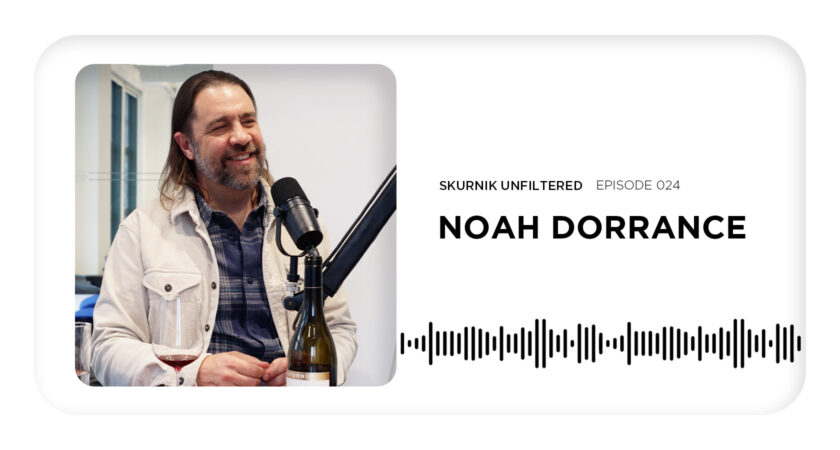
Noah Dorrance’s philosophy is clear and consistent: wine is connection. Paying close attention to the weather and the rhythms of the seasons connects him to the health of the planet. Donating a portion of his revenue to local nonprofits helps him connect with his community in and beyond the Sonoma Coast. And involving his wife and teenage kids in the Reeve Wines and BloodRoot projects brings their family closer together.
In this week’s episode, New York sommelier Mackenzie Khosla guest hosts Noah for a discussion over a bottle of Reeve Wines ‘Rice-Spivak’ Pinot Noir. Together they reflect on ways to find connection, generosity, and intentionality through the making and sharing of wine.



Next week, tune in as Skurnik Spirits Portfolio Director Adam Schuman and Spirts Content & Education Manager Amanda Elder go deep into the founding mission and recent growth of the Skurnik spirits portfolio.
Be sure to subscribe to Skurnik Unfiltered wherever you find your podcasts so you can stay up to date on all the exciting content to come.
Introduction
Noah Dorrance
I think if you’re really tapped into what wine is, giving back is a very natural extension of that because you realize that wine exists in this harmony with its environment. And if you’re not giving back out to that environment, you’re kind of like the dead end in the ecosystem. And it’s important that the ecosystem keeps moving around and that good keeps flowing in all directions.
[music]
Harmon Skurnik
Hey, this is Harmon Skurnik, and welcome to another edition of Skurnik Unfiltered. With me today is Jamie Schwartz, who is the ambassador and specialist in all things American wine here at Skurnik. How are you doing, Jamie?
Jamie Schwartz
I’m great. Beautiful day.
Harmon Skurnik
Beautiful day here in New York. You sat down with Noah Dorrance recently and discussed the brands that he is the proprietor of, Reeve and Bloodroot. Reeve is located in Healdsburg or in Dry Creek area.
Jamie Schwartz
Yeah, they’ve got their estate property in in Dry Creek, they have a beautiful tasting room for Bloodroot in Healdsburg, and then they also source fruit from all around Sonoma Coast.
Harmon Skurnik
He’s also had several of California’s best winemakers working with him, I believe, right? Ross Cobb, Katy Wilson. Who’s the winemaker now?
Jamie Schwartz
Katie Wilson is the winemaker and partner with Noah. He’s super involved with pick decisions, style, everything, but ultimately, Katie is incredibly talented and holds the role of winemaker.
Harmon Skurnik
Their primary wines that they produce are Chardonnay and Pinot Noir, but aren’t they experimenting with some Italian varietals?
Jamie Schwartz
Yeah, Noah loves Pinot and Chardonnay, of course, but he’s a huge fan of Sangiovese in particular. At their property in Dry Creek, they’ve actually started grafting over to Sangiovese there, and they have some Falanghina planted on the property.
Harmon Skurnik
California Falanghina.
Jamie Schwartz
That’s what’s up.
Harmon Skurnik
Who’da thunk? Noah’s originally from the Midwest, I believe, but he’s longtime California now.
Jamie Schwartz
He threads that hippie-country vibe so well. We actually had a spontaneous guest host, my friend Mackenzie Khosla. Mackenzie and Noah had just hit it off during a lunch earlier in the day, and I thought it was just great to keep that energy going and get the two of them on air, and they just went for it.
Harmon Skurnik
Well, it’s not the first time we’ve had a guest interviewer, and it’s a really interesting episode, a really interesting guy, and I’m looking forward to listening in to the interview by Mackenzie Khosla of Noah Dorrance. Let’s listen in.
Jamie Schwartz
Here we go.
[music]
Noah’s introduction to wine
Mackenzie Khosla
My name is Mackenzie Khosla. I’m here with Noah Dorrance. He’s been making some benchmark Pinot Noir and Chardonnay in California for 20 years. We’re at Skurnik headquarters, and we’re here to talk about what you’re doing and why you’re doing it.
Noah Dorrance
I love it. I love being here. I love talking about wine. It’s one of my favorite things to do, and it’s probably why I do what I do. I’m originally from Missouri, and I got into wine in a very interesting way. The best that I can trace it to is watching James Bond movies. I was 18 years old, and obviously to an 18-year-old, James Bond is really cool; beautiful women, fast cars, and there’s always a scene in a James Bond movie where he’s ordering wine, usually Champagne, but there’s other scenes. And there’s some part of me at that time that thought, I don’t know what that is, but it seems really cool, and I got to learn about it. And I went out and bought Wine For Dummies, and I started learning. One of the things that attracted me then is the thing that I still love the absolute most about wine, which is that it’s like this time capsule of time and place. You’re drinking this thing from some small village in Italy or France or someplace in California, and you’re, like, time traveling. You’re touching that time and that place and that culture all in a single bottle of wine that you picked up at the store. And being a kid from Missouri and not having traveled very much, I think it was a passport to the world. And like I said, today still, my very favorite thing about wine is that a passport across time and place.
Mackenzie Khosla
I think that’s how a lot of us fall in love with wine. It really is that way to explore other places without necessarily going there immediately.
Noah Dorrance
Yeah, for sure. And the other cool thing is, in this really intense way, you’re not only experiencing it, but you’re putting this thing in your body. You’re imbibing it, you’re commingling with it, you are becoming one with something that existed from somewhere else by some other people, and that’s a really cool concept.
Mackenzie Khosla
You very, truly get an opportunity to feel the thing.
Noah Dorrance
Yeah.
Connecting with people and the planet through wine
Mackenzie Khosla
I think that matters a lot. You work super closely with your family.
Noah Dorrance
Yeah, Reeve is our son’s name, and my wife and I run both Reeve and Bloodroot together. I think that’s another cool thing, too. It’s a very personal-level project, and it extends beyond that too, to our friends and our community. I think everyone that’s made wine in a wine-producing region, they recognize that it’s also not a solo endeavor, it’s like the result of—haha, I love the squeaky wheel!
Mackenzie Khosla
As you’re talking about it, I’m opening a bottle of Reeve for us. A little ‘Rice-Spivak’ Pinot Noir from 2021.
Noah Dorrance
I love that. This is a special vineyard that we’ve worked with for almost 15 years now, and it’s in the Sonoma Coast. It’s a very cool vineyard. The goal of all wines is to create a distinctive expression of a time and a place, and not all vineyards and not all places do that super well, but Rice-Spivak is one of those special places that does. It tastes like Rice-Spivak, even from the other producers that make it, Cobb and LaRue. You can always identify Rice as being specific. We started working with Rice-Spivak when I was the owner and winemaker of Banshee Wines, so that’s carried on to our new projects. There’s some continuity, and obviously, there’s personal relationships behind that too. As I’ll refer back to over and over again, that’s a very important part about making wine: the community, and the people, and the relationships. It kind of means everything.
Mackenzie Khosla
The winery is named after your firstborn. I believe you also have a wine named after one of your daughters, correct?
Noah Dorrance
Yeah, I have a son and a daughter. My daughter Remy and I make a wine called Remy Saves the Sea. It’s primarily a rosé. This was her idea. She wanted to do a project together where we made a wine and donated the money to ocean conservation. We’ve been doing that for a few years, and we work with a charity in Santa Monica called Five Gyres that does research and advocacy around ocean conservation. We live in Healdsburg, California, which is in Sonoma County. Sonoma County borders the Pacific Ocean. It’s the primary, I would say, distinguishing factor of our terroir and our region, that interaction with the ocean and the cool air that comes in from there. We’re able to make very elegant, very pure wines that have this great tension point between fruit and non-fruit characters. They have a lot of energy. And so we feel a real affinity and tie to the ocean and wanted to give back to its health.
Mackenzie Khosla
That sounds like great things for your kids to be around. Do you feel like they like learn a lot being around winemaking and harvesting grapes and all the decisions that come when you’re making wine? There’s there’s a ton of factors that go into play, but I’m sure they see it every step. If it rains, maybe you’ll get a little worried and maybe they’ll notice that. Or if you guys are all going to pick everything at once, how do you feel like that impacts them, and what do you think they learn from that?
Noah Dorrance
I think they learn the thing that we learn, that we’re connected to nature and that we’re not separate from it. It’s one of the beautiful things about wine. All these things that you’re not in control of that you learn to work in harmony with and that you learn to react to, you learn to do with what you’re given, in a way. There’s also a certain rhythm to the winemaking life where you’re very intimately tied to the season, and what’s going on, and to the cycles of the environment. I think people more broadly used to have more of a connection to this, and over time, we’ve—most people—have lost this because none of the things in their life really intimately depend on that. I mean, they do, but but they don’t see it in a direct way. And one of the things that I value about making wine and our kids being in this is that they are connected to the cycles and to the ups and downs of nature. It’s a good way to live. It feels connected. My ultimate thesis is that wine is connection on many different levels.
Mackenzie Khosla
That’s good to learn that young too, especially in an age where like everybody’s glued to what ever’s in front of them and our attention spans have been shortened for us, whether we really wanted it to happen or not. We were hanging out earlier, we were discussing this a little bit, about what connection to the world is like. We’re more connected than we’ve ever been, but there’s something about wine that forces you to be in the moment. And I think something about taking grapes, and pressing them, and vinifying them, and turning them into wine, putting them into a bottle makes a time and place stand still until you pull the cork back out of that bottle.
Noah Dorrance
Yeah, for sure. One of the things is this dichotomy that exists that everyone feels, that even though we’re more connected, we’re less connected. And we also live in this age where everything is basically digitized, infinitely replicable. You can make 10 of an app, you can make 10 million of an app. It doesn’t matter—it’s all the same commodity. Wine is beautifully resistant to that, and it’s unlike almost anything. Iit’s hard to think of other things that are inherently so variable because of nature, because of human interaction, because of place. This wine that we’re talking about comes from a very specific place in the Sonoma Coast, and it’s only a few acres of vines. This wine can only come from that place. We make a few hundred cases of this a year. Even if we could sell 100,000 cases, we can only make a couple hundred, and they change from year to year. I feel like that’s super, super special. And I feel like it’s almost this antidote to the modern world. It’s something that stands in resistance to that, and these types of things are becoming more valuable and less apparent in the world.
Mackenzie Khosla
Do you feel like that’s part of the reason you make wine? To contribute to that ability to hold time and space for what is right now and what was? I feel like we’re constantly worried about what the next thing is.
Noah Dorrance
Yeah.
Mackenzie Khosla
What was here at this time, what will be here later, maybe, but what is here right now?
Noah Dorrance
Yeah, a hundred percent. Doing this is an emotional connection to an idea and a philosophy. And I think that’s probably the most value that I get out of it, this feeling to something that I feel like is important. And the wine, on multiple levels, I’m attracted to it. It’s a beautiful thing. It’s an artistic thing. It connects us sitting here right now, but it also connects us to a time and a place that was in the past. I feel like all those values are attractive. And I feel lucky to do this because I’m doing something for these other ideas, and it’s not because I’m gonna make the most money doing this or because this is the best business idea. It’s because I believe in some things on a deeper level and they are fulfilling. I think a huge other thing about wine is that it’s meant to be shared, and everyone who loves wine knows, even if you have a great bottle, if you’re drinking it by yourself, it still can be enjoyable, but how much more enjoyable it is to open it with somebody else or multiple people and share it and talk about it and have this experience together. I always tell people, of all the great things I love about wine, sharing it with other people is easily the best part of it. And the fact that we make this enhances that a little bit. Sharing with other people and having an experience with people is pretty powerful.
Charitable work
Mackenzie Khosla
You and I have gotten to know each other just a little bit recently, but you have also been doing quite a bit of charitable work, whether it’s through Reeve or through Bloodroot. We’d love to hear more about what you’re doing and why you’re doing it.
Noah Dorrance
I think the why is really important because we’ve done a broad range of different things, but it goes back to what I was talking about before. The reason that we do this is for a deeper, philosophical feeling of connectedness, and I think what goes along with that is this premise of wanting to give back and wanting to leave your ecosystem that you are a part of in a better shape than when you found it. We do a lot of different things, and we’ve done a lot of different things on the Bloodroot Wines and the Remy Saves the Sea. We are members of 1% for the Planet, so we give 1% of all of our revenues back to Earth-friendly causes. We have donated all kinds of stuff to cancer research, raised a couple hundred thousand dollars for restaurants during the COVID period. Another one of our huge things that we focus on is gun violence and gun safety measures, both research and education and advocacy. Collectively, we are a very small family winery, but we’ve calculated, that we’ve raised over a million dollars in the last 10 years for various causes. I think if you’re really tapped into what wine is, giving back is a very natural extension of that because you realize that wine exists in this harmony with its environment. And if you’re not giving back out to that environment, you’re kind of like the dead end in the ecosystem, and it’s important that the ecosystem keeps moving around and that good keeps flowing in all directions. In a way, we’re like a conduit for that. We always want to do good with what we do.
Mackenzie Khosla
Oh, I love that. I think the best winemakers and the best wine sellers all have a mentality of “wine is for sharing.” And I think that when you extend that, Okay, how can I share with my community? How can I make the things around me better than they already are? And it sounds like you guys are working really hard to do that.
Noah Dorrance
I said wine is connection, and I mean that. It’s all connected. Everything’s connected. And so if you don’t connect all those dots, you’re kind of kind of missing out on the point of everything.
The Place of “What If”
Mackenzie Khosla
Yeah. The thing that you have been doing that I think is extremely interesting, is you’re starting to experiment with Mediterranean varieties in California.
Noah Dorrance
Yeah.
Mackenzie Khosla
That is not something a lot of people have dared to do. What what brought you to that? Why are you doing that?
Noah Dorrance
Well, certainly the way that the climate has changed, and we’ve had more extreme heat events, those Mediterranean white varieties are very buffered against those heat events. They handle the heat really well. In a way, it was this great fit between our environment and the types of wines I was really enjoying. On our Reeve property, we grew a Falanghina. We’ve also planted at some places we have very long-term leases with, Assyrtiko, Falanghina, Vermentino, and we’re exploring some other things as well. In our climate in Sonoma, we have a million different microclimates, but it’s very, very conducive to these wines. Our early results have been fantastic. I think our Vermentino with a little bit of Falanghina blended in under the Reeve label is one of my favorite wines. We probably drink the most of that of any of our wines. It’s a constant open bottle presence in our house. And I’m really just thrilled with what we’re learning and what the potential is for those wines.
Mackenzie Khosla
That’s really exciting. I think it’s great to see an adaptation too, with how the climate is changing and how the weather year over year is changing. To see wineries going ahead and being like, Okay, I was already interested in this, this may actually work even better in my current situation. To see that adaptability, I think, is really impressive and also speaks to how do we treat things in real time, and what is here and what is now. We can romanticize the Sonoma Coast as a great place to grow Burgundy not in Burgundy, but as that place changes, what can you do to change with it? I think you guys are doing a great job trying to stay in step with that.
Noah Dorrance
Yeah. I think that’s a little bit of the California spirit, being experimental, finding new things that work. I think not accepting the idea that everything is just perfect the way that it is, and that the reason that Vermentino hasn’t been grown anywhere else is because it only works in the Mediterranean, it’s just not true. There are so many things that haven’t even been tried yet. And the environment’s changing, so the conditions are changing. There’s always different lenses. In one lens, Pinot Noir and Chardonnay grow really well in the Sonoma Coast, and that’s great. In another lens, there could be other things that grow, and you need to shed what you think is an absolute truth and think about what could possibly be. I think that’s one of the beautiful things. You know I’m from Missouri, I’m not from California. But California is a land of people that decided to say, “I know this is an accepted truth, but what if we can make a new truth? What if we could make a new idea?” If there’s anything more California than “what about this new idea,” I don’t know what it is. Like, that is the idea of California.
Mackenzie Khosla
The place of “what if.”
Noah Dorrance
The place of “what if.” We revel in that too. And I think, not being from there, like a lot of people, I feel like immigrants have probably the best idea of what America can be because they’re imagining the best set of ideals ever. Sometimes when you grow up in it, you take it for granted. And I feel like California is a little bit of the same way, but California is made up of people that went there because they wanted to go to the frontier and see what if. I feel like that’s a powerful part of the California wine industry, like a lot of industries in California, people said, “What if?”
Mackenzie Khosla
I think that’s a tremendously important thing to point out about California specifically. And it’s cool that you guys carry that too when you’re making your wines.
Noah Dorrance
This is an important thing too. One of the things with our label and our design ethos was, proudly California but inspired by the Old World. We put “California” really big up top. It also has the vineyard name and Sonoma Coast and all that stuff. But people always ask us because, from an appellation sense, California is the most broad appellation; it’s less specific. We put this on top because of all those things I just said. We’re very proud of what California represents, and we wanted to have a banner that said “We’re from California and California is important.” One of the things that we always try to do with our wines is to think about elegance, prettiness, poise. They’re kind of abstract concepts. How do you actually get those things? But this is where there’s this awesome blend in wine between art and science, how to achieve those things, how to achieve that feel, how to achieve those experiences. Those are really, really important to us, and we think about it a lot, wine style-wise. I think California has gone through some eras where maybe there’s extremes one way or the other of style and trying to hit something different than an extreme, trying to hit kind of this ideal.
Making wine with intentionality
Mackenzie Khosla
After tasting some of the wines, you guys have done a very impressive job of getting to a place of effortless elegance, softness and depth without weight, a combination of wines that are kind of fruity, kind of savory, but they’re not really doing too much of either thing. They’re just in harmony with each other. And I think that also speaks to how you treat your vineyards and how your philosophy is, overall, with winemaking. It’s really impressive to see that translated into the bottle and then into the glass. It’s one thing to want to achieve effortless elegance, and to actually get it all the way to the glass is another conversation. I think you’ve done a very impressive job getting there.
Noah Dorrance
Thank you for noticing that. I think like many things in life, many artistic expressions—art music, whatever—it’s about setting that intention and following it. I don’t even know what it really means, but following that on an emotional level to try to achieve that, it leads to those results. I can’t necessarily point to any specific one thing or two that we do, except that’s the intentionality.
Mackenzie Khosla
The thing is you’re paying attention. I think that’s the thing. Whenever we talk about these hyper-specific winemaking philosophies or winemaking methods, the thing that I always think about is, a lot of these wines turn out really well because, regardless of the philosophy, everyone’s paying attention. You’re there and you’re paying attention every step of the way. And I think that ends up showing in the final product. You cared about when you took the grapes off the vines. You cared about how you press them to get the juice out of them. You cared about what kind of oak they went into and for how long. You took care to acknowledge all of those steps along the way. And I think in all of the best wines, you find that is a common threat, that the winemaker did all of those things.
Noah Dorrance
Yeah. I think that’s true too. That’s why I often say we’re not dogmatic about any particular part of the process, because what we’re passionate about is this feel at the end. And you don’t get there by saying, “I won’t use new oak,” or “I won’t do this or that.” You’re defining yourself and the things you’re not doing and not where your end point is, what you’re trying to achieve. For us, there’s a deep feel and philosophical place that we’re trying to get to, and everything else is only in service toward shepherding the wines to that place. And ultimately, the best wine is always about a place and a time and expressing that in some way. But I also feel like there can be this desire, this strand, to almost separate it from its humanness. And the fact of the matter is, even though this expresses Rice-Spivak from this vintage and this place, it’s inextricably tied to me and Katy Wilson, who’s my winemaking partner, in our vision of this. And that’s beautiful. Our imprint, our fingerprints, are important to this wine. It’s not about separating the humanness—it’s about adding the humanness to the wine. This is our version of this, and that’s an important part of it.
Mackenzie Khosla
I think that’s a great way to put it. Winemaking is a passionate thing to do.
Noah Dorrance
Yeah. The biggest lie—I’m gonna drop a truth bomb here—the biggest lie that a winemaker will ever tell you is, “The wine is made in the vineyard, and we just try to get out of the way and let it express itself.” It’s not what happens, it’s not how wine is made. There’s human interaction all over it. And I get the impetus why people say that, because the vineyard is really important, the place is really important. I believe that there’s a little bit of a faux humility going on in that situation, but the realness of it is that people make wine and they make decisions and it is imprinted with their fingerprints, and that’s not a bad thing. It’s an attribute of the wine that somebody actually did things to make it turn out like that.
Mackenzie Khosla
Yeah, and I think you bring up a really good point because at the end of the day, somebody either did do something or didn’t do something, and that is always going to reflect in the finished wine. But when the wine gets to the bottle and the cork goes onto the bottle or the Vinolok or the self-enclosure, however that bottle gets closed, the wine is finished now. And even after it goes into the bottle, it is absolutely still a living, breathing thing that’s going to change. But all the decisions that got made on the way there— Or not made. Or not made! But even not making a decision is a decision, is making a decision.
Noah Dorrance
We didn’t touch on this, but we were talking about this earlier, and I love this: the salad reference. I didn’t come up with this. I’d never even heard it before, but it’s like, if you just picked a bunch of vegetables from the garden and you put them in a bowl on the counter and you didn’t wash them, you didn’t refrigerate them, you didn’t put any dressing on them, and you just said, “There’s a salad, and this is exactly what the garden represents,” that’s not a salad. that’s a bunch of stuff put together and not taken care of.
Mackenzie Khosla
If I’m having a romaine salad, I would hope that somebody washed the leaves first.
Noah Dorrance
Exactly. And if you want to preserve it for the next day, hopefully they put it in the refrigerator after they picked it. All these things are small decisions, and it’s not to say that when you’re walking through the garden, you eat a cherry tomato, it does taste awesome right off the vine. And that is the thing you want to preserve. But once you pick it and you’re gonna put in a salad, you need to do some things to accentuate and preserve that flavor. That’s the human role. Making a good salad, even if it’s a very minimal salad, involves some human interaction and some prepping and some highlighting and some lifting.
Mackenzie Khosla
And not for nothing, the salad wasn’t gonna be a salad until somebody took its parts out and put them together.
Noah Dorrance
100%.
Mackenzie Khosla
Well, thanks, Noah. Yeah. Thanks for being here. Thanks for your time, thanks for your wines.
Noah Dorrance
Yeah, it was great talking with you, man.
Mackenzie Khosla
You’re incredible.
Noah Dorrance
This was great. Let’s do it again.
Skurnik Unfiltered is recorded at Skurnik Wines & Spirits headquarters in the Flatiron District of New York City. If you found the conversation interesting, please consider liking, subscribing, and leaving a review. You can stay up to date on our show and upcoming events by following @skurnikwines on Instagram and visiting our website at skurnik.com
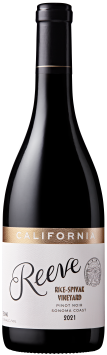
Reeve Wines ‘Rice-Spivak’ Pinot Noir
- Practicing Organic
- 100% Pinot Noir
- Rice-Spivak Vineyard (Sonoma Coast AVA)
- Six-acres planted in 2000 south of the town of Sebastopol outside the northern edge of the Petaluma Wind Gap
- Clones: Swan, 115, 667, 777
- Soil Type: Goldridge with volcanic ash
- 229 ft. elevation
- Hand-harvested
- Native yeast fermentation in small open-top fermenters
- 85% de-stemmed
- Aged in 33% New French Oak Barrels
- 13% abv