

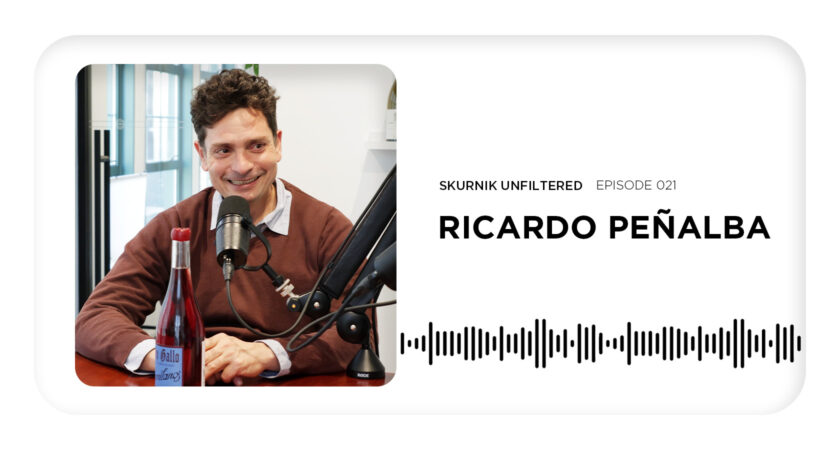
More than a winemaker, Ricardo Peñalba is a self-proclaimed “wine ideologist.” When he’s out walking the rows of his biodynamic vineyards in Ribera del Duero, he’s thinking obsessively about wine and how it connects humans to our shared history and humanity.
In this episode with Max Working, Ricardo shares a bottle of his Ojo Gallo from Finca Torremilanos and explains the region’s ties to this traditional clarete style of wine, with an inspiringly philosophical perspective.



Next week, tune in as rice ferment expert Lok Yan Li sits down with Alice Jun of Hana Makgeolli.
Be sure to subscribe to Skurnik Unfiltered wherever you find your podcasts so you can stay up to date on all the exciting content to come.
Introduction
Ricardo Peñalba
Wine has always been in change, in movement. The wine that we drink now is not the wine that was drunk hundred years ago or thousand years ago. For a revolution, you have to go back to the past to see what you have missed, and then bring it back.
[music]
Harmon Skurnik
Hey, this is Harmon Skurnik, and welcome to another episode of Skurnik Unfiltered, where we peel back the layers and get behind the scenes of our favorite wineries and winemakers and find out what makes them tick. And today I’m joined by none other than Max Working, who is our portfolio manager for Greece, Spain, and Portugal, primarily. We are here because you recently sat down with Ricardo Peñalba, who is one of the brothers who are the proprietors of one of our favorite wineries from the Ribero del Duero in Spain, Torremilanos.
Max Working
Finca Torremilanos, our great friends in Aranda de Duero, in the upper eastern reaches of the Ribera del Duero appellation, Burgos Province. Ricardo is the winemaker. It’s very much a family affair. His brother Vicente is also a dear friend, although to call either of them the proprietor might be laying it on a little thick because their mother, the redoubtable Pilar Pérez Albéniz, who’s a force of nature, is still the boss. And they’re doing an amazing job bringing the estate into the contemporary era, but Pilar is still very much the boss. We’ll get her on some other episode.
Harmon Skurnik
That would be interesting. It’s interesting that you say “bringing it into the contemporary era” because the estate itself has a lot of history. It goes back over a hundred years. And I believe, if I’m not mistaken, after Vega Sicilia, I think it was the second winery founded in the region, right?
Max Working
When you’re talking about the concept of a concretely named agricultural wine producing entity, by that metric, it is in fact the the second oldest wine estate in what is now known as Ribera after the famed Vega Sicilia. I say in what is now known as Ribera because when it was founded in 1903, a lot of people might not realize this, but that’s fully 75 plus years before the founding of the actual Ribera del Duero appellation, which was not even actually constituted officially until the 1980s. It’s one of these second or maybe even third wave, you could call it, Spanish DOs that nowadays are among the most famous in Spain, but are much more recent than people might realize.
Harmon Skurnik
It’s amazing sometimes when you think about these regions that are second nature to the Old World, and to think how recent some of these appellations are and when they were founded. They’re also Demeter certified, which is amazing to be completely biodynamic in the region. They’re very serious about their grape growing.
Max Working
Ricardo himself was the driving force behind moving their agriculture into a not just organic certified, but indeed Demeter certified direction. And they were the first ever winery in Ribera to get biodynamically certified. And to this day, Ricardo serves as the vice president for the Asociación de Agricultura Biodinámica de España. He’s the vice president of that association, and they host an annual conference for growers at the estate. I always love sitting down and talking to Ricardo because he’s what you might call a free and original thinker. And I always walk away from a chat with him thinking about something or multiple things from an entirely new angle or light. So it’s always a pleasure to sit down with him.
Harmon Skurnik
He seems to have a lust for life too. He’s always so much fun to be with, life of the party kind of thing. But at the same time, like you said, original thinker, creative thinker. And even if you don’t know him, you might come to that conclusion just based on the sheer breadth of types of wines that they produce there that is so atypical for the region. You think of Ribera del Duero, you think of big reds, you think of not all that much variety of different types of wines, but they make a lot of different types of wines, don’t they?
Max Working
Totally. Once again, really driven by Ricardo’s sense of moving into the contemporary era, the whole spectrum, whether it’s amazing white wines, which are only relatively recently allowed, by Ribera DO, although most of his white wines don’t even carry the DO. They’re Vinos de la Tierra de Castilla y León. Reds, both traditional and also new wave, which is to say minimal or no sulfur and completely unoaked and early harvested.
Harmon Skurnik
And like for some of the reds, glou glou.
Max Working
Literally. All the way to, in fact, the bottle that we shared when we were doing this interview was a delicious bottle of his freshly released just landed in the USA 2024 vintage of his beautiful clarete, which we have sitting right behind us here, which is called Ojo Gallo, the rooster eye, and that’s a red-white co-ferment.
Harmon Skurnik
Well, I think that’s a perfect segue to listen to what you discussed while drinking that delicious wine. So let’s tune in to your conversation with Ricardo Peñalba of Finca Torremilanos now.
[music]
The Torremilanos Estate
Ricardo Peñalba
Bueno, buenas tardes.
Max Working
Buenas tardes.
Ricardo Peñalba
Aquí estamos.
Max Working
Me alegra verte aquí in Nueva York. We’ve known each other for, I think we were saying eight years, right?
Ricardo Peñalba
At least, yeah.
Max Working
We’ve seen each other in Spain many times since then, but this is the first time we’ve seen each other in New York in eight years.
Ricardo Peñalba
Yeah, I see the city is still in the same place.
Max Working
It hasn’t moved. There’s still lots of people, we’re still drinking lots of wine, we’re drinking more of your wines than ever.
Ricardo Peñalba
That’s why the city looks better.
Max Working
They say that a little bit of clarete does wonders for your complexion. So tell us, tell the people who don’t know you, who are you, and where are you, and what are you up to?
Ricardo Peñalba
I am a wine producer from Spain. But more than a wine producer, I’m a wine ideologist. I think about wine, dream about wine, and I manage a group of people together to produce grapes and do the best wine that we can from our historical wine state.
Max Working
How historical is that? Because a lot of people, if they think of Ribera del Duero, where you are, there are a few famous, let’s say, historical names, but yours, which is very historical, is sometimes forgotten.
Ricardo Peñalba
Well, yeah, we have not been marketing people. We are more people from the land, from the soil. We are very much together with the vines and not too focused in the market.
Max Working
That’s our job.
Ricardo Peñalba
Well, yeah, we will help you. We are a classic winery, we have been in the market for over a hundred years, and in the 1970s, 1980s we created the modern Ribera del Duero at the time with a lot of inspiration from the classic Riojas with Gran Reservas wines. At that time, the most important wines in the area were rosés, clarete style, traditional rosé.
Max Working
Your parents’ generation founded the current incarnation, let’s call it, of Finca Torremilanos, a farm that had already been around for a long time. When did you really start managing things with the winemaking at Torremilanos?
Ricardo Peñalba
From the 2000 vintage, I have been present in the family estate.
Max Working
Congrats on 25 years.
Ricardo Peñalba
Yeah, more than half of my life, huh?
Max Working
So if I’m not mistaken, I think that the first new wine that you made at the estate that really was entirely yours, that you put your stamp on, was in a few years after that in 2003, I believe.
Ricardo Peñalba
Yeah, it was the Ciglo 2003.
Reintroducing organics and biodynamics
Max Working
There were a lot of changes you were also making, not just in the winemaking, but also in the farming and the way that you were running the vineyards. How was that new, and what was different about that at that time?
Ricardo Peñalba
Well, the idea was to take out the herbicides and to take out pesticides or chemical synthetic products. In Ribera del Duero, as we have been lost in the past for many centuries, until the mid 1980s or even the mid 1990s, everything was organic, mostly biodynamic. Because actually we can say that from the origin 1903 until late 1980s, beginning of the 1990s, Torremilanos estate was a pure biodynamic farm without even knowing it. We still had domestic animals living together with the vines. We were still working in the vineyards, like in the Middle Ages. My ideology is to think about the future with the knowledge of the past. Wine has always been in change in movement. The wine that we drink now it’s not the wine that was drunk hundred years ago or thousand years ago, and of course, it will not be the wine that we’ll be drinking in ten years. For a revolution, you have to go back to the past to see what you have missed, and then bring it back.
Max Working
Speaking of biodynamics, you also went down the path of official biodynamic conversion. Do I remember correctly that that was 2009?
Ricardo Peñalba
2010 was the first. In 2009 we changed all our surface officially to organic. Actually, the change started in 2004. And then until 2009, officially the harvest became organic. And then in 2010 is when we started to work in Torremilanos estate with the biodynamic preparations that were done in the same estate.
Max Working
And you were the first in Ribera DO, were you not, to get certified, right?
Ricardo Peñalba
Yeah, we were the first to get the Demeter certification from vintage 2015.
Max Working
And have you seen the group of producers also joining? Has that grown in the last 15 years, or what is it like?
Ricardo Peñalba
It’s moving.
Max Working
It’s moving?
Ricardo Peñalba
It’s moving slowly. I have seen how many people are becoming organic in Ribera del Duero more than in other north central areas of Spain. Biodynamic is a further step, but there are more and more.
Max Working
Yeah. But you have a personal stake in this, I guess, because you’re also involved with running the, I forget the name of the association.
Ricardo Peñalba
The Associacion para la Agricultura Biodinamica de España.
Max Working
So for all of Spain, the Association of Biodynamic Producers from all over the country.
Ricardo Peñalba
Yeah, I’m the vice president of the Spanish Agriculture Biodynamic Association.
Max Working
Yeah. And I don’t know if you do it every year, but you definitely have hosted conferences.
Ricardo Peñalba
Well, this year we had an international congress that was very interesting and with a lot of important producers coming to see what was going on. People are very interested about biodynamic farming, but there is something missing that prevents people from getting more involved in this movement.
Max Working
Do you have an idea of what is missing in Spain, at least to get more people interested? It’s a complicated question.
Ricardo Peñalba
People don’t understand really what organic is about, and if you cannot understand what organic is about, that is more simple. It’s harder to understanding biodynamics, so we really need to talk to the people about what is taking care of nature and about the future and what will be the legacy for the next generations. That, I think, is the most important part about organic and biodynamic farming.
Max Working
I feel like every time we’re with you in Aranda visiting at the estate, yes, we have fun, but with you, at some point late in the night, there’s always a discussion about these things you’re talking about, of where are we heading as a society, as a planet, our culture, our tastes, our politics. And living on the farm and making wines like this, I know you’re always thinking and talking about what are we putting in our bodies and what are we ingesting.
Ricardo Peñalba
It’s important because it’s related to what we think. If we eat something that respects lives, we will have thoughts about respecting each other. If we eat something that is related with suffering, our thoughts will be related with the suffering of the food that we put inside ourselves. You care about enjoying the moment with nature and doing something that has been going on in our area for thousands and thousands of years.
Max Working
It’s maybe a difficult question, because you’ve been changing the style of the wines at the same time that you’ve been changing the farming practices, but a question that we often have with wine producers who have changed the way they work in the vineyards is, over time, have you seen the character of the wines change because of the farming? I wonder if you could talk about that a little bit.
Ricardo Peñalba
Well, of course, yeah, but to change how the soil behaves, it’s not something that happens from one year to another.
Max Working
Sure, we’re talking about a time scale of years, right?
Ricardo Peñalba
Yeah, almost 20 years without herbicides, almost 20 years without chemical systemic synthetic products, this makes our soils more alive together with the plant, the root system, so this makes the wine with different personality. Nowadays, the wines that we are producing talk differently than the rest of our area. And sometimes, like these wines, you don’t need really to to give it time, you just need to fill it with your feelings.
Tasting Finca Torremilanos ‘Ojo Gallo’ Clarete
Max Working
Tell us about the Ojo Gallo that we’re tasting. You mentioned earlier that, historically, not all of Ribera, but specifically Aranda, up in the higher eastern part of the appellation, historically it was clarete country, not red wine country, right?
Ricardo Peñalba
Well, what is the color of this wine?
Max Working
Speaking from the perspective of what time it is now, I would say it’s a light, chillable red, right?
Ricardo Peñalba
Yeah, it’s a red wine.
Max Working
Yeah, light, chillable red.
Ricardo Peñalba
Yeah, but in Spain we don’t say that wines are red, we say that the wines are tintos.
Max Working
Yeah, colored, tinted.
Ricardo Peñalba
Tinted, yeah. It’s funny because in the rest of Europe, the wine is called red. If we look at this color, this clarete Ojo Gallo style, it’s a wine that has been in contact with the skin for a week. It’s red. Shiny red.
Max Working
Yeah, I’m with you.
Ricardo Peñalba
It’s the Ojo Gallo, which means “the color of the eye from the cock.” It’s cock eye colored. The rooster. Okay, rooster, not cock. Okay, cock is French.
Max Working
Yeah, we can say cock too in English, but maybe rooster.
Ricardo Peñalba
Okay, rooster will be more American?
Max Working
Yeah.
Ricardo Peñalba
Okay, this is the rooster color, and now the traditional style of red wines is coming back to life. This is 40% of white grapes, together with 60% of red grapes, and it’s the way the wines were mostly made, not only in Ribera del Duero but in the whole of Spain 400 years ago. This style of Ojo Gallo has been present in our history books for centuries.
Max Working
I’ve been reading the new memoir of José Peñín from Guía Peñín, which, your mother was the one who clued me to this because she sent us the clipping from his chapter about Ribera where he talks about Finca Torremilanos and Pilar and Pablo. She was the one who introduced me to the fact that the book got published, so I got a copy, I’ve been reading it. And one of the really interesting things that José talks about is that in the north of Spain, you have what he calls “el parallelo del clarete,” the clarete parallel, which for him runs from like Cigales up through Aranda and then continues northwest up into like the Valle de Jamuz in León, and it’s this whole spread of the north of Spain. And there were other places in Spain too.
Ricardo Peñalba
Also Rioja, but Rioja was already influenced by Bordeaux, so they were producing more of what Bordeaux needed at the time, trying to get darker color with more concentration that has been the Bordeaux style for a couple of centuries.
Max Working
I think for a lot of people, if they have an idea about Ribera del Duero, it’s obviously very different from the traditional idea.
Ricardo Peñalba
Well, it’s the modern traditional idea.
Max Working
Well, what does modern mean? What does traditional mean? Let me rephrase that. I think that the wine drinker in the United States, let’s say, if they have an idea about Ribera del Duero, it doesn’t look like this, maybe. But when I think of a 12.5% alcohol, probably 40% white grapes, this color, and the drinkability, this is a wine of pleasure, a wine of thirst. I feel like we could finish this bottle and open another and get back to work afterwards.
Ricardo Peñalba
Yeah. I think this is our most authentic Spanish style that we have lost. And the idea here that we had at Torremilanos is to bring this style back. And we want to encourage other producers from our country to work on this style. A lot of people talk about clarete, but I don’t think they are in the right path. A real clarete or a real Ojo Gallo is a wine that first is a mix of red and white, second at least start fermentations with the skins.
Max Working
Yeah, and this 2024, this was on the skins for about a week, you said, right?
Ricardo Peñalba
Yes, seven days. This is macerated in very big tanks, tanks that we enter in, we macerate it with our body, without the use of machine for those days. The most important thing is to pick the grapes as cold as you can so you can keep the grapes and the juice without starting fermentation for at least five days without any use of air conditioning, refrigeration.
Max Working
You’re harvesting it at night or in the early morning?
Ricardo Peñalba
Early morning.
Max Working
In general, talking about running your winery and electricity, which might sound very boring or prosaic, but electricity in wineries is a big deal, right? Because in the last five years since the pandemic, we’re talking about a lot of inflation and energy costs in Europe, and it’s a big problem for a lot of wine producers. And I assume that’s something that you’re thinking about a lot in the bodega.
Ricardo Peñalba
Yeah. First was the respect of nature, the respect of agriculture, looking at the plant like a living being, and now we have to look at the effect of man in nature, sustainability, that’s something very important, and the use of energy. We’re very sensitive to that. We put a lot of electric panels to get electricity from the sunlight.
Max Working
You get a little bit of sunlight there. Most of the time that we visit you, it’s probably in July, August on average, where it seems that Aranda is the hottest place in the universe. That’s just not quite true, but it seems that way usually.
Ricardo Peñalba
I think Walla Walla is warmer.
Connecting humanity, culture, and nature through wine
Max Working
Ricardo is funnily enough, is very knowledgeable about Washington State.
Ricardo Peñalba
I love Washington State.
Max Working
And the wines of Washington, he having done a high school exchange program there. It’s in fact a bit of a family tradition for you, and all three of you brothers have all done, and now your son is doing the same. It’s a family tradition. The Peñalba family sends their sons out to Bellingham, Washington.
Ricardo Peñalba
Yes, Bellingham, Washington. One of the greatest places in the world. It’s not a very big place.
Max Working
I’ve been! I’ve been there to sell wine, so I can confirm.
Ricardo Peñalba
You have been there to sell wines?
Max Working
I have, yeah. It’s a great place.
Ricardo Peñalba
Yeah. Great nature, actually.
Max Working
For me, it was driving up from Seattle, but the drive up there from Seattle is beautiful.
Ricardo Peñalba
Yes, the whole bay. It’s amazing. You have the San Juan Islands and the Orcas Island in front of Bellingham, and you have the volcano, Mount Baker, protecting the area. It’s a point of inspiration for us about the respecting of nature. I think Washington is one of the places in the US where nature is very present or mostly present in the mind of the people.
Max Working
I see that. I think that tracks. If I knew nothing about your history in the USA and you asked me what are your spiritual states, I would be like, Oregon, Washington, Vermont, Maine, New Hampshire.
Ricardo Peñalba
Well, this state also is a very interesting place. For us, New York is a place of inspiration in terms of wine. People love wine in New York. People drink wine from all over the world.
Max Working
We’re very spoiled here, as you know, with wine. And we’re also very open-minded about particularly European wines.
Ricardo Peñalba
And local wines also.
Max Working
Also local wines.
Ricardo Peñalba
I think New York is the place where US wines started to be at an important place in the whole country. I think where you first started to appreciate what you were doing in your own country was here in New York. The cities are the most important place for culture. What we want is to bring the people from the cities to our natural places, so they can connect with nature and go back to the cities to make the cities a better place.
Max Working
You talk about this a lot, connecting with people at this very primal level with wines. You’re making wines in a certain style, that it makes you happy to see that it’s connecting, especially with young people. Yeah, it’s pretty important. In a convivial shared environment, whether it’s Madrid or New York, this is something I know that brings you a lot of pleasure, a lot of happiness to have a deep connection with people with a beverage that they’re enjoying, but it’s more than just a beverage, right?
Ricardo Peñalba
You cannot compare wine to any other beverage that has alcohol, because wine is our oldest tradition for humanity. Without the the use of wine, maybe we would have never gone out of the caverns. Wine is one of the most precious things for humanity.
Max Working
And in Aranda de Duero, you know where of you speak when you talk about caverns because the town that the winery and the estate are right outside of has this locally famous, extensive series of subterranean cellars carved out of the rock underneath the town, the Peñas de Aranda. And still today you have all these, I don’t know what you’d call them in English, social clubs, sort of, that hang out in the caverns. So yeah, you know about the caverns.
Ricardo Peñalba
Spain is one of the oldest wine countries in the world. Maybe the oldest in Europe, also. This is something that maybe Italians will not like because they say that the Romans brought the wine to Spain, but I think the Romans came to Spain to drink our wine more than bringing the wine to us.
Max Working
I’m not a historian, but yeah, the idea that the Romans arrived in Spain and there was not already wine there, whether it was from the Greeks or the Carthaginians or whoever, seems unlikely that there was not already wine there.
Ricardo Peñalba
No, no, no, of course there was wine there. We were Iberians. There was something else before the Phoenicians or the Greeks or the Romans came, and the Egyptians talk about the knowledge of viticulture and winemaking in the Iberian Peninsula. We are going to consider our brother Portugal also with this old tradition in Europe about viticulture and winemaking. We’re still the largest surface of vineyards in the whole of Europe. There is no other country that has more vineyards than us, and we have one fifth of the vineyards we used to have seventy years ago in Spain.
Max Working
One fifth lost in the last seventy years?
Ricardo Peñalba
No, no, four-fifths lost. Four fifths lost in the last seventy years. Yes.
Max Working
That’s a sobering statistic.
Ricardo Peñalba
That’s huge. The thing is, in Spain, we are not drinking much wine. We have to do something about that. We have to reconnect our society with our most important culture, the wine culture. When we talk about wine, we talk about vineyards, we talk about soil, we talk about landscape, we talk about nature, we talk about rural life in a small town, just keeping population, keeping those small towns alive. The cultural importance of wine it’s more than just a bottle or just a glass or a good moment with friends. The word for “vine” in Spain is “vid.” If you add an A, you have the word “vida,” the wine is the drink from the plant of life, la planta de la vida. The word “divine” means “from the wine.” So when you meet with other people and you open a little bit of wine, you open a different dimension, you’re connecting with nature, you’re connecting with tradition, you’re connecting with humanity in general, and you are also connecting with the gods. In Finca Torremilanos we want to to connect people with nature in general and we want to connect human beings with humanity. I think our society is missing this humanity feeling that we really need because we are human beings.
Max Working
Well, if any of the listeners find themselves in the the Madrid area and have a little bit of free time, if you want to experience what Ricardo’s talking about, you just grab a car, and depending on how fast you can drive, you’re not more than one hour and a half north of Madrid, up in Aranda de Duero, you can experience the beautiful holistic entity they have in Aranda of the farm and the winery and the animals and everything.
Ricardo Peñalba
It’s an energetical place, also. You feel good when you’re in Torremilanos.
Max Working
I always do.
Ricardo Peñalba
And if you cannot come to Torremilanos, just grab a bottle of Torremilanos and share it with good friends, and there’s a way also to connect with Torremilanos.
Max Working
So there you have it, people. Finca Torremilanos. These are human-scaled wines made by great humans respecting nature. Pues gracias por la charla.
Ricardo Peñalba
Muchas gracias a ti, y a Nueva York, y a todo la familia Skurnik, y el equipo Skurnik.
Max Working
De nada a usetes.
Ricardo Peñalba
Un placer.
Skurnik Unfiltered is recorded at Skurnik Wines & Spirits headquarters in the Flatiron District of New York City, which is why you might hear some city noises as we go along, like horns honking. If you found the conversation interesting, please consider liking, subscribing, and leaving a review. You can stay up to date on our show and upcoming events by following @skurnikwines on Instagram and visiting our website at skurnik.com