

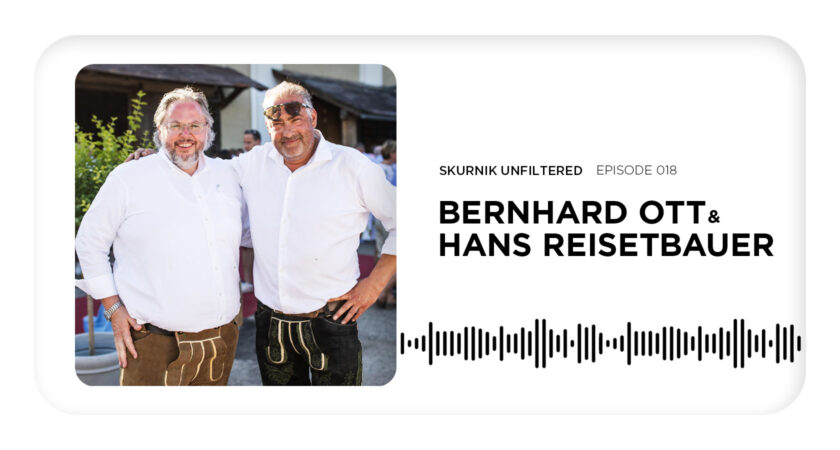
If you want to go fast, go alone, if you want to go far, go together. History is full of contemporaries who share visions of success, who, instead of competing, mentor and encourage the other to become greater than one could alone. Warhol and Basquiat. Lewis and Tolkien. Gauguin and van Gogh. Today in the world of craft wine and spirits, that pair is winemaker Bernhard Ott and distiller Hans Reisetbauer.
Born into farming families in Lower and Upper Austria respectively, they followed a common thread of honest farming, pure fruit, and quality beverages that eventually brought them together. Like looking in a mirror, they immediately bonded over their shared interests and identical values. Now after 25 years of friendship, their collaborative approach to farming, fermentation, and life has produced the most elite wine and spirits in Austria.
In this episode, they share their philosophies on biodynamic farming, their obsessive pursuit of pure fruit, and why doing things the right way doesn’t have to mean doing it the hard way when you always have a friend to lean on.



Next week, tune in as agave spirits expert Justin Lane Briggs interviews Daday Suárez of Alto Canto Tequila.
Be sure to subscribe to Skurnik Unfiltered wherever you find your podcasts so you can stay up to date on all the exciting content to come.
Introduction
Hans Reisetbauer
We are working together now more than 25 years.
Bernhard Ott
This is wonderful. Normally you have a best friend and everybody does his own job. And sometimes you met each other on weekends. But what do you want in your life? You are in the same business and you can do this with your best friend. And you feel lucky. You can’t find it a second time in the world.
Hans Reisetbauer
This is friendship.
[music]
Harmon Skurnik
Hey, this is Harmon Skurnik, and I am here with Mike Lykens, who is the portfolio manager for all of our German and Austrian wines here at Skurnik Wines & Spirits. You sat down recently with two incredible individuals, Hans Reisetbauer, who some say is the greatest distiller on the planet, and also Bernhard Ott, who might be one of the greatest producers of Grüner Veltliner on the planet. And they’re like best friends or something like that, right?
Michael Lykens
They are. Sometimes you meet somebody who’s kind of your counterpart and you don’t know it, and you immediately click. There was an immediate recognition that their values were completely in line, and they had both similarly rigid and distinctive opinions about the quality of farming and viticulture. And of course, in Hans’s world, the farming of all agriculture.
Harmon Skurnik
They’re both pretty meticulous about farming. I mean, they’re perfectionists, are they not, about getting the the best fruit possible and making the best product possible?
Michael Lykens
Correct. And actually, it’s quite interesting. So Bernhard was growing apricots for Hans to distill into his apricot eau-de-vie.
Harmon Skurnik
I didn’t know that.
Michael Lykens
Yeah, and so yes, they are very rigid and great farmers. And it’s so funny, the first time that you go visit Bernhard, for example, he cares so much about the farming, but he also wants to show you his bee colonies and say, These are the real workers out here in the vineyards. And then he wants to show you his very large compost pile and talk so much about his focus on regenerative farming, but also how that informs the quality of the wines that are produced.
Harmon Skurnik
He’s biodynamic, isn’t he?
Michael Lykens
Absolutely. Yeah, he was a founding member of a an organization called respekt-BIODYN, which is a biodynamic organization in German-speaking countries.
Harmon Skurnik
Well, if you’ve never had the wines of Bernhard Ott, they are really, really special. And Reisetbauer, I mean, the eaux-de-vie that he produces, everything from Williams Pear to Carrot, for example, are outstanding and unique.
Michael Lykens
Yeah, absolutely. Williams Pear is what he does, you would say, kind of like the everyday product. Those are in his backyard. Right off of the distillery, he has his pear orchard. There are, of course, the carrot eaux-de-vie, which is 40 kilos of carrots to yield one liter of eau-de-vie.
Harmon Skurnik
That’s insane.
Michael Lykens
There’s no blending here. Not only are both of these individuals really focused on high quality farming—and Hans would be happy to tell you about the time he realized he needed to transition from richer soils of growing carrots to more sandy soils because of the quality of the carrot that he was able to get—but also how focused they are in the production. Hans is really intense when he talks about the oxidation of the fruit, or in this case the vegetable, during the fermentation process and that every time he tastes another eau-de-vie he’s like, “You can taste that this is oxidized. This fruit was already oxidized before it was ever distilled.” And he designed—he’s not an architect—but he designed his entire distillery himself. He did the blueprints and he figured out how to reduce the number of steps in between each process, actual physical steps, so that there was less time for the raw ingredient to oxidize. And it’s just so fun to talk with these guys and hear how focused they are and how serious something that we may overlook on the consumer side of things, how much that informs the end product.
Harmon Skurnik
Well, I agree. And not only are they fabulous producers, but they’re also fabulous people to talk with. And I’m sure that this is going to be very entertaining. So why don’t we just listen in?
Michael Lykens
Great.
Harmon Skurnik
Thanks, Mike.
[music]
Farmers First
Michael Lykens
Hans, Bernhard. I love when you guys come to the city. It’s a it’s a semi-regular thing, and having you running around the city, seeing all of our friends and restaurants really keeps us busy, but it also is a lot of fun. I love the way that you two champion each other and travel together and really mirror each other’s philosophies. It’s really nice to have friends like this in the industry that are our true friends. How long have the the two of you been working together?
Bernhard Ott
More than 25 years ago now.
Hans Reisetbauer
Yeah,.
Bernhard Ott
In 1999. A lot of very close ideas of quality and about wine drinking, and also I learned a lot about the spirits. My father distilled at this time, and after I met Hans, we stopped it. So this was the beginning of this long friendship.
Michael Lykens
And you’re both from farming backgrounds. Bernhard, of course, it’s not just viticulture. You have lots of lots of things in the farm, including bees and and apricots. Can you tell us a bit about your farm in the Wagram?
Bernhard Ott
First, we are located in the Danube Valley. It’s, for us, a nice place. We have the Danube, we have the rivers Kamp and Kamptal in our village. We have a lot of wonderful agriculture, like corn, wheat, and sugar beets, up to pumpkins, apricots, peaches, but on the steep hills on the terraces, there is a big tradition of wine. It’s agriculture in the family and also animals. Each farmhouse has also its own animals.
Michael Lykens
Definitely not a history of monoculture. Bernhard, you’re in Lower Austria and Hans, you’re in Upper Austria, also from a farming background, but you’re the first distiller in your family. How did how did that come to be?
Hans Reisetbauer
My father has had a normal farm with wheat, barley, oats, sugar beets, and there was only one distribution up in Austria. You bring them the product, and they say you what you get, money. And for me, this was terrible. You cannot sell anything on your own, and so I decided in 1990 to plant the first orchard with apples because I want to make a quality to sell it and so on. This was the start. And I was always interested in wine, beer, and spirits. It’s not possible to make wine in Upper Austria. Now, some producers try it, but I think for a good wine, a really good wine, it’s not possible. So I started with distilling, and it was an idea. I got this idea on the 12th of June 1994, as Austria came to the European Union, and we started on the 16th of September with the first 100 bottles.
Starting with pure fruit
Michael Lykens
And now, hundreds of thousands of bottles later, you’ve become a household name amongst people who really care about high-quality spirits, and that’s because of your attention to detail. The Williams Pear eau-de-vie is is really your bread and butter, but tell us what makes that one so special.
Hans Reisetbauer
I think the hardest thing to distill is Pear Williams because it oxidizes quickly and so on. And if you can do this, then you can distill all. Because first is fermentation. Before distilling is fermentation. If you can make a perfect fermentation for Pear Williams, then you can distill a whiskey, you can make a gin, you can make a vodka. First is that you find the perfect ripeness and get the perfect fruit. We have now 13,000 trees of Pear Williams, and you have to do it as fast as you can, washing, cutting, and bring it in the stainless steel tank. If you do this really fast, then you have no oxidation. Then you make the fermentation, and for the fermentation, I learned a lot from Bernhard. We are working together now more than 25 years, and we are working together every day on quality, how we can change or not change, how we find small steps now to get better. The steps each year get smaller because we are, I think, together in a place where you cannot find the big steps.
Michael Lykens
Interesting. Bernhard, one of the biggest changes that you’ve made at the winery over the past 20 years is your conversion to biodynamic which has its roots in Austria by fellow Austrian Rudolf Steiner. Why is farming this way so important to you?
Bernhard Ott
For me, a wonderful terroir wine is 90% in the vineyard and only a little bit of intelligent work in a cellar. This was, for me, the biggest step ever in 2006. I met a wonderful guy, Andrew Laurent, US-born guy from California. He was the first teacher for biodynamic farming, and he transformed more than 40 wineries in the US to biodynamic. He’s looking to the place where Steiner starts this biodynamic work, and we were looking for someone to transform our winery because we started in ’93 and it works wonderful and was very successful. But it was difficult to find elegant and fine biodynamic wines at this time.
Hans Reisetbauer
And I think it was also difficult to find really elegant wines with not so much alcohol, but with the fuller body of flavor.
Bernhard Ott
This was a good decision, I think. Now we are in a comfortable situation that our soils are extremely healthy and can work with climate change, and also the wines are in a wonderful condition.
Sustainable Labor
Michael Lykens
The thing about biodynamics that I don’t think a lot of people realize is that when you cut out machines and chemicals, you need to replace those shortcuts with manual labor. It’s a lot of hard work. And you’ve assembled a team that’s more than ready for that challenge and any challenge that nature throws your way. I remember 2014 being a particularly challenging vintage.
Hans Reisetbauer
I think this was one of the most intelligent jobs because it was really a hard year.
Bernhard Ott
Yes, it was only one year that we decided to do no single vineyard wines, and we used 100% healthy grapes. We worked during the harvest with 40, 50, 60, sometimes 80, 100 people, and we pre-selected all the grapes in the vineyard. Only healthy and higher quality comes to the celler.
Michael Lykens
And when we talk about, of course, the labor, we’re really talking about the people that you work with. And you have assembled a really talented and small team of full-time employees that really operate like a family. What inspired that structure?
Bernhard Ott
It’s like in the Reisetbauer family, all co-workers sit together and eat together. We have lunch together. Hans normally cooks for the guys. I’m not so talented in cooking, so we organized a chef for us. And we need no meetings because in one hour we can discuss what we can do better or what happens in the vineyard and so on.
Michael Lykens
I don’t want to gloss over how rare that is for a company, especially a company of your size, to take a break in the middle of the day, break bread together, and discuss what needs to be done along with everything else.
Hans Reisetbauer
Also to have fun.
Bernhard Ott
Playing cards, football or walk with the dog.
Creating Reisetbauer Blue Gin
Michael Lykens
Yeah, that sounds like a perfect way to live. Hans, let’s talk about Blue Gin for a bit. I don’t know of many Austrian gins, and I can’t say many existed when you first came up with the recipe.
Hans Reisetbauer
First, the idea was to make traditional gin with a lot of juniper, but in a modern way, how we work. In Austria at this time, 2002, we have had not good gin and terrible tonic and no ice. Nobody knows that you need really perfect ice for a perfect gin and tonic. And then I went to London to the gin museum and learned all about how many botanicals you can use and so on. And we started with around about 72 botanicals. We needed nearly three years for our recipe. We had 56 gins before we were on the right recipe. And for me, the right flavor is, if you drink a gin and tonic, you need the freshness, you need the body from the juniper, you need also a little bit of bitterness, and it must be a round product, it must be clean and without sugar. And in 2006, we started with Blue Gin, and we will never change the recipe for Blue Gin.
Autochtone farming
Michael Lykens
We love the gin, it’s definitely our favorite gin, especially for gin and tonics. But you also make other spirits like brandy and vodka. And I also remember when you told me your next project was going to be soy sauce. I had never heard of an Austrian soy sauce. How did you come up with that?
Hans Reisetbauer
Yeah, the soy sauce comes from crop rotation in the agriculture. If you are organic, you have only the same fruit every five years on the same field. We have been planting soybeans since, I don’t know, 20 years. We learned a lot about soybeans, and then a friend came and we discussed soy sauce, and so we started this project. The idea at the end of the day is the same every time: we want to make a completely autochtone farmhouse, so for the Blue Gin, we grow the wheat, for the whiskey, we grow the barley. And we have to do irrigation. It’s completely different to wines because the roots for our fruits don’t grow 30 meters in the soil, they have 1 or 1.5 meters. We pick the rain water from the rooftop to a pond. The idea at the end of the day is that you make a completely autochtone farm. If you want to work organic, you know at the end of the day what you have to do. It’s a long learning process. I’ve been a distiller for 30 years, and I learn every day.
Michael Lykens
That’s admirable. Doing things the right way often means that you’re doing things the hard way. I don’t know of any other distilleries in the world that grow their own wheat to make their gin, and it just demonstrates your commitment to being present with the land and what nature can provide.
Hans Reisetbauer
If you are a big farmer in Upper Austria, you have to do 1,000 hours on a tractor. I think I was sitting, the last five years, not 20 hours on a tractor, because it’s not necessary if I’m sitting on a tractor. It’s necessary that we go through the fields, that we go through the orchards, through the vineyards, and it’s a completely other thing. We are looking with the nature.
Making decisions for posterity
Michael Lykens
I love that mindset. It’s not just doing what’s right to get through the week or through the month, it’s really thinking about what’s important for the land for the next generation, and it really does put the “cultural” piece in agriculture. It’s not just about commerce and making a ton of revenue.
Bernhard Ott
This is also a very important part for the price of a product, if I decide to get the revenue after one year or after one generation. If I want to have fast and quick money, I need chemical fertilizers and chemical sprayers, technical machines, cheap people, and destroy the soil and go to the next place. So on the market, the product is cheap. But at the end, you destroy nature, you destroy different kinds of birds, animals, other things. What is the price? And so this is also on the part of the customer to protect a little bit of nature and decide what they want to have, what they want to drink. Do you want to have only the cheapest products, or or do you want to have a look behind the working of this product.
Hans Reisetbauer
I see it completely similar, but this way is not easy. It’s not easy for this generation.
Michael Lykens
Yeah, I think the the the next generation really seems to be feeling that pressure with climate change to sustain a more difficult type of farming, and being organic or biodynamic is not as radical as it once was. It feels like every winery these days is claiming some kind of sustainability label, but there’s a lot of variation here. There’s a lot of greenwashing and big companies using this more as a marketing ploy than a commitment to a philosophy.
Bernhard Ott
But the product in the glass has to be outstanding. The product in the glass has to be the reason why people want to have this.
Hans Reisetbauer
Quality is the first.
Ott’s elegant Grüner Veltliners
Michael Lykens
Absolutely. And Bernhard, let’s talk about Grüner Veltliner. This is your primary variety, and it’s not one that enough people recognize as an elegant wine, but yours seem to have so much concentration and power and depth. How are you able to achieve that?
Bernhard Ott
You have to also look—there’s a history. Like if we went to a wonderful museum of art and we saw a lot of handcrafted things where you say you can do it better. It’s the same if you work on a product, and you work the whole day and the whole year, and you think also during the night about this. I think you learn from nature. You know the weather a little bit. You made a lot of decisions in another way, and we need no flying winemaker because we know what we want to do. And the thing is, after such a long time, every time, you’re one step more and one step more and one step more, and more pure and more pure and more pure. And to find the right employees, this is important. Our cellar guys have been here for 25 and 14 years now, and our vineyard manager more than 10 years here. These are all things for stability of lasting quality. And if the people go out into the farm, they know where the wet places are and they don’t drive the machines on these wet places, they go to the dry places. When diseases come, everybody knows where the biggest risk is, because we know this from history. To plant the right rootstock, to select the right vines for grafting, so you have your own quality, your own character in the vineyard with the soil, with the compost, and there’s there’s a million decisions that make a difference, and at the end, it’s a result of our life, and this is in the bottle.
Reisetbauer’s tasting philosophy
Michael Lykens
And speaking of what’s what’s in the bottle, we also, in front of us, have some of Hans’s Apricot eau-de-vie, which smells exactly like ripe apricots. How did you achieve this perfect essence of the apricot?
Hans Reisetbauer
I think what I learned for my product is that you can get sweetness in the mouth also for a spirit. I learned it from the wines. Because it’s apricot here now, the apricot comes from Bernhard. You have here the sweetness and you have no sugar. How is this going? And the fruit, the idea for a fruit sweetness came to me from wine, and I wanted to find it in the spirits. And I think we have found it in the spirits. If you get carrot, there’s so much sweetness. Also for apricot. The thing is, you have the sweetness on the side of the tongue. If you have sugar in spirits, it’s for me the worst. And I learned this from wines, from his wines. Because outside of the company, I taste really more Ott than all the other guys in the world. I think so. And for me I learned a lot about clean wines. But clean wines doesn’t mean technical wines for me. I want to have clean, ripe, perfect fruit. 90% of the world knows what I think about botrytis wines. It is not my idea, but I learned from these wines also how to make our product. We need it full-bodied, we don’t need alcohol overloaded. These are the things that I think we learn together from each to the other. And I think this is also the reason why we are also so good in the market. Bernhard knows all about me, and I know all the things about his wines and about him. And this is so great to work together.
Pushing the other toward greatness
Michael Lykens
It’s obvious that you two are so comfortable with each other, and when you taste each other’s either wines or eaux-de-vie and gins, you have a very firm opinion about how they taste, and you are honest about what you’re experiencing with each other. And it’s clear to me that you push each other in a way that really is recognizable with really great athletes or really anybody else in the world that is pushing themselves to greatness and have found a true counterpart that they can bounce ideas off each other.
Hans Reisetbauer
We see what we do, but it’s never a fight. You will never get a friend in the wine business and I will never get a friend in the spirits business that says the truth. Really the truth. And also the truth if something is perfect, because nobody from another producer will tell you it’s perfect. It’s very hard that we say something is perfect, but I tried two months ago from Bernhard a wine in his cellar, and for me, it’s the best I’ve ever had in Austria. The best white wine. It was mind-blowing for me that this is possible in Austria. Bernhard’s favorite of mine every time was was our Rowanberry. And he says to me, “I think this is the best you have ever done,” and four months later I got 100 points. This is friendship. I hope, and I say it to my son, that he gets a friend in this business, what we get.
Bernhard Ott
This is wonderful. Normally you have a best friend and everybody does his own job, and sometimes you met each other on weekends, but what do you want in your life? You are in the same business and you can do this with your best friend, and you feel lucky. You can’t find it a second time in the world.
Michael Lykens
I can’t thank you enough for being here in New York talking about the things that you’re passionate about, bringing your wonderful wines and eaux-de-vie to the world. I can’t understate enough how much inspiration you provide us here at Skurnik, the North Star of both farming but of holding ourselves to a extremely high standard when it comes to the wines and the products that we represent. Thank you so much.
Bernhard Ott
Thank you.
Hans Reisetbauer
Thank you.
Skurnik Unfiltered is recorded at Skurnik Wines & Spirits headquarters in the Flatiron District of New York City, which is why you might hear some city noises as we go along, like horns honking. If you found the conversation interesting, please consider liking, subscribing, and leaving a review. You can stay up to date on our show and upcoming events by following @skurnikwines on Instagram and visiting our website at skurnik.com