


Martha Stoumen is a first generation winemaker from California known for her fresh and youthful wines of primarily Italian varieties. After apprenticing with Giusto Occhipinti in Sicily, Martha returned to California on a mission to discover multigenerational organic vineyards to source her low-intervention wines.
Though she walks to the beat of her own drum, collaboration is a necessary ingredient in her work. First, she pooled resources with friends from UC Davis to support the beginning of her eponymous brand, and now she is one fifth of the Overshine Collective, a new organization which allows winemakers to share responsibilities for the “unsexy” parts of the industry while retaining full control over their individual brands.
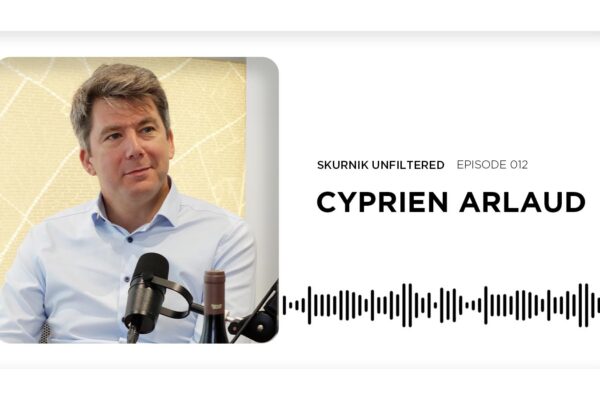
In this episode with American wine expert Camille Elguero, Martha shares the 3 key lessons she brought back from Italy, the charming story behind her Post-Flirtation label, and the joys of motherhood as a woman working in wine.



Next week, tune in as German wine expert Michael Lykens returns for a chat with Lara Haag of Schloss Lieser.
Be sure to subscribe to Skurnik Unfiltered wherever you find your podcasts so you can stay up to date on all the exciting content to come.
Introduction
Martha Stoumen:
You know, trends come and go, but I think there always is an evolution. I think the way I try to approach wine as well, and food, and anything else in life, even clothing, fashion, like what you like and trust your gut.
Harmon Skurnik:
Hey, this is Harmon Skurnik, and welcome back to another episode of Skurnik Unfiltered. Today, I’m sitting here with Camille Elguero, who is a portfolio manager here at Skurnik for our American wines, and you recently sat down with none other than Martha Stouman.
Camille Elguero:
Yeah.
Harmon Skurnik:
She’s fun. She’s a really excellent winemaker and very passionate. Tell us a little bit about your conversation.
Camille Elguero:
Martha is a Sonoma County native. She grew up in Sebastopol. It was great to hear from her about what that has led to and what her philosophy of winemaking is. She’s a first generation winemaker, which is difficult in California. It’s not an easy place to start a brand. And I think at this point she’s in over 10 years, but she’s grown her brand organically, slow growth.
Harmon Skurnik:
She’s grown her brand organically, and she grows her grapes organically as well.
Camille Elguero:
Yeah, that’s definitely a focus for her. Her focus is it’s more of a negotiant model.
Harmon Skurnik:
Whereas she doesn’t own her own vineyard, she buys grapes from mostly organic vineyards, I believe, right?
Camille Elguero:
Exactly. Multi-generational families who have been growing grapes in California since, you know, the 1850s.
Harmon Skurnik:
But she’s not making what’s typically made in California: Chardonnay, Pinot, Cabernet. She’s focused on mostly Italian varietals, I think, right?
Camille Elguero:
Yeah, that’s right. She was inspired by her time in Tuscany and in Sicily, which is where she sort of cut her chops and learned about the wine industry. So she’s taken an approach of farming first, which is why she definitely puts organic viticulture at the forefront of what she does.
Harmon Skurnik:
Her time in Sicily, that would explain her producing Nero d’Avola, which is not that common in California.
Camille Elguero:
Yeah, exactly. So when she came back from Sicily—she worked at COS…
Harmon Skurnik:
Oh yeah. Occhipinti and COS, yes, both of which are very naturally produced wines. Their philosophy is very natural. And Martha’s philosophy is very natural as well, isn’t it?
Camille Elguero:
Yes, definitely. She’s definitely a low-intervention winemaker. That really spoke to her when she worked with Giusto Occhipinti. She talks about mentorship and the importance of mentorship in winemaking because you only get one shot per vintage to make something great.
Harmon Skurnik:
So she had her mentors, and she’s mentoring others now, I assume.
Camille Elguero:
Yeah. Another thing we talked about was the importance of collective winemaking.
Harmon Skurnik:
How does she define that?
Camille Elguero:
So it’s kind of a way to pool resources to take care of the less sexy parts of winemaking, such as compliance and that kind of thing. And it was also an opportunity to start her brand when she was relatively young. I think she was still in her 20s when she started Martha Stoumen. And she pooled resources with some of her friends from UC Davis. That’s when I met her, actually.
Harmon Skurnik:
When you say she pulled resources with friends, are you talking about—because I noticed she used to make her wines at Pax Mahle’s facility in Sonoma? That’s where Carlo Mondavi makes RAEN, and that’s where Pax makes his wines. Is that what you mean by the collective?
Camille Elguero:
Yeah, actually, before that, when she started her brand, she was with a few of her friends that she met at Davis. And then during that time, she was also working at Broc Cellars. So she’s always really appreciated the collaboration element of making wine in a facility where others are making wine as well.
Harmon Skurnik:
And now she’s recently departed the collective with Pax and she’s joined another collective, isn’t that right?
Camille Elguero:
Yes, she’s at Overshine Collective now. Their aim is also to pool resources and utilize their different strengths.
Harmon Skurnik:
So her most popular wine, I would say, is called Post Flirtation, isn’t that right?
Camille Elguero:
Yes.
Harmon Skurnik:
And did she talk about the story of how that was named? It’s really, really fun.
Camille Elguero:
Yes, it’s a great story. And she does get into that. She gets into a little bit about the artwork. It’s really wonderful. She’s just a very down-to-earth, wonderful human.
Harmon Skurnik:
She’s a wonderful person, winemaker, and she makes wonderful wines. Let’s listen into your conversation. And I’m sure everyone who’s listening will agree.
Camille Elguero:
Great. Let’s do it.
[music]Learning to farm in California and Italy
Camille Elguero:
Welcome.
Martha Stoumen:
Thanks for having me.
Camille Elguero:
Starting off with early inspiration, how did your academic background—I know you went to UCLA for geography and environmental studies, and then you followed that with a master’s at UC Davis—how did that experience influence your approach to viticulture and winemaking?
Martha Stoumen:
I grew up in kind of a hippie-ish community, although my parents would never say they’re hippies. We lived on part of an old apple orchard and had veggie gardens, and so I was always interested in the environment and how we interact with it and how to responsibly interact with the environment, but also all of the most amazing, tasty things that come from our environment. So I went to study environmental studies, as you mentioned, and geography, which is a little bit of a kind of catch-all, like a kind of renaissance-type studies where you can get a lot of little bits of everything. And then my Italian minor. After I graduated, I really wanted to take all those experiences and start working. I became most interested in smaller-scale traditional agriculture and these closed systems where you’re using, say, manure from the animals that you’re raising and making compost and putting in a veggie garden, kind of these full circle systems. There aren’t as many of those in the United States. I wanted to continue practicing my Italian, so it’s just a lot easier to do that in Italy, believe it or not, so I went to work on a small farm there.
Camille Elguero:
That’s so cool. And you were in Tuscany first?
Martha Stoumen:
Yeah, exactly, this internship program at this small farm called Spannocchia, right outside of Siena, you can rank what kind of job you want for the three months you’re there. And there was one in the vineyard and the olive orchard, and that was my first choice.
Camille Elguero:
Well, that’s so cool.
Martha Stoumen:
I thought it would be fun.
Camille Elguero:
Yeah, and you mentioned coming from apple orchards. That’s Sebastopol, right?
Martha Stoumen:
Yes, exactly. From Sebastopol Apple Orchards. The orchard was not commercial. It had been divided into three large parcels, and we had the largest one of it, but it was a lot of picking apples, a lot of pruning and things like that, and then we would press cider every late summer. I worked basket press when I was very little, but just different fruit. It was really fun. Also it was cool because the apples themselves were no spray. The trees were close to 100 years old. It was a mixed orchard. So I got these ideas of older plantings of things are really interesting in terms of flavor, and these mixed orchard or mixed vineyards are really interesting as well.
Camille Elguero:
Speaking of your Italian influence, that’s where you first started in Tuscany. How did that experience shape your views on sustainability and farming?
Martha Stoumen:
I was already on board when I went there. It was part of the reason I wanted to, but I think there’s always what you learn in school or what you learn by reading a book, and then there’s the actual practical application, which is always far more complicated than what you’ll read about. That’s also something that really, really taught me early on to understand, what this actually means when you try to achieve certain farming practices. There’s the ideal, and quite frankly, even the best farmers, you’ll never reach the ideal, but it’s good to have one. And then understand all of the different forces, like how much extra labor does it take to do those things? It’s all very important, especially for me in California now, working with a lot of grower partners that I’ve worked with, some of them for 10, 11 years now. And if you have the practical knowledge, you can really relate to the people side of the farming a lot more too, right? So I think that was probably the most important lesson for me.
Camille Elguero:
It’s cool to hear you talk about how you started farming first, because I think that’s relatively rare in this industry. A lot of people go backwards, go wine first, and then they get into the soil.
Martha Stoumen:
I definitely wasn’t wine first. I mean, I thought wine was really sexy and interesting, and that’s why I chose like, Oh, I want to be in the vineyard and the olive orchard, olive oil and wine, like, what’s more exciting than that? But yeah, when I started this, they also put me in the little cantina, which is a little cellar on the farm. And I mean, I had tasted wine a couple times, but I didn’t even know what makes a wine a red wine is the pigment in the skins, and that you fermented on its skins. Like, I had no idea. So it was definitely a farming up background.
3 lessons from apprenticing in Italy
Camille Elguero:
What key lessons did you bring back to California from these experiences?
Martha Stoumen:
I was reflecting on this, and I think, well, one is the importance of mentorship in this industry. It’s something I think probably that goes beyond winemaking production, but certainly— I describe it sometimes, “Winemaking is like owning a restaurant, but you only get one night per year to like practice your cooking.” We have one harvest per year. You get one chance to pick it properly, you get one chance to ferment it in the best way you can. And then two years might go by aging it before you even see the results of your labor. So it’s such a slow process that I think I am proudly a first generation winemaker in California, but I think I wouldn’t be able to do that without mentorship. And there’s been a few people around the world who’ve really influenced me in that way and have been very generous with their time and lessons. And so I think it’s an important part. I actually don’t even know what the wine industry would look like without that kind of apprenticeship program. I think the other two things that I learned were just very almost too straightforward for me to see. But there was one time where when I first got to COS, Giusto Occhipinti said, “Okay, tomorrow go out to the vineyard and taste the different blocks and see if we’re ready to pick,” which, you know, picking is like probably the most important decision you can make all year. So as an intern, I thought to myself, like, Okay, you really want to trust me with this? And I said, “No, no, I couldn’t, I’m not that experienced.” And Justo said, “No, you’re human. You know what good flavors taste like, you know what ripe fruit tastes like. Go out there and tell me what you taste.” I think the way I try to approach wine as well, and food and anything else in life, even clothing, fashion, like, like what you like and trust your gut. It’s a very important lesson for me. And then the third thing I think I learned from that experience was, it was in this part of Sicily where we were at about 400 meters and then close to the coast, and you had this warm wind coming through all the time, dry climate. And one day, we’re looking out over the landscape, and Giusto said, “You’d be crazy to not farm organically here. You have the ventilation, you have the dry wind, you don’t have this prolonged wet spring.” And I thought to myself, Okay, when I go back to California, I want to find a region where there’s just less disease pressure. And that will be where I decide that I want to work. It won’t be because of the grapes they grow there. It’ll be because I can farm with fewer inputs. And then because I found these warmer pockets of California, that means that I do have to grow grapes or work with grapes that can hold up to the heat and maintain natural acidity. But that was really the anchor of all of it. So if you want to farm with minimal inputs, use the environment to your advantage.
Starting Martha Stoumen Wines
Camille Elguero:
You started your label, Martha Stoumen Wines, in 2014. What challenges did you face as a new winemaker in California and how did you overcome them?
Martha Stoumen:
There are two sides of the coin in California. One is that you can do anything, which is really wonderful. We don’t have these AOC laws telling us what to grow or what to make. We do have some tradition, but not so much that people feel like they have to do any one thing. So there’s a lot of freedom and liberation there and experimentation that still can happen, which is exciting. But the other side of the coin is that it’s a well-established region. Everyone competes for the land in California, whether it’s housing or other types of agriculture. It’s quite costly, to put it bluntly. So from the farm, quick fast forward, I did a few more apprenticeships after the farm, just in wine specifically. Went to get my degree at Davis, did a few more apprenticeships in some assistant winemaker positions. And then there was an umbrella company my friends and I started, all four of us together put our money in the same pot so we could share equipment and share even the umbrella of the business: compliance, all those things that you don’t really talk about and don’t want to talk about, but are necessary for running a winery. I think that’s how we took that challenge. And I’ve actually worked in shared winery spaces ever since. You know, it’s a necessity, but as it’s become less of a necessity, I still really like it. I like the camaraderie. I think that was it. But it’s kind of like, if there’s a will, there’s a way. It feels, again, balanced in that it’s expensive, but there’s also so much freedom in it. And the fruit. I mean, the access to old vine fruit—this is something that people haven’t really talked about that much in California as winemakers, because we have this idea that the grower-vigneron model is the best model. I think it’s a different model. So, a lot of California winemakers don’t necessarily celebrate the fact that they work with growers and don’t grow a lot of their own grapes if they’re younger. Some do, but the estate model is actually less common in California than the model where you purchase fruit from growers. But it is, I think, one of California’s best resources in terms of winemaking. I work with many multi-generational families who’ve always grown wine grapes, but they don’t make wine. So that’s this beautiful, I wouldn’t say untapped resource, but it’s a resource that I think is really special to California.
Camille Elguero:
Yeah. I love that you work with interesting varieties. And as I taste more and more wines from California, I’m always surprised that there are these older vineyards that are growing, you know, Nero d’Avola, just all these different varieties, not just Pinot, Chard, Cab. Do you have a favorite vineyard that you’ve been working with for the longest?
Martha Stoumen:
Gosh, there’s a couple, but one of my favorites, well, two of my favorites, I’d say, are Venturi Vineyard and Rossetti Vineyard. A lot of these vineyards that were planted just after World War II are owned by these Italian families who, again, have passed it on—multi-generational farms. Both Rossetti and Venturi grow Carignan that I work with, which is, I think, one of the unsung heroes of California, especially when it gets to be old vine. It’s really, really, really special. I think it expresses itself differently in California than any other place. And then Rossetti Vineyard, there’s also Valdiguié and old vine Colombard, which is— it’s harder to find old vine white fruit, which is really exciting to me as well. And just the vineyard itself is so beautiful and not overly fertile, but these vines, when we’ve had a couple heat waves here and there, you see these old vines, they’re like forests. They really are able to create their own little microclimate and I feel like they’re very resilient.
Camille Elguero:
Yeah. I feel like there’s also this misconception of California as a recent wine-growing area and there aren’t older vineyards there. But how old would you say an old vine vineyard is that you work with? Because I think people assume that there aren’t these vineyards.
Martha Stoumen:
The oldest vineyards I work with are the 1948 plantings, so just after World War II, which is still pretty old. There are plantings that are back to the 1900s, early 1910s. Prohibition kind of threw a wrench in a lot of these, you know, a lot of vineyards were pulled out. Interestingly, the vineyards, even though we don’t have this Cru classification system like you would over in Europe, I guess one of the silver linings of Prohibition is that people pulled out their worst vineyards first and their best plots were the only ones left. So if a vineyard did make it through Prohibition, certainly probably 90% of that was financial, that the family could hold on financially. But 10% of it was that it was just the best site the family had. So it’s kind of a roundabout way to have a Grand Cru type site.
Camille Elguero:
Yeah, that’s a cool perspective. I haven’t thought about what survived during that time.
Martha Stoumen:
Yeah, but a lot of these families have been around since—at least in inland Mendocino, where I work—primarily since the 1850s. So, it’s got a good bit of viticulture history.
Camille Elguero:
Yeah, wow. That’s really cool.
Honeymoon White and Post-Flirtation
Camille Elguero:
Let’s pour a little bit of this Honeymoon White that you made.
Martha Stoumen:
Yeah. Speaking of old vine, this is old vine Colombard, those 1948 plantings I talked about, head trained and dry farmed, which is fairly rare in California, but I really love dry farmed fruit where the roots go really deep into the soil. And then 30% of this is old vine Chardonnay. Colombard is a grape. One of its parents is Chenin Blanc, so if you leave it on the vine, let it hang into the later part of fall, you do get this beautiful honeyed note, which is part of the reason I named it Honeymoon. Cheers.
Camille Elguero:
Awesome, cheers. I love this label. It’s so pretty.
Martha Stoumen:
Thank you. The texture.
Camille Elguero:
Yeah. Does the same artist do all of your more single vineyard or—not single vineyard necessarily always, but…
Martha Stoumen:
Yeah, some of the smaller production wines. Her name’s Carolynn Haydu. She’s a collage artist out of Oakland, and she does these, like, she paints paper or stains it. Sometimes she uses natural pigments or coffee or things like that. And then she cuts them out. And they’re pretty large. They’re often four feet or so and very textural. And that’s one of the things I think about when I’m drinking wine the most. That’s what gets me is the texture of the wine, what I click with.
Camille Elguero:
I love collage. It’s so cool. And I really I love the Post-Flirtation label. I mean, everyone loves that label. Do you want to tell the story again?
Martha Stoumen:
So Post-Flirtation was, gosh. I had just started dating this guy who I don’t think understood how demanding harvest is. I think he thought I was kind of playing hard to get. And I was like, No, I just work 14-hour days for three months straight. But he was trying to find ways to see me. So he’s like, “Oh, I’ll bring takeout to the winery.” It was 10 p.m. I had barrels all over the floor. And he’s like, “It looks like you have a bit of work to do. How can I help?” I said, “Okay, I’m doing a filtration trial where this side of the room’s been filtered, this side it hasn’t. Can you take a sample of this and write ‘pre-filtration’ and a sample of that side and write ‘post-filtration’ on it? And I’ll taste them in a week and see what we think we should do with the wines.” And I pulled the bottle out like two weeks later, and he’d written ‘Post-Flirtation’ on it and drawn little hearts on the painter’s tape on the bottle. And then he ended up drawing the label, and he’s my husband now.
Camille Elguero:
It’s a very cute story.
Martha Stoumen:
Yeah, it’s really sweet. I love his artwork.
Camille Elguero:
I love that label.
Being a working mom
Camille Elguero:
How is it being a mom in this industry? I know it takes a lot of time during harvest.
Martha Stoumen:
Yeah, that part is hard. My husband’s been really wonderful about that. We try to have pizza night at the winery once a week. He often brings my son, August, who’s now five, to the winery after school. I tried early on, when he was a baby, have him in a carrier and do barrel work, and he was just not having it. I have a lot of female friends who are all working professionals and they have different demands. One works in media, so she has to be available at all times of the day for the news cycle. I think it’s all a balancing act for sure, and you’re personally—I shouldn’t project, but I have a feeling that most mothers are never gonna feel like they have it down and your child’s always changing. But it’s exciting too. I mean, I just love seeing everything through a child’s eyes. It’s really exciting. And winemaking is a very tactile, sensory, sensorial process. And he loves witnessing it. He loves riding on the forklift mostly, but he’s getting into this idea of like, oh, you know, it’s kind of cool. He can explain at five years old what his mom does.
Camille Elguero:
Yeah, that is very cool. I feel as if a winery is a child’s dream. Squishy things, bubbly things.
Martha Stoumen:
Oh, yeah.
Camille Elguero:
Trucks.
Martha Stoumen:
Yeah, going to the vineyard, it’s just a really wonderful place for him. So yeah, he’s excited. In his bath, he’s making wine with the bath water. That’s pretty cute.
Camille Elguero:
That’s great.
Martha Stoumen:
And he loves opening bottles at a party. I’m like, Oh, you like to be the one who’s going around, getting the attention, being like, “Look what I have.”
Camille Elguero:
That’s so great. What a different experience that must be. You were picking apples, he’s making wine.
Martha Stoumen:
Yeah, it’s really fun. So we’ll see. I don’t have expectations for how things are—he’s only five—how things are gonna turn out, but it’s fun and as demanding as it is during harvest, it feels like a place where he can come. And thank goodness for my husband’s support because he does do everything for the household during harvest. Like, everything.
Camille Elguero:
That’s so special and wonderful.
Martha Stoumen:
Yeah. Luckily my husband loves wine too, so he knows it’s for a good cause.
Looking to the future
Camille Elguero:
What are your goals for Martha Stoumen Wines? And how do you envision the future of low intervention winemaking in California?
Martha Stoumen:
Yeah, I think low-intervention winemakings always come from this place of loving elemental flavors, really wanting to represent the territory and love of tradition, of winemaking tradition and craft. When I first started making natural wines in my own business in 2014, it was very much like— I feel like so many publications said that I was a rebel and I was like, “Little do they know,” but I guess it never felt like as much of a risk as people framed it on. It felt like a very natural progression. You know, trends come and go, but I think there always is an evolution. Our food’s gone in that direction where it’s like, Hey, we don’t want everything to be a commodity. We want to eat real food. And I think we’re eating lighter foods. I think we’re eating foods that are not just European foods as well. And I think our wines should evolve because that’s, I feel like, the best companion: wine and food. And so if our food’s evolving, our wines need to evolve as well.
Camille Elguero:
Thank you so much for being with us. This was lovely.
Martha Stoumen:
Thank you. Cheers.
Skurnik Unfiltered is recorded at Skurnik Wines & Spirits headquarters in the Flatiron District of New York City, which is why you might hear some city noises as we go along, like horns honking. If you found the conversation interesting, please consider liking, subscribing, and leaving a review. You can stay up to date on our show and upcoming events by following @skurnikwines on Instagram and visiting our website at skurnik.com