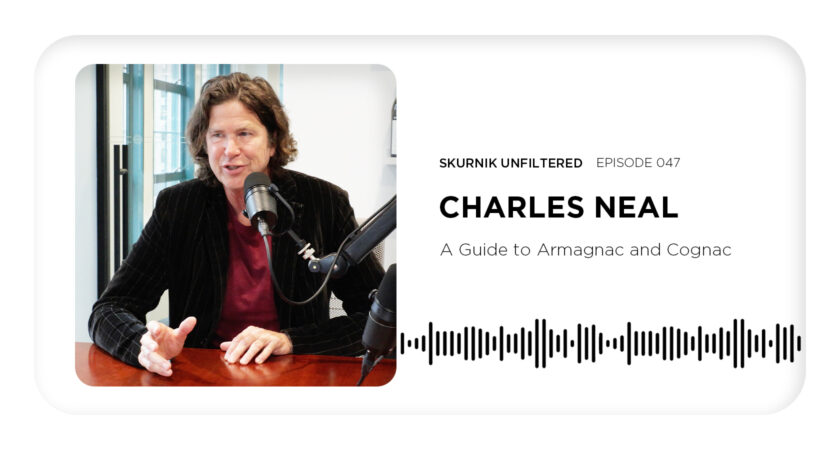
Like Champagne, a handful of big houses dominate Cognac. Also like Champagne, it’s the small, independent producers that offer more compelling expressions—and they have better stories to tell. Charles Neal has devoted his life to telling those stories.
As a young man, he was enchanted by life in his wife’s hometown, in the heart of France’s Armagnac region, where her family ran a small restaurant. His father-in-law introduced him to Armagnac, and his fascination with the French brandy tradition led him to discover Cognac and Calvados. To date, he has compiled hundreds of interviews with multi-generational grower-producers and published thousands of pages across several comprehensive books on the subject. To many, he is known simply as Armagnac Man.
In this week’s episode, Skurnik’s Spirits Portfolio Director Adam Schuman and his good friend Charles retrace their well-worn path from the Bas-Armagnac to the Grande Champagne region of Cognac, sharing anecdotes about the paysans and lessons about the spirits along the way. They discuss the history and methods that make a small cohort of French brandies among the most exquisite and—for those in the know—the most criminally undervalued distillates in the world.



Next week, Andrea Sottimano joins the podcast to share his extraordinary Barbarescos.
Be sure to subscribe to Skurnik Unfiltered wherever you find your podcasts so you can stay up to date on all the exciting content to come.
Introduction
Charles Neal
It seems that every five years or so, all of a sudden whiskey prices take a bump. And so people say, Oh, let’s get into Armagnac. And they buy a number of Armagnacs and stuff like that, but then they eventually go back to whiskey again. The question is, why do they do that, and what can Armagnac do to retain that customer rather than allowing something like that to happen?
[music]
Harmon Skurnik
Hey, this is Harmon Skurnik. Welcome to another episode of Skurnik Unfiltered. Today I have with me Adam Schuman. Welcome, Adam.
Adam Schuman
Thanks, man. Happy to be here.
Harmon Skurnik
Adam has headed up our spirits portfolio for almost 15 years. And recently you sat down with, I would say, the OG of our spirits here at Skurnik, Charles Neal, who has curated a portfolio of incredible spirits from France: Armagnac, Cognac, Calvados. They were really our first forays into the spirits world because we knew Charles going way, way back. He was a retailer on Long Island, and he came to us at some point and said, “I’ve curated a portfolio of Armagnac. Would you like to take a look at it?” And because we knew him and respected him, we did, and tasting was believing. One thing about Armagnac is that not that many distributors or importers focus on this category.
Adam Schuman
That’s a tough category.
Harmon Skurnik
So he went there and had the pick of the litter, and he came back with Domaine Boingnères and Ravignan and vintages back to the 1970s, and we were just blown away.
Adam Schuman
He cares about this in a way that I think most people do not, and he’s been writing—you know, he’s an author—and he has tomes on each of these categories. He’s rewritten the tome. And he’s been helping to steer these producers to not use adulterates, to produce and bottle these very pure expressions of incredible brandies. And these are his people. These are not just producers to him or to us. These are his friends and his family, and he’s been doing this thing for quite a few decades.
Harmon Skurnik
It’s not a particularly affluent region, and he’s done a lot for them by bringing their incredible spirits to America and helping to expand and make their business successful.
Adam Schuman
Yeah, there’s a real juxtaposition. When you go to some of these places, start in Gascony, you have a château with a château owner who might be château poor because what it means to maintain a château is a real situation.
Harmon Skurnik
Yeah, like a 400-year-old château with no insulation in the walls and no heat.
Adam Schuman
That’s right. Huge grounds to upkeep, and what it means to maintain that culture and that business. And then you walk right next door or you drive down the block next door and you’re sitting at a table with a family who speaks zero English, who is as—let’s call it paysan or rural. I mean, just we’re in the country here.
Harmon Skurnik
Foie gras on the table?
Adam Schuman
Foie gras on the table. Especially in the south when you’re in Gascony, home of foie gras for sure. But then you get up to Cognac, and it’s a very different, it’s much more similar to Champagne. There is more money. It’s controlled by the big houses and the towns run by the negociants who pay a premium, so you’re guaranteed a certain amount of money. It’s very similar to Champagne. Every inch of this beautiful place, every inch of it is planted with grapes, just like Champagne.
Harmon Skurnik
Amazing. I’m also partial to Calvados, and I remember when Charles first brought us Camut, for example. I mean, those spirits are among the best spirits in the world.
Adam Schuman
Yes.
Harmon Skurnik
I think.
Adam Schuman
Yeah, everyone thinks. And they’re alright. You’re alright. And I could tell you we always finish our trip there. We start in the south and we work our way back and end up always, the final visit is with the brothers Camut: Jean, Gabriel, and Emmanuel. Emmanuel is one of Charles’ closest friends.
Harmon Skurnik
Don’t they have a cellar that goes back into the 1800s or something?
Adam Schuman
It’s wild. It looks like coffee. There’s this layer of oil on top, and what rancio means, as these flavors change over time is incredible, especially in Calvados, including Calvados. But this is the home of all the triple-cream cheeses, Livarot, Pont-l’Évêque, Camembert, all this. There’s Andouillette, there’s this tripe sausage…
Harmon Skurnik
Health food, in other words.
Adam Schuman
It’s just incredible. And when you think about all these brandies through the lens of gastronomy and food, it all starts to make a ton of sense. And traveling with Charles, who’s been helping put food on the tables of all of these friends of his and ours for all of these years, you get a very different experience.
Harmon Skurnik
On that note, let’s listen to your conversation with the legendary Charles Neal. Hey Charles. It’s a fun one.
Charles’s origin story
‘Adam Schuman
Bonjour Charles.
Charles Neal
Ça va, Adam?
Adam Schuman
Ça va bien. Comment t’allez-vous?
Charles Neal
Je crois quand peut dire a tu…
Adam Schuman
You stop it. I just spent it all.
Charles Neal
Right.
Adam Schuman
Hey man, how you doing?
Charles Neal
Good.
Adam Schuman
Yeah?
Charles Neal
Good to be in New York City again.
Adam Schuman
You flew in when?
Charles Neal
Yesterday.
Adam Schuman
Yesterday.
Charles Neal
Yeah.
Adam Schuman
I flew in this morning.
Charles Neal
I can’t believe that you woke up at five in the morning and made it here in two and a half hours or something like that.
Adam Schuman
Yeah, well, I got a good night’s sleep. I was reading some some Charles Neal books.
Charles Neal
I’m not sure how to take that, actually.
Adam Schuman
Well, it was specifically Tape Delay.
Charles Neal
Oh, look at that.
Adam Schuman
Because I wanted to get my fix on 80s… I don’t know. I haven’t actually looked at it yet, b ut it’s pretty good.
Charles Neal
80s musicians and interviews with those, yeah. Yeah, that was the first book that I wrote, back when I lived in England. I lived there for five years.
Adam Schuman
You lived there for five years and and then you made your way to France? How’d that happen?
Charles Neal
No, I made my way to Spain, actually. I went to Spain because I wanted to learn Spanish. I also had an idea for another book to write, which was a novel. And that was written and published. I had gone there with my wife. We weren’t married at that point in time. And then to Italy for nine months, lived in Rome, and I wrote another novel there. And then moved to France, got married, and moved back to the States.
Adam Schuman
Amazing. And moved back to the States to New York?
Charles Neal
We moved to New York. And that’s where I first got involved. Uh no, actually, we moved to Texas. I’m sorry. We moved to Austin, Texas, and then to New York, and that’s where I basically got involved in the wine and spirits industry.
Adam Schuman
I want to say Oyster Bay?
Charles Neal
No, the store that I worked at was in Huntington.
Adam Schuman
I’m familiar with it.
Charles Neal
I grew up in Northport, so I was not too far from there. But we were living in Queens, in Astoria.
Adam Schuman
Ah. Yeah. For those who don’t know, Skurnik’s office was off of Underhill Boulevard in Syosset, and we used to take the Huntington line every day, reverse commute.
Charles Neal
That’s right. Back in those days, I became the buyer for imported wines at the store. And after several years, my wife and I decided to move to California. I was working at another store out there and went to France to write another book, and this time I thought I would write a book about a subject that was from my wife’s area in France, which is the Armagnac region. I decided to spend three months there, live with my in-laws, learn French better. Every day, I went out to see three or four Armagnac producers and came up with this book that basically covered every single independent producer in the area, plus the large houses.
Adam Schuman
Give me the approximate year we’re talking about right now?
Charles Neal
That was 1997, I believe.
Adam Schuman
Ahead of the curve here.
Charles Neal
A little bit ahead of the curve. And then I went back to California, which is where we had moved to, San Francisco, and I didn’t really want to work in retail anymore, but I kind of had to a little bit, just to make some money. But I figured I had all these relationships with producers and knew the subject inside and out, so I thought, why don’t I take three or four producers and try to get distribution for them in the States? Fortunately, it was one of those instances where maybe one phone call gets answered and that changes the course of your life. If that phone call hadn’t been answered, what would have happened? I hooked up with a distributor in California, and then I think I called David Bowler and said, Do you think Skurnik would be interested in doing something with these spirits? And he was like, Yeah, contact Michael and Harmon. So I did, and they came out to California to do something else, and we went out to eat, tasted some things, and they said, Let’s do it. So that’s how that part all started.
Adam Schuman
You’re the beginning of my Skurnik origin story as well, or towards the beginning, because when I first started in 2012, Skurnik was only dealing in a few different spirits. We had Hans Reisetbauer eaux-de-vie, we had some Cognac from Matthew Skoller, Family Tradition, and then we had Charles Neal spirits. And that was the very beginning. You’re one of the first people that I met when I came here, and you were definitely the first trip I took. I remember that first trip with those boys, with Thaddeus Vogler and the team from Bar Agricole, and we ended up in the Gers, right? In Montréal, where your wife is from?
Charles Neal
Yes. She was born, actually, in a town nearby called Condom.
Adam Schuman
Condom?
Charles Neal
That’s a true story. It’s a safe town.
Adam Schuman
Every time, everybody laughs because we’re all like 12 years old, apparently.
Charles Neal
Especially in this business.
Adam Schuman
I hear that the Brits love to steal the sign.
Charles Neal
They do. That’s right. I was very fortunate, in a way, landing in this particular village because her father and mother had the restaurant in the village as well as the local bar. He was president of the rugby club. I mean, I got to the village and everybody knew who I was because I was the one that was going to take away the daughter of this person that was in charge of all this other stuff. But I didn’t know anybody, and so it was difficult. It was very hard at the beginning because I really didn’t speak much French, and it’s a very small town where that was important. But it was a sink or swim situation, so I just had to ingratiate myself to the people and learn.
Adam Schuman
When I think about that town, it’s like a classic town of the region in terms of the center square and the church. You got married in that church?
Charles Neal
Yep, got married in that 12th century church.
Adam Schuman
It’s nice. I have been there with you more than half a dozen times, and the people of the town still know who you are for sure. You visit there often. It’s a beautiful thing to see. And your brother-in-law, Bernard, still has the restaurant, although it’s no longer operating.
Charles Neal
It’s no longer operating. He’s retired, yeah. But that’s another thing. I was very fortunate in that when I first got there, they owned the restaurant. We were living upstairs, and it was like you just go downstairs in the morning, cut a big fat slice of foie gras, and put that on toast, and that was breakfast. And at the beginning, I was like, I guess everybody in France eats like this, until I learned that really foie is more something that people have on Christmas or Easter or something like that, rather than every day. Not Bernard. No, not in the restaurant.
Adam Schuman
That’s how you get gout.
Charles Neal
That’s right. And Bernard was great because when he took over and we started going there, he would just put on these 12 course dinners for us that would start at 11 o’clock at night and go into three in the morning. He’d basically force you to stay at the table from eight o’clock when we got there until 11, just drinking at the bar. And maybe he’d put out a little thing or two. And then when everybody was falling asleep and wasted and ready to leave, he’s like, Alright, everybody, sit down, we’re ready to go. And then he would hit the hammer down, and you would not feel too good the next morning, but that’s the way it goes.
Adam Schuman
To paint a picture, when you go into the restaurant, in the back of the restaurant, there’s some sort of counter, and it’s nothing but magnums and jeroboams of Armagnac. It is incredible. It’s one of those things for years, I don’t know if anyone would would care the same way I do, but I was like, Man, wouldn’t it be sexy if you could just have a bar of nothing but big ‘uns?
Charles Neal
I know.
Adam Schuman
It would be amazing.
Charles Neal
They’re actually called Pots Gascons, which are two and a half liters. It’s sort of an odd-shaped size, but they look like in between a magnum and a jeroboam. And it’s vintages from 1930 through the present day.
Château de Pellehaut in Armagnac-Ténarèze
Adam Schuman
Alright, so let’s talk about it. So we’re in the Gers, and we are using this town as our home base. We’re starting to explore the region and write the book. Why don’t we begin with some producers? We still represent Pellehaut from the Ténarèze. Why don’t we talk a little bit about Pellehaut? Maybe talk a bit about the Ténarèze, maybe talk about the landscape itself when you’re driving around these roads. What does it look like? What does it feel like?
Charles Neal
Armagnac has three appellations: the Bas-Armagnac, Ténarèze, and the Haut-Armagnac. And Haut-Armagnac, there’s maybe five producers that are there. There’s very few people that you see that are actually selling things and putting them on the market. It’s mostly wheat fields or cornfields and things like that. All spirits go through these highs and lows as far as sales go, and there was a particular point in time when Armagnac wasn’t doing very well. I’m going back to like the 1960s and 70s. This was the time as well when stainless steel tanks were coming out, because before that, everything was aged in a large wooden vat or something like that, and so stainless steel tanks came out and they started being able to have temperature control with those tanks. And because the market in Armagnac wasn’t doing very well, they could take those grapes like Colombard or Ugni Blanc, they could ferment them in the stainless steel tanks with cold temperatures, and they could produce these very aromatic wines that were only about 11.5% alcohol because the alcohol level of distillation grapes is low. And they were very fragrant wines that could sell very inexpensively because the yields in Armagnac are very, very high. And so this launched these wines from the Côte de Gascogne, which was a new kind of vin de pays that came out, and they had immense success all around the world. People started focusing more on wines rather than the spirits that they were making. The Ténarèze was the area where the real focus was, and the very eastern part of the Bas-Armagnac. And so, because of that, people started neglecting Armagnac production a little bit and focusing on wines. The Ténarèze was especially important because the soils were clay and limestone. That’s high acid, but also with some body to the wines that you get from those two elements in the soil. Bas-Armagnac was always another area that, for instance, was more sandy soils, and they never necessarily had the success with those wines that you had in the Ténarèze. Pellehaut is one of those producers in Montréal-du-Gers, the town that I was going to, and had a lot of vineyards. When I say a lot of vineyards, I mean they probably nowadays have seven or eight hundred acres of vines, so it’s a lot for the area. And they make a tremendous amount of wine, but they also make a lot of Armagnac. And because they have so many vineyards, for their Armagnacs, they’ve decided for the past 25 years just to use Folle Blanche, which is one of the original grapes of Armagnac, and only planted on their sandiest soils of the property, so it’s going to give a spirit that has a little bit more round quality on the palate.
Adam Schuman
Just for those who don’t know, what are the other varieties of grapes that are commonly used in Armagnac?
Charles Neal
There’s 10 or 12 grapes allowed, but three are commonly used, let’s say: Ugni Blanc, Colombard, and Baco 22A, which was developed after the phylloxera and enabled people to have a grape that basically didn’t necessitate spraying as much as some of the other grapes, would give good yields every year, pretty much, and would give a rich, fat Armagnac that became what was known as the image of Armagnac, let’s say.
Adam Schuman
And the fourth grape is Folle Blanche, which is a real pain in the ass to grow, say some.
Charles Neal
Right. Some people have Folle Blanche. I think 3% or 2% of the vineyards in Armagnac are planted with Folle Blanche now, only. But it’s a grape, yes, that basically buds early, so there’s always the risk of a late spring frost or something like that that’ll wipe out that particular harvest or a good part of it. And you have to spray it a lot more because it’s susceptible to more diseases.
Adam Schuman
Before I worked for Skurnik and started selling spirits, I was just buying the wines for the restaurant that I was the buyer for, the wines of Pellehaut specifically. Côtes de Gascogne, I don’t even remember. It was like Petit Courbu and Jurançon or, what was in there?
Charles Neal
Those would have been the deluxe cuvées. The regular cuvées would have been like Ugni Blanc, Colombard, and maybe a little bit of Gros Manseng.
Adam Schuman
Gros Manseng, that’s right. But they were crushers. They were inexpensive and they were crushers and they had acid and were aromatic, and it was just easy drinking. Ténarèze, if you were to compare Ténarèze’s terroir to that of the Bas-Armagnac, Bas-Armagnac is considered the more premier terroir?
Charles Neal
Yeah, I think. Well, I think one of the reasons for that is because of the sandy soil, and because they don’t necessarily—nor have they ever really—focused on wine production as much as Armagnac production. So if you’re like Château de Ravignan or Château de Briat or Boingnères, you’re not necessarily making wine to sell in bottle. You’re really distilling everything. That’s the entire focus of what you’re doing. Whereas in the Ténarèze, you’re doing both. And let’s face it, you know what side of the toast your bread is buttered on. If you’re selling pallets and pallets of wine for every bottle of Armagnac you’re selling, you’re going to start focusing on wine.
Adam Schuman
Pellehaut is in the Ténarèze and is honestly incredible. Really, really approachable for what Ténarèze can offer. A real tightness to the Armagnac. I think that even in their youth, they’re incredibly expressive and approachable, which is awesome.
Charles Neal
Yeah, I think it’s also important to point out that, for me, to make great brandy, you need to invest in new oak a little bit. If you’re going to make a brandy that’s sort of natural, let’s say, and a lot of people, they don’t necessarily have the money. It sounds stupid because we look at certain places and we see all the barrels and the new oak that people are using, but if you’re a farmer that’s not making all that much money and relying on polyculture and don’t get away from the farm very much, and ultimately you’re not making too much money, buying even one new barrel is something that you might not be able to afford during the year. Pellehaut, I think, is one of those producers that does well through their wine, and they sell a good amount of Armagnac because they distill a good amount. They can afford to buy new oak every year and have somebody working just with their Armagnacs, whereas other people are working just with the wines and things like that. They do pay quite a lot of attention on their production. And because of that, I think that their Armagnacs are quite pristine and display what the Ténarèze displays, which is generally a little bit more force than you get in the Bas-Armagnac, a little bit more punch, let’s say. And their vintages are released at quite a high strength. Often 48-51% alcohol.
Where is the Armagnac craze?
Adam Schuman
Which we have talked more than one time, about how whiskey drinkers identify with Armagnac. Maybe because it’s a bit more bold and a bit more strong and at times there’s maybe more oak to it or something like that. We talk about whiskey drinkers enjoying it, but we haven’t seen the the same popularity in Armagnac as we do in whiskey.
Charles Neal
Not at all. We haven’t seen the same popularity with Armagnac as with Cognac either. But the whiskey thing, it’s an interesting topic. It seems that every five years or so, all of a sudden whiskey prices take a bump and the availability becomes lessened and people are looking for an alternative. And somehow Armagnac comes up in the decision again because, comparatively price-wise, for something that has quite a lot of age to it, it’s a steal, right? And so people say, Oh, let’s get into Armagnac. And they buy a number of Armagnacs and stuff like that, but then they eventually go back to whiskey again. The question is, why do they do that, and what can Armagnac do to retain that customer rather than allowing something like that to happen?
Adam Schuman
There’s probably a bunch of different things that they could do. Consistency would be a good one. You have a wide spectrum of producers with different techniques, not necessarily paying close attention to the consistency. Not always the case, but often you go to this person over here and you’re tasting with grandma and grandpa and mom and dad and children all at a table where they’re just looking at you while you drink, and it’s wildly varying in quality and style. And then you go to the next château over and it’s a completely different style altogether.
Charles Neal
Right. And even producer to producer, not even from one domaine to the other, but within the same domaine, their barrel program may have been completely different one year to another. And the grape blend is different because, let’s just say the Folle Blanche got wiped out or Ugni Blanc, they decided they needed money, so they sold that all off in bulk to somebody and then used other grapes. Where’s the barrel stored? We’ve got several different small cellars at a producer’s place. What position is it in? All of these things that ultimately make it very difficult to come up with something that, year in and year out, is going to have a particular consistency.
Adam Schuman
But there’s beauty in that thing. When you talk about what artisanship is, for good or for bad, there’s something beautiful to inconsistency. It forces you to taste through and find the diamonds in the rough, and it forces some amount of connoisseurship and education because the majority of it probably isn’t what you want.
Charles Neal
No, there is beauty, but there’s also subjectivity in that way, too. And everybody’s palate is different. When it comes down to that, for me, there’s that golden trinity, I suppose, of Armagnac or of spirits in general, which is going to be this balance between the fruit, the alcohol, and the tannin. But you see people writing about certain spirits, and they mention in their review five or six times the word dry, which to me isn’t a compliment about a spirit.
Adam Schuman
It can mean several things, including too much oak.
Charles Neal
It could be too much oak, it could be too much alcohol, but it’s too much of something, right? Yet they love it. And so today, it seems to be with lower alcohol, people aren’t as crazy about it and they want this kind of punch of alcohol. Or there’s a lot of people nowadays that want to sit down at night and they want to taste five things, but a tiny bit in the glass. Whereas I today prefer to have one snifter that I’m going to drink over the course of two hours while watching a movie or something.
Adam Schuman
Yeah, I’ve seen the video. “Hi, I’m Charles Neal, Armagnac Man.”
Charles Neal
Well, Armagnac Man came about because when I first started, back in 1998 I believe it was, I remember going to a tasting the first year. And these were back in the days when everybody that was a supplier at a tasting was in a suit and tie, right? And most people that were coming to the tastings were very well dressed. It was an event, and you dressed somewhat appropriately for it. I was the only spirit there, and people just walked by and looked and just kept walking. And I thought, the next year I’ve got to do something to get their attention. At this point in time, my kids were very little as well, and I went to rent a Superman costume at Costumes on Haight in San Francisco, and I changed the S to an A, so I became Armagnac Man. I remember I had a jacket on when I got to the tasting in my car, and I saw all these people walking with suits on and stuff like that. And I was like, Do I do this? Should I? I mean, am I going to be a fool? And I thought, Fuck it, I’m doing it. So I just took my coat off of and strode in in this Armagnac costume, and I was Armagnac Man after that. It became an image, almost, that people were like, Oh, Armagnac Man is doing this or doing that. It was back in the days where you had to do something to get attention. I mean, even for 10 years in the Skurnik book in New York, I think I was the only spirit. It was one of these things that, by association with things in the Skurnik book and that the products were of quality, they sold. But there was no emphasis or anything when you came on board.
Adam Schuman
Yeah. It doesn’t help that Armagnac is relegated to the back of every single menu as an after dinner digestif. It’s not typically put as an aperitif or in a cocktail, unless those types of bars and restaurants where that’s the thing they do or they’re more experimental. I just think there needs to be a big PR push. And I know that there’s the Armagnac marketing board, but I feel like they haven’t quite nailed it yet. Alright, speaking of quality, I want to talk for one more moment about how you help steer and guide some of these producers towards a certain quality, towards unadulterated, towards letting the art speak for itself rather than doctoring it all up all the time. Obviously, they control their own destinies, but you’ve been working really hard for a long time on trying to steer these folks towards a pure expression of the thing.
Charles Neal
There are additives that are allowed to be put into the spirits themselves, whether it be Armagnac, Cognac, or Calvados, including wood extract, caramel coloring, or sugar syrup and obviously water, those being the four. I always looked at that as being a little bit strange. I don’t want to say cheating, but something that took away from the purity of the particular spirit that one was after. So I started looking for spirits that were made in that particular way. That being said, there might be a couple of producers that for one reason or another added some water to the spirit, or at a particular point in time, maybe did something to a spirit that’s now 30 years old. And it’s very difficult to tell, especially at that age, if something was done. But for things, especially that are young and since I’ve been attempting to work with these people—
Adam Schuman
Let them be young and let them be fresh.
Charles Neal
Or, do that with whatever your other releases are going to be, but let’s just keep the pure stuff for us.
Château de Briat in Bas-Armagnac
Adam Schuman
Let’s move from the Ténarèze into Bas-Armagnac because you’ve got some people in the Bas-Armagnac that we know and we love. Why don’t we start with Briat? How’s Stephane de Luze?
Charles Neal
Stephane de Luze is doing well. I just wanted to also mention that, with the producers that we do work with, they are producers that do have consistency in that they buy new oak every year, in that they’re aging things in a somewhat similar way, using the same distiller every year, et cetera.
Adam Schuman
Yeah, there’s a house style.
Charles Neal
Yeah, for sure. Stephane’s doing well. That’s a domaine that ultimately had a tragedy in that the father and mother died in an automobile accident. He was the only son living in Paris, was forced to take over the domaine without knowing a tremendous amount. Fortunately, his father knew a lot of people and was well liked in the region, so he got a lot of help when he started, and now continues to make very good Armagnac. I think Briat, because they buy a lot of new oak and they use a good amount of Baco generally, I find that their Armagnacs display a lot of richness and roundness and full body. And sometimes with that vanilla note, there is a slight Bourbon-esque quality, I find, to their Armagnacs.
Adam Schuman
Yeah, the colors of the Armagnacs are incredible. They can be deep mahogany. They often tend to have a certain roundness. And I find that when people say, “I’ll have the Armagnac,” that’s what they’re thinking about. Whether that’s correct or not is not the point. It pleases the palate for sure. It’s always a good visit. Alright, so Stephane’s doing alright, splitting his time between Paris?
Charles Neal
Splitting his time between Paris and Mauvezin-d’Armagnac, the château.
Adam Schuman
The château is beautiful. I’ve cooked duck in the hearth there. What is it like at that château?
Charles Neal
It’s great because that was one of your first trips when it was like, alright, we’re going to go to Briat, but he’s kind of there alone. How about if we just buy a bunch of food and take the place over? We’ll bring wine and cook food and stuff like that. And then it turned out where the two people that were looking after the château at the same time also cooked a bunch of food, so we just had a huge food and wine fest with a bunch of Armagnac at the end of it, which was amazing.
Adam Schuman
It’s epic, and it’s gotta be haunted. If it’s not haunted, shame on the ghosts.
Charles Neal
Henry IV, King of France, that was his hunting manor.
Adam Schuman
That’s right, before it was bequeathed to the family of Pichon-Longueville.
Charles Neal
Pichon-Longueville took over, which is another interesting story because, 30 years ago when I started doing this, Pichon-Longueville was a big deal because it was a second growth Bordeaux, and Bordeaux was a very popular wine. When you got into the wine business, one of the first things you learned about was Bordeaux and the classification system, and you knew the names of all these top producers. So whenever I would go to taste Armagnac and people saw Pichon-Longueville on the table, they would say, “I didn’t know Pichon-Longueville made Armagnac.”
Adam Schuman
They still say the same thing.
Charles Neal
No, oh, really?
Adam Schuman
Well, certain buyers who’ve been around for a long time who tasted first and second growth. Now you can’t taste either of those things.
Charles Neal
But I was going to say that nowadays, people don’t learn about Bordeaux. In fact, you talk about a region that’s suffering, Bordeaux is that region. I think people that have gotten into wine in the past 10 or 15 years know more about Grüner Veltliner or certainly Burgundy, perhaps, than they do about Bordeaux.
Adam Schuman
It’s more accessible.
Charles Neal
I remember in this office, I was doing a tasting here and I started talking about Pichon-Longueville, and I saw blank stares on people’s faces, and I was like, Have you ever heard of Pichon-Longueville? And they were like, No. So I was like, Alright, I get it. I guess I’m not going to talk about Pichon-Longueville anymore.
Adam Schuman
Yeah, still part of the tapestry that lines the château everywhere, depicting Henry IV and all the hunting and all this is ridiculous, in the best way possible.
Domaine Boingnères in Bas-Armagnac
Adam Schuman
Close by is a town called Le Frêche, with Martine Lafitte, who’s the owner of Boingnères. How’s Martine Lafitte?
Charles Neal
She’s 78 years old, I think, now, something like that.
Adam Schuman
Living her best life.
Charles Neal
Doesn’t go out too much anymore, but still has Armagnacs in the chai that are among the best in the region, if not the best. Why? Because those soils, I think, in Le Frêche are very, very sandy, this iron-rich sand called sables fauves in French, which gives a spirit that tends to have a lot of delicacy and finesse to it. And because the majority of her vineyards are planted with Folle Blanche, of which she’s a huge defender—more than 50% of the vineyards are Folle—and she invests in a lot of new oak every year. You have these extremely powerful, focused Armagnacs that are laser-like in their precision.
Adam Schuman
They go zippido-doo!
Charles Neal
Yeah. And cask strength. She has a dry chai, so generally you don’t lose a tremendous amount of alcohol there. In fact, sometimes a 20-year-old might be a degree higher than it was 10 years before.
Adam Schuman
Yeah, everything that I’ve tasted is at 48-49% alcohol, and it was distilled at 52%. Super zippy. It’s like the Chablis of Armagnac . It’s got a lot of minerality to it, very floral, but in a very linear way.
Charles Neal
I always say it’s an Armagnac of connoisseurs, really; you kind of have to know what you’re doing when you approach Boingnères.
Adam Schuman
Kinda, or as long as you like alcohol and can appreciate alcohol for the spirit and the quality. When you line them up, you taste, you’re like, Oh shit, that’s the on. There’s something about it that is special. Not masked by oak. It’s really in balance. This whole area is–you talked about foie gras—it’s not a land of waterfowl or something, but I feel like there’s a lot of fowl in general. It feels like there’s like a lot of marshiness to it on these roads.
Charles Neal
Well, I think part of that, Adam, is that one year when we were there, and I think we were running late as usual, between Boingnères and Ravignan. And we were taking this little road, and I did see this sign that said, Flooded Road – Road Closed. But you would never know if that was an old sign that had been there for a while. Maybe the water had receded a little bit and we can make it.
Adam Schuman
And it hadn’t.
Charles Neal
It hadn’t. But I think there was maybe a four-wheel drive truck that had come towards us, and it was like, I think we can make it. Should we go for it?
Adam Schuman
You specifically said, “What we would say, because we’re Americans, is, ‘Let’s go for it.'” And then we did.
Charles Neal
Yeah.
Adam Schuman
And then we flooded the engine and had to push the car out of a flooded road. And then we made it to Boingnères. Or Ravignan, I think we made it to Ravignan. We had left Boingnères after drinking Champagne with Martine and what is her friend’s name?
Charles Neal
Eileen.
Adam Schuman
Eileen. And that was the first time I had pigeon in blood sauce, and that was where I cracked my tooth on a piece of buckshot that I pulled out of that pigeon. True story.
Charles Neal
Good souvenir.
Adam Schuman
I’ve been paying for it ever since. Here I am at 44.
Château de Ravignan in Bas-Armagnac
Adam Schuman
And then we went to Ravignan, and we cannot not mention Josselin d’Orglandes of Ravignan. How is Josselin?
Charles Neal
Josselin’s doing well. Josselin showed up after his uncle died. And Josselin had been in the region living a mile from the château with his parents. Josselin has three major passions in his life: surfing, hunting, but old school hunting, where people are on horseback and he plays the horn, and his third passion is bullfighting. Every day I see, like, five bullfighting videos that he posts on Facebook.
Adam Schuman
Bullfighting like Spanish bullfighting?
Charles Neal
Spanish bullfighting, yeah. A particular bullfighter named Morante de la Puebla, which he adores and is an amazing bullfighter, really. It’s kind of pleasurable to watch these videos of this master in action, so to speak.
Adam Schuman
Very different than the other type of bullfighting of the region.
Charles Neal
The Course Landaise, as they call it.
Adam Schuman
Right, where they have a rope tied to the horn, and then right before the cow strikes the… do we call him a matador? What is this person called?
Charles Neal
You call that an écarteur.
Adam Schuman
They pull the horn.
Charles Neal
Right.
Adam Schuman
And cows aren’t getting hurt in that, right?
Charles Neal
Cows are not getting killed in that, and they’re generally not getting hurt either. They’re vicious, too, you know, as many female cows can be.
Adam Schuman
Okay, so Josselin is doing well.
Charles Neal
Josselin’s doing well. Another domaine between generations. We always see a transition to a new generation. I think now Josselin’s paying maybe a little bit more attention because he studied things and is doing things the way that they should be done, rather than just things in barrel without doing much to them because there was perhaps a lack of attention for one reason or another.
Adam Schuman
Yeah. He’s the best.
Charles Neal
Josselin’s the best, yeah. When we first showed up, it was like, is this Benjamin Franklin or something that’s coming to greet us?
Adam Schuman
He’s got these rosy cheeks and he is a jolly old fellow with the curly locks.
Charles Neal
Curled hair kind of pushed back, yeah.
Adam Schuman
He’s a sweet dude.
Cognac
Adam Schuman
Let’s drive to Cognac. Where are we going? How far? What direction?
Charles Neal
Going about three hours north of Armagnac. We go from a landscape which is really very rural, let’s say, in which there’s a lot of wooded area, a lot of fields of corn and wheat and sunflowers and things like that. People who live there and produce the products are also working in polyculture, so they have cornfields, sunflower fields, some grapes, maybe they raise some ducks or something like that. We’re moving to Cognac, which is more an industry in which the entire region, if you have land on which you can plant grapes, that’s what you’re going to plant. You’re not going to mess around with having corn or sheep or cows or something like that. In Armagnac, people still will be at the domaine on the weekends. They’re not necessarily going away. Whereas in Cognac, you can close the door on Friday afternoon, go off, and then come back on Monday morning. The reason that they can do that is because Cognac is controlled by four major Cognac houses that have reach all over the world in every single country and are funded by multinational companies.
Adam Schuman
Let’s name them real fast.
Charles Neal
Hennessy, by far and away, the largest. Courvoisier, Rémy Martin, and Martell. Those are the four. And then there are a lot of sub-houses underneath them that are large, that are basically broker houses. They’re merchant houses that don’t necessarily have vineyards of their own, but they’re relying on the supply of individual growers who are also distilling and then buying that distilled spirit, blending it together and selling it under their label.
Adam Schuman
Even though that is not the thing that Charles Neal and Skurnik do, no one’s talking smack about these houses because the vast majority of the producers in the region sell to these houses. They put their kids through college. It’s the reason they could afford the Mercedes that they drive and close the doors on Friday, so no one’s poo-pooing the big guys.
Charles Neal
That is true. I think behind closed doors, they’ll say something about the large house because there’s that game too between the large houses and the producer. The large houses don’t always honor their contracts or the price. When things are going well and they’re being paid well, producers don’t say anything, but then as soon as the crisis hits, all of a sudden you start getting the bad talk and stuff like that.
Adam Schuman
But there are a number of producers, and you’re fortunate enough, and we’re fortunate enough to know some of these producers and people really, really well that choose not to go that route.
Maison Dudognon in the Grande Champagne of Cognac
Adam Schuman
Why don’t we talk about Dudognon for a second?
Charles Neal
After working with Armagnac for a couple of years, whenever you would talk to people, they would say, Well, what’s the relationship between Armagnac and Cognac? And so you’d always talk about that. But I thought, why don’t I try to find a Cognac producer? That way, we can also taste the difference instead of just talking about it. And that led me to doing some research, which led me to finding this producer named Raymond Dudognon, who had for years sold to the large houses like Rémy Martin and Hennessy, had a property in the central part of the Grande Champagne, and also had a large collection of older barrels that he was putting onto the market. It was the great new find in the Grande Champagne, Dudognon, and I went to see them and found them more rustic, to a certain extent, than the people in Armagnac who have the image of being rustic. But a lot of the producers that I deal with also have châteaux or make their living off of Armagnac rather than polyculture. I go into the Dudognon chai, there’d be, like, a bicycle hanging up over there, a mattress thrown up against a wall or something in one of the aging cellars. And I found their cognacs to be quite exquisite actually. They tended to have a style which was very unlike most people in Cognac; they didn’t use any of those permitted additives, which I would say, probably 98% of the producers in Cognac are adjusting their Cognac with something. And that’s not new. For 300 years since Cognac’s been exported, people have been using things in their Cognac to create either a particular taste or more than anything else, consistency.
Adam Schuman
Well, can you imagine if you’re one of those four large houses and every time you open a bottle it’s inconsistent? That’d be a real problem.
Charles Neal
For sure, yeah. Imagine things not having the same color, for example.
Adam Schuman
That’s right.
Charles Neal
That’s one of the reasons that Cognac’s also a blend, because that helps you to create consistency than if you’re doing single vintages.
Adam Schuman
And Dudognon is in the AOC that is Grande Champagne.
Charles Neal
Correct, yeah. In a town that was called Lignières-Sonneville. Now it’s changed its name to Lignières-Ambleville.
Adam Schuman
I remember the first time going and you saying, You want to know what the soil is made of? Look at the houses. And you look, and everything has this chalky, limestone-y white vibe to it. You see it in the soil, you see it in the houses. What does that do to the spirit itself, both in the grape and then in the barrel?
Charles Neal
I think it enhances the acidity of the grapes. In other words, it doesn’t allow the alcohol to get too high and it maintains this acidity. And then that acidity, in comparison with the other areas of Cognac, lends itself to a wine which, when it’s distilled, gives a lot of length on the palate and also a lot of longevity to the spirit. I don’t think there are many producers in the Grande Champagne that have been there for a while that don’t have a 35-year-old or a 40-year-old barrel in their cellar.
Adam Schuman
And it’s incredible what a 35- or 40-year-old costs wholesale, what it costs retail. If this was a bottle of scotch, thousands of dollars instead of a couple hundred bucks. It’s it’s truly a great value.
Charles Neal
But that’s one of those things with Cognac. With Dudognon, for instance, they’ll tend to distill their product, and they’re one of the very few producers that’s still using a wood fire to actually distill in their still rather than gas. They generally put it in new oak for a short amount of time, maybe six, seven, eight months, and then change it to older oak barrels. A lot of producers in the Grande Champagne will do that, which prevents the spirit from getting too dark at the beginning. And if it’s going to be 30 or 35 years old, it’s still not black in its color, like you would get if you were using new oak charcoal barrels.
Adam Schuman
And it’s still mostly in the family in terms of production?
Charles Neal
Yeah. Raymond died in 2002. He had three daughters. They each took a part of the property, and the distillery went to Claudine. Claudine and Gerald, her husband, are retirement age now, and their son is working next to them and taking over the property.
Adam Schuman
Incredible spirits.
Selection vs. Reserve
Adam Schuman
And I’ll just mention, for Pellehaut, for Dudognon, for some of our Calvados producers as well, there’s this idea of Selection and Reserve. Selection, you have guided them for cocktail purposes. A little bit younger, a little bit higher in alcohol, a little bit less expensive, but that’s okay because these are going to get mixed with simple syrup and other sweeteners and lengtheners and things like that. And it’s been incredibly successful. And then Reserve is the entry level, maybe you want to take a sip of a thing. This is where it starts.
Charles Neal
Right. Before the Reserve, a 10-year-old Cognac would have been the youngest, or other spirits that we’re talking about. But yeah, that was something when the whole bar movement started resurfacing and people were looking to make cocktails with some of these, but 10-year-old was a little bit too expensive, or at 40% they wanted something a little bit stronger. I was never a big fan of the whole V.S., V.S.O.P. system of naming things, so I thought Reserve or Selection would be a little bit better.
Adam Schuman
It’s worked for us at least. Does it have mass appeal on a retail shelf? Probably less so, but for the bartenders around the country, they’re really into it and have embraced it.
Ragnaud Sabourin in the Grande Champagne of Cognac
Adam Schuman
There are other appellations within Cognac, but for the sake of time, we’re really excited we are now going to be more officially working with Ragnaud Sabourin, also of Grande Champagne, another historic house. You wrote a book on Cognac. What do you know about this?
Charles Neal
In both the wine world or the spirits world, there are certain producers that were around for a long time. Maybe they were involved in politics in some way, like Gaston Briand was, and became known within the region and perhaps had the means as well to distill and save some of their distillate so that after several decades, they started having a fairly large collection of older spirits. And when in the 1950s, 1960s, when the press began focusing on some of the independent houses and things like that, not only with wine, but with spirits, they found that they would go to a place and somebody like Ragnaud Sabourin that had that particular image in the region would receive them. The journalist would be able to go and taste a pristine 40-year-old, 45-year-old Cognac or even older, and write glowing things about the particular domaine, which put them at the top end of the ranking, let’s say, of independent producers. And as time went on, they were actually distributed by Château and Estates. That was a very large company in the United States for distribution that dealt a lot with the big Bordeaux houses and the top growths, etc. They went out of business. And when that happened, it seems like a lot of importers got rid of the spirits part of their portfolio, maybe because it was so difficult to work state to state, as you very well know. And Ragnaud Sabourin began to disappear a little bit. You very rarely saw them in the United States. You didn’t really see them other places. The people that were running the domaine began to be elderly. There was no dynamic, so to speak, there. They still had great spirits within their chai, and they still continued to distill every year, and they still had great terroir, but they were forgotten about. We imported some stuff, and it went down well, but it was on a very small level. And just recently they’ve had an injection of money from a very famous shoe designer, Christian Louboutin, is that it?
Adam Schuman
I know that shoe.
Charles Neal
Yeah.
Adam Schuman
I know at least one of those shoes.
Charles Neal
What you have on your wish list for the holidays.
Adam Schuman
It looks like it was dipped in a Maker’s Mark wax.
Charles Neal
It does. It looks exactly like it was.
Adam Schuman
Or Rocky Horror Picture Show.
Charles Neal
It’s like a Doc Martin dipped in wax or something like that, right?
Adam Schuman
It’s real good. I wouldn’t wear it, but I get it.
Charles Neal
Right. In any event, there’s a lot of potential that everybody sees because the spirits are still great. They’re excellent. The spirits are still the same, and it’s simply getting them into people’s hands now to try them.
Adam Schuman
Yeah, and they run the gamut from a V.S. in a liter bottle—that we’re really pumped because we’ve never had a Cognac in a liter bottle to be able to like bang with in cocktails—all the way up to 35%, 45%, higher proof. That Florilege knocked my socks off. I remember when I first tasted and I remember the notes that I took, and we’re really, really excited to have it in the warehouse now. And man, just this whole region, the flavor profile that both of these producers have and their different styles. I think Ragnaud Sabourin definitely is a richer style than Dudognon, but both of them, the younger spirits, the greenness at 10 years old is still really soft and delicate. And as these spirits age and become 20 years old, maybe they’re exiting primary and getting to secondary flavors of stone fruit, this white peachy thing. And then, by the time you’re at 30 or 40 years old, I think it takes 30 or 40 years to even get out of secondary and into this tertiary quality. It is just the most ethereal, non-cloying that goes on for minutes on the palate without being sweet. These are special spirits that I think more people—I hope more people—will taste and buy.
Charles Neal
Yeah. Let’s hope so. They deserve to be tasted and bought.
Adam Schuman
We appreciate the work that you do. It has helped us grow this category, and we try to preach the gospel, and it’s always a pleasure to do the thing with you and to sit down with you like this.
Charles Neal
Hell yeah, let’s do it again.
Adam Schuman
Let’s do it again.
Charles Neal
Alright. Thanks, Adam.
Adam Schuman
Thank you.
Skurnik Unfiltered is recorded at Skurnik Wines & Spirits headquarters in the Flatiron District of New York City. If you found the conversation interesting, please consider liking, subscribing, and leaving a review. You can stay up to date on our show and upcoming events by following @skurnikwines on Instagram and visiting our website at skurnik.com