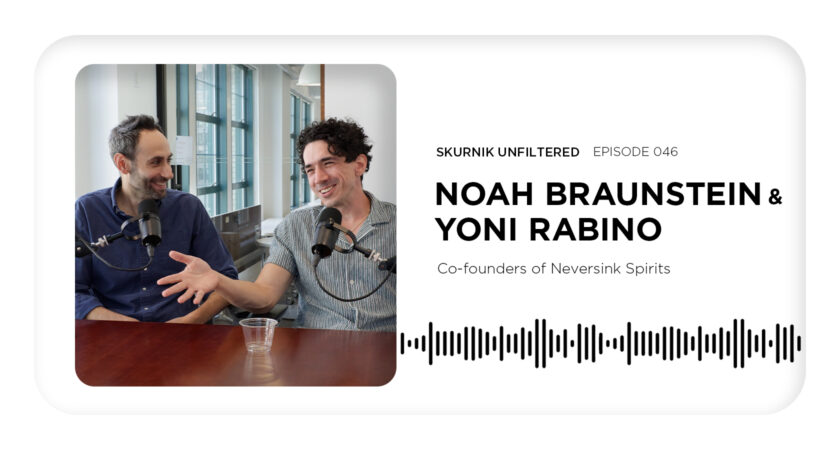



Next week, Charles Neal joins the podcast to talk about his remarkable career discovering Amangac, Cognac, and Calvados.
Be sure to subscribe to Skurnik Unfiltered wherever you find your podcasts so you can stay up to date on all the exciting content to come.
Introduction
Yoni Rabino 0:03
Apples were actually a big part of our history as New York State and as a colony before that. And we like to, in our own way, continue that tradition in just a small way, to showcase the wonderful things that grow in New York State.
[music]
Harmon Skurnik 0:19
Hey everybody, this is Harmon Skurnik, and welcome to another episode of Skurnik Unfiltered. Today I have with me Jared McGuire, the portfolio manager for All Things Spirits at Skurnik and the guy who keeps us all in line and gets everything from all over the world in one place so that we can present it to our customers. Thank you, Jared.
Jared McGuire 0:40
Pleasure.
Harmon Skurnik 0:40
You sat down recently with both proprietors of Neversink or just one?
Jared McGuire 0:45
Both of them.
Harmon Skurnik 0:46
So that would be Noah Braunstein and Yoni Rabino, right?
Jared McGuire 0:50
Yes, sir.
Harmon Skurnik 0:51
This is an interesting origin story, how we got involved with Neversink. My nephew, who grew up in Larchmont, New York, in Westchester County, went to high school with Noah and Yoni. And one day he calls me and said, “Have you seen the New York Times? There was an article about this brand new distillery based in Westchester County. Those are my buddies from high school.” Of course, our interest was piqued, and I got to meet the two of them. And of course, we were smitten with the quality of the apple-based brandies, which, I think, the original product was only the one eau-de-vie.
Jared McGuire 1:26
It was.
Harmon Skurnik 1:27
And very, very high quality. And they were very small. They’re still pretty small, but we were very interested. And now it’s been what, 10 years?
Jared McGuire 1:34
10 years.
Harmon Skurnik 1:35
Amazing.
Jared McGuire 1:35
Incredible. It’s a great origin story, and it’s great that the connection came from the family. And now they have been this fundamental part of the Skurnik family for 10 years. And qualitatively, it’s always nice when someone introduces you, and you think at first, I just want to be friendly and be polite about it. But here we are now with one of our top brands.
Harmon Skurnik 1:56
Sure. And I would say nine times out of ten or greater when somebody from my family says, “Hey, I know somebody who makes wine,” it’s never anything interesting. This was the exception to the rule. I’m glad that we did take it on, and it’s been very successful. They started with that one product, the apple eau-de-vie, and then it’s morphed into pears, I think, now. They also make a gin, which is very popular, right?
Jared McGuire 2:18
Yeah, very popular. This is really the story, at the end of the day, of a couple of kids from Westchester, as you said, who met over a common interest of cooking and science and agriculture and ecology and the natural world. And eventually they started tinkering around and making beer and making whiskey. They said their first efforts, like most people’s, were horrible. And actually, Noah said that his very first encounter with anything fermented was letting apple cider spoil, and that even as a kid, he really, really liked it. So their interests developed, and they also were really captivated by classic eaux-de-vie and brandies, French brandy as well. Originally, that was the core focus, and they found themselves in a rare and somewhat limited company. They made these eaux-de-vie that had initially a fairly limited audience because it wasn’t a very particularly popular thing around here. Eventually, yes, they did expand to making gin. The first release was what we like to refer to as Hummingbird, which is an entirely apple-based distillate.
Harmon Skurnik 3:23
They were inspired by the great eaux-de-vie of Alsace, I believe. And being that it’s primarily apple brandy, New York being the quintessential state for producing apples, it was a nice local story with authenticity of a New York-based product, right? And even the gin’s base distillate is apple brandy.
Jared McGuire 3:43
The original, the hummingbird, yeah. And then most recently, their real rock ’em-sock ’em well gin that we call Pigeon Gin, that they call New York Dry Gin, which is very much in the style of a London Dry, but told through the lens of New York and their entire business inspired by traditions from other places, but told through the lens of the lower Hudson Valley.
Harmon Skurnik 4:04
And it’s worked. Of course, we love our local products. We have the great wines from the Finger Lakes and we have distilleries from Brooklyn and et cetera, et cetera. The local story definitely sells, especially here in New York. On that note, why don’t we listen in on your conversation with the two boys of Neversink?
Jared McGuire 4:22
Great.
Getting to Know Yoni and Noah
Jared McGuire 4:24
I have with me Noah Braunstein and Yoni Rabino of Neversink Spirits. Welcome, guys. Thank you so much for being here.
Yoni Rabino 4:32
Thanks for having us.
Noah Braunstein 4:33
Yeah, thanks for having us, Jared.
Jared McGuire 4:35
We’re going to dig into the details, but let’s go back in time. Where do you hail from, Yoni? Why don’t you start?
Yoni Rabino 4:43
I grew up across Westchester County, New York, in a few different towns. I spent part of my time in Irvington, Mamaroneck, and lived in a few different locations. But most importantly, I’m a New York State native, grew up and spent most of my life in New York State, and I’m happy to be here now.
Noah Braunstein 5:03
This is Noah. I grew up in Larchmont, New York, which is part of Mamaroneck. Yoni and I met at Mamaroneck High School, so we’ve known each other since we were about 14, 15 years old.
Jared McGuire 5:15
You went to Mamaroneck High School and then you found that you had some common interests. What were those early halcyon days like?
Yoni Rabino 5:22
I was new to the school system in ninth grade. Noah’s a year older than me, but we found mutual friends very quickly and became good friends right away and found that we had a lot of the same interests. Before long, we were hanging out and eventually got really interested in various beverage experiments that we’ll get into further.
Jared McGuire 5:44
And you guys were interested, I think, in the natural world, right? The sciences?
Yoni Rabino 5:50
Yeah, I think a big part of our story is exactly that. We both pursued science as our education pathways. We pursued slightly different worlds of science. I was more in the biology, environment, and ecology world, and Noah is more in the physiology world, but we shared that interest from a young age. And a big part of our story of friendship is actually our love for nature and birdwatching as well. We’ve gone on many hikes, camping trips, and birdwatches together.
Jared McGuire 6:24
And I think some of that influence is represented well on the bottles of the brands that we’re going to get to.
Noah Braunstein 6:30
Yeah, absolutely. Before we started Neversink, Yoni used to work about 10 blocks from where I worked in Manhattan, and we would meet up before work and go birding in Central Park. It’s been a minute since we’ve been tracking down birds in New York City.
Jared McGuire 6:45
I’m sure making the time for it today is probably that much more challenging as well.
Noah Braunstein 6:50
Well, we definitely don’t go birding before work anymore. Yoni lives in Westchester and I live in Brooklyn, so maybe on the rare occasion.
Yoni Rabino 6:59
I will say though, I do get rare bird alerts. So sometimes on my way into the city, I will pop into Bryant Park for a quick rare bird spot.
Noah Braunstein 7:08
And to be fair as well, we did take a group of restaurant people birdwatching during migration this year, and we’ll probably do it again next year.
Jared McGuire 7:17
Count me in.
From Hobby to Career
Jared McGuire 7:18
Okay, so a couple of science nerds finding some common interests. You cook, you’re experimenting with fermentation, you each go your separate ways, go pursue science degrees in different fields, and then you stay in touch, you come back. What was the first real collaboration in an alcoholic sense that you guys did together?
Noah Braunstein 7:36
I think we made cider. I actually think that I was away and we were like getting ready to make some cider, and Yoni went to Hunts Point and bought every heirloom apple he could find and then made cider in his Breville juicer. I think it burnt out and he had to get another Breville juicer to finish the job. And that was the first iteration of cider that we made.
Yoni Rabino 8:03
Yeah, we definitely experimented with cider pretty early on. We made some beer, we made some wine, and it was not till a few years later that we really jumped into distilling.
Jared McGuire 8:13
Yeah. At some point, the tinkering becomes more than just a hobby, right? Was there a definitive flashpoint for you guys where you said, “We think we actually might want to pursue this, start a brand”? What was the origin there?
Yoni Rabino 8:28
I think it always has been a hobby and continues to be a hobby. And I think it’s important to maintain your love for what you do every day and your intellectual curiosity. But at the same time, I do think of one series of moments that really set us off on this path. And around 2007, 2008, with the New York State Farm Distillery Act, that helped launch the craft spirits movement in New York as we know it. Noah and I had been pursuing this as a hobby for many years, but we saw some of the early craft distilleries open up in New York. And it was a big inspiration for us. We had been pursuing this solely as a hobby for years now, and we saw this path that all of a sudden seemed to appear as a career. That was a big inspiration for us and started setting us on that path to create Neversink.
Jared McGuire 9:23
I think a lot of people easily forget over the last two decades what the landscape looked like prior to, then in the short time after the Farm Distillery Act, and now how many today are operating out of New York?
Yoni Rabino 9:34
It’s a really good point. At that time, before the Farm Distillery Act came to be, there were only a couple of distilleries licensed in New York. And in 2026, we have approximately 350 licensed distilleries in the state. It’s incredible.
Jared McGuire 9:47
When you launched the brand, what were your early expectations for it? What were you really out to accomplish?
Noah Braunstein 9:54
I think we thought we were going to be the biggest brandy producers in New York or maybe America. It turns out that there’s only so many people that drink eau-de-vie, and things have changed a little bit since the initial days.
Yoni Rabino 10:10
We had very big dreams at that time. We were much younger, and we thought eau-de-vie was going to be the next big thing in the US. And we love eau-de-vie. That’s how we trained as distillers: making eau-de-vie. But we learned pretty quickly that it is a delicious and amazing category of spirits, but it is also very niche. And there are only a handful or a few dozen or maybe a few hundred lovers of eau-de-vie that are actually drinking it around here. So we learned that and took that into account. But it’s still a big part of our history and our story and still something we love to make and something we love to drink.
Noah Braunstein 10:48
Oh, and for the record, I still think that brandy is the next big category.
Jared McGuire 10:52
Before we go micro, I want to go macro. What’s your 30-second elevator pitch? How do you encapsulate the Neversink brand?
Yoni Rabino 11:03
I think for me, it’s all about creating spirits that represent a sense of place rooted in New York State, the Hudson Valley, and celebrating these old-world techniques and old-world styles that we love so much, but also bringing them here to New York to reinterpret them with New York State-grown ingredients in our own style.
Noah Braunstein 11:25
Yeah, and the only thing I would add to that is that we approach every spirit we make with the same level of intention and quality, whether it’s an eau-de-vie that takes 50 pounds of pears to make one bottle, or the Hummingbird Gin distilled from apples, or even the newest Pigeon Gin that’s distilled from corn.
Jared McGuire 11:43
You guys have been with Skurnik for 10 years.
Noah Braunstein 11:48
10 and a half.
Jared McGuire 11:49
10 and a half?
Noah Braunstein 11:50
Yeah.
Jared McGuire 11:50
Who’s counting?
Noah Braunstein 11:50
Yeah.
Jared McGuire 11:51
Considering your steady rise within Skurnik, within the metropolitan area, what has it been like for a young independent distillery to carve out that mindshare, to remain dexterous, to adapt to a changing market, to carve out a niche within the industry? I think people are generally shocked to learn that you’re a two-person team, considering how you’ve been able to grow and adapt within this environment. What are those challenges?
Noah Braunstein 12:25
Well, the growth of Neversink has been, I would say, fairly organic. And the most critical thing for the growth of Neversink has been our relationships with people that we’ve met in the industry—restaurants, beverage directors, bartenders—but also the team of Skurnik, people on the distilling side, and we have people that package the product for us. So it’s not just the two of us, we’re just the only two employees of the brand.
Yoni Rabino 12:52
It is Noah and me who drive the brand forward every day, but we’ve had amazing help and partnerships from Skurnik, from the production team we work with, and from many other people inside and outside the industry. It’s been a team effort for sure. We’re excited that there is so much of this organic growth that people see the brand and they tell their friends and restaurant folks will get excited about pouring it. So it’s been a collective effort, I would say.
Representing New York Agriculture and History
Jared McGuire 13:21
Tell us about the name Neversink and the New York waterway that you’re honoring with it.
Yoni Rabino 13:27
Before I started Neversink, I used to work at the Nature Conservancy, which is an amazing environmental organization, doing amazing work nationally, internationally, and locally. And one of the projects that was a big project for us at the time in New York State was along the Neversink River and Neversink watershed. And that stuck with me. I thought the project was really cool and important, but I also think that water is just so vital. And for distilling and for brewing and for making beverage, water is the most important ingredient that you can use. It stuck with me. It stuck in the back of our minds. And when we were talking about our philosophy and our approach and our style, we kept coming back to this idea that we wanted to showcase something about New York State and really represent New York State. It made a lot of sense to us to represent the New York watershed that’s so vital to all of us here in the metro area and provides water to the distillery itself as well.
Noah Braunstein 14:30
Yeah, it’s really the river and the reservoir. There’s also the Neversink Unique Wilderness Area, which is a really beautiful state park up there. The town has a cool story in and of itself. They built a dam and they flooded it to create the reservoir. And that has a complicated past, but it is ironic that the town of Neversink was sunk. And that town was a dry town until very recently.
Jared McGuire 14:59
Ha! Until they flooded it.
Noah Braunstein 15:00
Ha! And there was a hotel basically on the border of, I think it was Rondout and Neversink. One side of the hotel was dry, and the other side was in the town of Rondout where they could have a bar.
Yoni Rabino 15:13
We do get that question a lot. And I think for us, we consider ourselves a pan-New York company. We work with farms across the state in many different areas, in the Hudson Valley and the Finger Lakes and the Catskills. We wanted to choose a landmark that was representative of New York State that we felt was connected to our products, even if it’s not exactly where our distillery is, because we do operate in so many parts of the state through different farms and sometimes different producers as well.
Jared McGuire 15:44
You’ve built your careers as well as your personal lives in both the heart of New York City and the Lower Hudson Valley. Can you speak to the connection that this brand has to both of those places?
Yoni Rabino 15:57
Something that has interested me a lot about the history of New York in the alcohol industry is how apples were actually a big part of our history as New York State and as a colony before that. Apples were brought over here by the Dutch hundreds of years ago and planted, and people were making hard cider from a very, very early time in New York City from apples that were growing in the Hudson Valley. And we like to, in our own way, continue that tradition in just a small way. There was a period of time where apples were not being used for beverage production through Prohibition and for other reasons. But with the craft cider movement and the craft distillery movement in the last 20 years, using apples for beverage production has gained a lot of popularity. And I think for the consumers as well, they’re seeing how delicious and versatile apples can be in beverages.
Jared McGuire 16:52
And your brand is defined by many things, but a big part of it is a commitment to environmentalism, a commitment to local agriculture, sourcing from regional orchards. Can you speak to these relationships and why they’re so important?
Yoni Rabino 17:11
We work with a number of different farms across the state, and it’s probably one of the things that bring us a lot of joy in this business. For each product, we think about the sourcing of that particular product and what kind of fruit or grain or otherwise we’re going to need for that product. We try to work with farmers that will help us achieve our goals where we can support them and also get the right produce for that particular product. We’ve been working with a cider maker in the Finger Lakes for a long time to help source the apples for our Apple Aperitif. It’s one of those relationships that bring us a lot of joy because it’s a partnership where he’s able to help source the right blend for the flavor profile we’re looking for, and then we can produce the product just the way we want to.
Noah Braunstein 17:56
In addition to working with cider makers in the Finger Lakes, we’ve recently relaunched our Apple Eau-de-Vie. And part of that process was sourcing heirloom fruit that was local to the distillery. So we reached out to our friends at Fishkill Farms, and apples are a seasonal product, so they had a big crop and we were able to get heirloom varietals for the Apple Eau-de-Vie from them, and they were able to ferment and deliver that cider to us, which we distilled on our continuous still, which is a new piece of equipment for us, and make our Apple Brandy for the first time since 2022.
The Apple Eau-de-Vie Relaunch & Agricultural Realities
Jared McGuire 18:33
This was the product that started it all for you guys. I think it’s really fitting. It’s great that we’re having this conversation right now when this product is back. It’s what people, when they first learned of the brand Neversink, this is the product that it was. Could you tell us why you were captivated by brandy in particular and the traditions that inspired this product?
Yoni Rabino 18:53
Of course, part of it stems from what we like to drink. For many years, we’ve both enjoyed the traditional fruit distillates of Europe. We love Armagnac, we love Calvados, we love eau-de-vie. Eau-de-vie, in particular, I think, is unique in the sense that it really reflects terroir in a way that is almost wine-like, in a sense that you can really taste the climate and the varieties and the distillation practices because there’s no oak, there’s no sugar, there’s no botanicals, it’s just a pure distillate of the fruit. And that’s what attracted us to making eaux-de-vie. And that’s why Apple Eau-de-Vie was our first product, because it encapsulated our mission as a company where we were going to showcase the wonderful things that grow in New York State.
Jared McGuire 19:39
What I’ve always loved about the brand, and what I love about this category, and you guys making this is that you take something with a firm tradition that’s very recognizable, categorically. You take French brandy or the products of Normandy. Speaking of Fishkill, when we went to Fishkill and we’re tasting ciders, some of them that have more of the tannic apple variety makeup were so, on the nose and on the palate, so reminiscent of what we find in Calvados. It was really, really interesting to see these traditions overlaid in a different place, so we can celebrate New York and celebrate the category of brandy at the same time. I think that that’s really romantic and really captivating. I love that there was this big, bountiful crop that you guys could actually make this product for the first time in a few years. But when we were visiting this year, they had a terrible frost and half of their harvest never happened at all. These are real people, these are real families, third generation and greater, whose livelihoods depend on everything going really well. The harvest that made you guys able to create this most recent batch was a really bountiful harvest in 2024. This year at Fishkill Farms, as an example, but really across the Lower Hudson, there was a pretty devastating frost that wiped out a lot of the fruit, and it took away about half of what they were able to produce in a normal year. Supporting this brand is supporting New York agriculture, and I think that’s another reason why a lot of people stay loyal to Neversink in addition to the quality.
Yoni Rabino 21:11
I think that was a big intention with the Farm Distillery Act in the first place. It was an opportunity for the agricultural industry in New York to be supported by this boom of small producers of alcoholic beverages. And we take that responsibility very seriously. We work really closely with amazing farmers across the state who grow amazing fruit and other ingredients. And we take that responsibility of working with their products very seriously in a sense that we want to be supportive. So when they do have a bad year, like the 2026 harvest, we’re understanding and we can pause certain production to give them space to recover. And when they have a great year, we want to support them and buy fruit from them and make them into great products.
Jared McGuire 21:58
The amount of agricultural waste that was happening that this change in the law allowed people not only to make a great new product, but it fundamentally cured a huge amount of food waste that was happening.
Yoni Rabino 22:09
Absolutely. And I will add that the bittersweet apples that we love to use for certain products like our eaux-de-vie and our Apple Aperitif were not easy to find in New York State until the last 10 or so years. They did plant some of these varieties for use in cider hundreds of years ago in New York State, but many of those trees were taken out of the ground during Prohibition because they had no use, because those apples are not great for eating and they’re not great for fresh juice. It’s only been recent that those farmers replanted those trees and are starting to see harvests that can support the craft cider industry and the craft distilling industry now.
Apple Aperitif
Jared McGuire 22:49
While we’re talking about French-inspired traditions, Apple Aperitif is also a product that gets folks very, very excited. Your homage to Normandy, perhaps? For folks who are listening who might not be familiar with Pommeau or the broader mistelle category, what is this product?
Noah Braunstein 23:08
Pommeau is essentially a blend of cider and brandy. Some people might ferment the cider a little bit. We don’t. It’s an unfermented cider blended with an aged apple brandy, and it naturally clarifies with the introduction of alcohol.
Yoni Rabino 23:22
It’s a low-ABV product that is really easy to enjoy on its own, and we see it more and more used as an ingredient in a cocktail. It doesn’t have any added sugar, so all the residual sugar is the natural sugars from the cider that’s blended in. And for the aging of that blend, we use French oak as an homage to Normandy. The aging of that product really helps develop the nuances of those bittersweet apples so you can get some of those really wonderful characteristics, and tannins and acid come through at the end.
Jared McGuire 23:56
And it is absolutely delicious on its own. As a modifier, how do you find bartenders are best utilizing it in cocktails?
Yoni Rabino 24:04
I know what my personal favorite way to drink it is. I love it as a spritz, either with soda or tonic and a little citrus. It’s a low-ABV, delicious-any-time-of-year drink, but we see it used often as a modifier with other aged spirits. We see it a lot with whiskies or rums. It adds a lot of apple flavor without adding too much sugar. Bartenders love that it gives them more ability to be flexible on the cocktail because they can choose to add sugar elsewhere or not, to make sure the cocktail is balanced.
Hummingbird Gin
Jared McGuire 24:36
Well, let’s pivot to the primary drivers of the brand, the gins. Your original release gin, Hummingbird, uses 100% New York-grown apples as its base instead of the more ubiquitous grain distillates that are saturated in the market. What inspired that choice? And what do you find makes apples such a good foundation from which to build a world-class gin?
Noah Braunstein 25:01
Apples generally lend a nice level of mouthfeel and texture to the spirit. We wanted to create a gin that was a little more robust and reflected a sense of place in New York. We had been making apple brandy and apple eau-de-vie for a little while there. And at the same time, brandy is a very fine or narrow cut of the distillate, so we had a lot of extra spirit to work with. We redistilled the apple spirit to make an apple-based base spirit, and with that, we wanted to figure out what paired well with the apple in terms of botanicals, and juniper happened to be one. As we accumulated this base spirit, we decided to make a gin.
Yoni Rabino 25:41
A big inspiration also was that we didn’t see a lot of apple-based gins on the market. We wanted to do something that was unique. Obviously, apple was something we had experience with and we understood and we knew how to distill. We wanted to make something that was different, so we played around with botanicals we thought would go well and accent the apple. We found certain botanicals went really well. Juniper, of course, went perfectly with the apple, but also things like star anise and cardamom and grapefruit peel—those were just natural accents for the apple-based spirit. It left us with a spirit that had texture, had some baking spice qualities, and some bright notes as well. It was a lot of fun. And that helped set our brand to the next level in terms of recognition and use in the market.
Jared McGuire 26:29
Yeah, definitely a game changer from purely brandy to introducing the gin. I think for a lot of our spirit specialists, I will echo what you said, this gin is all about texture, it’s all about body. It’s a favorite in stirred cocktails in particular. It makes such a good classic martini. Botanically, it’s also super autumnal and it’s a favorite layered with other herbal liqueurs like chartreuse, génépi, pastis.
Pigeon Gin
Jared McGuire 26:55
Okay, so the company that makes gin decides to make another gin. What was your goal in building what is today your number-one selling product, Pigeon Gin?
Yoni Rabino 27:07
We had our apple-based gin on the market for probably eight years at this point, or seven or eight years when we started working on our Pigeon Gin. And it was interesting because the apple-based gin is very unique. It is completely different from all the other gins on the market. I would not categorize it as being traditional in any sense of the word. It’s certainly not a London Dry gin. What we were seeing in the market was, some of our restaurants that we work with, some of the bars we worked with who loved working with our apple-based gin, started poking us and saying, “Hey, we love this apple-based gin. We have a lot of great uses for it. But if you had a London Dry style gin, that’s something we could do a lot of work with because then we could put it in martinis and gin and tonics and all kinds of other cocktails as well.” That was enough to get us starting to work on it. R&D is really fun. Noah happens to be really organized and really good at coming up with new recipes, so it was a fun project, I think, for him. And working on a London Dry gin with the experience of eight years as gin distillers already was really helpful because we started from a place of experience and we could start by taking some of the most traditional styles, building on a platform of those traditional botanicals, and then at the end adding our own stylistic twist to make sure that it was a dry gin, it was a traditional gin, but it was also Neversink.
Noah Braunstein 28:31
Yeah. I think I saw an article where they talked about the different types of martinis people were drinking and how many people drink a martini with a twist versus a martini with an olive. Yoni and I never really thought that it was a good idea to put an olive in a martini with the Hummingbird Gin, the apple-based gin, and we wanted to complete the rest of the Venn diagram and make a gin for the larger proportion of people that are out there drinking gin, which is most gin drinkers—they drink a dirty martini or a martini with an olive. We wanted to complete that Venn diagram, and that was the basis for our recipe. We also wanted to make a gin that made a perfect gin and tonic. We felt like if you could make a gin and tonic and a martini with an olive or a dirty martini with this, it would work for any gin cocktail. And that was the origin of that recipe.
Jared McGuire 29:24
I think what we hear most about Pigeon, and I think a major driver of its colossal success in the market, is its versatility. It offers a London Dry style utility at a really sharp price and a really high quality. It’s an amazing base for all classic cocktails that call for gin. One of our spirit specialists actually said it really well. They said that so many gins push one or two botanicals, and that makes them great at one thing, but it doesn’t make them great at everything. And often a gin that makes a great Negroni doesn’t make a great gimlet. Somebody called it a Swiss Army knife: it is just there to show up to be the base for any cocktail you throw at it. For those accounts that can only buy one gin, this is a great gin.
Noah Braunstein 30:10
Just to comment on tasting all the botanicals, that was something that we learned how to do when we were making the Hummingbird Gin and translated into this gin. We wanted to make sure in both gins that you have more of a flavor arc than a one-note tune. Whenever we construct a recipe, we want to make sure that you can get the citrus and the juniper up front, but you taste all the botanicals throughout. And to us, a dry gin really needs to finish dry, so we added a botanical we hadn’t worked with before, cubeb pepper, to sort of dry out the gin and really give it that distinctive London dry style.
Yoni Rabino 30:43
You touched on versatility of the gin, which was one of the intentions and very important to us that we achieved that through the Pigeon Gin. It’s actually a funny story. That’s why we chose to put a pigeon on the label, actually, because you may have noticed we have birds on all of our labels. In part, that’s because we love birds, but also we try to capture the style and essence of that particular spirit through the bird reflected on the label. And when we were working on this dry gin, there were a couple things in our mind. First of all, it was going to be in the style of a London Dry gin, but we’re here in New York. So we were calling it a New York Dry gin. And that was one of the things in our mind. But also, versatility was a key issue for us. We wanted to make sure this was going to be a crowd pleaser and was going to be versatile. And the pigeon just kept popping into our minds because what is more versatile than a pigeon? You can find it on any street corner in any city, and it’s tough and it’s always there, and it’s for everyone. And the Pigeon is really meant to be for everyone. You can use it for any cocktail, for any gin drinker. It’s meant to be a crowd pleaser.
Jared McGuire 31:49
So, the source distillate is different on the pigeon, but also the botanical makeup is different, and you’re trying to achieve a classic London dry style. What were the specific botanicals that you settled on to really make this shine?
Yoni Rabino 32:02
We started with a base of some of the most traditional botanicals that you want to taste in your London dry, including things like juniper, coriander, lemon peel, angelica, and orris root. But because we are Neversink Spirits, we wanted to make sure it had our own stylistic twist. And the botanicals we chose to give a hint of orchard fruit included bergamot for a little salinity and some more of that orchard citrus, and apple blossoms, because of course we love working with apples and wanted to include a more floral note from the apple tree in the product.
Reserve Gin
Jared McGuire 32:36
Let’s talk about Reserve Gin. I feel like reserve gins are out there, but they’re frequently underutilized. What is it about this reserve gin that separates it from the pack?
Noah Braunstein 32:53
There are a couple of things. We use the spent barrels from our Apple Aperitif, and those barrels are neutral French oak. French oak is typically toasted instead of charred, so that makes for a lighter touch on the gin that highlights the botanicals and also excludes any smoky character that you might get from a charred barrel. It also imparts the flavor of the aperitif on the gin. So you get a little more cinnamon, clove, vanilla, cacao. We don’t sweeten it. A lot of barrel-aged gins will be sweetened, and that allows it to fit into the Old Tom category, but also stand alone so bartenders can make up their own mind on how to use the gin. We proof it up to 90 proof that way. If you do dilute it with some simple syrup or something like that, you don’t dilute the product.
Yoni Rabino 33:34
Yeah, as a general rule, as Noah touched on, we prefer not to sweeten things, certainly not more than absolutely necessary, because our products are designed to be used in cocktails, they’re designed to be used by bartenders. And we want the bartender to have flexibility to use the product in the way that makes sense for their cocktail. If they want it to be a drier cocktail, the reserve gin is going to be perfect. And if they want to use it in a sweeter cocktail, they have a lot of ability to add simple syrup or other sweeteners to it.
The Port Chester Relaunch & The Freezing Valve Incident
Jared McGuire 33:59
When you moved from a couple of guys making batches of stuff to really having an operation, was it a smooth process? Were there any hiccups along the way or any awful or hilarious stories?
Yoni Rabino 34:12
It was definitely a transition to working on a full facility from working on a much smaller scale when we were developing our hobby. One funny story from when we were preparing to make our very first batch of apple brandy in our new facility in Port Chester. Now, granted, we had made some apple brandy at other facilities to prepare and get a recipe down and make sure that it was going to be calibrated for larger equipment. We were getting ready to ferment our first batch of cider for our very first batch of apple brandy in our new facility in Port Chester, and we had a very long day of pumping cider into each fermenter. It took probably 12 or 13 or maybe 14 hours. We were exhausted. We fill up the very last tank and we close the valves, and Noah’s over there kind of buttoning everything up and we’re getting ready to clean up and go home for the day.
Noah Braunstein 35:04
I’m just going to take over from here since I did this. I’ll accept responsibility. I unscrewed the valve from the wrong side, and the valve shot off, hit me in the chest, followed by a stream of cider. I put my hand over the port on the tank and proceeded to give Yoni instructions on how to pump all of the cider out of the tank so that I could take my hand off of the tank. The cider was 32 degrees and it was quite painful. Yoni hooked up the hoses, reversed everything, started pumping, and then I counted down three, two, one, go! Yoni had to switch positions with me because my hand was so cold. We pumped the cider out of the tank, and it all turned out pretty good.
Yoni Rabino 35:52
But Noah’s hand was like blue or green or some weird color from holding that freezing cold juice that was at force into the tank for several minutes.
Jared McGuire 36:01
You protected your baby. That’s what counts.
Yoni Rabino 36:03
That’s right. It was a learning experience. It gave us a little toughness for the next time.
What Yoni and Noah Are Drinking
Jared McGuire 36:09
So to close, I want to ask two questions. First, what’s next for Neversink?
Noah Braunstein 36:17
Maybe a third person. I think that would be great. We have a lot of spirits in our minds that we’d like to make. We do have a grape eau-de-vie that we made in 2016 that’ll be 10 years old in December, so you can look forward to that. We distilled that from wine from Hermann J. Wiemer Vineyards in the Finger Lakes. They shipped us the wine and we distilled it, and it’s been aging ever since.
Jared McGuire 36:46
10-year-old release coming next year. A little teaser. That’s great. Okay, last question. We love asking this, it’s really important. What is your favorite Neversink cocktail to drink right now?
Yoni Rabino 37:00
Getting into the colder weather, I come back to this every fall and winter. I’m already looking forward to drinking Martinezes with our Reserve Gin. I think it’s just one of the perfect cocktails. I do it two-to-one with sweet vermouth and a bar spoon of maraschino. It’s a real crowd pleaser. It’s one of my go-tos when I have friends over. It’s just a perfect warming, lightly spiced cocktail.
Noah Braunstein 37:22
Am I allowed to have two?
Jared McGuire 37:24
Yeah.
Noah Braunstein 37:25
Okay, I would say my two favorite things to drink right now are a Hummingbird Gin gimlet, and then the other thing is, I wanted to invent something that was fun and could be consumed as a shot or a cocktail, and I’m calling it the MCA. So that’s mezcal, Cynar, and Apple Aperitif. It’s a really delicious, smoky, equal-parts shot, or you can stir it. Super simple, super delicious.
Jared McGuire 37:51
Noah Braunstein, Yoni Rabino. Thank you both so much. This was great.
Yoni Rabino 37:56
Thanks for having us.
Noah Braunstein 37:57
Thank you, Jared. Thank you, Will. Really appreciate you guys.
Skurnik Unfiltered is recorded at Skurnik Wines & Spirits headquarters in the Flatiron District of New York City. If you found the conversation interesting, please consider liking, subscribing, and leaving a review. You can stay up to date on our show and upcoming events by following @skurnikwines on Instagram and visiting our website at skurnik.com