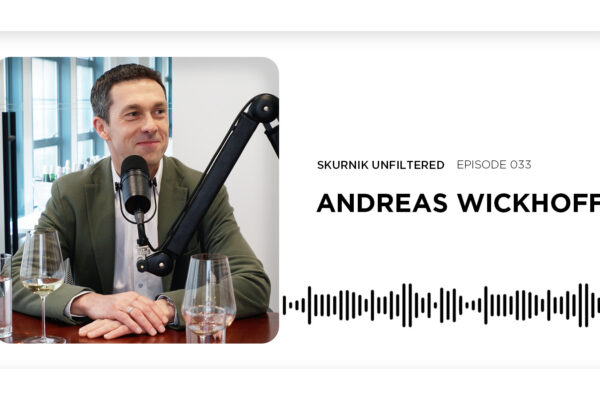





Next week, tune in as German and Austrian wine expert Michael Lykens sits down with Andreas Wickhoff of Weingut Brundlmayer.
Be sure to subscribe to Skurnik Unfiltered wherever you find your podcasts so you can stay up to date on all the exciting content to come.
Introduction
Tegan Passalacqua 0:03
I love the Europeans for believing that their wines can’t be emulated, but if that’s a truth, Americans need to have that too. Zinfandel is the one grape that California does better than anywhere else in the world. And I’m proud to say that just as a Burgundian should be able to say that about Pinot Noir.
[music]
Harmon Skurnik 0:27
Hey, this is Harmon Skurnik, and welcome to another episode of Skurnik Unfiltered. Today I have with me Jamie Schwartz, who is the ambassador for all things American, when it comes to wine. How are you doing, Jamie?
Jamie Schwartz 0:42
I’m good. I do dabble in spirits, but that’s personal consumption.
Harmon Skurnik 0:47
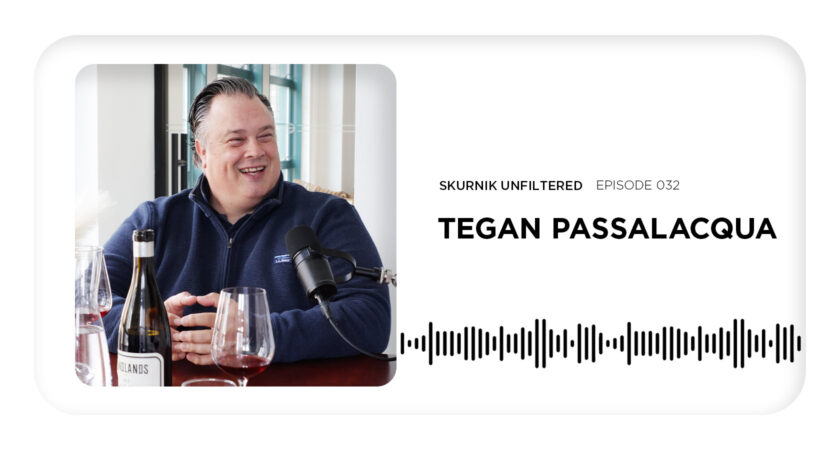
Dabbling aside, we’re going to talk about wine today, and we’re going to talk about one of the most influential winemakers in our portfolio, and that’s Tegan Passalacqua, who you recently sat down with. Tegan is the longtime winemaker for Turley Wine Cellars. And now you can say longtime owner and winemaker of his own brand, Sandlands.
Jamie Schwartz 1:09
Yep.
Harmon Skurnik 1:10
He is one of the most interesting winemakers that we represent. I think everybody who comes into contact with him and listens to him speak about the history of Napa and grape growing and farming and winemaking—it’s just intriguing. I can listen to him for hours.
Jamie Schwartz 1:27
Absolutely. I learn an incredible amount on such a wide array of topics anytime we spend time together. Undoubtedly, he is such a historian on California grape growing, going back to the 1800s with Turley and Sandlands. He’s working with vineyards that were planted at that time, and you can really track the evolution of the immigrant story of America through these plantings. It’s really amazing to hear him touch on that.
Harmon Skurnik 1:54
I would even go as far as to say I don’t know if there’s any greater authority on the history of California grape growing and winemaking than Tegan. I don’t know anybody.
Jamie Schwartz 2:06
I struggle to come up with it.
Harmon Skurnik 2:08
So whether it be Turley or Sandlands, I think there’s a theme that runs through both of those brands, and that’s old-vine vineyards that they source and/or own, organic farming, mostly dry-farmed, head-trained, sometimes field blends. But without Turley and without Sandlands, maybe some of these vineyards wouldn’t even exist today. Isn’t that true?
Jamie Schwartz 2:30
100%. I was on a trip with Tegan in Lodi and the Sierra Foothills a few years ago, and it was post-harvest. He hadn’t been there since the harvest time, and he couldn’t believe how many vineyards hadn’t been picked. There were also all of these fallow plots that were there, and the thought processes for these unpicked vineyards is they were likely going to get ripped out, converted over to something like almond farming . These amazing hundred-year-old vineyards are going the way of the Dodo Bird. It’s really sad.
Harmon Skurnik 3:02
It is sad. And without Tegan and without Larry Turley, many of these prized vineyards may not even exist today because I know that they have a great relationship with the growers; they pay them more and keep them in business. We have them to thank for that because those wines are just phenomenal. Of course, Tegan specializes in Zinfandel. Turley is primarily Zinfandel, although there is Petite Sirah and other grape varieties as well. And with Sandlands, there is quite a variety of varieties, including Carignan, Trousseau, Cinsault, and on the white side, Chenin Blanc. With Sandlands, he’s more focused in the Lodi area. He bought a vineyard in Lodi, so I think he’s really, really focused on that region and trying to preserve vineyards there through Sandlands. Is that accurate?
Jamie Schwartz 3:54
Yeah, I think he has heavily invested in the hopefully future success of Lodi by buying a vineyard property, which we talk about in the episode.
Harmon Skurnik 4:04
Kirschenmann, it’s called.
Jamie Schwartz 4:05
Exactly right. He’s also planted further east up in the Sierra Foothills, so he has some new property up there as well. He still maintains his home and his day job in Napa, but he’s heavily invested in the success of Lodi going forward.
Harmon Skurnik 4:19
No doubt. I remember when we first met Tegan, he told us that he had interned in South Africa, and Tegan is the first one ever to mention to me the winery Mullineux, which we represent now nationally. He told us those wines are incredible, and we went after them based on his recommendation. And of course, they are a leader in quality in South Africa now. I think he’s also done an internship at Alain Graillot in the Rhône. On that note, why don’t we sit back and let Tegan do the talking? I think everyone listening to this podcast will really enjoy listening to him as much as I do.
Jamie Schwartz 5:02
Without a doubt.
Harmon Skurnik 5:03
Let’s do it.
Mapping Tegan’s territory in California
Jamie Schwartz 5:05
I’m with my dear friend Tegan Passalacqua. Tegan, welcome back.
Tegan Passalacqua 5:08
Thank you very much. I love it here.
Jamie Schwartz 5:10
Yeah, we love having you in New York. A lot of the time that you and I talk, you’re in your truck. You’re covering some serious ground. Can you set the stage about how far you’re traveling, a couple of your favorite vineyards, or something in various pockets around the state?
Tegan Passalacqua 5:24
Well, for Turley, we’re lucky to work with the Dupratt Vineyard up on Mendocino Ridge. So that’s going out to Elk. It’s planted in 1920 in the middle of a redwood forest at ~1600 feet.
Jamie Schwartz 5:36
And that’s four hours from San Francisco? Further?
Tegan Passalacqua 5:39
Something like that, yeah. You go up to the town of Philo and then you go from Philo to Greenwood Ridge, which goes over to Elk. I love that vineyard. That’s the furthest north that we work with. The furthest south is the Turley estate down in Paso Robles . I’m born and raised in Napa, but I have this whole other life out in Lodi where I bought vineyards. Once I got into wine, I realized that I loved vineyards and I loved old vineyards, and it was a dream to own one one day. There’s plenty of old vineyards in California I wanted to own, and then you get what you ask for sometimes. In 2012, I was able to purchase the Kirschenmann Vineyard out in Lodi. I’ve told this story a number of times, but it is a story that almost makes me tear up every time I tell it because the Kirschenmanns were Russian Jews who were from Odessa, escaped persecution, and came out to the United States pre-World War I. And Kirschenmann, the family name, translates to “Cherry Man,” but they also were grape growers in Odessa. The woman who sold me the vineyard had a couple photos of her great-grandparents with old head-trained vines in Odessa.
Jamie Schwartz 6:49
Crazy.
Tegan Passalacqua 6:50
Really neat stuff. I had been doing numbers on vineyards to purchase for like five years, and I was like, “This is what I can pay you,” and she’s like, “That does not work for me.” And I was like, “Okay, I’m not going to agree to something that I can’t afford.” And then the next morning, before 7 a.m., I got a call while I was driving to work, and it was her, and she was like, “You know, when we left last night, I drove by the vineyard, and I just know my brother, my dad, and my grandfather would want you to have this vineyard.” And I was like, “What do you mean?” She was like, “If your offer still stands, let’s go for it. I know you want it.” She’s been building schools in Peru with the money. She’s this lifelong teacher, and like she just loves seeing her family name on the vineyard. It’s really important to her, and it’s been a truly beautiful relationship. She’s happy and I’m happy that the family name is still carried on in that area.
Jamie Schwartz 7:52
And the original vines went in when?
Tegan Passalacqua 7:54
1915.
Jamie Schwartz 7:55
Crazy.
Tegan Passalacqua 7:56
Her grandfather had planted it, and then her dad farmed it his whole life, and her brother farmed it his whole life. He died in 2004, and he had a couple plots of old own-rooted Zinfandel. I had met him, and it was then eight years later that I started a conversation with his sister, and I was able to buy a 20-acre piece from the family.
Celebrating an American identity with old-vine Zinfandel
Jamie Schwartz 8:18
Turley’s been working with various single vineyards for how long? Have these Zinfandel vineyards always carried the family names, or is that something that Turley helped spearhead?
Tegan Passalacqua 8:28
Turley was the first winery—I mean, Turley and Biale—to focus on Napa Valley old-vine Zinfandel. Turley started in 1993 with that, so we’re 33 years in. In a time when Napa Valley Cabernets were really flourishing, some of them got to work with Cabernet vines that are 30 years old, and we get to work with Zinfandel that’s 120. Napa and Sonoma might have a little more cachet to them, but California wine—whether they like it or not—was based on the success of Zinfandel, an unknown grape from unknown regions that ended up prospering in this New World. People didn’t know what Zinfandel was. They started planting it with other varieties, and they were like, “Wow, this one does really well here.” Zinfandel thrived in every region in California, more than most things. The story I tell is that Zinfandel was the red wine grape that did well before modern technology, i.e., refrigerated cellars. There were places like the Santa Cruz Mountains that had cool caves tunneled into the hill that could make Pinot Noir and Cabernet without microbial issues, but pre-refrigeration, the Mediterranean wine world was fortified wines. That’s the definition of fortified: to keep out intruders. And the way to do that was to add spirits. Lodi and Napa, primarily Lodi, had a huge history in fortified wines, but then there was this one table wine that kept coming up, like, wow, it’s tasting really good. And that was Zinfandel. Going back to the reports from the 1850s and 1860s, there was this unknown wine that was like, “wow, this is like tasting really good,” next to more well-known varieties being grown in California. Every European I know when they come over to visit, they don’t want to drink Sonoma Coast Pinot Noir and Chardonnay, and they don’t want to go to a French restaurant, they want to drink California Zinfandel and get a Gott’s Burger from Joel. You know what I mean? They want Gott’s Burgers and drink Zinfandel.
Jamie Schwartz 10:49
Maybe some tacos.
Tegan Passalacqua 10:49
And us, as Americans, we miss out on it. We want to be Burgundy and we want to be Bordeaux so much but they’re like, “No, you guys are never going to be as good as us at those things.” I love the Europeans for believing that their wines can’t be emulated, but if that’s a truth, Americans need to have that too. Zinfandel is the one grape that California does better than anywhere else in the world. And I’m proud to say that, just as a Burgundian should be able to say that about Pinot Noir. That’s the one thing we do have. We have so many other things, but Zinfandel is special. I always look at it as a comfort wine. It’s delicious. You look at why Italian restaurants do so well in down times and in war times. People want comfort food, and I feel like Zinfandel for Americans is that wine that gives you comfort. It’s not anemic, it’s not some cerebral wine that you have to sit there and think about if you like it or did you pair the right thing with it. It’s just delicious. Americans, unfortunately, you don’t ever know what you have until it’s gone. There’s a lot of Zinfandel that’s being ripped out, old vines all over the state of California. Once we get to a point where someone’s like, “Oh, let’s get Zinfandel,” like, “Sorry, we don’t have any anymore.” “Like, what do you mean you don’t have any?” Unfortunately, I think that’s the way Zinfandel’s going. Hopefully these great historic vineyards can stay in the ground, and then we can show the next generation that we have old vines, some of the oldest vines in the world, and we get to work with them! The wine we’re tasting right now, the Sandlands Lodi Red Table wine, this is from three vineyards with an average vine age of 126 years old and all own-rooted, surviving on their own roots and having a real pure expression of the place. The Cinsault is from the Bechtold Vineyard planted in 1886, that’s historically known as the oldest living Cinsault vineyard in the world. It’s 140 years old this year. And then the Spenker Carignan, that’s own-rooted, planted in 1900. And then the third vineyard is the Kirschenmann Zinfandel planted in 1915. These staunch, stubborn German farmers have kept these vines into the ground. And we look at all the problems in the world of wine right now. I mean, all these vines have seen multiple world wars, they’ve seen Prohibition. What we’re going through now is nothing like what winemakers went through during Prohibition. And the last 25 years of wine growth has been up, up, up. And then it went further up during COVID, and now leveled a little bit off. But everyone’s like, “Well, isn’t it just supposed to go up forever?” And it’s like, maybe the temperature of the climate will, but not wine sales. The people that are flailing that have been in the wine industry for 15 years or eight years and saying, “This isn’t fair!”—you’re not even half of a generation through! And a lot of us, and I count myself in this group too, are a lot of takers. We get celebrated for the hard work of other people. And we look great when we work with hundred-year-old vineyards that we had nothing to do with.
Why wasn’t Lodi affected by phylloxera?
Jamie Schwartz 14:07
Obviously, you cherish these old-vine vineyards, but you also recognize you’re not only focusing on that through your day job and through Sandlands, but also there’s a conservation aspect to the Historic Vineyard Society.
Tegan Passalacqua 14:17
Yeah, of course. The point of that organization is to first identify and educate the public on all the vineyards that are over 50 years old in California, not just Zinfandel, but any vineyard. We started it around 2010, and at that time it was 1960, and it was a really good time because viticulture had changed so much after 1960. Pre-1960, most everything was head-trained and dry-farmed. We didn’t have drip irrigation yet. There were some people who were using sprinkler irrigation or flood irrigation. There was very little trellising. There was some, but very little. It was a whole paradigm shift in grape growing. You know I collect a lot of old things. I have these viticulture posters from the 1873 World’s Fair, and it was France’s viticole exposition. Phylloxera had been discovered five years before, but it hadn’t decimated France yet. And the amount of different training methods, regionally, throughout France, was so diverse, and that all was lost through phylloxera.
Jamie Schwartz 15:28
In Europe, though, we get to see some of these ancient ways of training, maybe in Tenerife but it’s a very small amount of the overall.
Tegan Passalacqua 15:37
Very small, right. And the reason we have those is because those vines were usually in sandy soils and didn’t succumb to phylloxera, so there wasn’t a forced replantation of the culture.
Jamie Schwartz 15:49
Yeah. There’s a certain part of California that didn’t succumb to that.
Tegan Passalacqua 15:53
Yeah. I like to say that the creation of California was the tectonic plates and the uplift of the Sierra Nevadas. When you think about the creation of the Sierra Nevadas, these tectonic plates hit and pushed up, and what it pushed up was all this granite. You think of Tahoe and the Sierras—it’s all this granite. And what happens is, now it’s at higher elevation, the granite, and it snows up there. So you get snow melt. And then you get ice. And you get the ice to freeze into nooks and crannies of the granite. And when it freezes, it breaks the granite very slowly. And then when it melts, it erodes the granite very slowly. It starts coming down all these little tributaries and comes down to rivers, and then it ends up all going out through the Golden Gate Bridge. That’s what the delta is. Lodi is very close to the foothills, so it’s all sandy soils that are decomposed granite from the Sierra Nevadas. So the creation of California has allowed for us to have areas that, because of these sandy soils from the granite—that all harkens to the name of Sandlands—these were areas that you could have these old vines and we can actually farm own-rooted. More than anything, my 23 years at Turley has been a true education of California. I’ve been able to see everything, and I have friends in every region we work in. I can’t imagine a better place to have ever worked, and to be able to see the state, and formulate your own ideas and philosophies based on everything you’ve seen. Lodi is amazing, just an amazing agricultural place. I tell people that cherry blossom season out there is unbelievable. But you go to Contra Costa and it’s like a foreign land. There isn’t a long cultural history of winemaking in places like Contra Costa as much as there is grape growing. It’s these sandy soils, and you look at these vines, and there’s nothing. No power around them, no water. They’re just, like, there. It’s like, how are these surviving? America’s still dealing with a lot of antiquated Prohibition laws in Oakley. You couldn’t have a winery after Prohibition where all the Contra Costa grapes are grown. I think that’s changed recently, but it’s basically been that way for almost a hundred years. It’s like, you can grow grapes, but we don’t want a winery here. There are still weird Prohibition laws that exist throughout the country. There was never a small producer who made a thousand cases of wine in his little shed, and everyone goes there. There’s no Raymond Trollat of Oakley, but there should have been. Lodi is the same way. There were some great pioneers who, in the 1970s, started making a little bit of small-lot wine. One of them is the Phillips brothers that started making Riesling and things like in the 1970s. But unfortunately, neither of these regions have old bottles that you can go to, like some friend of a friend, you go to dinner, and someone brings a 1947 bottle of Charles Krug Burgundy. Part of what I’m hoping to do with Sandlands is that there will be bottles of Lodi Red Table Wine in 50 years that young people will be able to drink out to dinner and be like, “Oh my god, this wine held up. Wow, this wine is still great.” And I know California wines can do that. I’ve had them, but a lot of these regions don’t have that cultural safe deposit box of wines that we all feel so fortunate to have when we go to other regions in Europe and someone opens up an old bottle of wine, and you know that it’s a priceless moment that you get to share with people you know and people you just met, and you sit there and smell and go, “Wow, this is amazing.”
Jamie Schwartz 19:47
I feel really privileged to have had a chance to sit with you on a few occasions now and get to taste through verticals and horizontals, and it’s really exciting to taste the array of Sandlands.
Chenin Blanc, Cinsault, Carignan, Assyrtiko, Carricante, Nerello Mascalese, Trousseau
Jamie Schwartz 20:00
We’ve talked a lot about Zinfandel, but what are the other grape varieties that you’re already working with that really get you going?
Tegan Passalacqua 20:06
Well, obviously that would be Chenin Blanc. I’ve made Chenin Blanc since 2011, primarily all from the original Amador Vineyard. Another vineyard was planted for me up in a town called Fiddletown that’s 2,000 feet in black schist. And then, of course, I love Cinsault. In 2024, I bottled three different Cinsaults. I bottled the Bechtold Vineyard from 1886. For the first time, I got access to the Teldeschi Vineyard in Dry Creek Valley. They actually have the second oldest Cinsault in California, planted in 1953.
Jamie Schwartz 20:40
That’s such a crazy gap between the ages.
Tegan Passalacqua 20:43
I know, and 1953 is old. There’s only one older Cinsault vineyard in South Africa than that. And then the Kirschenmann Vineyard. I planted an acre of Cinsault back in 2018. I make that sometimes, but most of it goes into my rosé, the Kirschenbloom. Clearly Carignan from sandy soils is just the best iterations of Carignan. It rounds off all the rough edges that Carignan can have in the sandy soils. My friends, the Perlegos, these two Greek brothers who I adore in Lodi, both of their parents were born in Greece and they love wine and they’re grape growers, and they grafted over some Assyrtiko, the first to graft Assyrtiko in Lodi. The first year I saw the Assyrtiko grow in Lodi—I’ve seen so many white grapes grow in Lodi, and I’ve never seen anything that grows as well as Assyrtiko. Lodi has 125 different grape varieties. It’s got more grape varieties growing in the region than anywhere else in the world. One of the other projects I’m working on, I bought property up in the Sierra foothills. Most of the vineyards in Amador County are around 1,500 to 1,700 feet. Most of those soils are primarily based on granite, and up outside of a little town called Volcano, there’s some lens of Aiken cobbly loam. It’s the same soil you’ll find on Pritchard Hill and Howell Mountain in Napa Valley. I bought two parcels up there that are adjoining each other; one’s five and one’s seven acres. I’ve started planting Carricante, Nerello Mascalese, and then, because it’s my crutch or my guiding light, I planted some Zinfandel up there too because I think I’ll be able to understand the vineyard better through the lens of Zinfandel than anything else. The Trousseau from the Sonoma Coast, the Bohan Vineyard, I think most years can be the most ethereal wine I make. And the drive back from Bohan Vineyard on Highway One on the coast with fruit, it really feels like you won the Super Bowl and you’re doing the parade. There’s cows on the side of the road and you’re driving by 101, you’ve got four tons on the truck, and it’s afternoon, and you just smile. There’s the ocean. Windows down. Cell phones don’t work until you get to a certain part, and then you get back into cell service and you have, like, 30 missed messages from the winery, and everyone’s like, “Where is he? Has he been like partying all night?” I’m like, “Oh, maybe half the night.” It just takes so long and it’s so far to get through, and then you call them, like, “I’ll be there at three. We got four tons to crush.” That’s usually the last pick of the year, so everyone’s waiting, but for a while you’re just sitting there driving the truck, really thinking you’re in the Super Bowl parade.
Jamie Schwartz 23:27
Amazing.
Following perfection
Jamie Schwartz 23:28
How do you split your time? Obviously, you’re involved in production, but your background is farming and you have property, you’re developing property. What is that day-to-day like?
Tegan Passalacqua 23:38
It’s day-to-day and day-to-night and day-to-weekend. In all honesty, I’ve been trying to grapple with that the last couple years because I know that I’ve neglected some people I love for this wine thing. You get so into it sometimes and so driven to do something, and then you’re just head down and you don’t see the casualties of relationships go by. So yeah, I’ve been trying to deal with that. At the age I’m at—I’m 48 now—I don’t have the same unbridled energy that I did 10 years ago. I know I can do these things if I just work harder, but working harder is getting harder.
Jamie Schwartz 24:27
I think you have your dream job. Between your day job and what you’ve grown from that , it’s really remarkable. A lot of people don’t get to say that, but it’s hard when you’re passionate.
Tegan Passalacqua 24:39
But at a point, you have to look at it and you’re like, I’m being pretty fucking selfish because I have this dream job and that’s so rewarding, personally to me. It’s not “be careful what you wish for.” It takes time to realize that those are real life issues. That’s the work-life balance I need to start figuring out more.
Jamie Schwartz 25:04
I love when we get to talk about things that aren’t wine related. It’s generally baseball and you going to games with your boys, but I love that you find time to do that and make it a priority. I think that’s super important.
Tegan Passalacqua 25:16
I really mean it when I’m like, please share these wines with friends and those that you love. It sounds cliche, but there’s nothing better than that.
Jamie Schwartz 25:26
Something that keeps me engaged with this job is the communal aspect of it. It’s so important. When I interviewed Christina Turley, we were talking about how we all need to throw more parties and beautiful wine dinners, and I think that is super important. We are very lucky. I am wondering, maybe this work-life conversation is also part of a pursuit of perfection. Do you think you’ve ever made a perfect wine or do you strive to make a perfect wine? Have you had a perfect wine?
Tegan Passalacqua 25:53
A perfect wine only exists if there’s an experience. I don’t think I could ever say a wine’s perfect if I’m sitting with four glasses in front of me with 30 people at tables, doing a tasting where everyone’s silent and no one can speak. I don’t think I would ever consider one of those wines perfect.
Jamie Schwartz 26:12
Even if it was a 1945 La Tâche.
Tegan Passalacqua 26:15
Yep. I don’t think so in that atmosphere. But I can tell you, I’m looking over here at the Rocce Rosse ARPEPE, and I had a dinner at my house in Victor, what we call Victor Book Club, with the three-liter of the 2007 of that. That was a perfect wine. I forced everyone to drink it. We had Adi Badenhorst and Cristiana Tiberio. I had them present their wines, and we had 20-24 people sitting down, and I poured that three-liter, and everyone was so ethereal. I’ve always heard that they bottle the Reserve barrels in large format. I don’t know if that’s true. Don’t correct me if I’m wrong. I like to believe it. But that was such a special wine and a special place that you got to share. Large format, and you get to share. I was a little bossy where I was like, “Okay, we did this, but for dinner, when we sit there and have the first course, everyone’s going to drink the same goddamn wine. And that’s why I have a three-liter, and I have magnums of the same wine too. I want everyone to be having the same experience in that 2007 ARPEPE. I’ll remember forever. To me, that’s perfect wine.
Jamie Schwartz 27:26
On that note we can cheers and call it a day.
Tegan Passalacqua 27:32
Sounds good.
Jamie Schwartz 27:32
Thank you so much for coming.
Tegan Passalacqua 27:33
Thank you very much.
Skurnik Unfiltered is recorded at Skurnik Wines & Spirits headquarters in the Flatiron District of New York City, which is why you might hear some city noises as we go along, like horns honking. If you found the conversation interesting, please consider liking, subscribing, and leaving a review. You can stay up to date on our show and upcoming events by following @skurnikwines on Instagram and visiting our website at skurnik.com