

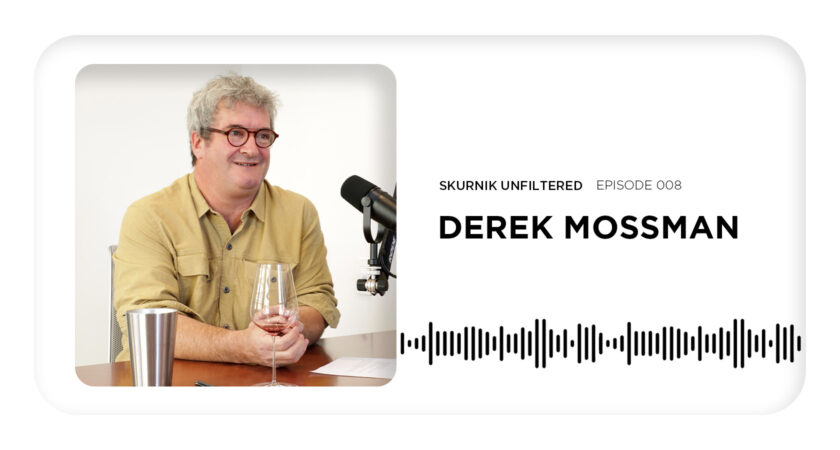
Since 2006, Derek Mossman and his wife, Pilar, have been working alongside local farmers in Chile’s Maule Valley to revive forgotten centenarian vines and express their full potential. True to their humble origins, Garage Wine Co. ferments in a mismatched collection of repurposed milk tanks, wooden lagares, and Spanish tinajas. Despite working in the heart of a region known for its bulk entry-level wine, every one of Derek’s bottles is a rebellion against mass production—a tribute to forgotten terroirs and the people who are proud to tend them.
In this episode, Derek sits with Skurnik’s World Portfolio Manager, Cody Stephenson, to talk about his unlikely path from Toronto to the Maule, why regenerative farming isn’t just a buzzword, and what it truly takes to make honest wine in a world obsessed with efficiency.



Wines tasted in this episode:
- Cabernet ‘Reelegido Vineyard‘
- País ‘215 BC Ferment’
- Semillon ‘Isidore Vineyard’
- Garnacha ‘Bagual Vineyard’
- Cariñena ‘CRU Truquilemu’
Next week, tune in as Whisk(e)y expert Gaby Eisenman sits down with Annabel Thomas of Nc’nean Distillery in Scotland.
Be sure to subscribe to Skurnik Unfiltered wherever you find your podcasts so you can stay up to date on all the exciting content to come.
Introduction
Derek Mossman:
I think many consumers, many somms, still think of it as a great supermarket wine for the money. I think Chile has still got much more to show. Many people, when they taste these wines, the first thing they say is, “But that’s not Chilean.” But it is more Chilean than what your image of Chile is. I think for Chile to be truly more diverse builds everyone up.
[music]Harmon Skurnik:
Hey, this is Harmon Skurnik, and welcome to another episode of Skurnik Unfiltered. And today we are focusing on the country of Chile, but not maybe how you might think of Chile, which is, well, lots of inexpensive Cabernets made in a mass-produced way. But at Skurnik, we’ve assembled a portfolio of producers that are pretty much the opposite of that. And today I have with me Cody Stephenson, who is the portfolio manager of, what we call here at Skrunik, the World portfolio. How do we define the World portfolio, Cody?
Cody Stephenson:
Well, certainly South America for today’s episode, but also the rest of the Southern Hemisphere— South Africa, New Zealand, Australia —and then the ancient world —Turkey, Lebanon, Israel, and throw in Ukraine, England, and Hungary, and I think we’ve covered it.
Harmon Skurnik:
So all of those things mainly.
Cody Stephenson:
Yes, exactly. Only a few countries.
Harmon Skurnik:
Everything that’s not Europe and North America.
Cody Stephenson:
Yeah. I’m plotting world domination, so any country that’s thinking about making wine— I’m on to you.
Harmon Skurnik:
So you don’t get bored, ever, just like dealing with just the wines of France, for example. How boring that would be!
Cody Stephenson:
For better or worse, we manage a lot of different countries in our portfolio dealing with the logistics of all that. But yeah, it’s an incredible opportunity to represent so many growers from so many different regions.
Harmon Skurnik:
Super. And today you are interviewing Derek Mossman, who is the one of the partners in Garage Wine Company in Chile, which is a recent addition to the portfolio, I think last year.
Cody Stephenson:
Yeah, in 2024.
Harmon Skurnik:
Very exciting.
Cody Stephenson:
Very, very exciting. These are wines that I have admired for years. We’re in the Maule Valley, in central Chile. Derek and his wife Pilar are focused on farming. They are focused on these incredible old vine vineyards that they work with— mostly Rhône varieties— Grenache, Syrah, Monastrell. They also make some País, make some Cabernet from Maipo, and were one of the pioneering small wineries of Chile 20 years ago in the early 2000s, and are making incredible wines and paying their farmers a living wage and really focusing on regenerative agriculture and the biodynamic principles— things that I think a lot of people will be excited to learn more about.
Harmon Skurnik:
Yeah, and you know, the name Garage Wine Company —in the wine world, a lot of wineries are called garage wineries, but this one literally started in a garage.
Cody Stephenson:
This one literally started in a garage in their suburban Santiago home, and while it’s still small to this day, it has become one of the most recognized wineries throughout all of Chile.
Harmon Skurnik:
And these really tiny production wines that they make from very, very small vineyards, they’re literally handmade, aren’t they? Like it’s sort of like Tito’s Vodka, right? Handmade?
Cody Stephenson:
Ha! Exactly. Exactly like Tito’s vodka. When I think of Garage Wine Company, Tito’s is the analogous spirits producer. No, this project was so small that they were hand stenciling all of their labels when they started, and no one would sell them wax, so they were melting down Crayola crayons and dipping their bottles into the this these crayons to create their the tops.
Harmon Skurnik:
Amazing. Maybe Derek learned that in Canada where he grew up. How did a guy from Canada end up as a winemaker in Chile?
Cody Stephenson:
Another another ‘ski bum winemaker’ story. He moved down there to ski both seasons, and like so many of us, fell in love, and the rest is the rest is history, and they’ve been there for 30 plus years now.
Harmon Skurnik:
Well, why don’t we tune in and listen to his story right now?
Cody Stephenson:
Sounds good to me.
Harmon Skurnik:
Let’s do it.
[music]How Garage Wine Co. came to be
Cody Stephenson:
Derek, hello, good morning. How are you doing?
Derek Mossman:
Cheers, great. It’s great to be back in the Big Apple.
Cody Stephenson:
Where are you based?
Derek Mossman:
Within wine country in Chile, the Maule is quite a bit south, but it’s a misconception to think of north and south as the big difference in Chile. The big difference is we are on the coastal range, so more than being close to the ocean, we are on a different set of mountains. We think of South America as having the Andes on one side and the Argentinians on the other. I’m just gonna smile and say the Argentina’s got the better side of the Andes, but we got the better mountains. We are both on the east side, how do you say, both facing east on our own set. But the coastal range is 110 million years older than the Andes, and because of that, there’s decomposed granite, there’s schist, there’s the soils of fine wine in the Old World, and where we are is kind of— I’m not sure it would be the birthplace of wine in Chile; I’m not really interested in being the oldest, but —there’s a lot of old vines, País, Cariñena, and those are the things we we do.
Cody Stephenson:
When when was Garage started?
Derek Mossman:
In 2001, it was a hobby. In 2004, our peques, our kids arrive, and my wife is offered a fantastic job in a perfume and flavorings company. So the garage turns into kind of a curriculum. I suppose, better said, the two of us have an excuse to spend more time in the garage with the idea that she would be at home working part-time with the boys for a couple of years, and then she would step back into a winery job instead of something adjunct selling barrels or whatever. And that’s where we gain steam, say.
Cody Stephenson:
So it may not come as a surprise to most of our viewers and listeners, but you are not Chilean. You are from the lovely city, the booming metropolis that is Toronto, Canada. What brought you to Chile and what made you stay? Besides, of course, your lovely wife, Pilar.
Derek Mossman:
We met later. I went several times. I went with a group of skiers as a coach a year that it didn’t snow in New Zealand. Otherwise, I hate to think of it…
Cody Stephenson:
You’d be making New Zealand Savignon Blanc.
Derek Mossman:
I might have been. So I thought that was a terrific setup. I did that in the summers while I went to the University of Toronto. So it was good fun.
Cody Stephenson:
And then how long did you stay there before meeting Pilar?
Derek Mossman:
I went back to live. I actually came back to North America. In New York City, I did a master’s. And then there was just things going on in Chile that I thought were wonderful. It was like things were emerging. It was a place to be, in those times. So I went to live in ’94.
Cody Stephenson:
Politically or culturally? What was it that kept you?
Derek Mossman:
C ulturally? I’m not gonna say economically, but there was kind of an opening. My father actually once said to me, he said, “I get this now. Now I’ve been here and around a while. This this is this is like the 60s in Canada and the United States.” I’m not sure if it was a post-war kind of thing, but it was an interesting time to be there. And I was always an entrepreneur. When I was 16 or 17, I had a windsurfing school with my brother. I was not old enough. We had a trailer behind his little Mazda. I mean, I was always an entrepreneur. I always wanted to do that.
Cody Stephenson:
You and Pilar started this over two decades ago. How has it been, creating something from nothing in your garage with your spouse? How is it working day to day, both in your marriage and in the winery with with Pilar?
Derek Mossman:
It been a real roll. We’ve done well. I don’t know how you could ever do this if you didn’t do well, because cash flow is always an issue. But we did it in a much more difficult way than one could have. And it was really because we tripped upon things. We started without the nest egg that you would have had, which meant that we never kind of made the mistake of, how do you say, overwooding the wines with new barrels that many people made back then. We were always looking for freshness. We went higher in the Maipo in the beginning, and then we went to the old vines, but we really went to the old vines because we were so small and we were, how do you say, we were a nuisance to a Chilean grower because we were buying three or four thousand kilos, and then a journalist would want to taste the wines, and for them that was an embarrassment, you know. We went to the Maule because we figured we’d find smaller growers and that we would be good for them, that they would recognize this as something positive, that there wouldn’t always be, “Oh no, the fruit’s no longer available.”
Cody Stephenson:
And that first vintage for you guys, how many bottles did you make?
Derek Mossman:
We made two barrels, so two barrels would be a little less than 600.
The handmade details
Cody Stephenson:
Yeah. When was that next big change and shift, in terms of growth for Garage Wine Co; in terms of how many wines you made, what your production was, etc.
Derek Mossman:
We got up to eight barrels while we were still in the garage. A Dane knocked on the door one day, Ken Usted, who had wine bars in Copenhagen, and he would not take no for an answer. And we literally had to kind of launder the paperwork of where these things came from, because not that there was anything I did, say, done illicitly, but you had to have paperwork back to have traceability to be able to export. But there was there were a lot of workarounds at that time that I find fascinating today. Like, I think it’s really funny when people say, “Oh wow, a terrific presentation.” Well, it was because you couldn’t print labels. We made the parcels; we silk screened them, because how do you print 600 labels in offset printing before digital? You just didn’t. It was so costly to set up a machine, it would have cost more than the wine! And the the wax, I think most people know, was crayon wax because it was food safe. And how do you buy a box of 10,000 capsules when you have 600 bottles?
Cody Stephenson:
What we have in the glass right now is the Ree legito Vineyard Cabernet. Was that your very first wine, or was that the second, third wine?
Derek Mossman:
Cabernet from Maipo was our very first wine, but not from here. Where we were, up higher in the Andes that we really liked for a few years, we made —it’s terrible to say this; I feel like I’m I’m tooting my horn a little bit too much, but —we made a couple vineyards relatively well known, and then that was better business, to sell that fruit to someone else. It was wonderful fruit from high up; people are doing wonderful things with it today. What we wanted to do with the Maipo is, we found old vines, which was more in tune with what we were doing in the Maule. And I think today we’re probably the only cellar in Chile that takes fruit from the Maipo to the Maule and not vice versa.
Cody Stephenson:
And right now you’re making all your wines in the Maule.
Derek Mossman:
In the south, yeah. So there’s a Cabernet Franc and Cabernet Sauvignon from Maipo that come down, and they’re made with stems and they’re done with similar sorts of things, and in small tanks with push- down. We never had large tanks and pumps. We always wanted to make the wines ourselves with our own hands. We never contracted it out, like, “Make me these on spec and I’ll sell them as my wines.” We always did the work ourselves.
Cody Stephenson:
And you were also building your own fermentation aging vessels, weren’t you?
Derek Mossman:
What we did was, we found no one would ever answer the email when you wanted to make two small open tanks. Because they felt since they had to design the tank, they should be charging extra, when in reality, it was our design. It was a wooden lagar; it was like a like a capsule or whatever that had a tapering to it, and we’d bevel them. And the only luxury or whatever you would put on it is one valve to do a full drain. And then once you drain, you could literally tip it over and pull the skins out the top. And that was winemaking like it was done in the neighborhood, that your nose is in, and you can guide things and smell things. But we literally bought the steel from, like, the elephant works or whatever, like the scraps from someone who was making stuff for the milk business or for the mining business, and you’d find the scraps. So if you see the the tanks today, you’ll see that most of them are different. We do have some modern ones that are really chichi that are square. We finally did come around, but I like the old ones.
Dividing responsibility
Cody Stephenson:
So for you and Pilar, how do you divide and conquer, in terms of your roles at the winery? Pilar comes from a winemaking background, and you don’t. I feel like that means you’re thinking about winemaking differently. I’m sure you guys have figured out a way forward together.
Derek Mossman:
In any small company, not just in wine, I think it’s wonderful when partners complement or are very different. We’re really three; Alvaro Peña is a professor at the University of Chile, he’s a wine scientist, and he never really had a role in any company. He has a role in viticulture, and he has a role in blending. But Pilar and I are very, very different. I think that’s why it works. She is very methodical, very meticulous, and I’m the one who, because I didn’t study it, I didn’t have to unlearn things. I think it’s fair to say that Alvaro and and Pilar were educated to work in the business that was the Chilean wine industry, but all the cellars were big then. This was a boom, they were making supermarket wines, they were training people to be the head of a large cellar, whereas I went at it completely differently. I’d done other things. I needed— what do you call it when you take a year off? I was in need of a sabbatical. So when we realized that we wanted to go south and we wanted to look for these smaller producers, I had a backpack and a pickup truck, and I had time. And I went to find people who had Cariñena and they didn’t call it that. I remember tasting with someone once, and we tasted their foudres, and when we got to the third or fourth foudre, he said, “This one costs more because I had to hold on to it for a second winter.” And I kind of smiled, “What does that mean?” And of course, that was the Cariñena, and it didn’t finish malolactic before winter, so you couldn’t sell it the following summer. You had to hold on to it for a second winter, and that was kind of a defining moment for us. We just realized, maybe the good stuff isn’t on anyone’s radar, and it’s not a question of finding a winemaker who used this to adjust acidity in a wine for whatever. This is like, let’s go looking for things that people don’t know are there, which is involved; it means Pilar has to come in and start doing paperwork because you have to have all this registered and certified because you’re gonna export it. Pilar is the keel. Pilar’s the boss. I’ve no problem saying she’s the one who pulls it all together, and Alvaro and I have roles that complement. Pilar is the one who steers the ship, absolutely.
Cabernet ‘Reelegido Vineyard’
Cody Stephenson:
We should probably talk about this wine we have in the glass, the Reelegito Cabernet. What does this wine mean to you? Where does it sit in the portfolio of wines that you and Pilar and Alvaro make together?
Derek Mossman:
I think I’m known for putting things in a funny order. We’re going historically and then we’re gonna take a ride in a pick up truck, we could say. We have always made wine from the Maipo, and we’ve got a Cabernet here poured to be efficient. This is Isla de Maipo. This is very old vines that no one was really making good use of. Someone is kitty corner to us, so the trend is catching on that we can make interesting wines of these things. I think this wine, for the American market, this is finesse -driven, much fresher. It’s not big, it’s not bold, but it’s also not underripe either.
Cody Stephenson:
It’s not. I feel like there is a trend in American Cabernet, alternative American Cabernet we were talking about earlier today, that it has this very green character, or they’re just picking too early. And I think that this is full, phenolically ripe, and has texture, but it also has acidity and freshness to it, which I think is harder to find in California and also not easy to find in Chile as well, at least ten years ago.
Derek Mossman
It has to do with the farming. To make a wine fresh, it’s not a question of picking earlier. If you’re gonna pick earlier —I think the official phrase would be “canopy management,” — you have to change things, you’re thinning leaves. Farming is fundamental to wine. And sometimes I think we get talking about the soils, the subsoils beneath a vineyard. Good point, but I think we all have to try and complement and contribute to whatever they’re doing. And I think too often, we are not concentrating enough on the farming, and it’s too prevalent an idea that if the soil is really poor, then the vineyard has to suffer, and that somehow brings character or something. And that’s not really true; if you have a if you have a vineyard that does not have enough nitrogen— better stated, does not have enough bacteria, fungus, microbes— you don’t have that, how do you say… I’m gonna make this really simple: you don’t have the peach fuzz around the roots, and it’s only through that peach fuzz and literally the bacteria that a vine can truly drink of said terroir. And in the end, the farming can make a big difference. I think that’s that’s the difference when you— I’m not sure you dial a wine back; it makes it sound so easy. But when you take a wine that was happy to be 14.5% alcohol and you bring it back to 13.5% in a balanced way—which I think this [Reelegito Cabernet] is one example of things like that— those are, to me, the Cabs that people want to drink. Did we need to do some green ones? Not necessarily ourselves. Did we need to do some green ones to make a point, so that people wake up and say, “Ah, maybe we could do this, kind of, less is more,”? Yes. But anything you do, it’s experimentation, and then it’s three or four years of farming. Because wines are grown, they’re not made. This isn’t a kitchen operation.
País and the character of Chilean old vines
Cody Stephenson
Well, I think that’s a through line through all your wines. It’s something that, having been lucky enough to visit you in the Maule, I think that some winemakers, some producers talk about terroir, and some wineries are about the winemaker themselves. And I feel like it was so evident, to myself and our team, that what you guys are passionate about is the vineyards and the actual farming that you’re doing. Regenerative agriculture is something that you just won awards for. You’re humble, so I’ll brag for you. Can you talk a little bit more about regenerative agriculture in Chile, the families that you’ve been working with that go back generations in the Maule and other regions?
Derek Mossman:
Let’s serve País as we do that.
Cody Stephenson:
Yeah, let’s do it.
Derek Mossman:
I think we were in a really unique position to appreciate that where we found these old vines, we also found farmers working them that were really interesting characters. Did they make brilliant country wines— Pipeños and all of that? No. I think the truth of the matter is, most of them had been receiving such a pittance for the fruit for so many years that they’d re-geared the vineyards to produce more kilos to compensate for what little they were being paid. And the wines were odd. That’s not a blanket statement, but I mean, we didn’t find an idyllic world. We found a frustrated world from both sides where the people wanting to buy the fruit, they felt that, “Geez, we can’t mechanize this, we’re doing this by hand, it’s hard to deal with people.” And then from the other side, you had people who come along, they break their word. When I first started —not knocking on doors, but —when I first started to figure out who we wanted to work with, I thought it’d be a tremendous disadvantage to be Torontonian and have an accent. And of course, it didn’t take very long to realize that I was a wild card. But if I came around three, four times and insisted that there’s something we wanted to do and it was a small scale and we were looking for how to work together, eventually it worked out because they had a bad experience with a Santiaguino. So what we did was, we encountered this community with these farmers working away. Now, these people— they don’t just grow vines, they’re not vignerons, they don’t live from that—they would have made the wines from the towns, but they also have vegetable gardens, they have some livestock. Most of them, until very, very recently, grew wheat, which they cut with a scythe by hand. And then a machine came around that clearly once worked on steam because they had these big belts, which for us at the time was this tremendous adventure, you know. That was just like, someone should be filming this! But perhaps the best example is, they prune on a “luna menguante,” on the waning moon, which would be right out of biodynamics. But they have no idea what biodynamics is, and if you said Rudolf Steiner, they would think, “What the heck does an Austrian have to do with what we do?” But these are practices that have been passed down, and you realize there was there was a wisdom to what they were doing. But the fruit, the vineyards hadn’t been given a fair shot in a good long time, where you trained them back to produce what would make a bottle of fine wine, let’s say. And when you started doing that, it wasn’t magic, it was logical that there were some really wonderful wines that came out. We then had to reorganize. Because in the end, when you start doing these things, you’re still the small guy, so you’re looking for people to pick, and you need these days and those days, but maybe you’re getting big and you’re picking 20,000 kilos or whatever. But someone else is picking 200,000, and you have to take second place, you know, we have space in two weeks’ time, and you have a better, much better idea. So, what we really had to do was, we had to get even closer and arm this team of our own, buy our own van so that we had our own transport, so no one would take the people somewhere else because they were paying better. And what ended up happening was, you made a small dent in a tiny little local economy. And it was like, businesses for good was really good business, because people felt that someone was believing in them again, they felt they were using skills that other people weren’t recognizing, the wines, when they came out, they were they were proud of how they did. But these are all things that— we didn’t set out to do that. We could have picked many easier paths. What do you think of this wine? País is, I think most people know País today.
Cody Stephenson:
Yeah, it is the face of New Chile. I think the Cabernet of what once was, now I think that if people have a Chile section in their retail shop or on their wine list, they need to have País.
Derek Mossman:
And it’s something that, on a commercial level, if you’d said to commercial people who were selling Cabernet 10 years ago, “Yeah, we’re gonna have País for $22 and your Cab is still gonna be $17.99,” they would have laughed out loud. And I think it’s true.
Cody Stephenson:
So, what’s the story behind this name, this wine?
Derek Mossman:
País. I went to England and there were some very well-educated somms who— País was not on their matrix of the world, and you had to impress upon them that this may be New World, but this is very old grapes. And we found that the original document of País existing in Chile was a document where someone had farmed the land, built a house, and made wine for the Catholic Church, so they now got title to their property. I can’t remember what we call that in North America, but we had it in South America too, and that was 1548. Now, that’s a really old year and sounds really incredible, but if you actually think about that, the Sistine Chapel had had just been finished, Copernicus is about to publish a book that says, the sun’s the center of the universe, not the earth. It’s published two years after that. And you get a perspective. Cabernet Sauvignon, the cross, comes along in 1763, the difference being 215 years before Cabernet. And I did that to hoodwink 70 somms in London to giving me the time of day, to put a wine on the table that they didn’t think should be there. I think the rest is history.
Cody Stephenson:
How old are the vines here?
Derek Mossman:
Puta. País, generally where we are, it’d be 150 years old. But remember, that wasn’t a vineyard that was planted and registered and has never been replanted. We can layer because we’ve never had phylloxera, so you’re always rejuvenating a vineyard. If there’s a section with a little too much water and the plants fade, later you literally can leave shoots long and create, like, umbilicals, and then after two years you clip and —what I’m trying to say is, you’re always reviving a vineyard. Next wine?
Cody Stephenson:
Yeah, let’s do it.
Sémillon ‘Isidore Vineyard”
Derek Mossman:
So Sémillon, this to me would be a typical vineyard in the neighborhood where we work, that it’s in a place where you’re too far from a paved road. It’s not enough fruit to fill a proper modern winery truck, so you have to question the efficiencies of the operation. And the way it’s planted, you could never mechanize. So three strikes, you’re out. What you would do probably is over farm it for as long as you could and sell to a local cooperative or something and try and make a go of it, just out of kilos. And when you come along and see what’s there, this is planted late ’30s, early ’40s. This is planted by a suffragette, Ernestina Cancino. It’s just one of many of those kinds of stories. We don’t have to go into that in such depth, but a suffragette in a town of 25 homes in the ’30s in rural Chile?
Cody Stephenson:
Not popular.
Derek Mossman:
She was an antichrist! I mean, she was crazy, right? She was she was out of line! She traveled abroad, she came back, and her cousins have usurped her farm because she “died on the high seas,” according to them. But there’s a wonderful history to it. We have a man who comes with his daughter to pick— it’s gonna sound terrible that I’m saying a 78-year-old man is is picking, but it’s his pride. He’ll plant the vineyard playing hooky from school, I would like to think, because many years have gone by. But he’s told the stories of these vineyards of those times and the family history of this. This is a little bit of Sauvignonasse and a little bit of Torontel, made on skins in tinajas, we say. How do you say tinajas?
Cody Stephenson:
Amphora.
Derek Mossman:
Amphora, yeah. The Spanish have now started saying “tinajas” after the Chileans. So I think we just need to push on that word.
Cody Stephenson:
Spain and northern Italy are sort of the homes of the modern Amphora /tinaja industry. But are you are you sourcing them from Spain or are you buying them locally?
Derek Mossman:
There’s lots of old tinajas in Chile that were made in the same place in Spain that went, hundreds and hundreds of years ago, out to Chile, when you didn’t have barrels from Bordeaux and you didn’t have fiberglass and you didn’t have laminates, you didn’t have cement. You know, those were the tanks of the time, I suppose.
Cody Stephenson:
This is a wine aged on skins, but I would say this is not an orange wine, either in texture and taste or in color. I feel like there’s now this differentiation in the world of wine, of a skin contact wine and a truly orange wine, because I think the skin contact is a little more subtle. It gives it structure and I think gives some tannin to it, but I it also isn’t overpowering. This is still distinctly Sémi llon. This is not just a generic, umbrella, orange wine that defies grape.
Derek Mossman:
I think you’re right. I think what we’ve done here is, we’ve not wanted that oxidation to happen. So we keep things really, really full. Seeds normally float and we take them off, but anytime anything dries out on top, that gets put away right away and we refill. And the idea is, if there’s 5,500 bottles, more or less, in a year of this, we’re gonna hold 1,200, 1,500 back for five years and re-release. And then five years later, that oxidation would be very subtle and it would be very slow to develop. It shouldn’t be there in the beginning.
Cody Stephenson:
This isn’t nutty in that way. I think the skin contact on Sémillon— I mean, Sémillon is such a linear, angular grape. I feel like, both in Chile and in Argentina, has sort of become one of the noble white varieties. I feel like producers like Vigil and Riccitelli— those are world-class Sémillon. Generally, the southern hemisphere just does Sémillon so well— from Australia, Hunter Valley. That grape dates back, you know, 100 plus years.
Derek Mossman:
You know, in Chile, there used to be a lot more. And of with the popularity of Sauvignon Blanc and Chardonnay, a lot of it was pulled out. And amazingly, it was in places dangerously close to the coast when they were experimenting much in the interior. And I think most of the valleys of Chile have some Sémillon in it. It’s dry farm to this day. Yes, we should have held on to more of that.
Cody Stephenson:
That’s the story, and so it goes. Next wine?
Garnacha and vintage variation
Derek Mossman:
The next wine is is Garnacha. Garnacha would be something that’s a little further into the interior, but it’s next to a river called the Perquilauquén, which is fed by the Purapel, which comes down the coastal range. So we could say this is a riverbank, an alluvial soil that is granitic, and that makes a big difference; gives it a lift, lowers alcohol. You’ve been in this vineyard, yes, so if we were to get in the truck and drive 10 minutes north, 10 minutes south, alcohol would go up, picking dates would completely change. It’s just this narrow little patch, there’s a bit of an oxbow in the river, and then there’s a patch on one side that makes for a wonderful piece of wine. We had access to a terrific clone of Garnacha from Miguel Torres, the the man, not the company, after the earthquake, to do some work creating field blends and helping people, like a bootstrapping program, to get them to come back after the earthquake. And he gave us this clone from Catalunya, and literally, when we were done, we still had bits to graft. And this was close to the cellar we were working in, and we did, like, an island with really terrific drainage, and it’s worked out rather well, indeed. There you see a real sense of raspón, of stems used; they give a real fine tannin, really round, not drying, a wine made of tension instead of extraction. That I think, even in the years to come, 2021, it’s, less is more, less is more.
Cody Stephenson:
I love the acidity here. It’s mouth watering. I remember being at the winery and tasting the ’19s. I feel like that was such a good vintage. What, to you, made that vintage what it is? Because I think we’ll taste it in this too.
Derek Mossman:
’18 and ’19, both wonderful vintages. ’19 a little warmer, so that would respond.
Cody Stephenson:
You don’t taste it in the wine. We don’t have an ’18 open next to it, but I feel like it doesn’t taste like a wine from a warm vintage.
Derek Mossman:
But I think that’s where you have a steady hand and you’re very much on top of things. We pick many times with alcohol in mind, because most of our wines have alcohols that the people working in the lab, the other wines they work with, they’re 14.5% and ours are 12.8%. This would be an exception that Garnacha’s a little headier. But you learn other factors and you work with other curves of pH and such, and you know what date you’re working with. And I think doing that, there isn’t so much vintage variation. That said, there is vintage variation. I remember a time when when Chile was trying to convince the world that every vintage was perfect. I mean, that’s just setting yourself up to fall on your face. How can that possibly be? That’s silly to even think of that. And I think vintage has become much more complex. When you have frost, for example, it doesn’t just affect that year, it affects the next year much more, because this year you could have a second bud. Next year, the initiation of next year was already inside the plant and growing, and that really does get damaged. Oftentimes, water that falls, rain falls, you think, “Oh, that was a really wet year.” But we have vineyards that, when you get out there with the geologists and you study how things— hydrologist, I guess it would be— you study there’s many places where the hillsides next door, the water doesn’t get to the vineyard in that same year. It takes longer. And then you scratch your head and start to realize that for years it’s been wet year, dry year, and that’s not actually the only factor. You move all the curves over and you start to realize just how complex wine farming can be.
Cody Stephenson:
Do you have something, when you’re tasting, that you feel like you’re striving for? With all your wines, is there something that you’re in search of? I don’t think there is such a thing as a perfect wine, but is there something, your pH or equal equilibrium or?
Derek Mossman:
I think it’s pieces that you put together. We use a lot of barrels in the cellar. We have foudres we have larger receptacles, whatever, but they seem to us this godsend, you have 2500 liters in the same place. It’s much more work to work with barrels. These are barrels that still breathe, but there’s no wood flavoring to them anymore. But when you work with barrels, what you can do is, you can pick early and pick late, or pick three times. You can use different amounts of, we were talking about raspón or stems. You can push down very lightly and make, like, an infusion in another. You can leave one a little longer. And then you do all of these experiments with the idea that we can put it into barrels that are, very much alike amongst themselves. And then what you do is you don’t make the blend until two years later when you’re almost ready to bottle, and you taste the difference those things make. I can’t imagine someone steering a wine having only finished fermentation last week. You’re blind. You’re in no position. And many times there’s the ugly ducklings that become swans. But I’ve been accused— let’s go last wine— I’ve been accused more than once by my partners that we’ve had this discussion, we decided we weren’t gonna do that, and my response is, “But it was just a bin, it was just an idea, it was just an experiment.” Now, there are things that, probably, I’m not sure they should have been thrown away, but, not miraculously, but many times post-harvest, like why did we do that? And after first winter, something starts to come around. After second winter, and we’re starting to bottle, it’s like, that is a very interesting, complex component for a wine. If we’d done the whole wine that way, that would have been a disaster. But now that we know it’s those permutations that experimentation that makes— how many harvests can you have in a harvest? The idea that there’s only one a year, I mean, that’s just a lazy man’s way of doing it, or they haven’t got the right equipment, or they’re not willing to do, not willing to walk the walk. I think you have to divide— And that’s the benefit of having a university person involved. You can always blend, but everything you can keep separate, you can learn.
Cody Stephenson:
I think there’s this hesitation in our industry, recently, of wine being a product of the vineyard and the terroir, to open up and be honest about the winemaking that does go into it. And I think it’s not a dirty word, like, there is winemaking and using these little experimentations of different barrels or vessels in order to make something more complete. And we were talking to a winemaker for Skurnik Unfiltered, Craig Wessels from Restless River down in the Hemel en Aarde, South Africa, and he talks about, for his Chardonnay, he has three, four, five different aging vessels, and he feels like that allows him— It’s an estate winery; he has one Chardonnay vineyard, but it allows him to make something complex that isn’t a winemaker’s wine, isn’t a bunch of new oak and batonage, but you are taking this these grapes from somewhere and doing something to them. Winemaking is volitional.
Seeking perfection – Cariñena ‘CRU Truquilemu’
Derek Mossman:
You asked a question I don’t think I ever truly answered, about what’s the ideal wine, and I think the way to answer it, now that I’ve talked about experimentation as such, is most of those elements, if we were to drink them like this, someone who knew their wine would be capable of performing a checklist on it. “There’s some really interesting tannins there.” “This is a little wider in the mouth.” And you would do that, but the beauty of it, when you do it properly, when those elements go together, something sublime happens, and it’s either very difficult or impossible to now apply a checklist. This just is so rounded, so balanced, so finished, that I think that’s the goal, that’s where you want to get with it. And not necessarily because you’re adding elements up; sometimes you really do— you co-ferment and you hit it, but you can’t co-ferment until you’ve tried each of the varieties from different places to learn what makes them tick. But I think there’s a moment you get to where something is just so well accomplished. I don’t know, maybe it’s me, but if you read tasting notes of wines, when you get to the upper end of things that are really, really nice, the tasting notes get shorter not longer. As you’re getting better and better, there’s lots of ways they’re walking around it, trying to describe what this is, so that someone would say, “Yeah I’ll spend 50 bucks on that.” But when you get to a hundred, it almost seems squalid. It was like, clearly he loved the wine, how could he write so little? And if you do something well it becomes effortless, or more effortless.
Cody Stephenson:
Much like the wine that we have in our glass, the Cru Truquilemu.
Derek Mossman:
This to me is just— this rocks my world. I don’t think there’s anywhere in the world that truly gives Carignan the credit it deserves. I think it’s been that silent partner in many wines, that it’s been included to freshen things up. In Priorat perhaps there’s a few things, but I think Maule is a place where it truly found its gait, and you can do absolutely wonderful things with it. There’s a little bit of Syrah in it that gives it a sensual, curvy element perhaps that tops it. And that’s ’19. Just getting started.
Cody Stephenson:
What was your first vintage of this wine?
Derek Mossman:
As a strict parcel, ’13, but there’s a wine that the core of it was ’11. I opened one the other day, a ’21 and ’11. The comment back was that the ’11 was almost ready to drink. It was standing up rather well.
Cody Stephenson:
No ’11 in your bag today for us?
Derek Mossman:
No I don’t have ’11.
Cody Stephenson:
Derek, come on.
Derek Mossman:
I started the trip on the West Coast.
Cody Stephenson:
Some guest.
Derek Mossman:
These national flights, you just can’t— you know in Chile, civilized country, we can take wine with us in our carry-on bag. In fact, you can take it back and forth to Argentina as well, because the both countries realize this is the official beverage, this is a business.
Embracing collaboration to advance the New Chile wine movement
Cody Stephenson:
Besides fernet and Coke. Something that we were talking about earlier is, you’re a founding member of MOVI, you’re part of VIGNO— clearly collaboration is something that you haven’t shied away from, and some winemakers certainly operate in a silo, whether it’s pride or nerves, not wanting to share their secrets or what they’re working on. But what does collaboration mean to you, in Chile, outside of it?
Derek Mossman:
When you work with old vines in Chile from a variety that really isn’t very well known in the world, you you start, not with one hand behind your back, but you’re not on the world wine map in the way you want to be, or you’re just not at all. I made a comment in in a Chilean magazine once. It was like the old explorer maps; “here there are dragons.” One of the things we had to do in both VIGNO and MOVI was convince the powers that be in Masters of Wine and Master Somms and W SET and all of that, that this should be on the curriculum. There’s other elements here. Chile isn’t just Cab at $19.95. And I think the only way you can really do that is to work with others very selflessly, donating a great deal of time, not necessarily investing that much money, but you must collaborate to create a category, and when the category is created, then you all work like heck to fill it. But I think when you show other wines made by other people as if they were your own, I think at the end of the year, more cases, more pallets leave your own warehouse. I don’t know how you explain that technically, or why that happens, but does it happen? Absolutely. And I think only then are you capable of truly putting a place like Truquilemu on the map. Otherwise, I think you would have been peeing in the wind, something like that.
Cody Stephenson:
And it shows a confidence to collaborate, and for the Chilean wine industry, you’ve seen it firsthand over the last two decades, it’s changed massively. How do you feel about the current state of Chilean wine? Where do you see it going in the next five, ten years?
Derek Mossman:
I think things have been really interesting these past five years. I think Chile still has much more to show. I think many consumers, many somms, still think of it as a great supermarket wine for the money, and I think what Chile really has to offer isn’t beneath $20; it starts at $20 and maybe gets to $40 maybe $50, and what you get for that is absolutely stunning. Ten, fifteen, twenty-five years ago, it was really easy to say “Chilean, Argentine, oh that’ll be the Old World,” whereas, I am deliberately trying to break down those things and make your job a lot harder. Many people, when they taste these wines, the first thing they say is, “But that’s not Chilean.” It is more Chilean than what your image of Chile is! Has the business evolved enough for my way of thinking? No. I think most people are still thinking, what would be the phrase— to show the interesting to sell the important, and the important is still Cabernet. And I think there’s a confidence that has to be gained, I think we have to work together. Last year, when MOVI did something with Wines of Chile, I think that was truly extraordinary because the wine showed really well, it showed that we’re all a tight-knit network, we all know each other, we’ve all worked together. I think we showed history; we showed old vines. I think that is the future. I would like to think that by opening up to that and not concentrating so much on this economic piece, I think then we can make wines that are proud to differentiate themselves. And I think those wines, even in bummier market times, I think those wines continue. Whereas, I think wines that are great for the price or hit the trend, I think those are the ones that truly suffer when the tides turn. I see very positive things happening. There are a number of smaller cellars in Chile, I’m not sure they’re all flourishing, but a number of them are flourishing. Argentina as well.
Cody Stephenson:
I feel like you and Pilar and other producers that we work with at Skurnik— Rafa Tirado at Laberinto— you were some of the first boutique wineries out there. Everything was centered around Maipo. To leave Maipo, there were wine growers, there were farmers in southern Chile, but it wasn’t a business, it wasn’t a winery. So to go down in the ’90s like Rafa did or early 2000s like you and Pilar did, I think it shows Hutzpah, as we would say in New York City.
Derek Mossman:
I don’t think that is an insult to Maipo in any way. I think for Chile to be truly more diverse and more— I’m a Canadian so I like to say a “mosaic” of terroirs, not a melting pot— but this mosaic I think truly builds everyone up.
Cody Stephenson:
And in a weird way it sort of comes back around. You see it here in Napa or in Sonoma or in Spain, Rioja or Bordeaux, you see in these regions that were the historic epicenter of a country’s wine industry, people leave and then you see people come back and reshape that region. Maipo is changing the wines that are coming from it. Rioja is changing, and wines are getting fresher. Napa is the same. Bordeaux the same. There’s this proliferation of young people making natural wine in Bordeaux, outsiders. Whether they’re Danish or Japanese, that’s pretty exciting.
Derek Mossman:
We’re working with people from outside. We haven’t really done a fair or done an appearance yet, but we’ve been visiting for years. We are closely knit with people, and I’ve truly enjoyed it because you have someone else in a portfolio, not just here, but in Toronto and other places. COVID was really good for that because everyone was on Zoom. So you present País with someone doing Listán Prieto from the Canary Islands, and the two bottles are in front of people. That was really good fun. We’ve done it with Mullineux. Those are terrific. Sometimes these national boundaries, if anyone in the world should realize that national boundaries are are invented rather lately— I mean when did Italy come into being as a country, and how old is Italian wine? But Bordeaux has a wonderful history in because in 1200, the queen and the king, Aquitaine was English; it wasn’t French. And in the end, when the Industrial Revolution comes, there was free trade, much more between Bordeaux and London than there was in Paris. There’s this wonderful history of these things, how it all how it all meshes. I think we should build on those things. We need to break down barriers in these times.
Cody Stephenson:
Well, Derek, thank you so much. A pleasure. Anything else for the for the listeners and viewers at home before we say farewell?
Derek Mossman:
Cheers.
Skurnik Unfiltered is recorded at Skurnik Wines & Spirits headquarters in the Flatiron District of New York City, which is why you might hear some city noises as we go along, like horns honking. If you found the conversation interesting, please consider liking, subscribing, and leaving a review. You can stay up to date on our show and upcoming events by following @skurnikwines on Instagram and visiting our website at skurnik.com