

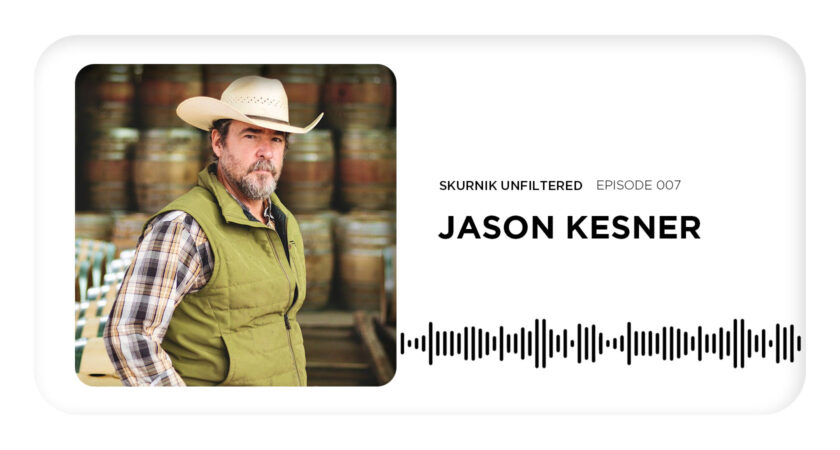
Today’s guest is Jason Kesner, the longtime winemaker of Kistler Vineyards, one of California’s most esteemed producers of Chardonnay and Pinot Noir. Having worked alongside founder Steve Kistler for nearly two decades—first as his only assistant, then as his successor—Jason has played a central role in stewarding the estate through one of the most important transitions in its history.
In this wide-ranging and deeply reflective conversation, Jason channels his inner Rick Rubin and speaks candidly about legacy, patience, and what it means to play the long game in a flashy valley that seems to be forgetting its humble farming roots. Despite the uncertainties facing California wine today, Jason remains deeply optimistic about the next generation of growers, the enduring power of Mother Nature, and the idea that wine, at its best, connects people to something larger than themselves.



Next week, tune in as Southern Hemisphere wine expert Cody Stephenson sits down with Derek Mossman of Garage Wine Co.
Be sure to subscribe to Skurnik Unfiltered wherever you find your podcasts so you can stay up to date on all the exciting content to come.
Introduction
Jason Kesner: We’re not making year-to-year decisions. We’re making hopefully what will turn into be generational decisions. And that feels like the only just way to treat and respect all the efforts that have preceded us. I think the next generation has a lot to learn from that. You remove yourself a little bit from it. It’s about how you’re contributing to this much larger thing than yourself. And therein lies potentially some meaning, rewards that aren’t maybe immediately obvious.
[music]Harmon Skurnik: Hey, this is Harmon Skurnik, and I am here with Jamie Schwartz, the American Fine Wine Specialist here at Skurnik Wines. And he just sat down with Jason Kesner, who is the longtime winemaker of Kistler Vineyards in Sonoma, who we have been proudly representing for many years. And Jason is an incredible human being, an incredible winemaker. Of course, Steve Kistler, the founder of Kistler Vineyards, made the wine for many of the first couple decades. But Jason was his initial assistant, and he’s been making the wine for a very long time, and he’s quite talented.
Jamie Schwartz: It’s really amazing to speak with Jason. He has so much reverence for Steve and everything that they built. He really talks about how they had like an eight-year interview process because before Jason even joined Kistler, he was working with Lee Hudson as a vineyard manager. And so their relationship began in the farmer to vintner capacity. And then Jason would become the only assistant winemaker that Steve Kistler ever had before getting the honor to take the helm.
Harmon Skurnik: And he’s quite a philosopher, is he not?
Jamie Schwartz: Absolutely. It was a very zen conversation. We got into Rick Rubin’s philosophy. I mean, I could listen to Jason for hours.
Harmon Skurnik: I was just going to say that. And I have. I mean, when we visit the winery and we visit the cellar, he kind of takes charge of the room and is kind of like a professor. But he’s an interesting professor. Listening to him, like you said, for hours, he can talk about farming, winemaking, and the way that they treat their employees. And it’s just a really wonderful winery. And he’s a wonderful guy. So why don’t we dive in and listen in right now to your conversation with Jason Kesner?
[music]Jason’s introduction to Kistler
Jamie Schwartz: Jason, you’re originally from New England, but you’ve been in California for a long time. Just walk us through your early days, moving to California from the East Coast and how and why you wound up there. I have a sense that leads to your your career path. So talk us through it.
Jason Kesner: For sure. So, long story short, my mother was a microbiologist in Massachusetts and eventually wound up working for Mondavi. She became the head microbiologist. So shortly after landing in Berkeley, I was living on a ranch outside of the Napa Valley to the east of the Napa Valley in Chiles Valley. She would have me come to work with her at Mondavi during harvest. So I grew up at Robert Mondavi winery in the lab, pretty much. So the sights and smells and textures and all of it to me, the smell of malolactic fermentation means wine, and it has since I was like 11 years old. We lived in the country, quickly learned how to drive a tractor, shoot guns at like 11 years old.
Jamie Schwartz: You’ve been with Kistler since 2008, but your relationship with Kistler wines and Steve predates that. Can we jump into your relationship with Steve before you officially joined the Kistler team?
Jason Kesner: For sure. So I took over Hudson Vineyards, worked with Lee Hudson running Hudson Vineyards in the June of 2000 and worked with a pretty strong group of clients there, aside from Kistler, kind of a who’s who of Napa Valley Carneros Chardonnay at the time. And Steve and I got to know each other very slowly over eight years through farming, and he paid attention to how I farmed his grapes. We had a lot of conversations in regards to that. Found him calling me up to bounce ideas off of me. And in hindsight, it was an eight-year interview for Kistler Vineyards. I didn’t recognize it at the time, but that’s exactly what it was.
Jamie Schwartz: I mean, my understanding of Steve, and I’ve met him briefly a few times, but he’s— I mean, verbose would be the last word to use for Steve. Eight years seems like an appropriate length of time, in some sense.
Jason Kesner: Absolutely appropriate. Yeah, and that translated into a decade of he and I working together in the cellar before he officially retired from Kistler and took up the full-time reigns at Occidental Wines. So, yeah, an 18-year relationship just with Steve involved, and then I guess you put another seven years on top of that, currently. One interesting way I was kind of reflecting on it the other day is you know, we’ve been around or doing what we do at Kistler for 47 years. And at this point, I’ve been there for over a third of it. That’s a little scary, but true.
Taking over from Steve Kistler
Jamie Schwartz: I imagine there’s no shortage of pressure in working for such an iconic brand and with such an iconic human. What’s it been like in both your time working directly with Steve, that long tenure of partnership, and then where are you at now in taking on that legacy?
Jason Kesner: Oof. A big question. And yeah, the time working with him was remarkable. As you mentioned, he’s very thoughtful, a very thoughtful gentleman. And our pace doesn’t move quickly at Kistler, and so we would have very thoughtful conversations that were drawn out over very long periods of time. We would have conversations that span vintages, literal conversations that dropped off at a certain point in time, and we would pick that up an entire year later. So to be part of his journey through Kistler and to take that torch is a remarkable opportunity and tremendous pressure, obviously. I don’t ever think I’ll fill those shoes. Got my own to cobble, as a way of thinking about it, maybe. It’s been a really remarkable journey. I guess I’ve been the winemaker since officially 2014, although Steve and I obviously worked very, very closely in his last years at Kistler. When the clock rolled to 2018, I was alone. I wasn’t alone. I had Fernando and Kai and Beta with me, but it was a brand new cellar master who had already been there for 25 years. He just wasn’t the cellar master. It was a brand new assistant winemaker because I just hired him. And then Fernando, who’s our vineyard manager, who had been at Kistler already for 28 or 27 years. So, talk about the four key components in this business having a little pressure underneath them to do well our first year into it. It was one of the more intense years of my entire life. That said, all four of us were nervous, and so there was this really amazing energy that we built, and we just leaned into it. And the 2018 vintage handed it to us on a platter. It was remarkable. And the Red Sox won the World Series, so I was super fucking pumped, and everything just kind of came into, it was like it was meant to be. And we all leaned in hard, all four of us, because we all recognized the precedent that had been set prior to that, and my repeated tone to all four of them that year, and since then, I said, “Look, guys, we just can’t fuck this up. That’s our job, we just can’t fuck it up.”
“Taste our farming, not our winemaking”
Jamie Schwartz: It’s safe to say that’s a testament to what has been built and why Kistler has the name that it does. I mean, we’re talking about some remarkable vineyards here. Incredible land stewardship. Can you expand on that? Can you tell us a little bit more? It sounds like you were set up for success in spite of big shoes to fill.
Jason Kesner: Yeah, set up for success. Obviously, an incredible suite of vineyards that we work with. But that said, a lot of moving parts in that facility and in the field. And obviously, I was pretty comfortable in the field and had spent a lot of time in the cellar with Steve. I just all of a sudden didn’t have anybody to ask. But yeah, that experience. We were we were handed a tremendous foundation, an enviable foundation. But other producers, many other producers, would be thrilled to have just one of our vineyards. I mean, some of the vineyards that we have internally, let alone the block we work with at Hudson, the block we work with at Hyde, the blocks we have at Terrell, and at the Dutton family ranches, there are a number of producers who would basically sell their firstborn to have access to just one of those. But we’ve got this whole suite, which is pretty remarkable and speaks to the span of time we’ve been at it, speaks to the patience, the thoughtfulness. You know, beyond just not fucking it up. My other orientation with all of this from 2018 on is what can we do? How can we as a group inform the next 40 years of this business? We’re not making year-to-year decisions. We’re making, hopefully, what will turn into generational decisions. And that feels like the only just way to treat and respect all of the efforts that have preceded us and all the energy and tension that’s gone into building this. It’s pretty remarkable and a remarkable guy to take over from.
Jamie Schwartz: You’ve learned a lot from your tenure working with Steve. And I imagine early days there was probably some like what would Steve do mentality in that 2018 vintage in particular, when you lost that direct access. Is that the case to this day? Uh has your team evolved? What’s what’s new and different and exciting at Kistler? Is everything exactly as it ever was? Like, let’s talk a little bit more about the evolution of Kistler.
Jason Kesner: Yeah. Interesting way to think about it. You know, Steve is not very forthcoming at certain times. So, in many regards, my path with him was all about following breadcrumbs because I think he recognized that there were certain things that I needed to just figure out, when I look back on some of those conversations we had that spanned vintages. There was a purpose to all that. That said, the evolution of Kistler started in 1978 with our founding, and it’s been a continual process along the years of constant refinement, trying to figure out ways to do less, to bring more to the wines. You know, the only ingredient in a great wine being the fruit itself. It’s a true statement that those wines will be better and more true to site and vintage if you make it that way. I’m not the only winemaker at Kistler. We have 56 winemakers at Kistler Vineyards. 56 year-round, full-time, fully benefited, permanent employees dedicated to the production of these wines. There’s a tremendous amount of work that’s behind these wines, and 90% of it is not in the winery. And that’s still our North Star at Kistler. And I would say that’s probably more of our North Star now than it’s ever been. And I’m proud to be encouraging us in that direction.
Jamie Schwartz: I think that’s like a really important thing. A lot of people, of course, want to champion the vineyards and the farming, and yet there’s still the hand of man. There is still winemaking. How do you navigate that pursuit of having so little input, but still making a stamp on the wines? Is that possible or is that just an unattainable North Star?
Jason Kesner: That’s a good question. Rick Rubin, the record producer, there’s a little bit in the documentary about him where he talks about the perfect album, him producing the perfect album. And he talks about it being a setting where he doesn’t meet the artist, he’s not present when it’s recorded, and he might not even hear the music. That to me is kind of the ultimate— Now, can you get there? There’s— not in a million years, right? But I love the ideology behind it, I love the thought process. So this this my track at Kistler Vineyards is about removing myself, slow but sure, every year, trying to not put a stamp on it, per se. What it really comes down to is, I want people to taste our farming, not our winemaking. If people taste a winemaking style at Kistler, then I think we’ve collectively failed. Everything to do with why I refer to 56 winemakers at Kistler Vineyards. Because there’s a lot of people that contribute to these final efforts. It has very little to do with me. I’m more of an observer than anything.
Embracing vintage variation
Jamie Schwartz: I’m sure an “easier vintage” might, on paper, be something that a winemaker looks more forward to, a farmer looks more forward to. But can you just elaborate on like what a chaotic vintage may mean or what a perfect growing season may mean, and and how that translates into the bottle in a given year?
Jason Kesner: The first image that came into my mind as you were asking the question was during the Walbridge fire in 2020. The day we were due to pick our Laguna Pinot Noir that year, I called off the pick because there was a lightning storm forecast, an extreme lightning storm. I remember waking up as the thunder and and lightning was starting to roll into Sonoma Valley, and walking out the front door of my house, and looking down into the valley. And as I did, the sun was barely just starting to come up. It was pretty gray, but there was light starting to be cast across the valley, and a ropey bolt of lightning—and it’s hard to describe it as being ropey, but it had these strands in it—and it struck a Douglas fir about 600 yards away from me. And it all but knocked the breath out of me. I was in awe. I was in awe of Mother Nature. It set the tone for some— well, 2020 was already going off the rails at that point, but— so it set the tone for a pretty exciting period of time. Ten days later, the Walbridge fire really kicked up to the north of us. It was on the north side of the Russian River. And I think it was about nine or ten days after the lightning storm. Me driving home up our driveway, and there’s the trees behind our house, and then there’s a 35,000-foot pyrocumulus cloud behind it. And I just pulled over and I was in awe. It was just a— wow. That is powerful, meaningful, profound. And that was Mother Nature. It wasn’t arson, didn’t have anything to do with anything else. That was a naturally occurring wildfire in the state of California, which is part of the landscape. What we’ve been seeing of late has been a little unusual, but it’s a natural part of the cycle there for certain. I mean, there are multiple species of plants that have adapted to fire. Whether it’s that or a really gentle sunrise or the first rain of the year, or a frost that just lights on your vineyard at four in the morning and there’s nothing you could do to it because it’s an unusual frost where you don’t have frost protection in that one vineyard— it just makes you humble. And I’m forever grateful for bumping up against that and learning my limitations and understanding that we’re not in charge. “Challenging vintages” are just as rewarding as “non-challenging” ones. But you know, in the “non-challenging” vintages, you find room to challenge yourself because you’re always thinking, okay, what does this mean? What is this going to mean to the wines? What is this? What kind of wines are other people making this year?
Jamie Schwartz: It could be more pressure, I imagine, if you don’t have Mother Nature dictating decisions.
Jason Kesner: Yeah, then you’ve got to make them. If she’s not making them for you, you’ve got to make them. So, vintages that run smoothly are just as fascinating and engaging as vintages that are overtly challenging because of the weather. And one thing I’ve learned is that every year, while there can be similarities drawn to other vintages, every year seems to be unique because there’s always variables. And I grew up in St. Helena when it was definitely ag-oriented; a lot of old Ford pickup trucks, not a lot of Range Rovers. That shifted pretty hard in the last 20 years in particular. I think all the pretenders will be left by the wayside. Let me put it that way.
Optimism for the next generation
Jamie Schwartz: There’s obviously the luxury aspect of the wine world, but what’s an exciting trend in the wine world right now? What’s something that gets you going? What’s gets you out of bed in the morning?
Jason Kesner: The infusion of youth! I think there’s a lot of people—not to throw shade on natural wines or any of the orange, bubbly, philosophical wines, wines that are making a statement, from my perspective—but the next generation is exploring, and they have this, at the heart of it, this orientation of really trying to respect site, and overall respect for older vines is kind of the subtext of that. So that’s a movement that I think, as it matures, will be really interesting to watch. That next generation of winemakers coming up in California that aren’t influenced by the flash, don’t care about the Ferraris in downtown Napa. There’s something different there. And I don’t know. Is that movement a little crunchy at the moment? You know, it seems like— I mean, the ’70s and ’80s were all about this really honest approach to grape growing and to wine making, because the ’70s and ’80s were producing some unbelievable wines. Unbelievable Cabernets from Napa Valley. Super balanced at lower sugars, great acidity, all this stuff. The ’90s and the early 2000s really kind of catapulted California wine onto the map, in particular a brand like us. And if you weren’t making bombastic wines or wines that bordered on the bombastic in the cocaine ’90s, you weren’t paying attention, and you probably weren’t making any money. So our whole industry sort of went in that direction a little bit. And I’m not apologetic about it at all. They were big, gooey wines that fit the era, and they were cocktail wines, and and they fit where we were on the scale of our understanding of food here in the United States, too. I mean, if you look at the trajectory of, for example, farmers’ markets and people being interested in where their food comes from, wanting to know the person that grew it or produced the food and meeting them at the local market, that’s only really been in the last 15, 20 years where it started to really take off. I think there’s tremendous room for people in general, the consumer, finding more and more authentic connection points with both their food and their wine, and more meaningful connections as a result. So, understanding that wine can go along with that, it feels like we’re almost in the first iteration of our industry here in the United States. I mean, we don’t have 600 years under our belt, we don’t have monastic beginnings, we don’t have the historical anointing of kings on our products. We don’t have literal journals written by monks who had nothing else to do except for grow and think about wine. So obviously they’re gonna share tremendous amounts of detail. And I’ve seen some of those journals and talks about the weather in fucking 1685, right? Wow, like, okay! But we do have, as proven in the wines that we’ve been producing for 47 years, and the wines that others have been producing in California for longer than that, we do have a tremendous future ahead of us, I think. I know because it’s genuine and authentic, and we’re just starting to scratch the surface of this. I think we have this next generation that’s got more open eyes to what this could all be, and in a way, gets us back to that innocence of the ’70s and ’80s. I don’t know. Viticulture and our approach and our heavy-handedness in the winery—not ours, I’m just saying as an industry—for a period of time, made wines that weren’t reflective of site and place. And I think we’ve got a better opportunity to make wines that are truly reflective of both moving forward.
Jamie Schwartz: So you’re aspirational for the next generation of American winemakers, and yet it’s seemingly as hard as it’s ever been in this industry in this country right now, and there’s a lot of unknowns. We don’t need to go down the rabbit hole of what those may be or where they’re coming from, but are you still optimistic? Like, what’s the 11-year-old learning how to drive a tractor right now got to look forward to, post graduation from college?
Jason Kesner: Great question. I think, well, for example, Kai, our assistant winemaker, he’s a fair deal younger than I am, and he was literally one day away from signing a contract to become the head winemaker at another winery when I called him and I said, “I’m ready. Steve’s leaving, and I need you to come join me.” And he and I had known each other for like six or seven years prior to that. So he’s got this patience already kind of woven into his position. He recognizes that this isn’t— there isn’t a rapid pace here. I think that trajectory, that way of thinking about our business in generational terms, I think the next generation has a lot to learn from that. You remove yourself a little bit from it. It’s about how you’re contributing to this much larger thing than yourself. And therein lies potentially some meaning, rewards that aren’t maybe immediately obvious. So I don’t know. To me, there’s an older, newer way to live for the 11-year-old that’s driving a tractor right now. If we can do things today to contribute to people being able to further that notion in the future in meaningful ways, if we can be doing foundational work right now, as opposed to just reactive work or production work. There’s a really iconic picture, iconic to me and iconic to some of us at Kistler that we’re starting to use more in more prominent ways, of an old mid-1950s Caterpillar D2 tractor that Steve Kistler was learning to drive in 1980. That same year, I, two valleys east, at 11 years old, was learning to drive the exact same tractor. That’s what I cut my teeth on. It’s literally how I learned to drive a tractor. So there’s some sort of synchronicity there. I don’t know if it’s fully Jung ian, but there’s maybe some alignment of the stars. That to me speaks to our DNA as farmers. And I could say that, with a lot of confidence, that we’ve we’ve been farmers since the beginning and we’re still farmers. I’m incredibly interested to see where Kistler goes from here. And the other producers that do have the greatest sites in Sonoma County and Napa County and other parts of California, and increasingly starting to discover other parts of the United States. I don’t know. That, to me, is interesting. Like, where’s California in 600 years? I’m super interested to see where all that goes. And again, because I think in many regards, we’re just getting started. So I don’t know, I’m super optimistic about the future. Much of it will in all likelihood be well beyond my tenure at Kistler Vineyards. But, to me, the next generation has everything to look for in that arc of being and of existing. I mean, if you put your time and effort into this— Look, at the end of the day, it’s agriculture, but we produce something that makes people pretty happy too, and can be an ingredient, most often is an ingredient, in these really special settings. And I don’t need an Instagram picture to know that had somebody had it at their dinner, but just the idea that we’re putting not many bottles out into the world that have the chance of bringing some joy to people is— man, the hair on the back of my neck stood up. It stands up every time I think about it. Robert Mondavi said it best, and I’m not even gonna try to bastardize what he said, but it’s a civilization thing, and it’s been around for a very, very, very long time for a reason. So that’s what the kid who’s 11 years old who’s gonna learn how to drive a tractor right now, that’s what he has to look forward to. I don’t know. Maybe it’s all worth something more. Create something different.
Skurnik Unfiltered is recorded at Skurnik Wines & Spirits headquarters in the Flatiron District of New York City, which is why you might hear some city noises as we go along, like horns honking. If you found the conversation interesting, please consider liking, subscribing, and leaving a review. You can stay up to date on our show and upcoming events by following @skurnikwines on Instagram and visiting our website at skurnik.com