

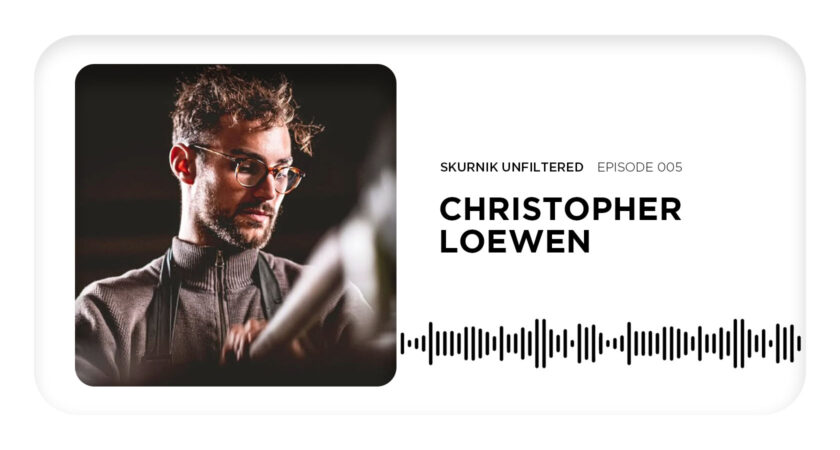
Today’s guest is Christopher Loewen, the 33-year-old at the helm of Weingut Carl Loewen, one of the Mosel’s smallest and most impressive estates.
Christopher, along with his father Karl-Josef and one other employee, farms some of the oldest ungrafted Riesling vines in the world from a fabled parcel planted in 1896 by the Schmitt-Wagner estate. By embracing traditional, low-intervention viticulture and “letting the wine decide” when it finds its balance, Christopher crafts Rieslings of astonishing depth, concentration, and energy. His wines aren’t about chasing numbers or trends—they’re about listening to the vines and responding to their needs like an attentive parent.
In this episode, Christopher sits down with Skurnik’s Austrian & German Portfolio Manager, Michael Lykens, to talk about the Mosel’s evolving climate, the magic of old vines on hard slate soils, and why making great wine is more about patience than intervention.



Next week, tune in as French wine expert David Hinkle sits down with Quentin Paillard of Champagne Pierre Paillard.
Be sure to subscribe to Skurnik Unfiltered wherever you find your podcasts so you can stay up to date on all the exciting content to come.
Introduction
Christopher Loewen: My goal is not to be a big businessman and have a big company. I studied viticulture and enology to do viticulture and enology, and working in these vineyards also makes me think a lot, honestly, because you really want to treat them right. You don’t want to be the last generation farming the vines that were surviving four generations, five generations. Yeah, it’s for me, unbelievable that we can farm a plant that was planted in times where even Germany was not founded.
Harmon Skurnik: Hey, this is Harmon Skurnik, and today I’m here with Mike Lykens, who is our portfolio manager for all German and Austrian wines. It’s a pretty important role. And you had the pleasure of interviewing recently one of our really great producers, Christopher Loewen.
Michael Lykens: Yes.
Harmon Skurnik: How did it go?
Michael Lykens: Really well. Christopher Loewen has taken over from his father, Karl -Josef, and they are wonderful stewards of old vines in the Mosel.
Harmon Skurnik: I remember when we first started working with the Loewen estate and I met Karl, but Christopher at the time must have been a child, but as time went on and he grew up, he’s quite an impressive young guy.
Michael Lykens: He really is. He’s wise beyond his years for sure. And I think viticulture, particularly in Germany, produces these individuals because they grow up with this understanding that every vine that they plant, the very best fruit that that vine will produce will be well after they’re long gone. And so they look at this, at their vineyards, as their living cultural history. And to find a young man who understands that to his core and is so proud of that history is really refreshing to see. He cares so deeply about the vineyards that he works in.
Harmon Skurnik: Some of the old vines that they have are some of the oldest in the Mosel or even in all of Germany, isn’t that right?
Michael Lykens: Yeah, so, I think I would press pause on saying they’re the oldest Riesling vines in the world because there is an old vine registry, and there there are some things on there that look quite old, but their oldest vines were planted in 1896.
Harmon Skurnik: Old enough, I think.
Michael Lykens: Old enough, yes, exactly right.
Harmon Skurnik: Didn’t they acquire some vineyards from the Schmitt -Wagner estate?
Mike Lykens: Yeah, it’s one of my absolute favorite stories to tell. And actually it’s so funny because it happened on a Skurnik June Tour, our annual tour every year in June.
Harmon Skurnik: You were responsible for this transaction?
Michael Lykens: I believe you were responsible, Harmon. This was a tour in which we take all of our growers across the country and promote the wines. But Karl and Bruno were friendly, and Bruno mentioned that he didn’t have anybody that was interested in taking over his vineyards and taking over these vines. And these are really important vines because his family had bought them directly from the Napoleonic auctions in the 1800s, and before that, the vines exclusively belonged to the to the church. And so there were only three documented owners of these really, really special vineyards. And over time they spoke more and more, but they never spoke business. They always talked about philosophy and life and family and about their culture. And Karl -Josef came back to the to the estate with Christopher and he said, ” I feel really good. I think that he’s going to sell us these vines.” And Christopher goes, “Oh, really? How much?” And he goes, “Well, we didn’t talk business.” But he just had that feeling that, again, this heritage, that they wanted to make sure that the vines ended up in the in the right hands. So these are the things, these romantic stories that make us fall in love with wine culture.
Harmon Skurnik: Fantastic story. Well, Christopher, I would say, is not only a wonderful winemaker, he’s a wonderful guy. But I would say that the wines have never been better. Do you agree with that?
Michael Lykens: A hundred percent. I would say that he is navigating these new challenges with the climate, really extreme weather conditions, he’s navigating them really well. And it’s quite simple. I believe that Riesling is the king of all grapes and it expresses itself through a variety of spectrums. And Christopher understands that he doesn’t make wine for a market, so to speak. He believes in spontaneous fermentations and, for the most part, letting the wine decide when the fermentation is done. And so if that’s your only focus, and once the fermentation stops, the wine knows that it’s done and it’s balanced. And so it’s like the old -school, low -intervention winemaking.
Harmon Skurnik: Well, it’s a fascinating conversation you had with him, and why don’t we listen in and see what you guys have to say?
Michael Lykens: Great.
Harmon Skurnik: Thank you, Mike.
History of the Loewen estate
Michael Lykens: Today I’m sitting down with Christopher Loewen in the Mosel, based in the town of Leiwen, and we are incredibly big fans of the estates and the collection of wines that you produce. Would you give us a brief introduction into your section of the Mosel and what it is that makes your area so special?
Christopher Loewen: Yeah, thanks a lot everyone. My name is Christopher Loewen from Winery Carl Loewen. We are located in, as you said, in the city of Leiwen, which is in the upper part of the Middle Mosel. We are located in between the two main cities of Mosel, Trier and Bernkastel. Our part of the Mosel is maybe a little bit colder than the traditional Middle Mosel, which brings a little bit more salinity and freshness to the wines.
Michael Lykens: And you also have maybe some of the largest collection of old vines of any estate that we work with. That’s quite an interesting story. I’d love to hear a little bit about it.
Christopher Loewen: Basically, it’s a story of our estate going a long time back. In the mid-ages, the best vineyards in the Mosel Valley were farmed by monks. And then around 1800, Napoleon the Conqueror came to our area, and in 1803 he set up a big auction to gain more money for the war to go further east, and so in 1803 they sold the best vineyards of the abbeys. An ancestor of mine, Nikolaus Loewen, was the last vineyard manager of that abbey, and he bought out the best parcels, and that was basically the start of our estate, and that is the Maximiner Klosterlay vineyard that we still farm in the city of Detzem. And then the family went on farming this vineyard, but more as a normal farm. We had farmland, we had cows, we had corn and vineyards, which was quite common in the Mosel. Then my father took over the estate in the middle of the ’80s as a very, very tiny estate, around one hectare, he took over. And from the start, he had, directly, the goal to make great wines and not just average wines. In the ’80s, the Mosel was facing a big crisis, and he used that crisis selling the easier flat vineyards with young vines and buying topsides with very old, ungrafted vines. We had a big advantage somehow in that crisis because the great vineyards that were unaffordable for a normal family like us for over 100 years, we could afford it. We focused a lot on buying more old vineyards, and the estate was growing because the success was also growing more and more with higher wine qualities that we could produce. The estate grew from 1 to nowadays about 18 hectares, and in that time we were always focusing on buying old wine parcels. That is the big advantage that I have nowadays, that such a huge portion of our estate is planted with older vineyards.
Michael Lykens: So you basically got in early on these really great old vines that, most likely, wouldn’t have been available for someone like a family like yours to purchase in the Middle Mosel, especially within that quantity, which is quite rare and quite special. And now it seems though your section of the Mosel is starting to get a bit more of the recognition that it deserves.
Climate change in the Mosel
Christopher Loewen: Yeah, yeah, definitely. You can say that historically, the area around Bernkastel was the most famous part of the Mosel. The reason for this is, in my opinion, mostly the climate, because the area about around Bernkastel is a bit warmer. And if you go a few decades back, it was always a big fight in the Mosel to get the grapes ripe. Especially in the colder vintages, it was normal that sometimes you couldn’t get the grapes ripe, so that was a little bit a disadvantage of our part of the Mosel. But now with the climate getting warmer a bit every year, we can have nowadays just the perfect ripeness. And I think—it feels a little bit awkward to say— but like honestly, our estate really had advantages in the warmer climate of the last years, and that brought unbelievable qualities of dry wines too in our area.
Michael Lykens: Yeah, it really has been amazing to watch the evolution of wines in the Mosel. It almost seems as though historically, there were always wines made with residual sugar out of necessity, because you’re always fighting for more ripeness and fighting for the the perfect structure, and now you ‘re fighting against ripeness.
Christopher Loewen: Yeah. So really, a lot has changed. Like for me, as a young person, I’m 33 years old, and I already see that the climate is changing, the viticulture is changing. But I really, as I said, I feel like my generation, being on the perfect spot of climate in the Mosel Valley and being maybe the perfect generation, that we can still make those traditional fruity styles in high altitude parcels, in parcels that have more freshness, more elegance. But on the other hand, we can make really great dry wines in the warmer parcels that have the ripeness, that bring the structure and complexity to the wines.
Michael Lykens: Yeah, it’s amazing. It’s one of the very few lucky places in the world right now where wines like this are even possible with this level of precision. There’s depth and there’s complexity, but there’s also an immense amount of pleasure in these wines. So it’s quite special. I should go back to the beginning. Your estate, though, still is quite small. It’s a quite small family operation. How many hectares are you and how many full-time employees do you have?
Attentive farming and winemaking
Christopher Loewen: Yeah, we are, in the structure, a bit unusual. We do about 18 hectares right now, which is for Mosel not tiny, but also not big. We have nowadays super big estates with over 100 hectares in the area, but the average winery is still about three or four hectares, because farming in the Mosel means a lot of handwork, a lot of tough, intense manual work. Basically, our winery is set up really, really small. It’s basically just my father, one employee, and me. So if, now sitting here in New York, if you would call the winery, the phone would just ring and nobody would answer. I studied viticulture and enology, and I always say, I studied viticulture and enology to do viticulture and enology. And my goal is not to be a big businessman and have a big company. I see my strength in being a good viticulturist and winemaker, and that allows us also to do a very individual farming of our vines. There is no master plan of farming in our winery. It’s really just, in the summer, being every day in the vines, seeing how the weather has influenced the vineyards, and while working there, seeing also how to react on maybe a rain or a hot day or high humidity, low humidity, lots of growth or weak growth, so we can really— While I’m every day outside, there are everyday decisions and a very individual farming. And that’s the same in the cellar. There is no plan how to ferment the wine. They all do natural fermentation, but normally in the winter, I’m every day in the cellar. Now, for five days I’m not, so my father is taking over for a few days, but I’m texting him every day. There’s just more decisions made through how the wines individually taste.
Michael Lykens: Yeah, it’s almost like parenting a little bit, in the sense that, except you’re not telling the vines what to do, you’re listening. And the vines are telling you what’s going on and what they need. And you have to just be there when they need it.
Christopher Loewen: Yeah. I mean, that’s totally right. And I think it’s a very good example, with parenting, and you can try to parent each child the same way, or you can try to listen to the child and react. Not every child wants to do sports, or others want to play music, you know. And I think it’s not a good idea to put every child so it must be a musician or it must be an athlete. So it really depends on what the child can offer.
Old vines
Michael Lykens: And the reality is, because you have such a large collection of old vines— I mean, I can’t think of anybody that has as many vines as you planted between 1896 and 1903. They’ve lived a lot more life than you and I have. So they they have a lot to tell us, even though they’ve been in that same space.
Christopher Loewen: Yes, and that’s, even for me, really sometimes crazy to understand. Working in these vineyards also makes me think a lot, honestly, because you really want to treat them right. You don’t want to be the last generation farming the vines that were surviving four generations, five generations. Yeah, it’s, for me, unbelievable that we can farm a plant that was planted in times where even Germany was not founded.
Michael Lykens: Yeah, it’s humbling to think about that. As an outsider, I can’t imagine what that responsibility must feel like, in terms of you really wanting to to do right by these magical little vines.
Christopher Loewen: Yeah, yeah, yeah. That’s right.
Michael Lykens: I’d like to to pause and now talk about what we’re here for, some of the wines themselves. The first wine I wanted to talk a little bit about today is your your estate Alte Reben. First of all, it’s, of course, one of my favorite labels of all time. It’s romantic, yet this is exactly what the vines look like.
Christopher Loewen: Yeah. So basically, it’s wine that is also, to me and our whole estate, very important because this wine is the outcome of working two generations towards one way. My father started focusing on old vine vineyards, so we could buy a lot of very old parcels in the last 50 years. And that brings us to the big advantage that we have, in a high selection of older vineyards. The old vine Riesling is not just kept for a Grand Cru or a GG, so that allows us to make a wine from 50 to 70 -year -old vines which is in the basically the “village” quality category. The older vines have a lot deeper roots, they have tinier berries, and also we try to do low interventional viticulture. So basically— maybe we can talk later about it. We do, in the cellar, low-interventional winemaking, but also in the viticulture, we try not to interfere in the vineyards too much, and that only works when you have a very weak growing vine that is not making a lot of leaves and not making a lot of grapes. My father is also quite proud to say he has never cut down a green grape from a vine, so we never did green harvest, which is quite common to give the wines more complexity. But our view is more long-term, bringing the whole balance in the vineyard. Balance is, for me, the most important word in viticulture and in winemaking, really bringing the growth down so that you have, naturally, that low yield. And then you have wines with very good structure and complexity.
Michael Lykens: Yeah, they’re quite special. And if you haven’t had the wines, for anybody listening out there, just the amount of kind of concentration and depth— but before we move on to the next wine, this is also a wine that you don’t force the fermentation one way or the other. You let the fermentation stop when it does.
“Let the wine decide”
Christopher Loewen: Yes. So basically, that’s also something that we realized in the last few years, you could say. We do all the wines with natural fermentation, so maybe we can talk about that a little bit. So basically, we try to do low -intervention winemaking in the sense of very traditional winemaking. That means we just pick the grapes, press them, letting them fall by gravity into the cellar. The cellar is classically down in the earth, so we can work with gravity. And the big advantage for us in the earth is that we don’t need any cooling or heating system, it just ferments how it ferments, but the temperature is very stable in the earth. It ferments without any additions. Sometimes the natural yeast is not strong enough to ferment the wine all the way through until very dry levels. There were times when we were thinking about adding yeast to really make the fermentation go again or waiting a lot longer to see maybe then the fermentation starts again. But what we saw very often is that when we interfered, we saw very often that these wines were, taste-wise, showing an imbalance. That also led us at the end to the point where we said, maybe it’s smarter to let the wine decide how it will be at the end. And when the wine stops fermentation, we accept it and then we bottle it the way it is. Since we have been doing that, I feel that the wines have a very good balance. I’m not a big fan of numbers in wine making anymore because I like to say no customers have numbers— we all taste the wine. And I think it’s more important to have a wine that just tastes balanced than something that we pushed to certain numbers.
Michael Lykens: Right. Sometimes these numbers are somewhat arbitrary, and we utilize them for commerce, for sales and marketing, but it’s not what makes the very best wine.
Christopher Loewen: Yeah, and I also think that tasting wine is such a complex thing, and flavor is such a complex thing, that with a few numbers, we can’t get what the wine actually tastes. And so it’s a little bit misleading. All winemakers want to have a certain safety in taking numbers, and also for an importer, it’s always nice to see, “Okay, the acidity is good, the alcohol is good. That’s exactly what we are looking for.” But that tells nothing about how the wine later on tastes.
Maximiner Herrenberg vineyard planted 1896
Michael Lykens: Exactly right. Let’s move on to this, this one special vineyard. So we have Maximiner Herrenberg. You make a handful of wines from from Herrenberg. My colleague came in and this was just delivered— the very special 1896 bottling. Talk to us a little bit about this site. I think you know I’m not always big on just talking about rocks and soil, but I think that in this case, it is worth bringing up a little bit because it’s an important point of distinction.
Christopher Loewen: Yeah, so, talking about Maximiner Herrenberg vineyards, it’s important to start with how those vineyards ended up in our estate. We talked about before, in 1803, there was a big auction. My family bought one vineyard in that auction, and so the whole family story started. Some vineyards our family didn’t buy because they were 20 kilometers away. There was another abbey that was sold in 1803, and there was a different family, the Schmitt Wagner family, who bought that in 1803, having 1.5 hectares of over 100-year-old ungrafted vines, which is super rare and unique. We got the chance to buy these, and that’s what we did. We also were super interested in that estate because it had a very special terroir. Where our winery is located in Leiwen—and also most parts of the Mosel—you have blue and grey slate. But 20 kilometers upstream in Longuich, you have high portions of iron that makes the slate coloring red, and that brings completely different aromatics. So it’s more about herbals, floral aromatics, and a bit more complexity. In Mosel, we have a very old vineyard classification from 1868—it’s the second oldest vineyard classification of the world, even older than Burgundy—and in that classification, there was one prime parcel from the Schmitt Wagner family. It was the only parcel in the whole town in that highest category, and that was a parcel that the Schmitt Wagner family planted in 1896, and it seems to be that these are probably the oldest Riesling vines in the world. It is a big, big honor for us that we can make now two wines out of that very special vineyard.
Michael Lykens: That’s great. And thank you so much for allowing us to have a little bit of that wine. They’re they’re quite special. But also, the vineyard itself is not just the 1896 parcels, correct? I mean there are parcels that are much younger that were planted in 1903.
Christopher Loewen: Yes. We have that one parcel that was planted 1896, which lays on the bottom of the hill where we do those two types of 1896 Rieslings: one with the wax, where we try to make a very traditional wine, like in the year 1896 —only handwork in the vineyard, pressed on a wooden basket press, and a very, very traditional mindset—and then we have, as you said, one parcel that is a bit younger planted in 1903, our Grand Cru parcel, so Grosses Gewächs, we say in German, or GG. This is a lot steeper, a lot stonier, and it brings a bit more complexity and power, and that’s why we decided to make it as GG. And then on the same red slate hill, there’s another parcel, or three other parcels that are also ungrafted, pre- phylloxera, like the others, but a bit younger, so just about 100 years old. And that’s where we make a special Kabinett from the Herrenberg vineyard. Three parcels very far up the hill, which brings higher altitude, more freshness, more elegance. And I really like the idea of making Kabinett from ungrafted vines because the ungrafted vines grow slower and weaker, and due to this, the wines have more structure. Also, in this way, we can make a style of Kabinett that has, in the mid palette, a lot of structure and backbone, but in the finish it has that very typical Kabinett elegance.
Michael Lykens: Yeah. It’s deep, it’s concentrated, and I use the same terminology when we’re talking about these older vines, because it’s just hard to articulate that concentration that you get. But this is still very much a classic, crunchy Kabinett that for everyday consumption. It just so happens that these vines have seen a lot. And then lastly, a wine from your home village.
Traditional farming in Laurentiuslay
Christopher Loewen: Yes. On top of the wines we make from Longuich, we also, of course, have the topside of our town of Leiwen. It’s the vineyard called Laurentiuslay. Laurentiuslay has a very unique terroir. It’s one of the rockiest vineyards we have in our area. What shows quite well how hard the slate in this hill is, is that the state tried to build roads in the middle of the hill in the ’80s. They did trials to crack the slate, and they saw that it’s impossible to crack it; it’s so hard they couldn’t build a road. So there is only one road on the bottom hill and one road on top of the hill.
Michael Lykens: Wow.
Christopher Loewen: And that brings a lot of work to us because, due to this, it’s only handwork possible; there’s no machine work in the vineyard. But it has the big advantage that due to this, people didn’t replant the vineyard because it was just way too much work. More or less they said, “We accept very, very low yields,” because replanting would mean in this dry vineyard having six years of no grapes, which, like normally after two years, you have the first grapes. And so it was a big advantage for us that nowadays we have here a vineyard with over 100-year-old ungrafted vines, single pole training system, and on top, in Laurentiuslay, because of that handwork, we can plant even denser. We don’t need to make wide rows for machines driving through. And due to this, we still have here the very traditional way of farming in Mosel with 10,000 vines per hectare plantation, which is double the amount of vines than what is planted normally.
Michael Lykens: Wow, I have to say just a big thank you. And it’s it’s great to know you and your family and these wines. I feel lucky to sell these wines and tell your story through customers. And thank you for all of the inspiration. Thank you for joining us today.
Skurnik Unfiltered is recorded at Skurnik Wines & Spirits headquarters in the Flatiron District of New York City, which is why you might hear some city noises as we go along, like horns honking. If you found the conversation interesting, please consider liking, subscribing, and leaving a review. You can stay up to date on our show and upcoming events by following @skurnikwines on Instagram and visiting our website at skurnik.com