

The Schloss Lieser estate boasts one of the most privileged vineyard portfolios of the Middle Mosel, with famed sites like Piesporter Goldtröpfchen, Brauneberger Juffer, Wehlener Sonnenuhr, and Bernkasteler Doctor creating incredibly sharp and precise wines from impossibly steep slopes.
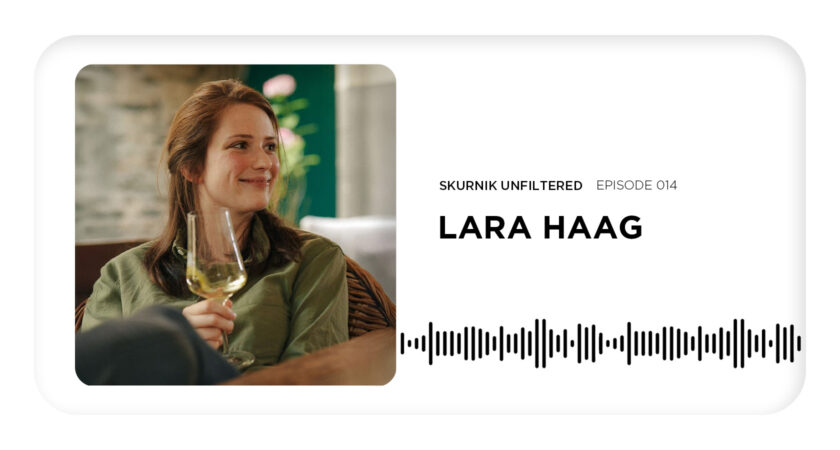
In this episode, German wine expert Michael Lykens tastes a flight of Rieslings with Lara Haag, winemaker Thomas Haag’s daughter. They discuss how respect for terroir directs their low-intervention winemaking practices and where Schloss Lieser’s signature “sponti” aroma comes from.



Next week, tune in as Italian wine expert Mark Fornatale returns for a chat with Chiara Boschis of E. Pira.
Be sure to subscribe to Skurnik Unfiltered wherever you find your podcasts so you can stay up to date on all the exciting content to come.
Introduction
Lara Haag
Even if it’s the highest level, it’s still not getting opulent or ripe or more fat. That’s not what we want to aim. We are more aiming about, like, mineral-driven, sharper, cooler style, very fine, very precise, getting more focus and more finesse and more talking about the character.
[music]Harmon Skurnik
Hey, this is Harmon Skurnik, and welcome to another episode of Skurnik Unfiltered. Today I have with me the director of all of our German and Austrian wines here at Skurnik, and that’s Mike Lykens. You just interviewed Lara Haag, the daughter of Thomas Haag of Schloss Lieser in the Mosel. Really one of our best Mosel producers, without a doubt. I stayed there, visited the estate, but also stayed at the Schloss. You know, “Schloss” in German is “castle,” it means castle. And not only is it a castle that goes back, I don’t know, to the Venetian days or whatever, but it is currently a four or five-star hotel. It’s amazing.
Mike Lykens
Yeah, I think that’s one thing I always try to remind people, that the castle and the Vinothek are completely separate. The Lieser family, they are very much blue-collar, roll-up-your-sleeves workers. They are not aristocrats living in a castle.
Harmon Skurnik
Without a doubt. But the quality of the wines is aristocratic.
Mike Lykens
Absolutely. Nail on the head. They’re really elegant. These are very special vineyards that they’re mostly farming in the village of Lieser and Brauneberg. And they do have some holdings also on the Bernkastel ramp. But yeah, these wines—
Harmon Skurnik
I mean, the vineyards that they produce reads like a Who’s Who of the very best in the Mosel. You’re talking about Brauneberger Juffer and Juffer Sonnenuhr, Wehlener Sonnenuhr, Piesporter Goldtröpfchen, Graacher Domprobst, and Bernkasteler Doctor.
Mike Lykens
That’s right. Yeah. That is the Who’s Who of the Middle Mosul for sure. And what’s really outstanding is that Thomas’s signature is on all of those wines, that those vineyard sites do speak for themselves, but through Thomas’s dialect and winemaking, and just one of the things I love so much about the Mosel and those wines.
Harmon Skurnik
I remember him telling me, I think he had just acquired, I don’t know, a few rows really of the Doctor vineyard. And he says those vines do not change hands very often. And they got very, very fortunate and were able to get them through, I don’t remember what connection.
Mike Lykens
Yeah, the way it works in the Doctor too is, the leases are on different terms. Normally you’ll see 30-year terms on a lease for a vineyard site, and so you have essentially a generation to farm it and make it your own. The Doctor, those leases are 10 years, so it’s a much more compressed time, but it’s because that site is so special and so sought after.
Harmon Skurnik
The estate is historical. It goes back to, I believe, 1904, but it was more recent that the Haag family, which is a famous family from the Fritz Haag estate, Thomas, I guess, is his son. Is that right?
Mike Lykens
Yeah.
Harmon Skurnik
And I don’t remember exactly why he left the estate, the Fritz Haag estate, and went to Schloss Lieser in order to resurrect this once famous estate, but it was quite a challenge to do so. And he’s succeeded in spades.
Mike Lykens
Yeah, Thomas was a young man and looking for an opportunity. And you know, one thing about taking over a family estate is it’s the uncomfortableness of waiting for somebody to either retire or pass away to get your opportunity. So he took an opportunity with Schloss Lieser to have something of his own. And then the person who owned, at that time, the castle and the Vinothek had financially run it into the ground. And so it was presented an opportunity from the bank to essentially take over the the Vinothek at a deal that was too good to pass up. It is uncommon to see something like that in the Mosel, but we’re sure glad that he did it.
Harmon Skurnik
Absolutely. And now the second generation is involved. You’ve got Lara, who’s the one you interviewed, who is sort of the front of the house.
Mike Lykens
Yes. I love this family so much. They’re always so welcoming and so just genuinely nice and and passionate. And like so many families, her and her mother—the women of the family—really steer the ship and are the the pulse, the North Star, if you will. They have a very strong opinion and vision for the future of the winery. But like so many of the family businesses that we work with, which is always one of my favorite things about being at Skurnik, is it’s a family business working with lots of other family businesses, they all work together and always find common ground. And it’s just really refreshing to see. And the result are these really beautiful wines that we get to share with each other and our customers.
Harmon Skurnik
Great. Well, why don’t we dig in and listen to your excellent conversation with Lara Haag.
[music]History of the Schloss Lieser estate
Mike Lykens
Today we are with Lara Haag of Schloss Lieser in the heart of the Middle Mosel. Thank you so much for joining us today. Would you mind telling us a little bit about the estate, how it came to be? I think it’s a fun story.
Lara Haag
My dad came into the winery in ’92 and he was very young. He went to the university in Geisenheim, studied wine, came back to the Mosel, and started at the Schloss Lieser estate as a cellar master. And by that time, the winery was in extremely bad shape. The buildings were rundown, the vineyards as well, because the owners before only sold bulk wines. No bottles in the cellar, no customers. He really started from scratch in the ’90s and putting everything back into the bottles and focused on quality. So we are in Lieser, that’s like the heart of the Middle Mosel, between Trier and Koblenz. Very famous vineyard sites, and we are located in Lieser, and that’s also where the vineyards were at the beginning. Then my parents could buy the estate in ’97, but they had no money. They went to the bank, asked for huge credit, they were exactly my age, and then really started. In the beginning, there was no other investment possible. They tried to do something just with what they had. We quickly joined the VDP, which was very good, so we followed that classification system. Especially in the last 10 years, we expanded the portfolio and other Grand Cru single vineyards as well, that we are now having different ones from the Wehlener Sonnenuhr to Piesporter Goldtröpfchen. We will taste a few so that you focus on the terroir. My dad always did spontaneous fermentation from the beginning. He was one of the few ones in the ’90s really doing it and showing the character of the vineyard. So that makes it exciting, tasting it in the glass.
Mike Lykens
I think it’s an important point of distinction to point out because maybe if somebody were to look up Schloss Lieser online, the first thing they might see is this wonderfully beautiful castle. But you don’t own that, right?
Lara Haag
No, you can even see that in United Airlines advertisements when you fly. The castle and the winery was always together in the past. It was one wealthy family who was living in the castle, and doing wines in the winery. The castle was built in the 1880s, and then they built the winery in 1904. They were very famous with the wines. That was also the time when we produced the most expensive white wines in the world. Then they sold the wine estate in the ’70s, and from that point on, the two things were separate. The castle then, it was the same with the winery in very rundown condition as well because it was longtime owned by the village and they didn’t do much with the castle. It’s now owned by a Dutch guy who has made a hotel out of it. Just since 2019, it’s open. It’s very nice, it’s very beautiful.
Mike Lykens
Yeah, it is. It must be quite interesting, like, your father literally had to rebuild the estate as far as construction and redoing the buildings and the roof and all of that, but literally living next to a castle. It’s quite an interesting dynamic.
Lara Haag
Yeah, and even that was a big project with the winery. I do not want to see how much was the the castle to build everything. It was a lot of money he had to spend. The Dutch guy was crazy. It was 10, nearly 15 years of construction work. It’s very intense, but now very nice.
Mike Lykens
Okay, very good. Well, I just wanted to to make sure that it was clear that this is very much a small family domaine and not a Marriott winery.
Lara Haag
No, a small family estate.
Building a coveted vineyard portfolio
Mike Lykens
Yeah. But you have some really, really privileged vineyard sites.
Lara Haag
Yeah, in the beginning, always Niederberg Helden as our main Grand Cru vineyard. It’s our home vineyard, it’s one minute far away. Extremely, extremely steep. And also then, so, Niederbeckhelden and Brauneberger Juffer and Juffer Sonnenuhr. These are very close to each other, but completely different. We had very bad hail in 2013. We had it in 2011 already, but it was in August, which was a better time, though still not good, but a better time. In 2013, we had it during the flowering season, which was the worst. We lost 70% of our whole production, which, for a winery which has not existed for a long time, always had to invest, also doesn’t have any back vintages to sell… Yeah, it was a disaster. So at that point, we said, Okay, we have to expand the portfolio, be a bit more independent. With that vintage, it was a bit funny. My dad got the Best German Winemaker [award], so there was a demand for the wines as well. So we needed to get bigger too. In 2014, we added the Wehlener Sonnenuhr. It’s probably one of the most famous vineyards for white wines in the world. Very hard to get, but my mom is originally from Wehlen, so my grandma was already, like, in the village talking and always around. So, we got some offers for some plots for the Wehlener Sonnenuhr in 2014, which was very good. That’s when it started. In 2016, we added the Piesporter Goldtröpfchen and Bernkasteler Doctor, which is now the most expensive vineyard in Germany, just a very, very small plot. So, we have several vineyards to show the terroir, yes, but to be more independent. Now with climate change, there can happen so much, even frost, which is not so much the topic in the Mosel, but we saw in 2024 that we had it also on the steeper slopes. So yeah, we can be happy that we have some different microclimates.
Mike Lykens
It’s amazing to me how often little parcels become available within the Mosel, really prized parcels, and who’s able to get them. And it’s always about connections and relationships. I think this is one of the things that we love so much about the wine trade, how no matter what happens, it’s always about your relationships. At least it seems for now, this is one job that AI isn’t coming for.
Tasting 2021 Niederberg Helden GG
Mike Lykens 11:51
But let’s taste the [Niederberg] Helden GG, always one of my favorite wines. And this is from 2021.
Lara Haag
Very unique vintage, more like an old-school vintage because now—I mean in comparison to many years before—we’re starting earlier with the harvest, obviously, with climate change. 2021 was very different. We had a lot of water, we had a lot of rain, the development was behind, quantity was extremely small. In 2021, we started in October. Usually now something like 24th of September. In 2021, it was 8th of October until November, a little bit more than four weeks. Because we lost so much quantity and we had so much water in the soil, it’s good. You have that extract and that energy and tension, so there is a lot of acidity, but in a good way, it’s not, like, green or too much or dominant. It gives that length and a lot of minerality and energy.
Mike Lykens
Yeah. The style of the wines that you all make, though, is quite distinct to you. For me, when I smell Lieser, I always love how intense and perfumed the wines are. The sites, of course, stick out, but there’s always this really noble reduction that I get in the wines. Has that always been your father’s style from the very beginning?
Lara Haag
It was, yeah. The most important thing is the picking date. And because we have so many different plots and vineyards, we do so many different selections as well. So it’s logistic-wise very intense, but to find always the perfect ripeness, perfect time to harvest the grapes. We’re not doing maceration, we are pressing directly. We do not have a sorting machine in the cellar, we do everything, sorting and selecting directly in the vineyards. If it comes to the winery, the quality is already high and good, and we can process directly as well. So we press them with a very gentle press program, just the best free-run juice, so like low-intervention, we do not use anything. Then it comes to another tank and then it just ferments naturally. Then we play with a lot of fine lees aging or full lees aging with the GGs, but that’s it. And also stainless steel does not have any influence, and that’s why it’s a bit more mineral-driven, sharper, cooler style, very fine, very precise. And I mean, this is now the highest step of the dry wines with the GG, so best plots, oldest vines. Here we’re talking about 110-year-old, ungrafted vines. Even if it’s the highest level, it’s still not getting opulent or ripe or more fat. That’s not what we want to aim. We are more aiming about getting more focus and more precision and more finesse and more talking about the character. It’s very dry. We do not play with a lot of sweetness. Like 12% alcohol.
Mike Lykens
I mean, it’s so good. And you know, I remember tasting this vintage upon release, and it certainly took a little bit of time for the wine to settle into its own. But it’s certainly a vintage that a lot of people misjudged a little bit too quickly.
Lara Haag
And we did as well, even before the harvest started, because it’s the year my nephew was born. For my dad, my mom, he’s their first grandchild, and he was coming just in time for the harvest, so early October, 6th of October, two days before we started. We were saying, Oh my god, first grandchild, and he’s getting such a vintage, such a bad vintage and whatever. We were just making it much more negative. And then I think he’s having one of the best and most unique vintages when you’re talking about opening it in like 18, 20, 30 years. Because we can talk about having a warmer vintage and a warmer summer. We can talk about that crispy acidity, more old school, and it was just so, so, so different. And that’s very exciting for the vintage.
Experimenting for Goldtröpfchen Feinherb
Mike Lykens
I think so. Speaking of the 2021 vintage, this was also a year where you did something a little bit different that you normally wouldn’t do. And it kind of led to a series of three wines, and the first of which we’re we’re tasting right now from from Goldtröpfchen.
Lara Haag
Yeah, Goldtröpfchen, also now 2021 vintage. And because I said 2021 was so cool and we had the acidity, we decided to also do some very good plots, GG material, but stop the fermentation earlier. And also doing a feinherb off-dry wine because it makes sense to balance the acidity with a touch more sweetness. And I’m just talking about a hint of it, so not much, because feinherb is an open word, which can make it complicated as well, because everyone has their own philosophy of producing a feinherb wine. We are liking it more in a drier style, so that there’s just that little hint to make it a bit more open and approachable in the first years. And we stick with it because it’s such a good combination with food. If you have more intensity, more aromas, more flavors, it’s good to have that little touch of sweetness as well. It’s so classic Mosel.
Mike Lykens
But this was material that really could have gone into the Grosses Gewächs, or would have.
Lara Haag
Yeah. We still did a GG, but it was a small quantity also for the off-dry. But we did decide to split and also do an off-dry wine.
Mike Lykens
Yeah, I remember thinking about this when we tasted this for the first time, and I was like, “So let me get this straight: this is, in essence, a GG, but you let the fermentation stop a little bit earlier, and it has a touch of residual sugar?” And this is, for me, perfect. It’s like a GG with an immense amount of pleasure in its youth, but also maybe half the price.
Lara Haag
Yeah, I remember exactly when we were sitting at the table, and I said to my dad before, “You should show them the off-dry single vineyard wines,” because I was so happy about them. I like them so much and was standing so much behind it. And he was like, “Yeah, we could show them.” And I was like, “Yeah, we should!” And then we were talking about it and I showed you the three single vineyards off-dry, and you really enjoyed it, and you were like, “Okay, we’re gonna have to get it.”
Mike Lykens
I still really do. I mean, it’s always one of my favorite wines. These are wines that you bring to your friends, right? There’s, of course, not a lot of them produced, but they’re so good and they’re also so special, and it shows your willingness to adapt to the conditions. The vintage told the story, and you said, “Okay, we’ll make a wine that is the best for the wine.”
Lara Haag
And it doesn’t taste sweet at all. Even if you put that blind in the middle, no one would guess that it’s off-dry. It just has a touch more, but would be like more the upper edge of Trocken. And 10.5% alcohol. I mean, we are talking nowadays a lot about alcohol, and we see that as getting more demand for lower alcohol wines or more moderate alcohol levels, which is good for us in the Mosel because we are still Northern, cooler climate, we can handle alcohol extremely well, also in the warmer years. But 10.5% ABV and having that intensity on the flavor is just perfect. Good drinkability as well.
Mike Lykens
It’s great. It’s so much pleasure in that wine and it makes me happy. It’s almost like an insider secret that this is the GG material that you can get access to for a much lower price. I always offer them to my friends, and I consider everybody listening to be one of my friends. Talk to me a little bit about Goldtröpfchen though, because this is a little bit further away from the home.
Lara Haag
Yeah, it’s the most furthest away from our village. It’s 15 minutes. It’s a very special vineyard site. I personally like it a lot. It’s a bigger Grand Cru vineyard. It’s like an amphitheater. The Mosel river is making a curve that’s very beautiful if you’re standing on top. Goldtröpfchen always has more water, more energy in the soil. It’s very important to pick Goldtröpfchen and work the perfect phenolic ripeness without being unripe, but also not being overripe, so you have to be very careful. But if you find that time, it always has more tension, more energy, sometimes also more acidity, sometimes one gram higher than the other ones, and saltiness and coolness. It’s a very, very special vineyard side. Not opening up so early in comparison than Juffer. Juffer’s always a bit more charming in the beginning. Goldtröpfchen needs more time. It’s usually also a bit more reductive, but then it’s really showing after some years.
Brauneberger Juffer and “sponti”
Mike Lykens
Yeah, it is. I love the way that it’s able to be powerful and dense in its structure, but also elegant, almost like a ballerina, almost like it feels very light on its feet and and delicate. It’s not just pure intensity, it’s wonderful wine. I’m excited about it as if we were sitting at your table again, tasting it for the first time. It’s making my soul smile. I love the wine. But you were talking about Juffer, and this is another, and I always say it’s my favorite site of yours.
Lara Haag
Yeah, it’s close again to our winery. It’s three minutes in the other direction, in the same direction as Piesport, but in the other direction from Niederberg Helden. Brauneberger Juffer is also historical. It’s a very famous vineyard site. We have the Brauneberger Juffer in total, and we have the Juffer Sonnenuhr, which is in the middle, and the the best part or the heart piece, filet piece of the Brauneberger Juffer. The Juffer Sonnenuhr is extremely steep. It’s known for being one of the steepest vineyards in the world. We have nearly 80% grade. It’s more south facing, so more riper and warmer, which is good for Spätlase and Auslese and GG, but for Kabinett, where you need that cooler, lighter, fresher style, Brauneberger Juffer is much more optimal for these wines because it’s not about having ripeness or being more opulent. It’s more about being very fine and fresh and still not too high in sweetness. So it’s now 2023 vintage, which was a good mix because we had some cooler days and weeks, but also some warmer ones. We had enough water in comparison to 2022. 2023 is already very open because, like I said, 2021 needed a bit more time. 2023 from the beginning was shining and has that juiciness and extracts, which is very good for cabinets. Still good acidity as well. It’s a very nice balance. A little bit more fruitier than the 2021.
Mike Lykens
Yeah, I think so. It’s just open right away. One thing that we we haven’t touched on too much is, also there’s something that we’ve talked about internally in the portfolio, a word that we use, “sponti,” this wonderful kind of aroma. It’s not quite reduction. Some people have associated the flavor a little bit more with sulfur, but it’s not sulfur. It’s not. Can you articulate what sponti is for our friends?
Lara Haag
We’re doing always spontaneous fermentation. It’s always also spontaneous where the wine is showing more sponti or not. So we cannot tell that Juffer is already more sponti than another one, so it’s always exciting as well. But then you have on the nose, I know that some are saying, Okay, is that SO2? But it’s more like that yeasty, bit of spicy, more stony, wet stone character. It can be also a little bit more funky sometimes. But if you open it new and just open the bottle, it can be a bit more present on the nose if you’re having it in the glass. Also, it goes away a little bit, also with age. But I think that spontaneous fermentation makes it just much more exciting and much more focusing on the terroir. We talked about that as well, if you’re more just focusing on its own, the character, the soil, the microclimate, the wines are never so fruity. They’re much more like the minerality is coming much more forward, also on the nose, which we like a lot.
Mike Lykens
So do we. That’s it. Here is Schloss Lieser in a snapshot. We have the three vineyard sites of Helden, Goldtröpfchen, and Juffer. Thank you so much for your time.
Lara Haag
Thank you as well. It was very nice.
Skurnik Unfiltered is recorded at Skurnik Wines & Spirits headquarters in the Flatiron District of New York City, which is why you might hear some city noises as we go along, like horns honking. If you found the conversation interesting, please consider liking, subscribing, and leaving a review. You can stay up to date on our show and upcoming events by following @skurnikwines on Instagram and visiting our website at skurnik.com