

The Skurnik Unfiltered Podcast is officially live!
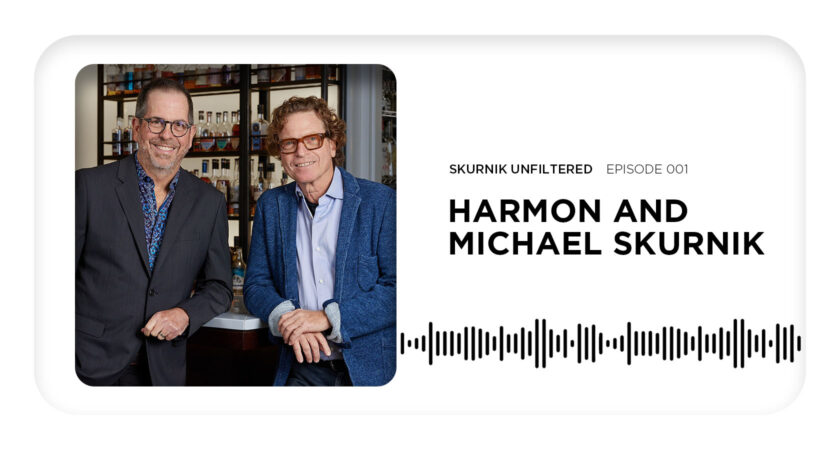
The first episode features a lively conversation between Michael and Harmon Skurnik. They dig into the history and future of Skurnik Wines & Spirits—sharing stories about how we got to where we are today and the markers of taste that define a Skurnik product.



Next week, tune in as Iberian Wine Specialist Matt Wolfe sits down with Pepe Raventós for a deep dive into his family history of winemaking since the 1400s and his new projects on the horizon.
Be sure to subscribe to Skurnik Unfiltered wherever you find your podcasts so you can stay up to date on all the exciting content to come.
Harmon Skurnik: Hey! This is Harmon Skurnik, and for our first episode of Skurnik Unfiltered, I sat down with my brother, business partner, and founder of Skurnik Wines, Michael Skurnik. We discuss the founding of the company nearly 40 years ago, how and when we joined forces, how we pick the wines and spirits that are right for our portfolio, and how our guiding principles help us navigate uncertain times. So, grab a glass of wine and enjoy.
Michael Skurnik: Cheers, Harmon.
HS: Cheers, Michael.
MS: I am Michael Skurnik, and I’m here with my brother Harmon. We’re in our 38th year in business as Skurnik Wines, formerly known as Michael Skurnik Wines. We both have the same parents, oddly enough, and so we got interested in wine because our parents got interested in wine. On Long Island, in the town of Merrick, on the South shore, nobody was drinking wine in 1965, ‘66, ‘67, at that time in the United States. It was not a wine-drinking country. People didn’t eat fine French food. It was sort of a cultural barren wasteland when it came to taste. I’m talking about beverages and foods and things like that.
HS: But then mom and dad went to France in 1970, and got completely hooked. We were ahead of the curve with mom and dad putting a bottle of wine on the table almost every night. Fine wines, dry wines. That was atypical for the time.
MS: Years later, I went to work at Windows On The World, which is how it all started, which was the restaurant at the top of the Twin Towers, World Trade Center number one, may it rest in peace. That’s when I was going to be a musician. I moved to New York, I played guitar, went to a party, and I found out that—
HS: I thought you were going to be a zoologist?
MS: Well, that was college. That’s another story for another podcast. But anyway, I went to a party in downtown Manhattan in 1976, and met some people who were musicians. I said, well, how do you guys make a living? Oh, well, we work in restaurants. That sounds like a pretty good idea. So I lived in Tribeca, I looked up and I saw the top of the Twin Towers, and I heard that there was a restaurant up there. So I decided the next day to go up there and apply for a job as a waiter. And I somehow got the job without any experience.
HS: My memory’s a little bit different there, because I remember we went up there with Mom and Dad for a drink or something when you lived in Tribeca, and I recall saying to you, the waiters here look like they make pretty good money at this restaurant. You were looking, you didn’t have a job. And I said, why don’t you become a waiter here? I thought I gave you that idea.
MS: Well, when you get to be close to the 40th year in business, these kind of things are going to happen. We have different memories. But I’m going to go with, you might be right.
HS: Well, I’ve said that to many, many people over the years. So, even if it wasn’t true, it’s true in my mind. All this time Michael was getting exposed to the wine industry and working up at Windows, I graduated college, and I had a business degree. First. I worked for my father for a short time after school. Really didn’t like that. My father was a great salesman, which is why you’re a great salesman. I think you inherited those genes. What I ended up doing was taking a break from that. I worked for him for about a year, and I took a break and went to Europe for six weeks by myself with a backpack, and learned a lot about myself by visiting all these countries in Europe. Opened my eyes and my world to numerous things, including wine and food. Although I was on a really, really strict budget at the time, Europe on five dollars a day. When I came back from that incredible experience, I went to work for a company that did market research here in New York, lived in Tribeca, the same place where Michael lived. I subletted an apartment in the next building over. He was working at Windows and I needed a job, and I said, well, can I work up there, too? Well, they don’t let family members work there. Well, what if I or maybe—
MS: His middle name is Wayne. It’s not related to Bruce Wayne, but it could be.
HS: He suggested I go by my middle name. We didn’t say we were brothers, and I ended up bussing tables and doing and serving cocktails and working at the hors d’ourvery, which was the bar, for the summer. So I got that experience as well. Working for Kevin Zraly up at Windows really set the stage for you as founder for this company, which happened, what, maybe five years later? How did you found it?
MS: It was not lost. Ha! I worked at the restaurant from the fall of 1976. After that, I went to work for a small wholesale company, kind of like Skurnik Wines, but nothing like Skurnik Wines. But it had the opportunity to become a company like Skurnik Wines. It was called Establishment Import Company, owned by a guy named Larry Rapoport. And then after that, I convinced him because I had learned, during my stint with Kevin at Windows, that American wine was actually a thing! Nobody took American wine seriously, and there was an up-and-coming group of wineries, brand new wineries at the time that just started making wine. Wineries with the names of Chateau Montelena, Stag’s Leap Wine Cellars, Stonegate, Raymond, Chateau Saint Jean. These all became famous and eventually sold and became much larger wineries.
HS: But they were brand new wineries at the time, right?
MS: Right, so I convinced Larry Rapoport we should go out to California and find a bunch of wineries, which is what we did. And I came back, and so I was the only sales rep for all of these wineries in metro New York. And I had every account. I had every account, I had Sherry-Lehman, I had Abramsky, of course, from Crossroads [Wine and Liquor]. I had Windows On The World. Do we still use the same numerical account numbers?
HS: I think so.
MS: Anyway, account 001 was Windows On The World. And then 002, 003, 004, and 005 were all Smith and Wollensky Group restaurants. Because what happened was I was also a founder—not just of Skurnik Wines—I was a founder of The Winettes. The famous—infamous—unknown rock and roll cover band that included Kevin Zraly, myself on guitar, Josh Wesson, Richard Wagner, Joey DeLissio, Brian Miller, who was the restaurant critic of The New York Times at the time. We went out to California with Ray Wellington, who was running the wine program for Smith Wollensky, and Ray and I hopped a ride in the car together down to Monterey for the Monterey Wine Festival. And he then informed me that he was putting together this special, exclusive California program for the Post House, California Cache. It was called the California Cache. So we we went, I said, look, Ray—I had a wholesale license at the time because I was working for this French company—and I said, why don’t I bring in the wines for you? Let’s go find these wines together, and then I’ll bring them in. I’ll do the logistics and I’ll sell them to the restaurants. And he said, yeah, that’s a great idea. So we tasted together, and we discovered William Selyem, we discovered Talbott. Anyway, there were six California wineries, and that was the beginning of this company.
HS: Wasn’t Bonny Doon one of them?
MS: Yes. Bonny Doon was one of them. So that’s how it started. We had six California wineries. “We,” meaning me. I was the only one.
HS: And you brought in like five cases of each or something?
MS: We brought in the amount for the California Cache program and that was it. And then I contacted the wineries and I said, I’d like to have your blessing to be able to go out and offer these wines to other people. And they said yes. And that’s that’s how that started. So we started as an American wine only wholesale company in New York. We had no sales reps. That’s when we hired Tom Lynch, who was our first salesperson, and Dan Lerner was our second salesperson.
HS: Well, you didn’t hire Tom before you hired me. Fast forward to 1989, which is when the business was starting to take off. I did a lot of administrative work for you on the side.
MS: Because the company you worked for had the Apple account, and Apple was a new, young computer company, and at the time Harmon worked for it was Needham Harper Worldwide, or BBDO. One of those companies.
HS: BBDO had the Apple account and made that famous 1984 Macintosh commercial. And it was the it was the advertising agency in the world, really. Phil Dusenberry was the creative guy who created that commercial and they were world famous.
MS: They gave every employee of the advertising company an original Apple Macintosh, you know the one that looked like it would make a great fish aquarium? Yeah. So Harmon was way ahead of the curve because he learned how to operate that thing. I’m probably saying too much or maybe it’s inaccurate, but I don’t think you had enough work to fill your fill your eight- or nine-hour day. And you were learning the computer. And so when I needed some price lists or some point of sale material, I would I’d be running around selling and I’d go up to the 44th floor or something, and he’d print out a hundred copies of price lists and I’d go back out.
HS: We also had the Xerox account.
MS: Free Xerox, free Macs.
HS: We had top of the line Xerox machines, and I’d run his price list through there.
MS: Double-sided and stapled! This was, like, mind-bending.
HS: After I created them on the first word processor, and we had the very first laser printer. But anyway, so I was working for you part time with no pay. You gave me a bottle of wine every now and then, probably. But, at one point when Kermit Lynch said yes to you to give you a line of imported wines, you told me to come to lunch with you at Keen’s, where we had a really nice steak, and you had opened a bottle, or we ordered a bottle off the list that you sold them of the William Selyem Leno Martinelli Zinfandel 1985 or 1986?
MS: ‘86.
HS: With the company, we never really had a business plan or anything like that, that we were going to grow to a certain amount, a certain point, a certain it—was just very organic, the whole thing. We started with these six California wineries and the French portfolio of Kermit Lynch, which gave us instant credibility in the marketplace with wineries like Raveneau and Coche-Dury and Chevillon, Jayer. The one case you got allocated a container every year.
MS: Oh, we got a whole container of Jayer every year. I don’t know what anybody tells you.
HS: Ha! Yeah, right. And so the business grew organically from there, and we hired our first salesman. Michael, you said earlier, being the founder and all, that the company for many years was called Michael Skurnik Wines, and then we decided probably, what, eleven or twelve years ago to change the name to Skurnik Wines & Spirits. One reason was that we got into the spirits business, right?
MS: Well, just a short offshoot, anecdote about that. The reason we changed the name of the company was because we designed a new logo, the one you see about about the office and on the back labels of our wines and spirits.
HS: That was right about the time that we moved into this New York City headquarters office that we now occupy.
MS: We came up with this beautiful design, which looks like a top of a champagne cork. And the designer had “Michael Skurnik Wines & Spirits,” and we all looked at thisand said, it’s too many words. Something has to go. And it was either we lost “Spirits” and kept “Michael Skurnik Wines,” which is what the name of the company was, or we lost “Michael.” It had to be one or the other. And I said, it’s clear we lose “Michael” because we are invested in spirits. We want that. That is who we are. And that’s more important than my name continuing to be on the name on the logo.
HS: Also, we said at the time that most people referred to the company as “Skurnik Wines” at that point already. So, what was the origin of how we got into spirits? Do you want to want to touch on that?
MS: Yeah. Well, my wife and I had a restaurant in the Caribbean, in the Virgin Islands, called The Fatty Crab. The Fatty Crab was a couple of restaurants in New York owned by Zak Pelaccio. And Adam Schuman, our beloved director of our spirits portfolio, originally was a cook, and he became the the guy who did the cocktail program for Fatty Crab. And when we opened up in Saint John, Adam did all the cocktails in the program, and I got to meet him. And the restaurant, sadly, is no longer, but we got Adam out of the deal. We decided to work together and start in earnest our real spirits portfolio. We already had Charles Neal’s wonderful brandies and Cognacs, Armagnac and Calvados elixirs, and we had the great distillates from Hans Reisetbauer in Austria, and we started out that way.
HS: At the time, isn’t it true that the craft spirits boom was just underway? Because prior to that spirits were your standard brands, your brand names. But there weren’t these exciting new craft distillers out there.
MS: Also, the cocktail bar movement was just starting. Death and Co. had just opened up, Mayahuel was a legendary mezcal bar on East 6th Street. And it just became exciting. Then Pouring Ribbons opened, where I think Adam worked, Amanda Elder worked there, and we have quite a few people who worked there. And so all this was happening at the same time. Adam came on board, and our very first two spirits companies that we took on following that were Greenhook Gin, Steven D’Angelo’s great company in Greenpoint, Brooklyn, and El Dorado Rum from Guyana. And that was the beginning. Those were two very important brands—still are—in our portfolio. And it happened from there. It kind of grew.
HS: Do you remember back before then, though, even 20 or 30 years ago, people in the wine trade would say you were either in the wine trade or you were in the spirits trade. There weren’t many companies that did both. And there was kind of a competition, like wine people would look down on spirits, and they would say things like, well, you’re in competition with each other. If you go to a restaurant and you order a cocktail, well, you’re not ordering wine. And at this point in time, in our evolution, we realized that there was a synergy between the two. And at the same time, restaurants were getting serious about their cocktail programs. And there’s no reason why somebody who comes into a restaurant, can’t have a cocktail and order a bottle of wine with their dinner.
MS: Like the two of us!
HS: It works! They work in tandem and they actually help each other out. And it’s been just a tremendous addition to this company to have what many people consider to be the finest craft spirits portfolio in the business.
MS: I have a good friend who is a winemaker, and I was at his home for dinner. This is a couple of years ago, and there was someone at the dinner who was a critic and said, hey, Michael, how’s the spirits business going? I said, oh, it’s going phenomenally. It’s the fastest growing part of our company. She says, that’s interesting because I’ve spoken to a number of other local New York wholesalers, and they’re not doing so well. In fact, some of them are even considering getting out of the spirits business. I said, well, that’s pretty curious. So I scratched my head a couple times, said, I think it might be this: we love spirits. We have a passion for spirits. We go home and we mix cocktails. We love the flavors. We love to experiment. You can’t just decide to get into the spirits business because you see other people are doing it. Unless you have skin in the game or you really care, this is a business of passion. So we continue to do well, and I don’t know how the other people are doing.
HS: Well, we often say that we have curated the spirits portfolio with a wine palate. We do approach our selection of what goes into the spirits portfolio the same way we have done for many, many years with wine. And, um, I don’t know that a lot of spirits companies operate that way because they don’t have the experience, so I think it has given us an advantage.
MS: I think our other big advantage is the team that we have in our spirits portfolio, from Adam Schuman all the way down. This is a collection of superstars, people that have high, high levels of integrity and can communicate the enthusiasm and the excitement and the knowledge of not only the products that we represent, but cocktailing and the mixology part of it with passion.
HS: Yeah, that extends to our entire sales staff and our entire staff at large. Portfolio management team is amazing. As I said before, it’s about the portfolio and it’s about the people. You have to do both well. And I’m really proud of it, really.
MS: I think it just comes down to, you know, the fact that we have passion for what we do. We have passion for wine and spirits, and love selling those things and turning people on to new experiences.
HS: Wine is not just a product. Spirits are not just a product. They are the product of the people behind them. And the more you learn about the people behind them, the more you can appreciate tasting their great wines.
MS: I think the USDA actually has a definition when they’re talking about cheese—there’s “cheese” and then there’s “cheese food.” Cheese food is like an individually wrapped piece of Kraft American cheese. It’s not really cheese. The government wouldn’t allow them to say cheese. So they came up with a new term, cheese food. But most people who buy that think it’s cheese. But I raise that because I think we should have something similar with wine, because there’s wine, and there’s fine wine, which is who we represent and what we drink. It comes from under 5% of the total production of wine on the planet. And there’s industrially-made wine, which I’m not looking down my nose at it, I’m just saying it’s a different category. The person that buys a bottle of Skurnik wine or Skurnik spirit is looking for a different experience. They’re looking to connect. They’re looking for the personality of the wine, authenticity. When you pop a bottle of Beaujolais, if you’ve ever been there, you’re immediately transported back. And that’s the part of the wine world that we’re involved in along with many other companies. We’re not the only ones.
HS: As Michael said earlier on, we were not a wine drinking nation in the 1970s, in the 1980s. We are much more so now, but we’re still not! We have a long way to go. Fine wine, at least, is here to stay, and more and more people will be discovering it as time goes on, as young people mature. Wine has been around for six thousand years. It’s not going anywhere. It may not grow ten, fifteen, twenty percent per year, like it has in some years. It may flatten out for a couple of years, which is where we are now, and there may be some casualties along the way, like wineries that are not well-financed will go out of business. Distributors and importers that are not well-financed may go out of business.
MS: Also, the trends that we read about and that people write about and that people want to talk about are real, but let’s not get overexcited about anything that suggests that we’re going to be in trouble as an industry. They mostly affect brands that have 100% distribution in the marketplace. Whether it’s Josh Cellars, for example, or Kendall Jackson, you know, well-known brands, Gallo. As soon as demand has a slight pullback, they feel it first. But everything that we do here at Skurnik Wines & Spirits—we’re so far under that radar. In this country, I don’t know what the per capita consumption is today, but it’s something like 4% of the population drinks 85% or 90% of the fine wine. So we haven’t even begun to scratch the surface with who the potential consumers are going to be. But we do know that this whole idea of people learning about how to eat right—and I don’t mean healthy. There’s that too. But how to eat well, what’s the difference between a great butter from Brittany and Parkay. That’s the trend, and it’s a revolution, really. I remember back there was a great little store called the Silver Palate. It was a food provision store on the Upper West Side. Two women started it, Sheila Lukins and Julee Rosso, and they published a book, maybe you’ve seen The Silver Palate Cookbook, and it became a standard, a staple for most cooks. And the book, I still have my copy of it. A lot of the pages are falling out, but every ten or twelve or fifteen pages there would be a box with info inside. And it has shallots—there’s a page on shallots explaining to America what a goddamn shallot is. So here we are. That’s forty years ago. That’s around the time that we started this company. So when I started selling wine and I went to restaurants, they had one white by the glass, one red by the glass. Not varietal, not vintage dated. Sometimes they called it Burgundy if it was red, sometimes they called it Chablis if it was white. Almaden would do that. So there was no such thing as wine by the glass. So the transformation has been tremendous, and we’re not going backwards. The best thing about this business, really, is the fact that we still learn almost every day. Kermit Lynch, as Harmon mentioned, was our first foray into imported wines. A few years later, we had the opportunity to begin working with Marc De Grazia selections. We met Iano, Iano De Grazia and Marco are brothers. They ran a company out of Florence. It still exists. We still work with them, and we learned about Italian wine through this experience with the De Grazias. Of course we had had Italian wine before. We had had French wine before, but we learned through our association with Kermit Lynch going to Burgundy, visiting not just Raveneau, Coche-Dury, Jayer but we had Verset and Cornas. So we had Clape in Cornas, we had Michel Rostang and Côte Rôtie, so we got to meet the legends when we were young and they were not yet old.
HS: And we learned how to do it. We learned how to go into the cellar and taste out of the barrel and evaluate what makes a good wine. And the wine should reflect the place from which it comes. And by going to Sancerre and tasting twelve or thirteen different producers over the course of the years and understanding what are the ideals that you’re looking for? What makes a great Sancerre? You can then, if you have a palate memory, you can then compare what you’re tasting today to what that ideal is. It’s not perfection. It’s the quintessential, I would say. The French use the word typicity, you know, typical, which in English it doesn’t really translate that well because like, typical sounds like it’s just average, but that’s what they mean by typicity or typical is that—you mentioned Verset, Cornas—nothing tastes like that. These are unique expressions of wine. You don’t have to make the wine that way. Like, you can come into Cornas and bring a bunch of new new oak barrels and make it taste like a Cabernet if you wanted to. But it would be atrocious. The reason is because it wouldn’t taste like Cornas. Right? I think that there is a standard that you learn to respect when you taste wines over the course of many years, and you travel, and you understand what the wines are supposed to taste like, and then the subjective part is which qualities turn you on? And I think that this portfolio reflects a lot of our personal tastes. There are some wines that are considered great wines that we wouldn’t take on, because they just don’t speak to us. They’re not our style. And for whatever reason, our palates and our style has resonated in the marketplace, thankfully, you know, and that’s one of the secrets, I think, to our success, is that that pursuit of that style has been consistent over the years. When people turn around the bottle and they see Skurnik on the back label, not only do they think that the wine will have a certain quality to it, but also that it’ll have a certain style to it that is consistent.
MS: I wouldn’t disagree with anything you said. That’s beautifully stated, actually. But the word “style” is a tough word because it means different things to different people. So, we like Cavallotto’s Cru Barolo. But we also like equally well the Anfosso Rossese, which is a light red wine that you serve slightly chilled. So, we like wines that are super well made. They reflect where they come from. They have less hard edges than some others. We don’t like dirt in the wine. We don’t like funk. Sometimes a little funk is good, but we don’t want anything in the wine that covers up the terroir. And we are mostly representing small craft producers.
HS: They are family businesses as well, and there’s a kinship and kind of a simpatico between us and our winery partners because, in many cases, they’re multi-generational family businesses that have passed down five, six, seven, sometimes eleven, twelve generations. And so those similarities in our business style and our family business approach really resonate with our with our wineries. They love to work with us because we’re, we’re sort of like them
MS: All through the years when we would visit cellars around the world, it was either two brothers or a brother and a sister or two sisters. It’s siblings. So there was a natural affinity there.
HS: As opposed to a company who’s not like us, you know, the corporate-run company that may be backed by private equity. And they’re very impersonal. It’s a completely different type of company to work with. Maybe they pay the bills, maybe they can attract some good wineries, but you don’t have the same kind of simpatico that you do with our producers, I don’t think. They love the fact that we’re a family business. They absolutely love it. And when we told them last year that we have a plan where our children are going to be taking over eventually, as soon as this coming year, taking over the day to day responsibilities, they were thrilled for us, and they understood that that’s exactly what they go through. My son and daughter both work in the business. Michael’s son and two daughters both worked in the business. His son in law works in the business. So I think that being a family business has been a great strength of ours.
MS: And if we need inspiration, we can talk about our great friend Pepe Raventós from Raventós i Blanc in Spain, who’s going to be one of our first, if not the first podcast guests. And he is either the sixteenth or the twenty-first generation of his family.
HS: Well, you’ll have to listen to the podcast to find out.
MS: Listen to the podcast to find out what the correct number is. But they’ve been living in the same place south of Barcelona, and it’s pretty phenomenal, especially for Americans like us. We live in a country where we’re all immigrants and we all came from—most of us—have all come from someplace else. For better or for worse, we get the strengths of that, which is why this country is so great, the foundation of that. But to hear somebody go that far back in their family history and talk about it and get strength from it is really, really incredible.
HS: Well, his family history was the origin of Cava in Spain. And today Pepe and his company, Raventós i Blanc, which branched off from that, are producing the finest sparkling wines in all of Spain.
MS: His grandfather was the cellar master at Codorniu, which is a large, inexpensive, industrially-made Cava. But back in those days, his grandfather went to Champagne to see how they were doing it, and they saw that they had caves down that were cut out of chalk in Champagne. So they came back and decided to call it Cava. But, uh, when you visit Raventos, if you’re lucky enough to go there, their property is contiguous to the Condoniu property because his grandfather used to be part of it. They arranged for us an incredible visit. They’ve got like six or seven or eight levels of cellars. And I don’t want to make it sound too Disneyland, but there’s a little motorized vehicle that takes you all the way down, and it’s filled with millions and millions of bottles. So, maybe he’ll get to say more about that than I can.
HS: This Skurnik Unfiltered podcast is going to be exciting to follow. I hope you find it exciting to follow. We have already recorded some really cool episodes with some great winemakers, and you’ll get to learn about them, who they are, and their winemaking philosophy and what makes them tick. We’ve got episodes recorded with Giorgio Rivetti, who is the proprietor of La Spinetta, as well as Contratto sparkling wine in Piedmont. We’ve got the aforementioned Pepe Raventós, the great sparkling wine producer from Spain who spends a lot of time here in New York and loves New York. And he’s got a lot of wonderful things to talk about. Who else do we have?
MS: Christina Turley is going to come by. She’s the daughter of Larry Turley, who’s the founder of Turley Wine Cellars in Saint Helena, the great Zinfandel producer. Quentin Paillard from Champagne. Christopher Loewen, the son of Carl Loewen, the great producer in the Mosel Valley. He’s a terrific, terrific winemaker and got a lot of great things to talk about. Hans Reisetbauer, who some people feel is the greatest distiller in the world, will be here. I guess he’s going to be here with his best friend Bernhard Ott, who is a great producer of Grüner Veltliner and Riesling from Austria.
HS: And Jason Kesner, the longtime winemaker of Kistler Vineyards in Sonoma, one of the great, great producers of Chardonnay and Pinot Noir, going back decades now. Originally started by Steve Kistler, who now moved on to Occidental, which we also represent. But Jason is a terrific, fabulous winemaker and also philosopher. And there’s Annabel Thomas, who’s the proprietor of Nc’nean, the great, small producer of Scotch in Scotland. Completely organic, one of the rare woman-owned distilleries. And she’s really a fun person to talk to.
MS: Stay tuned. We’ll have a lot more, but that’s just a little teaser. Basically, the idea behind all this is to try to give you a chance to meet the personalities behind the wines and the spirits. I think that it’ll be well worth your while to spend a little time with these people and hear a little bit about what goes into the production, a little bit about the history, a little bit about their passions and where things are headed.
HS: You know, it’s one thing to listen to this podcast, to learn about the producers. But it’s very easy to just go to skurnik.com and look up a producer that you liked or that you’re interested in, and there’s just an incredible amount, a plethora of information.
MS: There’s way more information than you’d ever want to see. Just go on the website, look up your favorite producer. There’s YouTube videos, there’s tech sheets, of course, and statistics—more than you’d ever want. Have a field day.
HS: So if you’re a wine lover, spirits enthusiast, or you’re looking to learn about the people behind your favorite wines and spirits, be sure to subscribe to Skurnik Unfiltered on Apple, Spotify, or wherever podcasts are found.
MS: Thanks for listening. Harmon, it’s been great sharing this podcast with you and all these 38+ years.
HS: Cheers to the next 38.
MS: Na zdorovie.
Skurnik Unfiltered is recorded at Skurnik Wines & Spirits headquarters in the Flatiron District of New York City, which is why you might hear some city noises as we go along, like horns honking. If you found the conversation interesting, please consider liking, subscribing, and leaving a review. You can stay up to date on our show and upcoming events by following @skurnikwines on Instagram and visiting our website at skurnik.com