

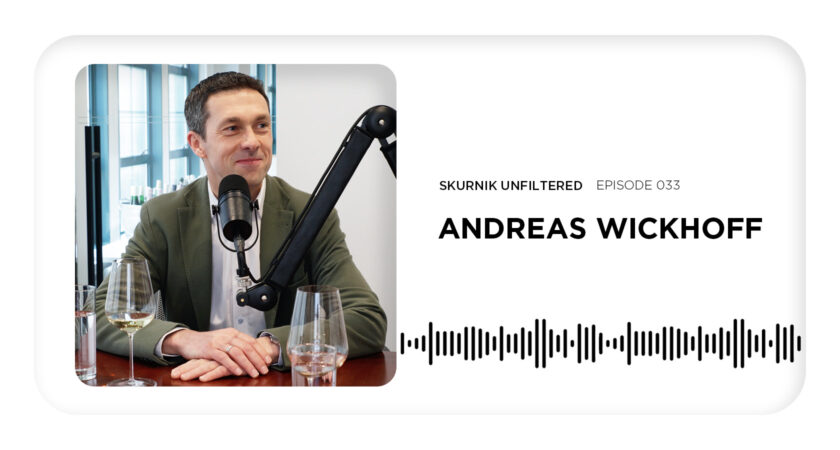
Climate change has arrived, and weird things are happening in Europe. Hailstorms in March. Bud break in October. Deadly flooding during harvest. Despite it all, Andreas Wickhoff’s radiant optimism is rooted in an historical perspective, that wine must survive.



Next week, tune in as Italian wine expert Mark Fornatale sits down with Sicily’s Gaetana Jacono of Valle dell’Acate.
Be sure to subscribe to Skurnik Unfiltered wherever you find your podcasts so you can stay up to date on all the exciting content to come.
Introduction
Andreas Wickhoff 0:03
From a historical point of view, the wine industry, wine, has always had its crisis, every century had a crisis. But wine has always survived. Wine culture will always survive, I’m convinced. And even though the circumstances at the moment are very easy, we still have a bright future ahead, no doubt.
Harmon Skurnik 0:25
Hey, this is Harmon Skurnik, and welcome to another episode of Skurnik Unfiltered. With me today is the portfolio manager of all things Austrian and German, Mike Lykens.
Michael Lykens 0:38
Good morning.
Harmon Skurnik 0:39
You just sat down with Andreas Wickhoff, who is running the very well-known and famous estate of Bründlmayer in Austria. Willi Bründlmayer is taking a back seat now as he’s older, isn’t that right?
Michael Lykens 0:54
Yeah, I don’t know if I would feel comfortable saying fully retired, but he’s enjoying the fruits of his labor a little bit more.
Harmon Skurnik 1:02
We’ve been representing Bründlmayer for 30 years or so now. I remember when I first heard the name Bründlmayer, they had quite the reputation as maybe the best dry wines in Austria at the time. And when we did get involved back then with Terry Theise when we started bringing in Austrian estates, and Bründlmayer was part of the portfolio, I was really excited.
Michael Lykens 1:30
It was my introduction into great Austrian wine. I remember having some Heiligenstein for the first time and having a lot of fun saying the name Willi. The wines have always maintained this real precision, but never lacking in depth or soulfulness. And that hasn’t changed in any of the 30 years that Skurnik has represented the wines.
Harmon Skurnik 2:00
I would say the quality of the wines—as good as they were then, they seem to be even better now.
Michael Lykens 2:00
As much as I wish I were tasting the wines back in the mid-90s, now the wines are certainly the best that they’re tasting in Austria. The quality of the wines continues to get better every year that I’ve worked with them, and it’s been 15 years I’ve been working with the wines. One thing about this estate is they have such an embarrassment of riches in terms of the quality of vineyards they have.
Harmon Skurnik 2:24
They’re in the Kamptal, right?
Michael Lykens 2:25
They’re in the Kamptal. In the mid-80s, when Willi started to make a name for himself, he was able to have access to a lot of really great vineyards that would be very difficult to acquire these days. Over time, they’ve been able to continuously raise the quality of the wines because the vines themselves are getting older and older. They’re really great farmers and they haven’t lost sight of their agricultural background, so the wines are never lacking in depth or concentration or structure.
Harmon Skurnik 3:00
How does it break down, Grüner Veltliner versus Riesling?
Michael Lykens 3:04
Of the white wines, it’s 60-40 Grüner to Riesling. Where they’re situated in the Kamptal is quite unique because it’s really where the pure loess soils mix with more primary rock, so you have this really great diversity in the vineyards, in that you have elevated vineyards with a lot of primary rock, which is great for Riesling, then lower on the hillsides you have loess-rich soil.
Harmon Skurnik 3:30
And that’s where the Grüner is planted?
Michael Lykens 3:31
And that’s where the Grüner is, because Grüner is always in need of nutrition and always in need of water, and loess possesses both of those.
Harmon Skurnik 3:40
Where is the Ried Lamm on that? Is it on the Heiligenstein hill?
Michael Lykens 3:44
Yeah, exactly. It’s a very special vineyard site directly below the Heiligenstein. You can always notice it when you’re driving up the Kamptal; Heiligenstein has a tower at the top, it’s very easy to recognize. When you get to the base of the Heiligenstein, the rows change direction—they go horizontal instead of vertical—so it’s always easy to see that transition from Riesling to Grüner.
Harmon Skurnik 4:08
So Andreas, who you just interviewed, he’s quite the gentleman, isn’t he?
Michael Lykens 4:13
He is very passionate. He is such a gentleman. He’s really one of these unique characters in the world of wine in Austria who is comfortable at a table with a king or a queen, and he is equally comfortable at a bar seat with friends talking about sports and things like that. He really is such an interesting and thoughtful person. He’s a really great listener, and I think that’s what makes him such a great leader of this iconic winery. There are people who have been working with Willi since the 1980s and 1990s.
Harmon Skurnik 5:14
And from what I understand, his decisions about farming and about running the estate are all about quality; he’s uncompromising as far as that’s concerned.
Michael Lykens 5:23
Yeah, absolutely. The way that I think about Bründlmayer is it’s almost one of the most complete wineries in the way that it’s operated. It has its sparkling wine production, which they do in-house, which is not common in Austria; they have their own Sektkellerei. They’re making, in my opinion, some of the very best, if not the best, sparkling wines coming out of Austria. They are on par with our great Champagne portfolio from a quality perspective. Then, of course, the normal traditional Austrian wine, the home of classic Grüner Veltliner and Riesling. They of course do wonderful red wines as well.
Harmon Skurnik 6:04
What do they make? Blaufränkisch?
Michael Lykens 6:06
Yeah, Blaufränkisch, but Pinot Noir has become increasingly popular, and that has a lot more to do with the climate getting a bit warmer. They’re having no problem getting phenolic ripeness in every single vintage.
Harmon Skurnik 6:20
Which wasn’t always the case in the past.
Michael Lykens 6:21
Yeah, exactly. The Cistercian monks brought Pinot Noir with them from Burgundy when they were doing their real estate tours through Austria, but it was Zweigelt and Blaufränkisch that really took root.
Harmon Skurnik 6:33
You mentioned the sparkling wine and Sekt, which is what we call Austrian sparkling wine, is becoming popular. I’ve noticed Eric Asimov wrote an article all about Sekt. Are you seeing that in the marketplace, a lot more interest in Sekt?
Michael Lykens 6:49
There’s a lot more interest in the category for sure. I think that all of a sudden now there is more value in these high-quality Austrian producers—and for that matter, German Sekt as well—where Champagne was always the standard and it was only slightly more expensive than Sekt from Austria and Germany. Now the playing field has been leveled a little bit. And I wouldn’t characterize them as inexpensive, but they represent incredible value.
Harmon Skurnik 7:16
And incredible quality.
Michael Lykens 7:17
Yes.
Harmon Skurnik 7:18
Well, let’s get to the discussion and let’s listen in and enjoy.
Joining the estate
Michael Lykens 7:21
Today we are joined by Andreas Wickhoff of Bründlmayer. First of all, Andreas, tell us a little bit about your path leading up to joining the team at Bründlmayer.
Andreas Wickhoff 7:33
Good morning, Michael. It was a little bit unexpected, I would say, when I got a message from Willi back in late 2014, and he said he wanted to have a talk with me. He said, “You know, I have to look into my future as well.” The estate is still, of course, completely family-owned. Vincent, the older son who is still very actively involved, was however saying to his dad, “I’m not 100% sure if I want to run the whole entire thing by myself.” This is why Willi approached me and asked me if I would join the team and become their estate general manager. It was a big thing for me when he asked me because we weren’t so close in contact before. Of course we knew each other and respected each other, but it was a very positive surprise. Willi’s a true gentleman, and he gave me time because it meant a big move, personally and also on a scale from what I did before. I had to move the family from our place, which is two and a half hours away from where we live right now. In the United States, that’s rather simple and normal. For us, as old-school conservative Austrians, it’s a bit of a bigger life task. It took me a while because it’s a huge responsibility to work for such an esteemed estate in such a role. But we have an outstanding team and a family who is a hundred percent behind what we do, who allows us to do the things we want to do. It’s all a team effort, and I think we have a good team.
Michael Lykens 9:20
I agree. It’s a fantastic team. Willi has been instrumental in not just forging an identity for the Kamptal, but for all of Austrian wine. I’m wondering what that felt like, the gravity of stepping into an estate that was so iconic and synonymous with quality wine, both within Austria and in the export markets as well.
Andreas Wickhoff 9:43
Right. Thankfully, I didn’t think of the scale. I of course knew the magnitude of it, but I think it was also an advantage that I’m not a family member, so the pressure is for myself, but not on a family personal level. Whenever I’m in doubt, whenever I need some advice, Willi is always there. We should never forget also his wife, Edwige, who is always in the back, but she’s doing some very important work for the winery. Whenever I’m in need of them, we can always talk. We are always exchanging ideas, and that’s what makes the work not as difficult. Of course we have challenging times, as we all know, and if you take all this into aspect, then I think we still have a bright future ahead. There’s no doubt, even though the circumstances at the moment are not very easy. But from an historical point of view, the wine industry, wine, has always had its crisis. Every century had a crisis. We are probably right now in such a delicate moment, but wine has always survived. Wine culture will always survive, I’m convinced. And who knows what the next generation, not the ones that we always talk about, will be consuming. Maybe they’re totally back again into the wine world. This is my sincere hope.
Michael Lykens 11:09
Yeah, I think about this quite a bit as well. Wine culture is a really important part of our full civilization. There’s something about this culture that seems to bring people to tables. It’s always been very open-minded and intellectual in terms of discussing new ideas and things like this. It’s so important that we continue to fight for this culture, that it’s not just a luxury good, as some characterize it. I’m with you in these endeavors.
Precision farming
Michael Lykens 11:42
I want to talk a little bit about the wines. We’d be remiss if we didn’t spend a little bit of time with them because when I think about Bründlmayer, I think so much about these really pure and elegant expressions of very specific terroir. With the growth of the estate, I’m wondering, how is it possible that the wines continue to show this really precise elegance, vintage after vintage, despite the climactic challenges that you face every single year?
Andreas Wickhoff 12:14
All of the great wine growers in the world will say that the quality starts in the vineyard, and we are certainly very much of the same opinion. Our biggest team of the entire crew at Bründlmayer is the vineyard team, and that’s where the delicacy, the finesse, starts. We are making great efforts in terms of soil water management and canopy management. We are always looking at these things. Evaporation at the moment is, of course, also a very big topic. The evaporation rate has increased significantly. We’re trying to work with the changes of nature as best as we can. When it then comes to harvest, I think there’s no compromise for us. The selection is very sharp. We don’t actually do normally a selection at the winery before the grapes go into the press because everything happens outside. This brings in consistency and purity of the wines from one vintage to another. We also make sure that in the cellar, in the winery, we’re giving the wines enough time. We treat them very gently when it comes to whole-bunch pressing. We have a gravity flow system applied in our winery. Of course, there’s a big part happening in the vineyards, but in the cellar, you have to make sure that you shepherd that delicacy into the final bottle. I’m very cautious that we do the right things in the cellar and not work the wines too much.
Michael Lykens 13:48
Being very careful in the vineyards—that’s a monumental challenge. To have those who are harvesting the grapes understand exactly what you’re looking for in terms of ripeness and how the grapes should be tasting at the moment, coordinating that across several hectares—how do you communicate that from a harvest perspective? That seems like a logistical challenge to ensure that everybody knows what the vision is and where the end product might be. This part of the process is instrumental to achieving the end goal.
Andreas Wickhoff 14:18
We need to have an idea of what we need, what we want in terms of style, in terms of quality, and also quantity for us. Our sparkling program, for example, is quite distinct. You need to make sure, at this time when you harvest the grapes for sparkling wines, you have dedicated blocks for this. And then we have “leicht und trocken,” light and dry, a really crisp, refreshing style of Grüner Veltliner that never hits more than 11.5% alcohol. That one is a time span of seven to ten days that we need to get the grapes in. Once we get closer to harvest, the planning has to be quite strict, or the planning has to be done. Of course, nature always gives us new challenges, and when we have a vintage plan laid out for the next season, we always have to adapt if the circumstances, in terms of weather, do not permit that. And we had that a couple of times in the last years. But you need to be very flexible and discuss what to do when. We see the ripeness levels. We go into the vineyards, taste, and check the grapes, and with all these parameters, we would then decide to pick which vineyards, and which ones have priority. But there are circumstances, like in 2023, where everything was just perfect, a picture-perfect harvest to begin with. And on the third day, we received a hailstorm that hit about eight hectares of our vineyards. Thankfully, the hailstorm passed away quickly, and it was sunny again. The next three days were all about taking care of those hail-affected vineyards. Then, after these three days, we were back on track. But we need to make sure we have that done in an orderly time.
Extreme weather from climate change
Michael Lykens 16:02
I remember about a year ago, I was in Austria with you touring the vineyards after a horrible night of frost, and there was concern, but unwavering confidence to figure out how to make the best of this. And then come harvest time, nature had another surprise.
Andreas Wickhoff 16:21
Yeah. The flooding of 2024 in the middle of harvest. It was, of course, not very easy, but people lost lives. In that aspect, the winery, the vineyard, the grapes come second or third. When we look back to the last two years, those are extremes that we have probably never encountered in such a frequency and such an intensity in such a short time. And there is this irregularity of these weather patterns that will become more apparent. We had a hailstorm. We had never encountered a hailstorm in March. Willi is 73 right now, and he said, “The last 70 years I have never had something like this in March.” And we had some great producers just visiting us on that very day from France—Jean-Marc Roulot was there, Kreydenweiss, Maxime Graillot—and they were just shocked how impactfully that hailstorm came down. Those extremes are just increasing radically.
Michael Lykens 17:21
Yeah. Does it seem more extreme in the winter months because they’re so much warmer now than in the summer months? It doesn’t seem like the vineyards are getting a full rest in the winter, and they’re pushing earlier in the spring.
Andreas Wickhoff 17:38
I was at a presentation last week in Krems from Hans R. Schultz. He’s the director of Geisenheim University, and he told us he had an experimental vineyard up in the Rheingau, in Geisenheim, where he saw a budding happening in October, because of the warmth during the late fall and early winter period—something that is totally crazy in a way. I think all of the seasons have their more frequent extremes, but Europe’s temperature in winter is certainly or has increased. To put it into some figures, it’s crazy when you think about a 1 ºC increase of the global temperature, how big the evaporation rate increases, like by 7%, I think. That would mean it’s more than 70,000 cubic meters of rainfall precipitation for the entire world. If you think about all this, then it’s quite clear that extreme rainfall in a very short period of time is increasing more more. The one thing that we could do is look at carbon emission decrease. The biggest thing for the greenhouse effect is water vapor. We can’t do anything about this, but we can look into CO2. We’re organically certified, sustainably certified. I think it’s a big thing. People talk about this so often, the term is used so often. But if you take it very seriously, have a look at what you do both in the vineyards from an organic point of view. Have a look at the glass weight of your bottle, which is the biggest CO2 emitting factor in the wine industry. Water reusage, energy savings. We put out Photovoltaikanlage, solar panels, at our winery, and now after COVID, we have increased it by multiple times. Things like these, I think we should all look at. To be honest, it’s probably already too late, anyhow, to change this fast pace of climate change.
Michael Lykens 19:49
Yeah. We don’t want to give up. It’s not hopeless, but we certainly have run out of that grace period.
Andreas’s favorite wine
Michael Lykens 19:57
I do want to talk a little bit more about some of the vineyards and specifically, if you haven’t had the privilege of tasting wines from Bründlmayer or from the Kamptal, which wine in the collection would you point to, that sort of encapsulates that wine?
Andreas Wickhoff 20:13
It’s a difficult one, Michael. As you know, our portfolio is far too big, in a way. Our common friend Terry once said, “You know, Andreas, I think your winery is actually a winery made out of three separate wineries because you’re doing a really proper Sekt sparkling portfolio, then your great dry white wines, and then more recently, you’ve excelled on the red wine production side,” although that is very small; we’re making about 14% of our entire production red. One really key, important wine for us is Kamptal Grüner Veltliner. I think this is a wine that shows the appellation of Kamptal at its best. That’s always our goal: to showcase purity, delicacy, finesse. The Kamptal is still fortunate enough to make light- to medium-bodied white wines with enough fruit and a good acid backbone, but all usually very much in balance. Kamptal Terrassen Grüner Veltliner is definitely a wine that showcases the vintage. We want to have a vintage character in there, so a little bit more density and more power towards the yellow fruit when it’s a warmer year, and more of the lime, yuzu, and green citrus fruit in a cool year. This is certainly a key wine for us. And we should not forget sparkling wines. Brut Rosé, what you have in the glass here right now, is definitely a hugely charming wine, in a way. I think we have this advantage where the Zweigelt brings us very delicate nuances and cherry-laden aromas. The pH is kept at a very good level; it’s still quite moderate. All of the grape varieties that we use there—Pinot Noir, St. Laurent, and Zweigelt—are thin-skinned varieties, therefore, the phenolic component is on a very low scale. And we like this for Brut Rosé. Definitely something that people can cherish without knowing so much about wine.
Michael Lykens 22:19
You don’t have to be a wine professional or connoisseur to enjoy the wines; they are very giving and very pleasurable wines, and I think that’s why it’s such a joy to work with those wines. One wine that we didn’t talk about that is really foundational for the estate is the iconic wine of Kammerner Lamm. For me, this is my favorite wine of the estate. I think it’s one of those wines that, when people think they understand what Grüner Veltliner can or can’t be, well, why don’t you try this wine?
Andreas Wickhoff 22:50
Yeah. Kammerner Lamm is an iconic wine, although I probably would have chosen the direct neighbor to Kammerner because Heiligenstein definitely is the most famous site in our area and so unique when it comes to soil and so forth. But it’s also sometimes a polarizing wine, both locally but also abroad. Willi made this the first time in 1986 with the 1986 vintage, and he just had pretty good success with his 1985 Chardonnay, which won an international blind tasting during Vinitaly. These, as you know, were dire times for Austrian wine. We’re talking mid-1980s, and Grüner Veltliner was all about the jug, all about the liter. We’re not talking about the greatest quality here. And he said, “I want to showcase what’s possible with that grape variety.” So he took Lamm because it had a little bit more ripeness. It’s on the eastern side of the Kamptal. And he said, “I want to make it single vineyard, and I want to treat it really seriously.” And by that he meant—and this was from the first vintage onwards—he fermented it in small barrels, he gave it a lot of time, and just tried to make it in a style that he said, “This is also possible. This is what Grüner Veltliner can also do.” Ever since then, we try to keep that little bit of philosophy. We’re not talking about a varietal typicity here. For us, Grüner Veltliner is a tool; it’s the lens from where it’s been grown. This is our interpretation of Lamm. We’re doing this for a full year on full lees. We’re then taking it out for half a year into a neutral vessel, then we give it really enough time. And I think that remains a very special wine. That is certainly an iconic, but also as I said, a bit of a polarizing wine. When you’re in France, for example, with top French somms, they’re like, “Okay, what is this? We get this blind, it’s almost like white Burgundy.” But it’s Lamm.
Michael Lykens 24:56
Yeah, it’s Lamm. It doesn’t have this overtly rich character. There’s certainly some rounder edges there, but also this really crystalline, linear minerality that forms the backbone of the wine, which I think is why I love it so much. It’s not just, hey, let’s take really ripe Grüner and barrel ferment it and do bâtonnage, and it becomes a really big, powerful wine. There is an elegance to the wine, I think, which is why it resonates so much for me.
Andreas Wickhoff 25:22
Our vision is about delicacy, purity, finesse. It’s all about the timing when you harvest, the physiological ripeness of the grapes, and then you achieve hopefully that unique version of Lamm.
Michael Lykens 25:34
Well, I want to thank you so much for taking the time to talk with us today, and we thank you for being in the US.
Andreas Wickhoff 25:42
I thank you for having me here, and I truly hope these rather challenging times will be overcome by the quality of the great wines of the world. Cheers.
Skurnik Unfiltered is recorded at Skurnik Wines & Spirits headquarters in the Flatiron District of New York City, which is why you might hear some city noises as we go along, like horns honking. If you found the conversation interesting, please consider liking, subscribing, and leaving a review. You can stay up to date on our show and upcoming events by following @skurnikwines on Instagram and visiting our website at skurnik.com