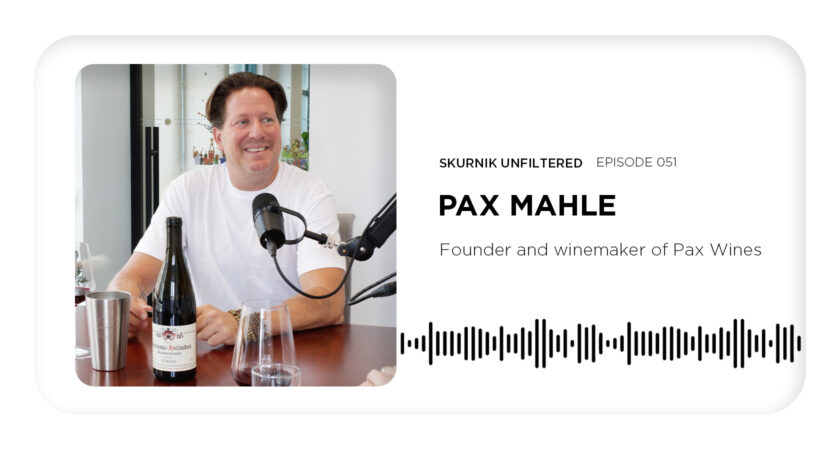
Pax Mahle’s journey to becoming one of California’s leading winemakers was never part of his plan. He was just a wine geek trying to get as close as possible to the object of his desire.
Sitting down with American Wine Ambassador Jamie Schwartz, Pax pulls back the curtain on his accidental entry into California winemaking—from drawing wine maps as an 18-year-old busboy on Nantucket to bribing cellar crews to foot-crush his own grapes without additives. He maps out the evolution of his craft across three defining eras: his single-vineyard beginnings (Pax 1.0), his cool-climate, esoteric detour with Wind Gap (Pax 2.0), and his current focus on harmonious, timeless blends and accessible by-the-glass pours (Pax 3.0). Finally, Pax reflects on the communal spirit of his facility at The Barlow and explains why the “singer-songwriter” winemaker is an endangered species worth fighting for.



Next week’s episode is a special interview with acclaimed distiller Lance Winters, recorded on-location at St. George Distillery in Alameda, California.
Be sure to subscribe to Skurnik Unfiltered wherever you find your podcasts so you can stay up to date on all the exciting content to come.
Introduction
Pax Mahle 0:03
There’s so much that goes into what makes something perfect—time, place, mood—but the actual concept of striving to make a perfect wine is very problematic. You’re working to create something that is created and manipulated, and I don’t think that anything that’s ever been made that way is truly perfect. I think the perfect things are the things that happen.
[music]
Harmon Skurnik 0:26
Hey, this is Harmon Skurnik. Welcome to another episode of Skurnik Unfiltered. Today I have with me Jamie Schwartz, who’s the sales ambassador for all things American wine. You recently sat down with one of my favorite winemakers in the Skurnik book, Pax Mahle.
Jamie Schwartz 0:42
Yes, I did.
Harmon Skurnik 0:43
He has a brand called Pax, and what makes him unique, I think, is his approach to a grape that has been underappreciated in the United States, but certainly not around the world, and that’s Syrah.
Jamie Schwartz 0:56
Yes.
Harmon Skurnik 0:56
He has, I think, for 25 years been driven to make a terroir and terrific expression of the grape. And I think that he has achieved that. I think he has more of a European expression, and I think that was always his goal. I think he has revered certain producers from the Northern Rhône, particularly Raymond Trollat, who, if you notice his labels, they resemble his old-fashioned labels. That was always his goal, and he’s achieved that.
Jamie Schwartz 1:28
We talk in the episode about the evolution of Pax Winery, and as a result, the human. We’re into Pax 3.0 at this point, and I do think that we are seeing his best wines. It’s really exciting to see what the future has in store, but the track record has already been pretty amazing.
Harmon Skurnik 1:47
Totally. And he’s not only succeeding with the terrific expression of Syrah, but he’s also focusing on Chenin, it seems, where there’s a lot of really good old-vine vineyards of Chenin throughout the state. I know we have some other producers who are discovering that as well. And it’s amazing how fast these wines sell.
Jamie Schwartz 2:06
We can’t keep them in stock. I don’t know if there’s enough old-vine vineyards out there for us and the appetite that Pax has created, but he’s certainly really dialed in with producing Chenin Blanc, and we’re happy to have that as a counterbalance to the focus on Syrah.
Harmon Skurnik 2:21
And whether it be white or red wines, for anybody out there who hasn’t tasted Pax, you’re talking about wines that exhibit freshness, balance with good acidity, lower ABV, and great food wines.
Jamie Schwartz 2:34
Absolutely.
Harmon Skurnik 2:35
The other thing that he is known for is his winemaking facility. It’s called The Barlow. It’s not only the winemaking facility for Pax, but it’s also the home of several other brands, and they share it, like a co-op space. I’ve been to other custom crush facilities in California, and that’s not that unusual. In a typical custom crush facility, you rent out some equipment, you rent out some space, you make the wine there, and that’s basically the transaction. With The Barlow and with Pax, they all sit down and dine together, they share insight and knowledge, and it’s more of a cooperative kind of effort. It’s really more of a community, and it’s really cool to experience.
Jamie Schwartz 3:17
I couldn’t agree more.
Harmon Skurnik 3:18
So, on that note, why don’t we sit back and listen to your conversation with Pax, one of our favorite winemakers, and I think you’ll enjoy it.
Pax 1.0 – The Wine Geek Era
Jamie Schwartz 3:28
Happy to have you back in New York, Pax.
Pax Mahle 3:30
Thank you.
Jamie Schwartz 3:31
We’ve had a lot of fun conversations over the last couple of days with some wines that we’ve been having. We’ve dived into your library, we shared a bottle of 2016 Pax ‘Sonoma Hillsides’ Syrah, and you explained to me that that marks Pax 3.0. I’d love if you could expand on that and tell us a little bit of the evolution of Pax, or more so, is there a Pax 4.0 we should be on the lookout for?
Pax Mahle 3:53
The 3.0 demarcation comes from the creation of a couple of blends, ‘Hillsides’ being the most significant wine of that. 2000 was my first vintage. I was 28 years old when I started the winery. And back then, we were 100% vineyard-specific wines, and they were vineyards that a 28-year-old thought had something to say who had never made wine. I think there’s a lot of that in California still to this day. But lucky for us, I was fortunate enough to find some cool sites, and we did make some wines that we’re very proud of, and that would be 1.0.
Jamie Schwartz 4:27
How do you become a winemaker at 28, especially if you haven’t already been working specifically in production?
Pax Mahle 4:35
Well, I was a busboy on Nantucket Island at age 18 for the summer, and I would help the wine director unload boxes, and he would let me buy wine. And by the end of the summer, the 40- and 50- and 60-year-old servers that had been there for forever would call the 18-year-old busboy over to sell wines off of the wine list. I was a very geeky student of wine. It’s all I read about, it’s all I focused on.
Jamie Schwartz 5:05
If you get the bug, you can’t…
Pax Mahle 5:06
Yeah.
Jamie Schwartz 5:06
Those early days, I remember. It’s really fun, actually, to dive into a book and a bottle of wine or whatever.
Pax Mahle 5:13
Graphing regions, I would spend like two weeks on a region.
Jamie Schwartz 5:15
Doing maps?
Pax Mahle 5:16
Yeah, just everything and testing myself and stuff like that. So that was me. I was a horrible geek, but still am, I guess. I came into winemaking in a very different kind of avenue of the taste of it and the concept of it. When my now wife and I moved to Napa in 1997, I interviewed at Dean & DeLuca to be one of the wine guys. I think the night before, somebody had mentioned to me that it was a total 100% California program, and I was like, “Oh fuck, I don’t know anything about California wine.” I literally picked up a book that morning, and the gentleman who interviewed me was like, “Well, what’s your favorite Cabernet in Napa?” I was like, “The Rutherford Dust BV?” like I had the one answer in my pocket. And so I really, really, really applied myself to helping create this California-only program for Dean & DeLuca, so for me, in order for that to make sense, it was like: where’s Pauillac or Saint-Estèphe? Where’s Pomerol? What’s Chassagne-Montrachet in regards to Chardonnay in California? What is Puligny-Montrachet? How is this going to make sense for me? And in that process, there were beautiful Syrahs being made by John Alban, Manfred Krankl in the late 1990s, Adam Tolmach at Ojai Vineyard. They were all in the south. And then there was Havens or Neyers, or the one or two people who made Cabernet or Chardonnay or Pinot Noir that made this tiny bit of Syrah. But the North Coast Syrahs to me just spoke a different language with their freshness and their energy. I was the wine buyer for Dean & DeLuca, and every winery wanted to have me over to their house for dinner and to schmooze me, and I just utilized that time to be like, “Where’s this Syrah vineyard? What’s this from?” Just getting the goods. And in late 1999, I had a customer friend get married whom I knew from Nantucket, and I was helping a friend source the wines for the program, which meant traveling around the world and sourcing. This was not your standard wedding, buying 400 cases of Clos de Tart in magnum from the winery cellar, you know, things like that.
Jamie Schwartz 7:43
Yeah.
Pax Mahle 7:43
I got fired from Dean & DeLuca for doing that, and I took that opportunity to just meditate on what I wanted to do. I thought, “Why isn’t somebody focusing on the terroirs of Northern California and making these really bright, vibrant, gorgeous Syrahs that a couple of people are doing but only touching on?” And that was how I convinced myself and a money partner that it was a way to go forward and do it. I wasn’t going to make the wine. I guess I was going to be the sales guy, I don’t really know what my role was going to be. We didn’t know what it was going to be called, but because I was the one whose name was on the invoices, everything just said “Pax” on it. When the barrel would be delivered, it would have the big “PAX” written on the side. When bins were being delivered, they were wrapped in plastic, they had a big PAX on the side, and the people where we were making our wine were like, “Oh, when do the first grapes for Pax come in?” I’m like, “Oh, that’s not the name of the winery, that’s my name.” And they were like, “What are you talking about? Everybody’s talking about how cool that is.” And I was like, “Oh, I don’t think that’s going to go over well with my wife or my business partner, calling the wine after me.” At any rate, that’s what we called it. We had a couple of gentlemen who were the actual winemakers at a custom crush facility, one who was involved with the facility because I thought that was a good idea, and one who wasn’t. We brought our first grapes in from Contra Costa County, a cool old-vine Mourvèdre vineyard and a cool old-vine Syrah vineyard, and the consulting winemaker was like, “Okay, well, we can use the Syrah yeast, or we can use the Assmannshausen yeast, or we can use the Barolo yeast, and then we’re going to get the sugar and send it off to the lab, and then we’re going to add de-alcoholized wine or water that we buy from somebody here at the facility to bring it down to the right alcohol, and then we’ll ferment it and this, that, and the other.” And I was like, “Huh, well, why don’t we just, like, not do that?” But we did that, destemmed the grapes, stuck them in tanks, added yeast, and sometime between the Contra Costa fruit coming in and the Russian River and Mendocino fruit coming in, I decided not to tell any of the winemakers that I was picking the grapes and just hand the cellar team a bottle of tequila and a couple cases of beer. It goes a really long way with people that work in a cellar. I would have the grapes delivered and weighed and stuck in the corner, and I would just go hop in the grapes and crush them with my feet, and then we would pick them up with a forklift and dump them by gravity into a tank, and then we would not add anything to them and we would just allow them to ferment, and that’s still what I do to this day. They call it winemaking, I suppose.
Jamie Schwartz 10:27
I’m pretty sure that’s pretty close to the original recipe.
Pax Mahle 10:30
Yep, yep, yep.
Pax 2.0 – The Wind Gap Era
Pax Mahle 10:31
I think 2.0 was a total boondoggle for me. I had a business partner in Pax, initially, that wanted to cut the program down to only focus on the wines that Bob Parker gave a certain point score to and higher. That left the cold-climate, 12% alcohol wines out of the equation moving forward. I thought it a real shame at the time, just because I thought nothing tells the story of Syrah in California better than a wine that’s 12% alcohol and a wine that’s 15% alcohol, side by side; different places that grow wines of different style, just like the Rhône Valley and the other great appellations. But we jettisoned all the vineyards, we cut them out. We weren’t going to be making the wines from the vineyards. It was dawning on me going into harvest season that those were some of the wines that I found the most interesting. Not that they were the only wines I liked—I loved the wines from the other vineyards as well, or we wouldn’t have been working with them—but I was thinking, “Well, if it’s a cool thing, if my partner in his infinite wisdom wants to make this winery a winery that’s just focusing on this style of wine, wouldn’t it be cool to have a winery that focused on the other style of wine?” And so I reached out to the growers and I was like, “I’ve heard that you may potentially have grapes available, and if you are looking for somebody to buy some grapes, I would certainly be willing to have that discussion with you.” You know, people I’d been buying grapes from for many, many years at that point. We secured all the contracts for all the places that I wanted to do and made the wine between us and one of our neighbors’ facilities, and I started Wind Gap. And this is when Asimov wrote an article about, “What’s the difference between a case of herpes and a case of Syrah? You can get rid of a case of herpes,” or whatever the horrible joke was. I can’t believe I’m saying it out loud because it drove me crazy back then, but Syrah was becoming this self-fulfilling prophecy of just not being an easy thing to sell. One of the arguments was that people didn’t know if they were going to get the savory Syrah or a big, sweet, decadent, rich Syrah. We figured calling it after the appellation, putting the Wind Gap on it, putting this old-school label on it, it would help inform people to what they were going to be drinking: these naturally low-in-alcohol wines, naturally high in acid, because they’re coastal. We didn’t want to use any new barrels. We wanted them to be very much indicative of the Wind Gap. And then my business partner sued me and fired me, and my little boondoggle of a cool Syrah coastal brand turned into a job. Then it was Chardonnay, and then it was Pinot Noir. There was an ad in the local grape classifieds, and Trousseau Gris was something I started making. Then that led us on the path of, not only is Wind Gap going to be these idiosyncratic, savory, coastal red and white wines, but it’s going to lean into the esoteric thing. And Trousseau Gris was just the beginning of that. There was Freisa and Charbono, and…
Jamie Schwartz 13:31
I don’t know if I even knew there was Freisa in California. I guess everything is grown in California somewhere.
Pax Mahle 13:36
Yeah, and we made this amazing wine that was—talk about ahead of its time. In 2014, 2015, and 2016, we made oceans of a wine called Soif. Soif was all carbonic—Petite Sirah, Zinfandel, Negroamaro, Nero d’Avola, Dolcetto—just building this harmonious blend like we’re doing with Hillsides now with just Syrah, but with all these different grape varieties, the bitter with the sweet, the tannic with the low tannin, and Soif was all carbonic. It was 11.5–12% alcohol, jet black in the glass, delicious chilled.
Jamie Schwartz 14:13
You created the chillable red.
Pax Mahle 14:17
Ha! Not alone, but we were certainly out in the front of that parade for sure. And it took us a long time to come to the conclusion that the wines that we do gravitate towards the most are the most harmonious wines, the wines that are like a wine from Saint-Joseph, which is utilizing these different elevations and soil types to create a blend that’s harmonious over the appellation as a whole and the vintage as a whole. So ‘Hillsides’ and ‘North Coast’ mark that beginning part of 3.0.
Pax 3.0 – The Timeless Wine Era
Pax Mahle 14:46
I think 3.0, which I would say we’re pretty comfortably in the middle of now, would be me just coming to the realization that the boxes that I created for myself, that I put myself into—these restrictions and these silly rules that are present in other appellations have nothing to do with California, and we can do whatever we want. And here we are.
Jamie Schwartz 15:07
My first recollection of encountering you and your wines was a Wind Gap tasting, and I remember the Soif and the Trousseau Gris. They stuck out to me. I’m curious if some of those varieties, some of those wines, have found their way into 3.0. Are there things looking ahead? Are there varieties you haven’t made before that you’d like to? What’s inspiring you lately?
Pax Mahle 15:27
Yeah, you have no idea how important that is. Keeping it interesting, keeping it fresh. It’s hard to fake excitement. I think the most exciting thing for me right now is just really focusing on creating timeless wines. I think that’s what the era is about. It’s not about the extreme cold coastal part of Sonoma and making these really savory wines. It’s not about trying to make something that’s big and flashy and luxurious. It’s just really leaning into the timeless thing. That isn’t to say that I’m not interested and fascinated about trying new things, but I’ve done a lot of that in the last couple of years. We have to do those things to remember where true north is for us and where home is. As you know, with the launch of the two by-the-glass (BTG) wines that we’ve just put into the market earlier this year, we’re trying to make a wine that punches above its weight class, a wine that’s really high quality, a wine that is taking advantage of high-quality grapes available in the marketplace, and finding organic grapes in interesting soils in order to grow those wines has been a real challenge. When I started Pax in 2000, our Alder Springs Syrah was $55. Our 2023 vintage is $60 a bottle. The wines may have been a little bit more expensive when we launched, and they may have been a little bit less expensive now. But in order to hit this price point, that the two by-the-glass wines—the Helios for the Chenin Blanc and the Cuvée Syrah for the Syrah—in order for those wines to come into a restaurant in New York City, we have to really watch what we’re putting into that. And we only know one way to make wine. There’s no shortcuts there. It’s still me and it’s still my team. We don’t know how to make cheap wine. We’re just making wine. I just need to keep the cost of goods down and bring in high-quality grapes that are organically farmed from these different places in order to make a harmonious wine. There’s a lot of interesting Chenin Blanc in California, but I don’t want to get away from the savory, mineral style of Chenin that we’ve been producing so far and make some floral or citrus-driven Chenin. It’s been a challenge, but that’s the current challenge, and that’s what’s keeping me really engaged and really on my toes and really eye-on-the-ball type thing.
Jamie Schwartz 17:46
Not everybody can have a fancier, super expensive bottle of wine, regardless if it’s Pax Syrah or just like anything in the market, and it’s so important to take that entry-level wine as seriously, if not more seriously, which is, I think, exactly what you’ve just said. There are a lot of happy mistakes in the history of the world of wine, and the Helios, to my understanding, is that a stuck fermentation, if I’m correct, launched the whole thing.
Pax Mahle 18:11
Yep. Super reductive barrels and stuck fermentation. Everything is indigenous yeast. We don’t add anything and we don’t add sulfur during the crush or for fermentation. Sometimes things go really well and sometimes there are issues, but we’ve always just known that those wines are going to happen out of the natural way that things are being done at the winery. But yes, Helios was a catch-all for the barrels that were not going to be bottled as a vineyard-designated wine. And to be perfectly honest, I bottled the wine, I stuck it in the bottle, we called it Helios, and I didn’t know if it was going to be an $80 bottle of wine or a $20 bottle of wine when we did it. I’m serious. I really didn’t. I thought it could go either way, and we saw the opportunity to price it at a point where it could go to work for us and help us move our higher-end Chenin Blancs by having a less expensive wine, a kind of entry-level wine.
Looking back on the journey to becoming a winemaker
Jamie Schwartz 19:07
The plan was not to make the wine, initially, yourself, but then you found yourself in a tank. Obviously it stuck, but could you see yourself doing anything else anyway?
Pax Mahle 19:19
No, absolutely not. And I’m so fortunate. I did probably think that I was going to be the person in the vineyard the most, more than anything. Those were the courses I took, that was the science I took. I’ve never taken a winemaking class, but I’ve taken a lot of soil studies classes and vine growth and all of that sort of stuff. The goal was definitely 100% not for me to be the winemaker. But I guess in looking back on it, it’s not that crazy for it to have eventually happened. But it’s so long ago at this time, and I’ve told the story so many times, I’m not even really sure what’s true anymore. I kind of feel like, yeah, of course it was how it was going to end up the whole time. Maybe I just didn’t think that I had the ability or the knowledge. I was, like I said, such a geek and such a student of wine that I held winemakers in very high regard. Now that my only friends are winemakers, I know that that was unnecessary. But at the time, I really held winemakers in incredibly high regard.
Jamie Schwartz 20:22
I think that speaks to admiring craftspeople. Winemakers are artists, and it’s a cultural artifact. There are so many different things, and when you come from a restaurant background, and you’re someone who runs around a restaurant floor doing things, I think it makes a lot of sense to actually sink your teeth into production.
Pax Mahle 20:42
I’ve said this to people before, but on any given week in September, I am a custodian, I am a geologist, I am a winemaker, I’m a meteorologist, I’m studying wind patterns and fire and smoke drift, and I have to be so many things in order to do this very simple thing. But I’m all of those things and none of those things. We don’t do split shifts at the winery. You don’t have to be there at 8 a.m. and you don’t have to work until 5 p.m. You just need to do your job and do it better than anyone can do it. We have a shower at the winery. We want you to go for a hike in the middle of the day. We don’t want you to sit on your computer. We want you to be the best you can be at what you do. And that means that you don’t sit there and get sucked into your computer just wasting time because it’s part of the job requisite. Everybody cleans the drains, everybody cleans the toilets. There’s nothing that they do that I don’t do, there’s nothing that I do that they don’t do. They don’t go home with my wife, thankfully, but I don’t want somebody who’s working an afternoon shift to miss what happens in the morning because I want everybody present for everything. It can make for some really long days, and some people don’t get it, but we have a three-hour lunch and make these great meals for each other, share wines, have a theme. There’s a part of the lunch where there’s a blind tasting and we educate each other. It’s very communal, familial. It’s very much a way of life. And because of that, we’re all doing everything. Even though it’s my decision, we’re all doing the same thing. I’m the one that has the level out for the sorting table to make sure when the RAEN Pinot Noir gets dumped on the table that the juice runs in the right direction. That’s the only way I know how to do it. That’s why I don’t really consider myself a winemaker, because I do so much more.
Can anything be perfect?
Jamie Schwartz 22:41
In all of this, getting your hands dirty and doing so many things, wearing so many different hats, have you found yourself ever making a perfect wine or aspiring to? Does that exist for you?
Pax Mahle 22:52
Yes and no. Wine is truly an art up until the point it becomes a commodity. You need to be able to sell your art, and some people can get away with it doing what they want to do. Some people get away with it doing what exactly the market wants. And then there’s the singer-songwriter winemaker who writes his own stuff, makes his own wine, is his own person. They’re really few and far between. We’re losing them every day. There’s consolidation happening. You know, it’s tough out there, economy-wise. Very few people get to make things and not sell them. There’s so much that goes into what makes something perfect—time, place, mood—and what is perfect to one person is not perfect to everyone. I feel the same thing about “hedonism” or “sexy.” Don’t tell me what hedonism is. My hedonism is my hedonism. Your hedonism is your hedonism, like your perfect is your perfect. And are there perfect things? Yes. It’s a term of communication. But the actual concept of striving to make a perfect wine is very problematic. You’re working to create something that is created and manipulated, and things are added and things are taken away in order to achieve something that is this idea in your mind. And I don’t think that anything that’s ever been made that way is truly perfect. I think the perfect things are the things that happen. We have been blessed with having a couple of hundred-point scores over the years. And in one of those instances, I remember just being like, “This wine is worthy of that score, even though it was 12% alcohol, didn’t have any new oak on it, and was made 100% whole cluster.” But it was a time and a place. Other things are very much somebody else’s opinion. I try not to believe the good press, I try not to believe the bad press. But I certainly have my favorites of wines that I’ve made. I know I’ve shared a couple of them with you. Those aren’t the wines that have been anointed perfect, but to me they are. Does that make sense?
Jamie Schwartz 25:08
That’s next to a perfect answer.
Pax Mahle 25:10
Okay.
Jamie Schwartz 25:10
I think that’s pretty good.
Pax Mahle 25:12
Well done. I see what you did there.
Jamie Schwartz 25:13
Yeah, thank you. It’s always a pleasure to pontificate and share beautiful bottles of wine with you.
Pax Mahle 25:22
Yes, and you as well.
Jamie Schwartz 25:23
Well, we will do it again sometime soon.
Pax Mahle 25:25
Like in an hour.
Jamie Schwartz 25:27
Today, yeah. But cheers to that.
Pax Mahle 25:29
Cheers. Thank you.
Jamie Schwartz 25:30
Thanks for being here.
Pax Mahle 25:31
Yeah, thanks for having me. I appreciate it.
Skurnik Unfiltered is recorded at Skurnik Wines & Spirits headquarters in the Flatiron District of New York City. If you found the conversation interesting, please consider liking, subscribing, and leaving a review. You can stay up to date on our show and upcoming events by following @skurnikwines on Instagram and visiting our website at skurnik.com