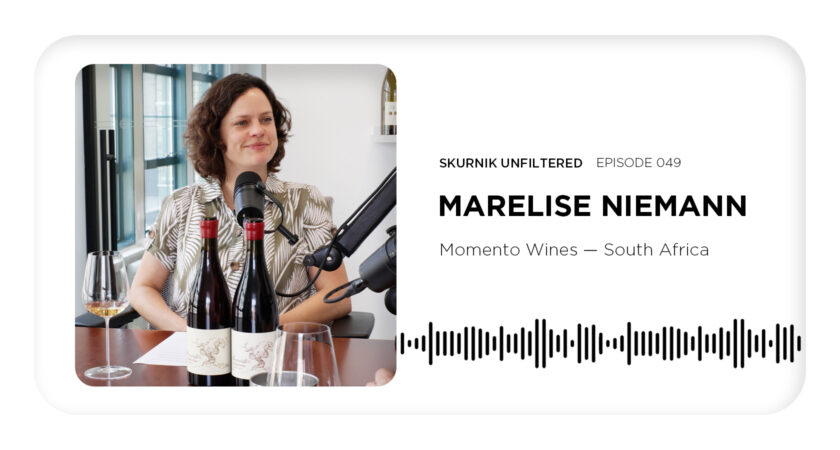
While her neighbors fuss over Chenin Blanc and Pinotage, Marelise Niemann has spent her professional wine career on a crusade for Grenache in South Africa. There is no grape more bright, more elegant, and more properly suited for the hot, dry climate of the Western Cape, she believes. And, when a rare old Grenache vine is found, it has an uncanny ability to transmute the unique character of the world’s most ancient soils. She goes on to say that farming these vineyards among the prehistoric koppies of the Paardeberg is a breathtaking feeling that never gets old.
In this week’s episode with Skurnik’s Ambassador to the World, Desiree Russo, Marelise makes her pitch for Grenache—for more farmers to grow it, more winemakers to make it, and more drinkers to drink it. Together, they taste her Momento Grenache Gris and Grenache Noir, plus an exceedingly rare single-varietal Tinta Barocca.



Next week, Mathieu Deiss joins the podcast to talk about complantation and innovations in farming in Alsace.
Be sure to subscribe to Skurnik Unfiltered wherever you find your podcasts so you can stay up to date on all the exciting content to come.
Introduction
Marelise Niemann 0:03
There’s a time when a vineyard becomes of a certain age where we’re not actually drinking varietals anymore—we’re drinking place. They’re part of the soil, they’re part of the land, and they’re telling the story of where they grow.
[music]
Harmon Skurnik 0:16
Hey, this is Harmon Skurnik, and welcome to another episode of Skurnik Unfiltered. Today I have with me none other than World Ambassador, Desiree Russo.
Desiree Russo 0:27
What a weighty title.
Harmon Skurnik 0:29
That’s a really important title.
Desiree Russo 0:31
Thank you.
Harmon Skurnik 0:31
What is it that the World Ambassador does?
Desiree Russo 0:33
The World Ambassador is about connecting people with the people who make the wines, and it’s people like Marelise Niemann of Momento that just is a flag that I love to fly.
Harmon Skurnik 0:45
Well, that’s who you sat down with recently to discuss her passion project, which is called Momento.
Desiree Russo 0:51
Correct.
Harmon Skurnik 0:51
She is a well-established winemaker in her own right, and those wines are phenomenal. They’re stylized, they’re elegant, and you’ve told me that the wines are sort of like her.
Desiree Russo 1:04
Yes. Her story is really interesting because she worked with Eben Sadie at Terroir al Límit in the Priorat, and then also worked with Dirk Niepoort in Portugal when she backpacked with her husband Hennie. But it was with her time with Eben where she realized that Garnacha could make these beautiful wines, almost ethereal. I’m trying to hesitate to use the word Burgundian. They are ethereal, they’re light. And I think her message of wanting to work with varietals that can withstand drought-like conditions in South Africa, it’s not even just about her anymore. It’s about: where is South Africa going to be in a hundred years’ time? And she falls in love with this one varietal, goes back to South Africa, contacts Rosa Kruger, who is the preeminent figure for old vines and viticulture in South Africa, and they go and find Grenache Noir. And that story is just so fascinating. There’s something really special about all of her wines because there is the aspect of the wine itself, but there is a human element—not in an intervention way, but her personality, I think, just shouts from the glass. There’s a certain…
Harmon Skurnik 2:20
Joie de vivre?
Desiree Russo 2:22
Yeah, there’s just something earnest about the wines.
Harmon Skurnik 2:25
So Grenache, both red and white, right?
Desiree Russo 2:27
Yes. She works with Grenache Noir. She has several bottlings. We currently work with the Paardeberg bottling of Grenache Noir. We have Grenache Blanc. We also have Grenache Gris. For instance, like how rare the Grenache Gris is, she said that there are only three vineyards planted to Grenache Gris.
Harmon Skurnik 2:43
In all of South Africa?
Desiree Russo 2:44
Correct. We also have a beautiful Chenin Blanc-Verdelho blend, which—this is her quote: “Chenin Blanc without Verdelho is like dancing without music.” It just adds that zestiness, which I love. And then she has a single varietal of Tinta Barroca, which again speaks to South Africa’s viticultural history with Portuguese varietals, but also how Tinta has always been used as a blending component, so that’s her passion just coming through even more.
Harmon Skurnik 3:12
Well, let’s let our listeners experience that passion and listen to your conversation with Marelise Niemann of Momento.
Desiree Russo 3:20
Enjoy.
Who is Marelise Niemann?
Desiree Russo 3:24
Good morning, Marelise. How’s it going?
Marelise Niemann 3:26
Morning, Des.
Desiree Russo 3:26
What’s going on?
Marelise Niemann 3:28
Fresh as a fiddle.
Desiree Russo 3:29
Yeah, yeah. You just landed.
Marelise Niemann 3:30
Exactly. It took me like 48 hours to get here, so I think the travels were longer than I’ve actually been here.
Desiree Russo 3:37
48 hours. Where does that put you in the world?
Marelise Niemann 3:39
No, it’s more like 24 hours.
Desiree Russo 3:42
Yeah, fair, fair. It feels like 48 hours.
Marelise Niemann 3:44
But for a cheaper flight, like on my way back, it’ll be 48 hours because there’ll be a 12-hour layover, so 24 to 48 hours back to Hermanus, close to Bot River.
Desiree Russo 3:54
Okay, and where’s Bot River in the world?
Marelise Niemann 3:56
Bot River is roughly in the middle between Hermanus and Elgin. And Bot River is a very small little place in between two mountains, the Elgin Mountains and then the Hemel-en-Aarde Valley and mountains. And we’re about, as the crow flies, 20 minutes from the ocean. It’s not a cool, high-elevation area, but there is some coastal sea influence, so night temperatures are nice and low, day temperatures get pretty hot. It’s considered a warmer region with some cool aspects, but it’s a tiny place in the middle of the beautiful Western Cape of South Africa.
Desiree Russo 4:38
Nice. I remember one of the last things that I saw when I was in South Africa was the humpback whales coming into the bay with their calves. It’s a really beautiful part of South Africa. What made you start Momento Wines? Who are you? Tell the world who you are.
Marelise Niemann 4:52
Who am I? You tell me. Momento Wines started out of a passion for Grenache. You’ve been to South Africa, you know how warm and dry things can get in South Africa. We obviously live on the coast, so it’s beautiful with the whales, but as you go slightly inland, things get really hot and dry, and it’s sometimes quite a challenge to grow grape varietals in those warm, dry climates. I always say you have to work with varietals that are meant to grow in places. For example, Bot River is hot and dry, so it’s good to plant heat-resistant and drought-resistant grape varietals in those areas. When I was much younger and I had the opportunity to go and do internships all over the world, I got stuck on bright, elegant red wines. I also realized we cannot make Pinot Noir in all the different areas of South Africa. There are little spots like Hemel-en-Aarde or Elgin or close to the ocean or high up in the Ceres Mountains where things are cold enough and wet enough to plant those grapes, but 95% of the Western Cape is pretty much hot and dry. I wanted to make elegant, bright red wines with personality and character, wines with energy, but I knew that I didn’t want to work with Pinot, so I got stuck on Grenache. I went through the whole Cinsault, Carignan, Syrah journeys and then ended up really falling in love with Grenache. I started my first Grenache in 2011, bought two tons of grapes with my friend Donovan Rall, because I couldn’t afford the whole vineyard. We shared a block, and from there on, it just kept on growing. I now make four different Grenaches, all different soil types, and also Chenin Blanc, blended with a bit of Verdelho, and a little bit of Tinta Barroca as well, just for salt and pepper, to complete the round.
Desiree Russo 6:45
Yeah.
Is Grenache the Future of South Africa?
Desiree Russo 6:46
I always refer to you as being the Grenache Queen of South Africa. Where did that love affair with Grenache Noir come from?
Marelise Niemann 6:54
There are certain things about Grenache that I can’t resist. The way the vineyard speaks of where it comes from and where it’s planted is one of the most magical things about Grenache. If you grow Grenache in Paardeberg in the Swartland, or you grow Grenache in Bot River in shale soils, those are two completely different Grenaches. Other varietals show their sense of place, yes, but I think Grenache just goes that extra mile to show where it’s actually growing and the conditions that it grew up in. So, sense of place, and then just the way the grape really loves being in dry and hot conditions in South Africa. It just makes me so happy. When I see Grenache, it makes me happy. When I see vineyards planted in South Africa, dryland-farmed, and it’s 35ºC (95ºF) outside, you know that they’re meant to be there, and it makes me happy. Grenache is something that I can’t resist. It’s become my professional life journey to get not only people in South Africa but all over the world to drink Grenache, because it’s only when people drink lots of Grenache that we can plant lots of Grenache. And if we want vineyards to be happy, established, strong for the generations to come, we need Grenache planted in South Africa. We’re getting there now a little bit faster than 10 years ago, and there’s some really good traction with people drinking Grenache and understanding Grenache, so we’re getting farmers to plant a lot more Grenache in different areas of South Africa.
Desiree Russo 8:24
When did Grenache come to South Africa?
Marelise Niemann 8:28
Grenache was one of the first varietals that we planted. We planted Chenin, we planted Sémillon, and then later on came Grenache. We planted Grenache already in the 1950s and 1960s, so we had some beautiful Grenaches, old-vine Grenaches, established in South Africa. And then, unfortunately, we went through a period of trying to follow people that we thought were cooler and people that we thought were doing better, so we started ripping out all these beautiful old Grenaches to plant varietals for fashion or for coolness. We started planting varietals in places that we should have never planted there. For example, let’s take a place like Swartland, which is hot and dry. You go a little bit north in the Cederberg Mountains, those places are hot and dry, so we planted the right varietals there back in the day. We had beautiful Chenins, Grenaches, Cinsaults. But then during the late 1980s and 1990s, we wanted to be cool, so we planted lots of Cabs, Merlots, Sauvignons. And those varietals don’t do well in those hot and dry climates. And yes, you might make a success on a short-term basis, let’s say for 10 or 20 years in those hot, dry areas planting Cabs, but long term, to take care of vineyards in those extreme conditions—like a Cab which needs a lot of richness in the soil, that needs more water, it needs more energy—those vineyards won’t last dryland-farmed bush vines in those areas. We realized that, and now we’re starting to replant the grapes that were originally planted and that were meant to grow there. We’re making a full circle. Now we’re planting Grenaches again. Some old pockets of Grenaches are still in the soil, but a lot of them have been uprooted, and now we’re planting them again. We’re getting the farmers to really get excited about Grenache, which is one of the most important things—not only to get people to drink Grenache, but to get the farmers excited about Grenache because they need to know that they are able to sell their grapes or they are able to make their wines and sell the wines.
Desiree Russo 10:38
Yeah, especially because y’all are farmers at the end of the day, and you’re dealing with an ever-changing climate. I remember this one vintage, you had droughts, but then you had wildfires, and you’re having floods all in one area, which is like, how do you manage that? And I think planting something like Grenache gives a viable future for people to have a livelihood, which I think is really important. So this is the future for South Africa, right?
Marelise Niemann 11:01
Absolutely. And it’s that livelihood, the long-term livelihood, that’s for me one of the most important things when we select varietals to plant, because to just go and plant what’s cool and with what you can make money now or in the next 20 years is really not the right thing to do. There’s so much work to do in South Africa. I think the groundwork has been done, but there’s so much more work that we need to do in South Africa to make people aware of buying the correct wines, drinking the wines that are meant to grow in South Africa. If you have to force a vineyard to grow properly and to produce proper grapes, then I think we’re already on the wrong track. Vineyards that are meant to grow in South Africa are vineyards that are well adapted; they naturally do well. And with those vineyards, I think there’s a future for us to make proper, awesome wines. That’s why something like a Grenache or a Cinsault or a Chenin, even a Sémillon or Verdelho, those are all grape varietals that can work with the heat. I also make Chenin and blend it with Verdelho. We pick our grapes in January and February. So if you have late-ripening grapes, like your Cabs, your vineyards have to sit with all those grapes in heatwave after heatwave until the end of March or April. If you’re not in a cool region with deep soils and lots of water like Hemel-en-Aarde, for example, then it’s best not to even look at those varietals. What you plant where is absolute key to the future of South African wines. Take Verdelho, which is an early-ripening grape. That means we’re taking the Verdelho grapes off the vines early in the season so it doesn’t have to go through five heatwaves, lots of heat, a little bit of water. We’re taking the Verdelhos off at a beautiful freshness where the vineyards are happy when you pick them so there’s still lots of energy left in the grapes. I always talk, when it comes to wines, I talk about energy in the wine.
Translating Energy from the Vineyard to the Glass
Marelise Niemann 12:53
If the vineyards are suffering too much, you can’t get the energy in the grapes and in the wines. Something like a Grenache, which is really happy when you pick the grapes, there’s so much energy in the grapes left, and that all goes straight to the wines that we drink.
Desiree Russo 13:08
Your wines, they just yell of energy and passion, and I think that’s what makes your wines so beloved. For people wanting to drink wines that you can slightly chill down, wines that are not overly oaked, these wines are such a pleasure to show, to talk about, and to drink. You’ve mentioned a little bit about these vineyards. You make wine from 16 different vineyards. You’ve also worked with Rosa Kruger, but what are some of these defining features? You go and you see a vineyard in Piekenierskloof, and you’re like, “I want to work with that vineyard.”
Marelise Niemann 13:41
I believe that the vineyards that you work with all carry a certain sense of place, sense of energy. And when we drink a glass of wine, they share the story of where they grow. When you go to Piekenierskloof, 700 to 800 meters above sea level, you can feel the age of the soil, you can feel the age of the place. And if you work carefully when you’re planting vineyards and picking grapes and farming vineyards there, you can get that sense of place and sense of energy in your glass. When I first started making wine for myself, for Momento Wines, it was really about carrying a message across about South Africa and what we can do in South Africa with our vineyards planted on our soils. I don’t want to copy what other people are doing in other countries. What we drink when we drink Momento is, we’re drinking South African wines. We’re drinking South African soil, sunshine, we’re drinking South African Grenache or Chenin or Tinta Barroca. And for those who have been to South Africa, it’s a place with lots of history and soul. You know, if you stand in those mountains, a lot of these vineyards are planted in the middle of really beautiful mountain landscapes. And when you taste the wines, you taste the place and sunshine, old, old, ancient soils, just the beauty of place.
Desiree Russo 15:01
Yeah, I remember standing in the Paardeberg and just looking at soils that were half a billion years old, and you can’t even comprehend it. You’re just looking at it, like, “Wow, that’s 500 million years old.” These are some of the oldest soils in the world with vineyards growing on them. You can’t see it in the podcast, but my mind is blown just thinking about that.
Marelise Niemann 15:23
And it doesn’t get old. When you stand in those beautiful old vineyards and you realize that you’re working with old vineyards planted in this ancient, ancient soil, it’s humbling. It’s a very powerful thing. And I think if you don’t feel that and you don’t realize what you’re actually doing, then you’re missing half of the pleasure that you can get from growing grapes and making wine. There’s a handful of people that made sure that we keep these vineyards in the soil. When I started looking at my first vineyards, my absolute idol in South Africa is Rosa Kruger. She knows so much and more about not only South African vineyards, but also vineyards all over the world. I phoned her and I asked her if she knows about any really awesome old Grenache. And she pointed me to Indekale, which is a little vineyard in Piekenierskloof, just as you look down towards the Saldanha West Coast Bay, there’s a little vineyard there that was over 50 years old, and the farmer didn’t even know how special this vineyard was. This was in 2011, and I couldn’t afford to buy all the grapes, so I phoned a friend, Donovan Rall—he makes incredible wines as well—and I said to him, “Don’t you want to share this little vineyard of Grenache Noir with me?” So thanks to Rosa, we started with that old vineyard of Grenache. And then Rosa pointed us to other Grenaches, and she said there’s also the Paardeberg Grenache that she showed me in 2014 that I still work with. So that’s now 12 years of making wine from the same vineyard. Also, when you get to know these vineyards and you work with them year after year, you can really work with them and not try to force yourself by farming the grapes in the way that you want, but listening to the vineyards and working with their strong points and the way that they know how to grow.
Desiree Russo 17:13
You take what nature gives you in that one vintage, but now you have the landscape, nature, and you’re using your style as a conduit to get that into the glass, which I think is the signature of your wines. Your wines are expressive. They leap out of the glass. You don’t even have to swirl, it just comes out—and this liveliness, the sunshine, as you say, is captured.
Locating Chenin Blanc and Verdelho in the Western Cape
Desiree Russo 17:37
I can wax lyrical for hours about your wines, but besides Grenache, you also make Chenin Blanc, you make Verdelho, you make Tinta Barroca. Where are these parcels in the Western Cape?
Marelise Niemann 17:47
Let’s start with the Chenin-Verdelho blend. I worked for a family winery called Beaumont Wines. That was my very first day job. The Beaumont family taught me about farming, they taught me about the wine business, winemaking, picking grapes, tasting grapes, because in university, we study winemaking, but we very rarely are there in the ripening season tasting grapes every single day. My love for Chenin came from my days working in Bot River at Beaumont Wines. They have the most beautiful, awesome old-vine Chenins on that farm. If you taste a Chenin from Bot River, which is on shale soil so it’s more clay-based soil, and you compare that to a Chenin from the Paardeberg or the horse mountain, which is 100% granite, those are two completely different Chenins. I started by making Chenins in Bot River. My neighbor, José, was from Madeira and he had some Verdelho planted next door, and he taught me all I know about Verdelho. He always used to be so passionate about the energy that Verdelho can give to a blend or to a wine. I made his wines for him for a few years in the Beaumont cellar, and there was a moment where I thought, “Wow, what about blending a bit of Verdelho with a barrel of Chenin?” And we started this experimental blend of one barrel with 10% of Verdelho, compared it with a straight Chenin, and I ended up making a blend in 2013. I’m still doing the same Chenin-Verdelho blend, I’ve just added more vineyards. The Chenin that I work with is from three different Chenin Blanc vineyards. Paardeberg, grown on granite, Piekenierskloof, which is four hours north of Bot River—that’s grown on sandstone—and then a little bit of Chenin grown in Bot River on shale. Those are the three Chenin components. Old vines from Piekenierskloof, old vines from Paardeberg, and then younger vineyards from the Bot River area. All bush vine farmed, all dryland. They all speak completely different languages, so they show so beautifully where they come from. And the Verdelho is also from three different regions and three different soil types. I blend the six vineyards together to make a complete South African Western Cape white blend. You can bottle them separately, but I think for these vineyards, they work so well together and they represent the different regions. And when you put them in a puzzle, it’s a complete wine.
Desiree Russo 20:08
It is such an experience to drink that wine. In one of your tasting notes, you say to drink Chenin Blanc without Verdelho is like dancing without music.
Marelise Niemann 20:15
My husband thinks it’s super geeky, but…
Desiree Russo 20:17
Nah, it’s great. Keep it. We need to use that tasting note. It’s almost like you take a diamond and you’re polishing it, and then you start to see the little tiny facets that you would normally miss, which I think is important in the wine.
The Secret of Old-Vine Tinta Barroca
Desiree Russo 20:29
What about the Tinta Barroca?
Marelise Niemann 20:31
The Tintas are a bit of a passion project for me because it’s one of the most amazing grapes to work with in South Africa, but unfortunately, there is not a lot of it planted. We used to plant Tinta Barroca for port wines. We used to make quite a bit of fortified wines back in the day, and it’s also a varietal that wants to give you lots of grapes. They’ve got very long bunches and very dry, stalky tannins, so when they’re young, they yield a lot, and you can make a lot of wine from it. And then when they get older, they become these beautiful old souls that have so many stories to tell, like an old person that you talk to. They’ve got so much to tell you, and they’ve lived their lives, and they’re so rich. Tinta Barroca for me is like that. When we work with these vineyards that are all over 40, 45 years old, they’ve got stories to tell. And even though there’s not a lot of Tinta Barroca planted, it’s a sin not to show these stories that these three vineyards that I blend together can tell. And they are planted in granite soil, so it’s a fresh style of Tinta Barroca. Sometimes, when people think of Tinta, they think porty, they think high alcohol, they think jammy fruit. These vineyards are the opposite. They grow in places where they speak of freshness and they speak of delicate tannins and spice and black, darker fruit, but they’re not jammy, they’re not alcoholic, they’re not porty red wines. They just have beautiful freshness, telling the stories of where those vineyards are grown.
Desiree Russo 22:07
So cool. And so it’s you, Eben, and Adi that are making single-varietal Tinta Barroca. There’s not a lot being made. It’s a blending component that you find in South African red wines, but to find straight Tinta is pretty rare.
Marelise Niemann 22:19
It is rare. There is another handful of people that are working with Tinta Barroca. Not a lot, because it’s something that, people who drink Tinta Barroca, they’ve got a special side of them that will always be interested in the unknown or vineyards or grape varietals that are off the beaten track. If you’re the kind of person that wants to explore and wants to get to know the soul and soil of a place, then that’s your wine. It’s not your everyday wine that you go and grab off the shelf. And it’s not like I sell a million bottles of Tinta Barroca, but the four or six barrels that I make per year go to the special people and to the special places that get them and that understand them.
Tasting Grenache Gris
Desiree Russo 23:00
Why don’t we taste some wine? In the glass, we’ve got the Grenache Gris 2025. How did you find this vineyard in the Voor-Paardeberg?
Marelise Niemann 23:08
This vineyard was planted in 2015 or 2016. I was already quite passionate about Grenache Gris in 2011, and it was just a natural thing for me to go and look for more Grenache—even white Grenache, red Grenache. And then I started buying Grenache from a farmer called Willie Mostert in the Voor-Paardeberg. He realized how passionate I was about Grenache, and he drove me around the dam and then he came to this vineyard of Grenache Gris. And he was like, “I think you might be interested in trying to make some wines from this as well.” And that was 2017. I said, “Absolutely, yes. Let’s go.” The first vintage from this vineyard was 2017. It’s a magical grape. Like Grenache Noir, Grenache Gris is an amber-colored grape with a slightly bigger tannin structure than Grenache Blanc. Grenache Gris is like a Grenache Blanc with some oomph. So while Grenache Blanc is more open and fruit-driven, more white peachy, the Grenache Gris actually has some red grape characters in there as well. You sometimes get hints of strawberries, and there’s a slightly thicker skin. I worked with some skin contact on this wine.
Desiree Russo 24:23
But it’s not an orange wine or a rosé.
Marelise Niemann 24:26
It’s not a rosé, but you can call it what you want. If it makes you happy, then you can call it orange wine, but this one is not fermented on skins. I find if you ferment wine on skins, you lose varietal character and you lose sense of place. For me, it’s important to show sense of place and sense of varietal in all the wines that I make. And with a Grenache Gris, we do four to seven days of cold soaking, so the yeast cannot start fermenting at eight degrees when we cold soak the grapes. We crush it. It’s a big bath of grapes and juice all mixed up. And during those four to seven days, we’re extracting tension and tannin and texture. And then once we think we have enough, or once we feel we have enough when we taste the juice, we press it into neutral 300-liter oak barrels, and that’s when you get to a wine like this where you have texture, tannin, tension in the wine, but without it being orange or without it losing the character of Grenache Gris. It’s a fun wine.
Desiree Russo 25:21
It’s so fun.
Marelise Niemann 25:22
It’s got a lot to offer. It’s quite layered and structured, but it’s also super fun because it’s a white wine, an amber-colored wine, but it’s got layers of tannin and texture and fun, great character. And the way we make it is tightened together. And then with age on this wine, next year, the year after that, those tight tannins relax, and then you get this beautiful openness that only Grenache can give us.
Desiree Russo 25:52
For me, this is such a textural experience. You get that strawberry, you almost get a little bit of tangerine and herbaceousness to it. It’s a gastronomic wine. You can get all the facets of it. There’s not that much planted in South Africa, right? There are only two vineyards of Grenache Gris?
Marelise Niemann 26:06
No, there’s this one, and then I think there are two vineyards planted up in the Voor-Piketberg.
Tasting Grenache Noir
Desiree Russo 26:12
We can’t obviously show you what the color of this Grenache Noir is in the glass, but every time this wine is poured, everyone talks about how it’s this beautiful, vibrant, red Jolly Rancher. It’s luminous.
Marelise Niemann 26:28
You can’t taste color, but you can almost see the energy in the wine when you look at the color. And this is exactly what the vineyard is like. When you pick the grapes, the color of this wine is what the vineyards, what the grapes look like. It’s got this really fresh, bright red color and slightly pink. When we make the wine, we don’t try and add something to make it darker or make it slightly deeper in color. This is exactly what we get from this vineyard. When we taste this Paardeberg Grenache, first of all, it’s Grenache—that’s the most important thing, the most wonderful thing in the world—and it’s planted in decomposed granite, so ancient, weathered granite sand. And when you stand in the vineyard and you look towards the granite, we call it *koppies*, these massive granite boulders. Millions of years of weathering, granule by granule, created a layer of granite sand, and these vineyards are planted in that sand that came from the granite boulders. That deep granite sand always produces something fresh and elegant and energetic, and when you drink a Grenache from the Paardeberg, this is the soul and energy that you get from those vineyards. And when you drink wines or make wines from vineyards that are planted on schist or shale or sandstone, they are completely different. The Paardeberg granite, of all the four Grenaches I make, is definitely the one with the most fresh acidity. It’s got that powdery tannin structure in the middle of the wine. That’s the magic of granite. You cannot get that tannin structure in sandstone or shale or schist. This is pure Paardeberg granite tannin structure, and it can last for years, so even though the wine looks light and bright in color, and it’s a more delicate, elegant version of Grenache with slightly lower alcohol, this wine can last for many, many years. We’re drinking 10-year-old Grenaches now. We opened a few 2015s and 2014s not long ago, and those wines are just absolutely beautiful at this stage. Light-colored wine doesn’t always mean that you cannot mature it. It’s obviously perfect to drink now. Drink all of it now. But if you happen to stumble upon old Grenaches that we made in earlier years, they are still absolutely perfect, and they give you a completely different story because they’ve been in the bottle for so long.
Desiree Russo 28:55
This wine is perfect. Simple as. This is exactly what people should be drinking to understand South Africa.
Marelise Niemann 29:06
The real story is in those vineyards. It’s in the vineyards, in the soil, in the place where these grapes come from. I’m just a winemaker in order to preserve the soul of the place. And when you say you drink this wine and it’s absolutely perfect, that is because the place is absolutely perfect, that vineyard is absolutely perfect. Wines can never be perfect because you cannot get character and personality if everything’s too perfect. But soul, character, personality—this is what this wine has to offer, and that’s what I want people to know of South Africa.
Desiree Russo 29:40
Well, thank you for sharing the Grenache Noir.
Tasting Tinta Barroca
Desiree Russo 29:43
We’ve got one more wine to try before we send you out into New York and Brooklyn.
Marelise Niemann 29:46
Beautiful.
Desiree Russo 29:48
We have the Tinta Barroca.
Marelise Niemann 29:50
The only people that really understand this passion project are someone like Adi Badenhorst or Eben Sadie or someone else that makes Tinta Barroca. There’s always this nod of acknowledgment and understanding that you’re still holding on. It’s an incredible grape to work with. When I worked at Beaumont, they had old-vine Tintas planted in 1973. As a young wine person, there was no such thing as noble grapes and less noble grapes, so I treated Tinta Barroca as the most noble thing on the farm, and we got to make these fantastic, soulful Tinta Barrocas. And even today, when I work with Tinta Barroca, it feels the same. It’s something that we need to acknowledge more and drink more. It’s a niche wine for people that want to explore new things and understand new varietals or different varietals. But there’s a time when a vineyard becomes of a certain age where we’re not actually drinking varietals anymore—we’re drinking place. And these Tinta Barrocas that were planted in the 1960s and 1970s, they’re almost not Tinta Barroca anymore—they’re part of the soil, they’re part of the land, and they’re telling the story of where they grow. It’s a wine that you can also mature for very long. The older it gets, the better it gets.
Desiree Russo 31:09
Marelise, thank you so much for your time. This was such a great interview. So great to catch up with you. Awesome, and it’s really so awesome to be here. Thanks for having me.
Marelise Niemann 31:20
Lekker.
Desiree Russo 31:21
All right, let’s get you to Brooklyn.
Marelise Niemann 31:23
Cool, man.
Skurnik Unfiltered is recorded at Skurnik Wines & Spirits headquarters in the Flatiron District of New York City. If you found the conversation interesting, please consider liking, subscribing, and leaving a review. You can stay up to date on our show and upcoming events by following @skurnikwines on Instagram and visiting our website at skurnik.com