

Underwood
Underwood is the flagship of Union Wine Company and one of the most recognized wine brands in America — born from a conviction its founder refused to let go of. Ryan Harms arrived in Oregon for the 1997 harvest at Rex Hill under Lynn Penner-Ash, loved every minute of it, and returned for good in 2001, working for Bergström and other respected Willamette Valley houses. What nagged at him was simple: his friends wanted to drink the wine he was making, but they couldn’t afford it. “I wasn’t going to accept that wine made in Oregon had to be expensive,” he decided — and in 2005 he founded Union Wine Company to prove the point, establishing Underwood the following year as its everyday expression.
Underwood draws from the full, diverse range of Oregon’s wine-growing regions — including Union’s five estate vineyards and long-standing grower partnerships across the state — to craft approachable Pinot Noir, Pinot Gris, Rosé, and Bubbles for every occasion and for no occasion at all. The wines are made at what Harms calls his “industrial château” in Tualatin, where traditional craft winemaking and lean manufacturing genuinely coexist: every efficiency in the facility keeps the value in the glass. The winemaking team is women-led, headed by Director of Winemaking Meredith McGough, a UC Davis-trained winemaker who left Napa to return to her Pacific Northwest roots.
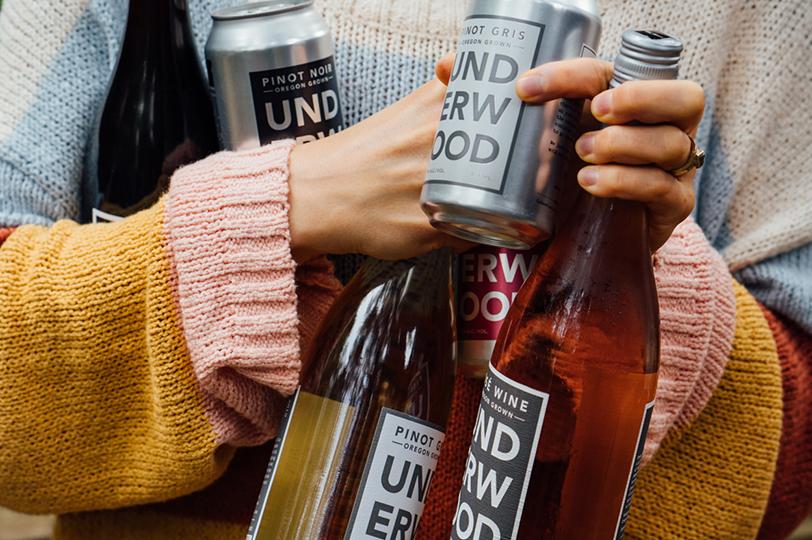
In 2013, Underwood changed the American wine landscape. That spring, a brainstorming session ahead of Portland’s Feast festival produced three ideas at once: wine in a can, a tasting truck instead of a tasting room, and a rallying cry — #pinkiesdown — that put words to what the company had always believed. When canned Pinot Noir and Pinot Gris debuted that September, the response from drinkers, media, and the trade was immediate. Others had tinkered with sparkling wine in aluminum before, but Underwood was the first to take still, premium wine seriously in the format — and the first to turn a curiosity into a category. Union has since grown into the largest canned wine producer in the country, operating and owning the largest winery-dedicated canning facility in the United States.
Sustainability at Underwood is structural rather than cosmetic. Two-thirds of Union’s production goes into infinitely recyclable aluminum — a case of cans weighs 21 pounds against 36 to 50 for glass, meaning roughly half as many trucks on the road for the same volume of wine — while the bottled wines use Portland-made glass with 80% recycled content, the highest of any glass facility in the country. The winery runs 79% below the industry average in water use, holds LIVE certification, and in 2024 Union earned B Corp certification, joining the small handful of wineries worldwide to meet that bar. A multi-year partnership with the National Parks Conservation Association reflects where these wines are meant to be enjoyed.
Today the range spans bottles, cans, and a new frontier: Underwood Non-Alcoholic, a sparkling rosé made from real Oregon grapes for a category more relevant to wine drinkers every year. Across every format, the promise is the same one Harms made in 2005 — genuine Oregon character, made with care for the land and the people drinking it, with the fussy parts left behind.