

Brennivin
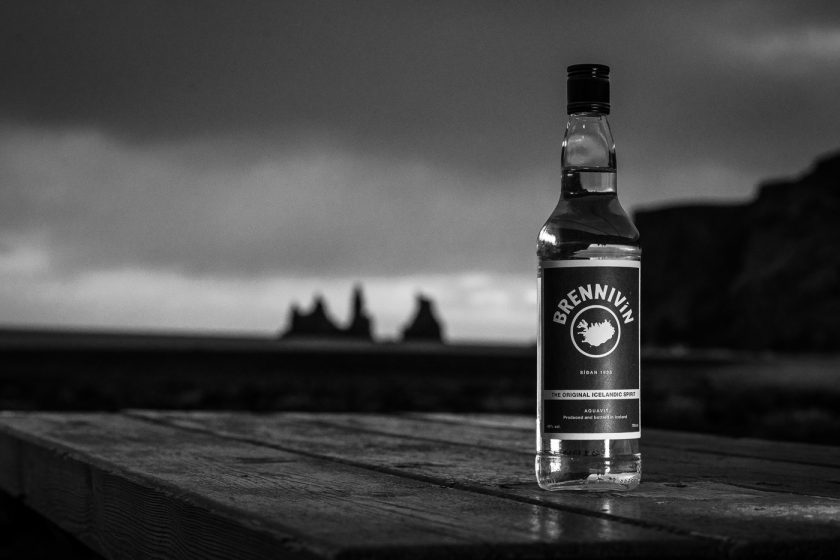
Brennivín aquavit has only been available in the United States since 2014, but its associations with Iceland’s history and national identity have been centuries in the making.
The island country of Iceland was initially established in the late ninth century by mostly Norwegian settlers. By the early 1600s, they were subject to a trade monopoly instituted by the Danish King (their sovereign for several centuries) that prohibited the island from trading with all but a few Danish merchants. Alcohol on the island was increasingly limited by the goods available from these merchants, who reserved very little room on ships for mead, beer, or their raw ingredients. However, the merchants could quite economically stock and trade spirits.
The settlers quickly learned how to mask the imperfections of these crude distillates with spices and herbs. Iceland’s terrain, composed extensively of lava fields and subject to slow natural fertilization, allowed for precious little farming, but caraway was introduced to the island in the early 1600s and thrived in its grasslands; this savory spice became the preferred addition to the region’s alcohol. Though similar Nordic traditions of aquavit (derived from the Latin for “water of life”, aqua vitae) were simultaneously emerging in Sweden, Norway, and Denmark, this focus on caraway became a trademark of the Icelandic style.
Denmark’s trade monopoly ended in 1786, but Iceland was still prohibited from distilling its own spirits, and aquavit’s dominance in the country’s drinking culture remained. But aquavit met its match in 1915 when Iceland (granted initial home rule in 1874) instituted a prohibition on wine, beer, and spirits.
The prohibition of Spanish wine was lifted in 1922—the ability to trade for salted cod proved too tempting for Iceland’s temperance movement—and spirits followed in 1935 (beer wouldn’t be allowed on the island until 1989). When the ban on wine was lifted, Iceland’s government created a state-run liquor store known by the acronym ÁVR (later known as ÁTVR when it was consolidated with tobacco) and between 1935 and 1989, this entity was the only producer and retailer of alcohol in the country. When the ÁVR chose what limited spirits to produce, you guessed it—caraway-focused aquavit was at the top of the list, and Brennivín was born.
The government, wishing for the country to tread lightly in its new alcoholic latitude, chose for the brand a stark black label, intended to convey the seriousness of intoxication and thus limiting demand. The label instead became a beloved emblem that has retained its cultural cachet, earning the brand its beguiling nickname, “The Black Death.”
Brennivín was privatized in 1989 and is now produced by the prolific brewery and beverage company Ölgerðin Egill Skallagrímsson, based in Reykjavik. In 2014, after years of transporting Brennivín to the US to enjoy with family and friends, Joe Spiegel, founder of Brennivín America, finally succeeded in importing Iceland’s heritage spirit for the US market at large.
Brennivín is made from grain (aquavit is traditionally distilled from either grain or potatoes), incorporating caraway in its second distillation. Iceland’s naturally occurring, soft, high-pH water is used to proof the spirit, resulting in a silky texture and a subtle, tempering sweetness. Brennivín is made in accordance with European Union law, which stipulates that aquavit must be flavored with either caraway or dill and bottled at a minimum ABV of 37.5%.
While an exciting selection of traditional and modern aquavits continues to grow in the US market, Brennivín is a tangible custodian of Iceland’s drinking heritage and a perfect introduction to the aquavit category. Skál!